
A $200 ChatGPT, Worth $14,000?
A few days ago, I had dinner with a friend who builds AI applications.
A few days ago, I had dinner with a friend who builds AI applications.
He had just wrapped up an internal round of tool evaluations. Over dinner he rattled off a few numbers, and I did a double take. Here's what I heard.
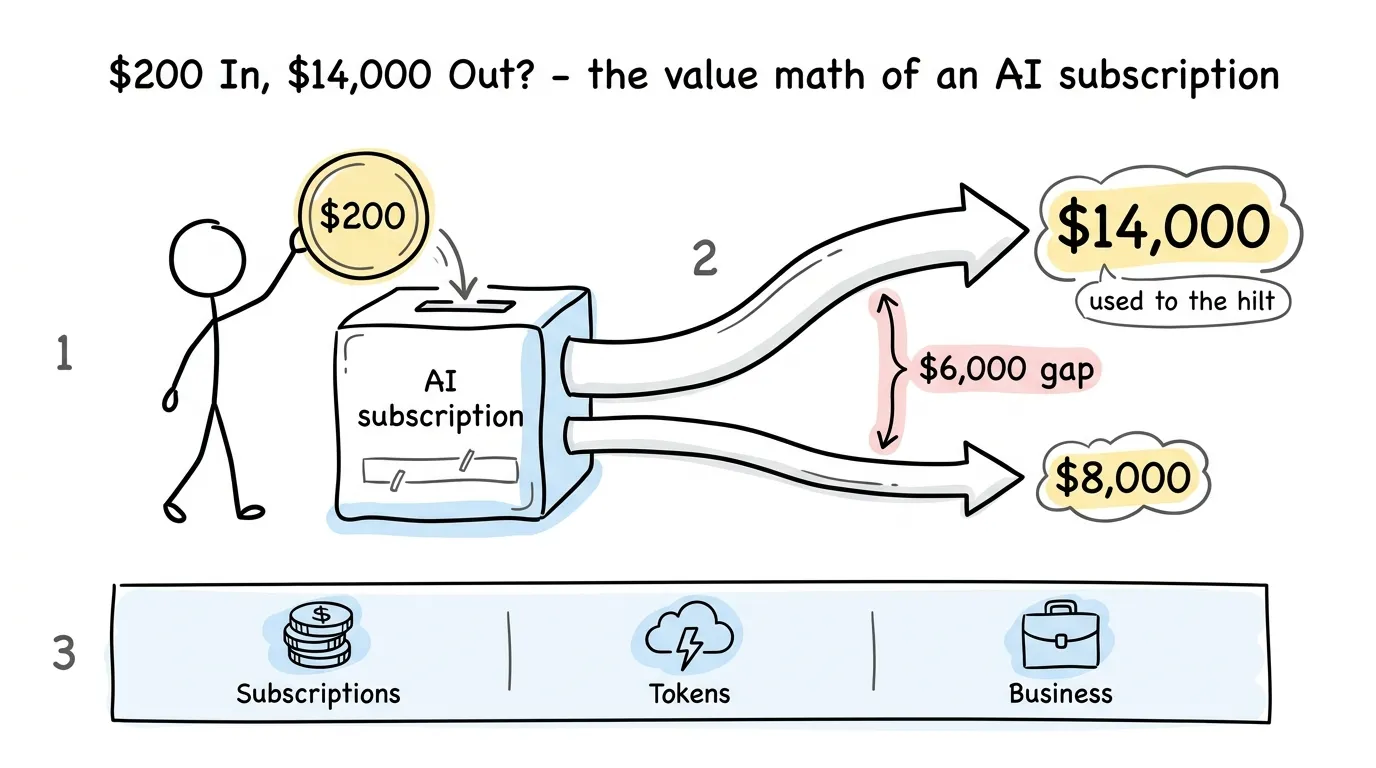
The first number: $200. That's the monthly fee for the top tier of ChatGPT Pro and Claude Max.
The second number: $14,000. Someone ran the math: a $200-a-month ChatGPT, if you use it to the hilt, can "extract" $14,000 worth of value.
Same $200 — switch to Claude Max?
$8,000.
Wow. A full $6,000 gap.
What's going on here? Let me walk through it, point by point.
Agents First: Great Tools, Don't Overfeed Them
What's an agent? An AI that keeps working on its own. You give it a goal; it breaks the work into steps, calls its own tools, and runs the job to completion — no babysitting required.
The ones making the most noise right now, like Hermes and OpenClaw, are all in this category.
His verdict on them, in one breath: he loves them, and he hates them.
Love, because they're genuinely useful. His team built a creative agent called Picasso that generates ad creatives in bulk. And it doesn't generate blindly — it keeps an eye on three things: campaign performance data, brand guidelines, and competitor moves, with a human designer as the gatekeeper in the loop.
When he decided this thing was good, what was his first instinct?
He asked the team for the GitHub repo and forked it.
What's a fork? You copy the whole thing — code and logic — into your own hands, free to modify however you like. He handed the code to Codex and said: turn this into a cold-outreach tool. Meaning what? Cold-emailing prospective customers like Salesforce directly: we made three ads in your brand's style, they're right here — want more?
Codex built the main framework, then had him finish up with Hermes, hooking it straight into an existing outreach system. That same day, it could send emails.
From an internal tool to a customer-acquisition weapon in your own hands — a few days.
That's leverage.
So what's the hate about?
Hate, because this kind of tool is absurdly easy to ruin. How do you ruin an agent? Stuff its memory. Stuff it — keep stuffing. At some point you ask it: help me find that file from last week. And it says, I can't find it.
You say: you have that capability.
It says: I understand your trust, but I truly don't.
And then the two of you go back and forth. There goes your agent.
Think about it — isn't this just like managing an intern? Give them three tasks at once, done beautifully; give them thirty, everything falls apart. An agent's memory is a backpack: you stuff everything into it, and when you actually need something, you can't dig it out.
So the first lesson of using agents is subtraction.
By contrast, coding assistants like Codex and Claude Code have stayed rock solid.
This round of evaluations had its disappointments too. A tool called Higgs field is decent as a product; the problem is that its credits burn so fast, before you get a chance to use it in depth, the credits are gone. Something you can't use is worth zero, however good it is.
Three Ledgers
With the AI stack, there's never just one place money burns. Let me tally three ledgers for you.
The First Ledger: Subscriptions
Start with a set of research data from SemiAnalysis, a firm that specializes in deep AI-industry research. At the $20 tier: ChatGPT Plus, fully used, is worth $700; Claude Pro, also $20, is worth $400.
At the $200 top tier, that's the math from the opening: ChatGPT is worth about $14,000; Claude Max about $8,000.
The conclusion is blunt: when it comes to subsidy generosity, OpenAI is currently more generous than Anthropic.
So should you mindlessly buy the most expensive plan? My friend's advice is simpler: buy both. $400 a month isn't cheap, but he thinks it's worth it.
Why?
Because the subsidies won't last forever.
Think about it: why are these companies subsidizing so hard? To grab users. Same logic as the food-delivery wars — a buck or two off per order, more riders on the street than convenience stores. The day they go public, shares become liquid, and shareholders demand returns, the subsidies get pulled.
There's also a detail many people miss: those hosted features that claim to do work for you — like Claude's cowork — draw down the quota inside your $200 subscription, not the API. You think the API is billing you; in fact it's your subscription bleeding. He burned $12,000 on Claude's API alone last month, so he feels "quota anxiety" in his bones.
The window won't stay open long. First come, first served.
The Second Ledger: Tokens
This may be the bill giving corporate CFOs the worst headache in 2026.
Ramp's CEO Eric Glyman said something that stuck with me: basic AI tasks have gotten 700 times cheaper than before; frontier AI tasks have gotten 300 times more expensive.
What does that mean?
Tasks are not priced the same. Having AI sort documents or pull out key points is table-wiping chores — no need to send in a professor. But many companies, to keep things simple, throw every task at the biggest model. A frontier model running a task costs 300 times more, and the premium comes from being bigger, doing more reasoning, thinking longer.
Using a sledgehammer to crack a nut — and the sledgehammer isn't just expensive, it's slow.
The fix is called token routing: simple tasks go to small models; only the hard ones go to big models. Same work, split smartly, can be 700 times cheaper.
I didn't invent this theory. In some of the CEO group chats my friend runs in, token cost has already been argued to death. Companies have even come knocking on his door, opening with: can you help us optimize our tokens?
Another friend of mine who builds software: one of his departments nearly missed its profitability target this year. The postmortem added it up: hiring saved money, ad spend got cut, plus some natural attrition — all told, a decent pile of savings. And the result?
Token overspend: nearly $500,000.
Every dollar saved was eaten straight back up by tokens.
And it doesn't stop there. Leading players are already talking about further price cuts. Price cuts are never charity; they're compression — squeezing every competitor's margin thinner at the same time.
Incidentally, even the act of buying computers has changed. High-memory machines are often out of stock on Apple's side, so enterprise customers turn to Dell instead. Dell's server business is booming again.
The Third Ledger: The Business Itself
My friend runs two kinds of businesses at once: one is a traditional marketing agency service; the other is a new AI service, helping clients build out AI capability.
He says these are two completely different businesses.
Selling agency services — what's the client's mindset? You're the vendor, the supplier. In meetings, the client is thinking: what have you done for me lately? Plenty of long-time clients even demand outright: don't use AI. They don't understand the thing; not understanding, they don't feel secure. So many of those meetings happen precisely because of that insecurity — they have to watch you.
Selling AI services is an entirely different picture. Clients chase you. The week after a conversation, they're back asking: can this be done too? Can those five things ship together? They hate meetings, they just want new ideas, and they're extremely willing to test.
Lovely.
But there's a trap in it: demand keeps climbing. And when it climbs past a point, what then? His answer is blunt: hire more engineers, hire more people who understand AI. The market is pulling you forward; you can't satisfy every "five more things" — capacity is the bottleneck.
Last week he met a founder who makes mosquito-repellent products, called Shoe Bug — natural ingredients, no smell. The founder's opening line, sitting down: I hate agencies. The two colleagues behind him chimed in unison: we hate them too. They'd been burned too many times.
Why do agencies get hated? Opacity. Where the work stands, where the money went, what next week's plan is — the client is guessing at all of it. Guess long enough, and the only option left is holding meetings to keep watch. The AI-service path, by contrast, lays everything out on the table, and trust gets built up bit by bit.
Handy Sockets: Three MCPs
Back to tools. Beyond models, what genuinely made me feel "this is incredibly powerful" this year is MCP.
What's MCP? Think of the model as a brain. The brain is smart, but it can't reach your data and your tools. MCP is the socket plugged in between, letting the brain stretch out its hands and get to work.
He picked the three that have proven handiest.
Ahrefs's MCP. Anyone in SEO knows Ahrefs; its Brand Radar is excellent, and now AI can call its data directly.
Riverside's MCP. Anyone who records podcasts knows its value: one line — clip the highlights out of this segment — and it goes and clips, then hands you the transcript and the asset files.
Beehiiv's MCP. For email newsletters. He even filed a request with them: after every webinar, have the AI generate a dedicated lead-capture page on the spot. Their answer: in the works.
One-line summary: the brain thinks, the sockets do.
Anthropic's Silence
Finally, something a bit delicate.
Have you noticed that every time Anthropic ships a new model, SaaS stocks take a dip?
My friend has chewed on the mechanics of it: who are Anthropic's biggest paying customers? Precisely those SaaS companies, those software companies. Writing code is the number-one use case for enterprises buying AI. Which means if AI really does disrupt those companies, Anthropic's own revenue feels the pain first.
Has Anthropic come out to reassure the market, then?
Barely.
Why not talk?
Because talking would dent its valuation. Interestingly, Nvidia's CEO has publicly said several times that it's "not as disruptive as everyone thinks," and each time, the stock popped back up — then drifted back down before long.
The market wants a story. Anthropic chose not to tell one.
It went public this year. So who won? Amazon holds 21%, Google holds 15%, and Salesforce's $50 million invested in 2023 turned into $5 billion worth of shares before the IPO.
And the founders themselves?
Seven founders, each holding less than 1%.
Compute is just brutally expensive — only the giants can bankroll this game. And the giants are plainly competitors of one another, but that's fine: with a piece of each competitor's shares in your pocket, you make money all the same.
Back to the Opening Math
A $200 subscription can be "worth" $14,000 — provided you can actually put it to work. Most companies' problem lies elsewhere: work that should go to a small model gets thrown to a big one; the agent that should be fed three tasks gets fed thirty at once; the places that should be saving are hemorrhaging cash.
As tools get cheaper, dumb methods get more expensive.
The first lesson of the AI era isn't learning tools. It's learning to do the math.
May every token you spend land where it cuts deepest.
Continue reading
Related articles
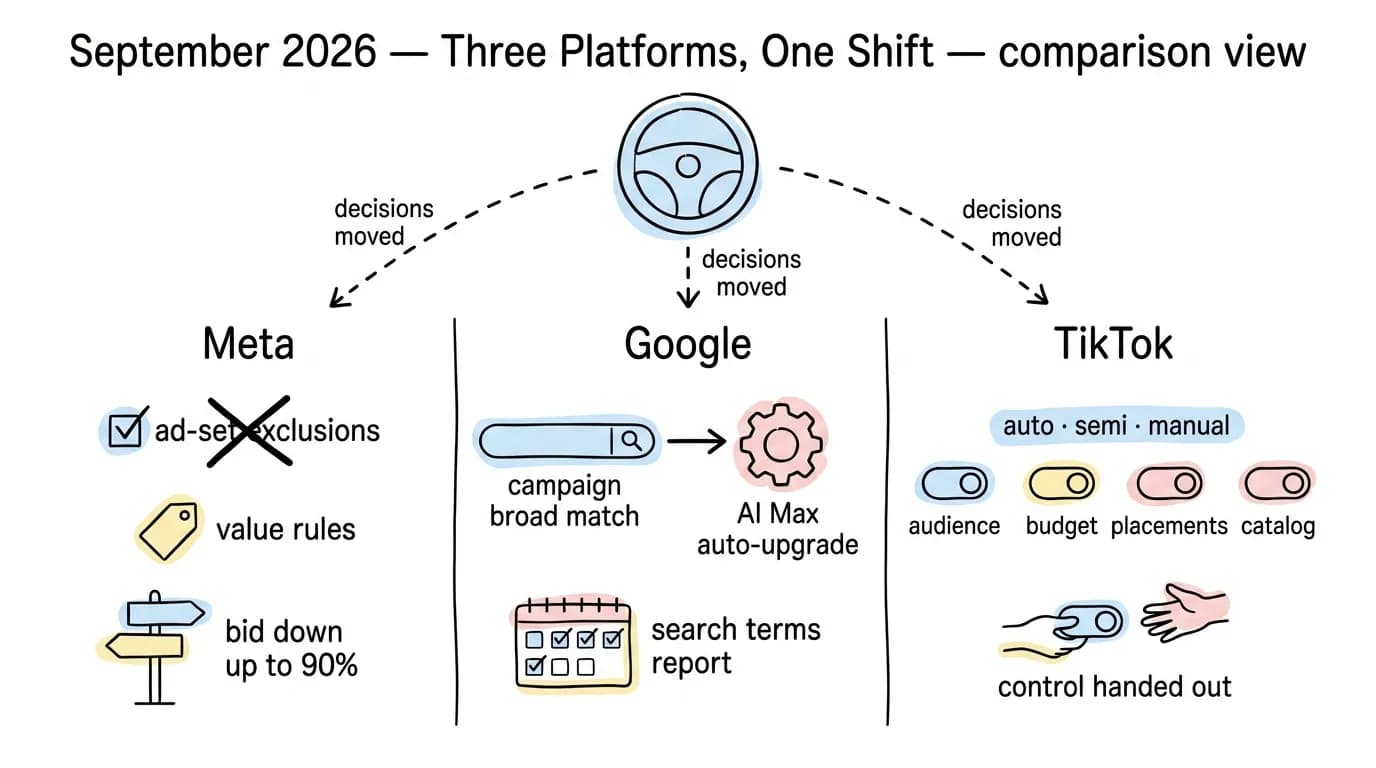
In September, Three Platforms Took Away Part of Your Steering Wheel
A few days ago, I went through everything the three big ad platforms did in September 2026. And I noticed a remarkably interesting coincidence.
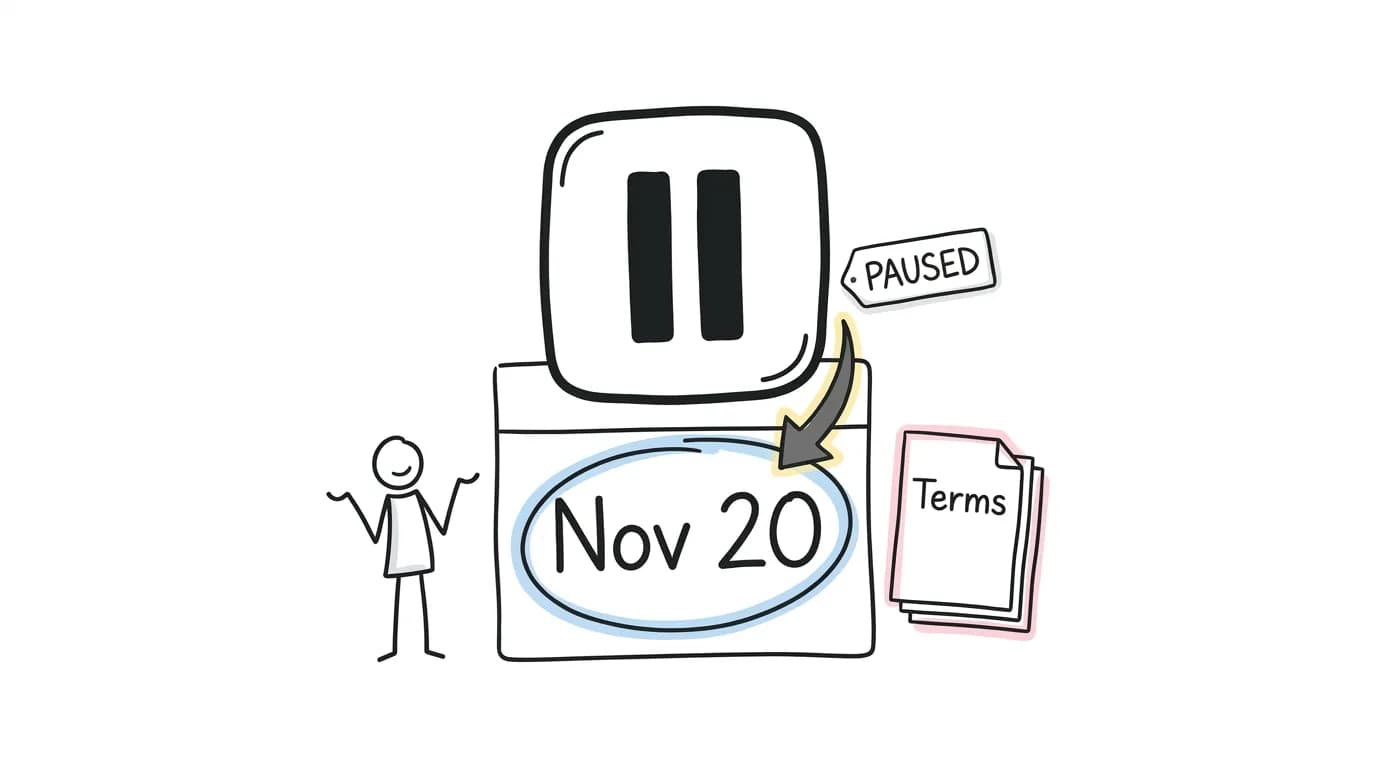
Meta's New Terms Hit the Pause Button on the Eve of the Effective Date
A while back, I was helping a friend of mine who runs a cross-border e-commerce business go through the compliance checklist for his ad account.
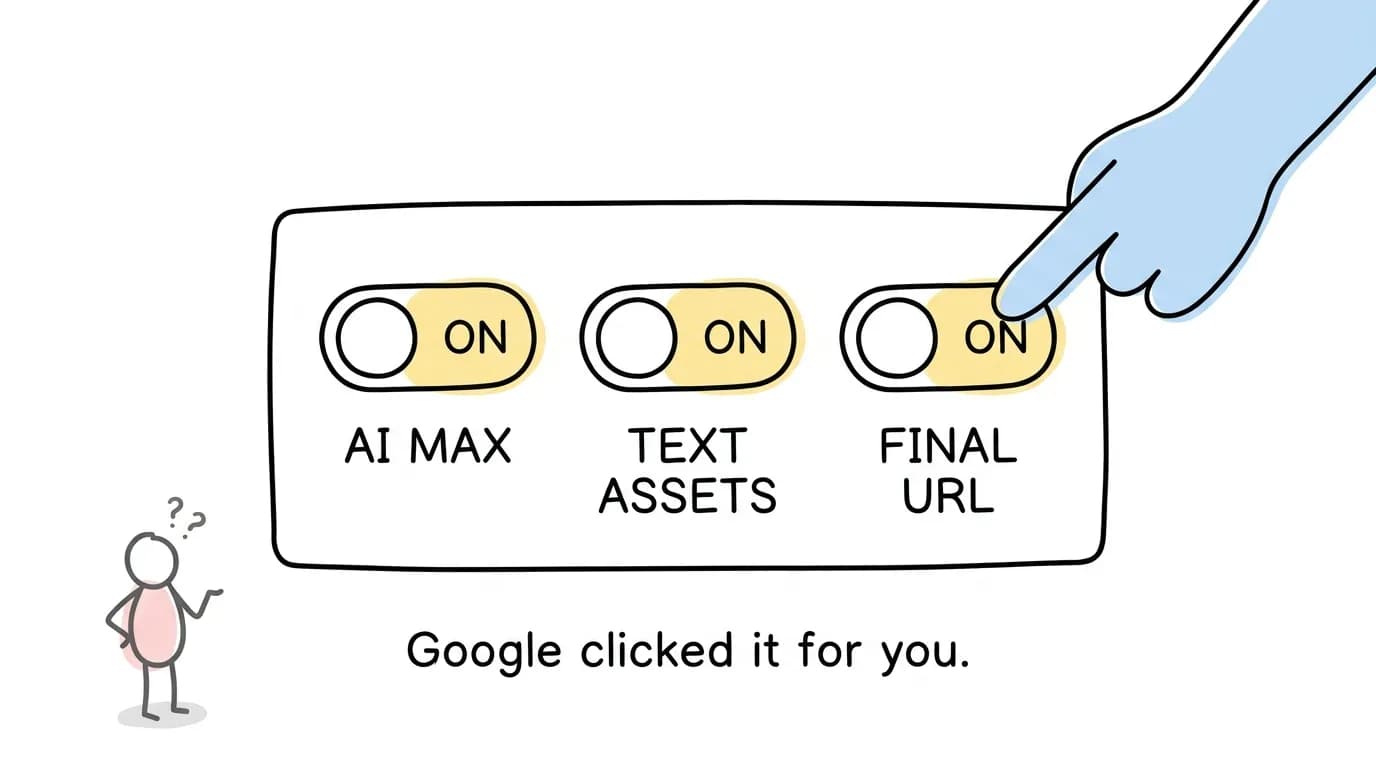
Google and Meta changed 17 ad rules this week. 6 of them need checking today.
A few days ago, I was helping a friend who runs a cross-border e-commerce business go through his ad accounts.