
AI Has Started Making Decisions for People. Kantar's Top 10 Marketing Trends for 2026, Distilled into One Sentence
A digest of Kantar's 2026 marketing trends arguing AI shopping agents now sit between brands and buyers, so brands must persuade people and machines alike. It covers GEO, data quality, consumer shifts, and budget moves toward retail media, creators, and micro-communities.
A few days ago, with our home renovation wrapping up, I asked AI to help me pick a washer-dryer set.
I didn't open a shopping app. I didn't read reviews or compare prices. I just asked one question: an 8,000 budget, family of three, needs a dryer — which one?
It gave me an answer, plus a little "here's why."
I stared at that answer for a long time, and suddenly it hit me: in this entire purchase, from start to finish, not a single brand ever spoke to me. No ads. No push notifications. No coupons. It simply got recommended — by that machine.
It never used to be this way. Whenever you wanted to buy something, brands could always find you: in the elevator, on your phone's splash screen, in a livestream. Where there was intent, there was an ad.
And now? Your intent gets told to AI first.
This year, Kantar released the 2026 edition of its Marketing Trends report. Ten experts, ten trends. I skim one of these trend lists every year, and honestly, most of the time I forget them as soon as I'm done. This year's, I read word for word.
Because I noticed something: these ten trends talk about ten different things on the surface, but underneath, they're all about one thing:
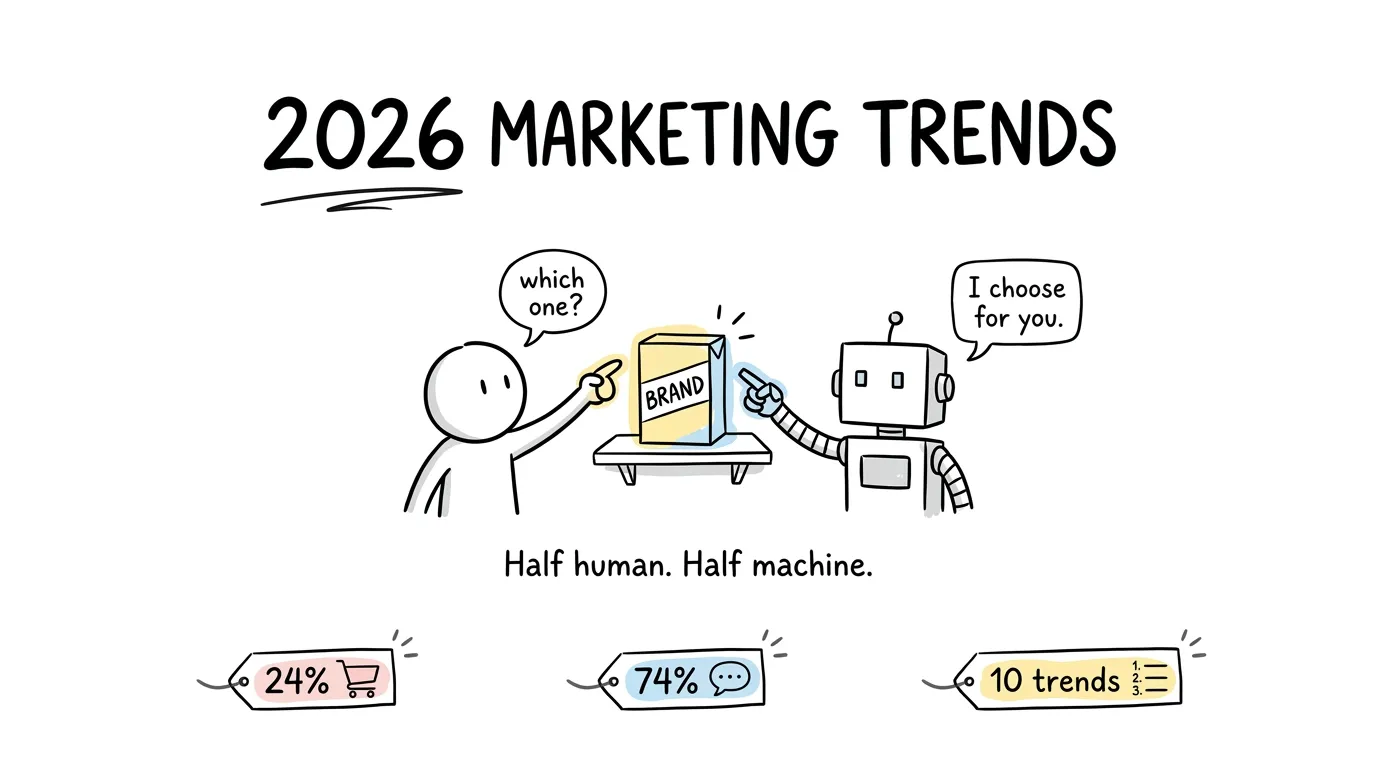
The structure of the customer has changed. Half of them are human. The other half is turning into machines.
1. A Bunch of "Non-Humans" Have Snuck Into Your Customer Base
What's a purchase agent?
It's an AI you hire to do your shopping for you. You hand it your intent: "I want a mascara that doesn't smudge." "I want to switch streaming services." It understands, compares, picks, and hands you an answer — or even places the order itself. And as cryptocurrency gets embedded, these agents will only grow more autonomous.
Sounds like science fiction. But Kantar's Connecting with the AI Consumer report has the numbers: 24% of AI users are already using AI shopping assistants.
One in four people has already outsourced the "picking" part.
Wow. That number is way higher than I expected.
Never mind that OpenAI has already announced it will put agents right into the browser. What does that mean? AI used to be your advisor. Now it wants to be your procurement department.
So what should brands do?
In the Brand Growth Blueprint, Kantar has a phrase I love: for a brand to grow, more people need to be predisposed to you. For the past twenty years, that meant winning over more people.
Now the sentence needs a second half: win over more people — and persuade more agents.
How do you persuade an agent? It doesn't watch TV ads. It doesn't chase promotions. It trusts exactly one thing: information. Product specs, service details, how-to guides, real user experiences — they all have to be findable, readable, and believable to the machine.
And here's a detail that's both brilliant and a little chilling: in a transaction with no human buyer and no human seller, does empathy still have a seat at the table? Does emotion still work?
Honestly, I don't know the answer. But it's a question every marketer should sit with.
2. If the Model Doesn't Know You, It Won't Recommend You
First, a data point that stings even more: 74% of AI assistant users go out of their way to ask AI for recommendations.
In other words, before buying anything, your customers no longer ask their best friend first. They ask the model.
You might think: my brand is famous enough, the model will naturally recommend me.
Exactly the opposite.
Fame alone isn't enough. If the model doesn't know you, it won't recommend you.
What does "know" mean? You take what your brand stands for, what you offer, and why you're good — and you feed it to the machine in a form it can actually read, honestly and completely. Recipes, tutorials, structured documentation: these are the "textbooks" you hand the model.
And out of this, something new has emerged: GEO (Generative Engine Optimization). Think of it as SEO for the AI era. Back then, you courted Google's crawlers. Now, you court the corpus of large models.
What happens to brands that never make it into the corpus?
They get "optimized out of existence." That's the harshest phrase in the whole report, as far as I'm concerned. In the shelf era, if you weren't stocked, customers couldn't see you. In the model era, if you're not in the corpus, the machine simply treats you as if you don't exist.
Think about it: that's an emptier shelf than any store's.
3. A Machine's Judgment Starts with Good Feed
Across the ten trends, one thing Kantar hammers at again and again. I'm pulling it out on its own, because it's the foundation: data.
Everyone's been talking about synthetic data these past two years — using AI-generated "virtual samples" to fill the gaps in real data. It's fast, cheap, and can simulate scenarios that are nearly impossible to capture in the field. Kantar's own synthetic data solution matches "ground truth" with 94% to 95% accuracy.
Impressive.
Digital twins — building digital replicas of real people or products — have only just reached the stage where the rules need to be written. Text, voice, imagery, and VR are being mashed together fast. But Kantar's judgment is clear-eyed: the industry isn't ready, or at least not fully. It needs rigorous testing, new skills, infrastructure that can scale, and data partners you can trust.
Put simply: an AI's judgment is only as good as what you feed it.
The same holds on the creative side. Most marketers are itching to play with generative AI, and one of its genuinely valuable uses is prediction: which ad will grab attention, stir emotion, lift purchase intent, and build long-term brand equity. AI-assisted testing keeps getting faster and more accurate — today, marketers can adjust a live ad on the fly based on historical performance, real-time buzz, and audience feedback.
But one warning: all of this rests on the training data you feed these tools being solid. If that data isn't solid, what AI gives you isn't insight — it's hallucination.
And don't forget: telling your brand's story well is still a human job. No matter how fast a machine is, it doesn't know why your brand moves people.
4. People Haven't Changed — But They're Changing Faster, and Fragmenting
That's the machine side. Now for the human side. Three observations stuck with me.
The first is about "small but certain happiness."
Kantar calls this Treatonomics — the economics of treats. The big-ticket stuff — marriage, a house, having kids — is increasingly out of reach, or increasingly unwanted. So people turn around and look for a sense of control in small pleasures: a great coffee, a small bag, a short trip.
Kantar Global MONITOR's tracking shows that 36% of consumers are willing to take on short-term debt just to "make themselves happy."
36%. I stared at that number for a long time.
There's a trendy word for this, too: inchstones — milestones measured in inches. When the traditional milestones are out of reach, you celebrate the small ones. A party to mark a divorce. A diamond to console yourself after a rejected job application.
Isn't that just the lipstick effect? Yes. But this is the lipstick effect on steroids. Social platforms have become buy-it-instantly arenas, and the gap between "wanting" and "having" has shrunk to a few seconds. With economic uncertainty still lingering, I see no sign of this trend cooling off.
But brands should be careful: trends are shifting faster and faster, and they're fragmenting by region, by culture. The trick that works in Shanghai may do absolutely nothing in São Paulo.
The second is about inclusion.
In 2021, 59% of people gave bonus points to companies that advance diversity and inclusion. Today, that number is 65%.
Keep in mind, DEI (diversity, equity, and inclusion) has taken plenty of backlash in Europe and the US in recent years. Precisely in times like these, Kantar's advice gets sharper: don't chant slogans — show your stance. Do the concrete work: products that more groups of people can actually reach, genuine representation on the team, authenticity both in front of the camera and behind it.
Inclusion isn't a moral pose. Inclusion is bringing high-growth audiences into your business — for real.
The third is about innovation.
Over the past 20 years, the brands bold enough to disrupt themselves — Apple, Amazon, Google — created $6.6 trillion in new value combined. That's the math from Kantar BrandZ.
But most companies, the moment real risk shows up, get cold feet. Everything around them is changing, so standing still feels safer. The cost of standing still, though, is future growth.
Kantar's verdict: you can't defend your way to 2026. Make "experiment" the organization's default move — give teams permission to push boundaries, build the structure for exploration, and reward the willingness to try and fail.
One line I especially agree with: let the brand lead the innovation — don't let the technology lead. Start from what your brand stands for, start from consumers' motivations and anxieties, and then look at which technology can help. Do it the other way around, chasing every hot trend, and you'll always be behind someone else.
After all, the biggest risk has always been taking no risk at all.
5. The Money Is Flowing to Three New Places
Finally, the money. Where budgets flow is the most honest expression of any trend. Kantar's annual Media Reactions survey points to three places.
The first: retail media.
What's retail media? It's the media space that grew out of e-commerce and retailers themselves: on-site recommendation slots, shopping search, member outreach. This track already has more than 200 retail media networks — and counting.
Does it work? Kantar LIFT's data says yes: 1.8x more effective than typical digital advertising, and nearly 3x at driving purchase intent.
No wonder a net 35% of marketers say they'll put more money here in 2026.
But there's a catch — one the report hammers repeatedly: for retail media to reach its full power, the data scattered across retail touchpoints has to be connected. That's also an opportunity for the media side: whoever can measure results with total clarity wins advertisers' trust.
And watch one more shift: shoppable ads on connected TV (CTV) and streaming are going mainstream. Buying halfway through a show will change the entire way people discover, get sold on, and purchase products.
The second: creators.
A net 61% of marketers plan to spend more on creator content in 2026. But the more money flows in, the harder the accountability: likes and views aren't results. ROI and brand equity are.
The trouble: right now, only 27% of creator content has a strong connection to the brand. And another finding from the Kantar LIFT+ database: consistent creative across channels matters 2.5x more to a campaign's success than it did a decade ago.
How to fix it? Kantar's prescription is structural: stop buying content piece by piece. Build long-term creative platforms, or cluster content around the same themes, so the brand's content and the creators' content grow on the same tree.
And for brands, the hardest lesson is letting go. Creators aren't actors — they can only be themselves. Over-direct, and the spark dies; give no direction, and the brand disappears. Where's the balance? Set the guardrails, define what success looks like, and then let the professionals do their thing.
The third: micro-communities.
Organic reach from brand pages keeps sliding. Algorithm-driven feeds reward generic, hard-sell content. Public spaces are getting more crowded — and less sincere. Where do people go? Into small communities: tight circles, interest groups, private sharing spaces. That's where people actually open up.
Here, the way brands win is by offering real, tangible value — not a barrage of promotions.
China's example says it best — plenty of social trends start there first: brands that market through knowledge-sharing micro-community platforms see marketing ROI 25% higher. And nearly 40% of consumers say a recommendation in a micro-community is as trustworthy as one from a close friend.
Wow. One word in a community can be worth six months of your ad budget.
6. Back to That Washer-Dryer Set
Back to the washer-dryer set from the beginning.
Later, I kept thinking: why did the AI recommend the one it did? Because of everything that brand had done over many years: whether the specs were written clearly, whether the tutorials were good enough, whether real users' word of mouth had traveled, whether it showed up in the places worth showing up in.
A brand being recommended has never been about the three seconds in front of the shelf. It's the work of many years that began long before the customer had any intention to buy.
Except that from this year on, the one reading you first — before the customer makes up their mind — has become a machine.
That's what Kantar's ten trends boil down to: the foundation of brand growth has always been data and trust. What's changed is that the first test of that trust may no longer be pairs of human eyes — it may be machines.
May that machine read you — and your brand — well.
Continue reading
Related articles

What Is GEO? How Your Brand Gets "Mentioned" in the Age of AI Search
An explainer on GEO (Generative Engine Optimization) for e-commerce and DTC brands: how it differs from SEO and AEO, why AI answers shape brand visibility, and eight practices covering question-focused content, consistent brand messaging, structured pages, external evidence, comparisons, and AI mention tracking.

AI Is Already Making Decisions for Your Customers. Are You on the List?
A learn article explains GEO (Generative Engine Optimization): why AI-generated answers now shape which brands customers see, and how SEO fundamentals, entity clarity, citable evidence, and monthly measurement affect visibility in AI answers.

Google Is Stuffing Ads Into AI Search: These Recent Stories Are Really One Story
A news roundup linking recent AI marketing stories—Google adding ads to AI Mode, Amazon's Ads Agent, ChatGPT image updates, a UK startup tracking brand mentions in AI answers, and an AI ransomware warning—arguing that control over ad data and visibility is shifting toward platforms.