
Your Customers Are Asking AI Now — What About Your Marketing?
Explains how search entry points are fragmenting across AI assistants, search engines, and social platforms, and introduces GEO and AEO alongside enduring SEO fundamentals like content quality, site speed, and mobile experience.
A while back, an old friend of mine who runs an e-commerce business invited me out for tea. The very first thing he said when he sat down caught me off guard:
"My website keywords are still ranking near the top. But no business is coming in."
I asked: so where did your customers go?
He said: they went to ask AI.
Oh? Now that answer is worth unpacking.
The Entry Points to Search Have Shattered
Think back to the last time you looked for an answer. How did you do it?
Maybe you opened a search engine and typed in a few keywords. Maybe you went straight to an AI: "Compare these two products for me." Maybe you asked out loud with your voice. Maybe you were scrolling short videos and picked something up along the way. Or you watched people argue out an answer in a group chat or a comment section.
In other words, the way we find information today has shattered. No single entry point owns the journey anymore.
So what does that mean for people who do marketing?
It means that if you fixate on just one entry point, you're handing more than half your audience to the competition.
The AI Side of the Story: What Is GEO?
Before, when you did SEO, your goal was to rank near the top of the search results and get users to click through.
Now, AI reads information on your users' behalf. It sifts through a mountain of sources, picks out the few it considers reliable, and then writes up a "summary" — and delivers the answer straight to the user.
Here's the crucial part: does your content get "cited" in that summary?
If you're cited, you get seen. If not, no matter how beautiful your writing is, you don't exist in AI's answer.
This new game is called GEO, or Generative Engine Optimization. How do you actually play it? Three things:
Structure your content clearly. AI can't follow tangled, winding paragraphs. Write clean, and it will actually use you.
Go deep on one topic. Ten posts that skim the surface are worth less than one that goes all the way down. When AI judges whether you're an "authority," it looks at how deep you've dug into the subject.
State your information clearly. Data with sources, claims with backing, no vague hand-waving. When AI picks what to cite, it's picking for "trustworthiness."
What Is AEO?
Now let's look at the other side — what users are doing.
Before, a search meant typing something like "thermos recommendation." Now? Users ask directly: "I have a budget of 200 yuan — what thermos should I buy for an elderly relative?"
Search is looking more and more like a conversation.
This has given rise to another new game: AEO, or Answer Engine Optimization. Put simply, your content has to answer a specific question head-on — clearly and accurately. No more circling around with a long setup. Whatever the user asks, that's what you answer.
Old SEO Isn't Dead
Hearing all this, you might be thinking: so is traditional SEO something I can just toss out?
Don't. The fundamentals still work: site speed, mobile experience, internal links, content quality — every single one has to hold up.
What's changed is the playbook. Before, you'd write an article and repeat the same keyword ten times, hoping the search engine would notice. Now? You write one long piece that covers the entire string of questions users might ask, all at once, all the way through.
From "repeating keywords" to "covering questions."
The Other Half of the Battlefield Is Social Media
With AI covered, here's the other thing I feel even more strongly: social media is turning into a search engine.
Look at the young people around you. Choosing a restaurant? They don't search — they scroll through restaurant review videos. Researching a product? They head to YouTube for reviews first. Instagram, Facebook, Pinterest, LinkedIn, X — every one of these platforms now carries a "look it up" function.
And each has its own division of labor.
Instagram handles visuals — it's where the desire to buy gets sparked. YouTube handles depth — tutorials, reviews, how-tos, all live there. Facebook handles community — a whole group circling one topic in discussion. X handles real time — trending topics hit there first.
What does this mean? You should be saying something different on each platform. One set of content blasted everywhere will not work.
Short-Form Video? Keep Making It
Is short-form video still hot? Yes. And it's the kind of heat that's actually justified.
A short video that can deliver has just three elements: it has a topic — no rambling; it grabs you in the first three seconds — no slow burn; and it has something real to say — no padding.
The uses are practical too: explain a concept, answer a question, show off a product. Instagram Reels, YouTube Shorts — either one works.
Social and Search Are One Web
The thing most worth mulling over is how these two webs interact.
Watch a typical user's path: they see something on Instagram and get a little interested; they hop over to YouTube to search for videos and see what others are saying; finally, they click through to the official website and dig into the details.
That path is your marketing map. You have to be present at every step.
And here's a layer that's even more brilliant: the comments, questions, and complaints on social media are your free topic library. Whatever users are asking in the comments — that's your next article. That's more direct than any market research report.
Show Different Content to Different People
AI and data analytics can now slice your audience remarkably fine: is this person visiting for the first time, or actively comparison shopping?
First-timers get education — help them understand. Comparison shoppers get reviews and comparisons — help them decide. When content follows the stage, conversion rates naturally climb.
But there's one red line: data has to be used cleanly and transparently. Don't scare users away in the name of "precision." Trust takes a long time to build and one moment to shatter.
Quality Has Become the Great Divide
AI has made writing articles much faster. It has also multiplied the amount of mediocre content out there.
When everyone can publish ten pieces a day, "publishing a lot" stops being worth anything. What is worth something? Being right. Being useful.
Especially on topics like technology, finance, and healthcare — one wrong number and things can go seriously wrong. Human editing and fact-checking are becoming scarce commodities in the AI era.
Stop Sprinkling Pepper on Every Platform
One last piece of advice, about running social media: don't throw yourself at every platform.
Get clear on three things: which platform are my users on? What is my persona here? What content should I be publishing?
Once you're clear, dig in deep. Better to master two platforms than to sprinkle yourself across ten. Posting frequently is not the same as operating well. Watching the data, watching engagement, choosing the right content types — that's operating.
Back to My Friend
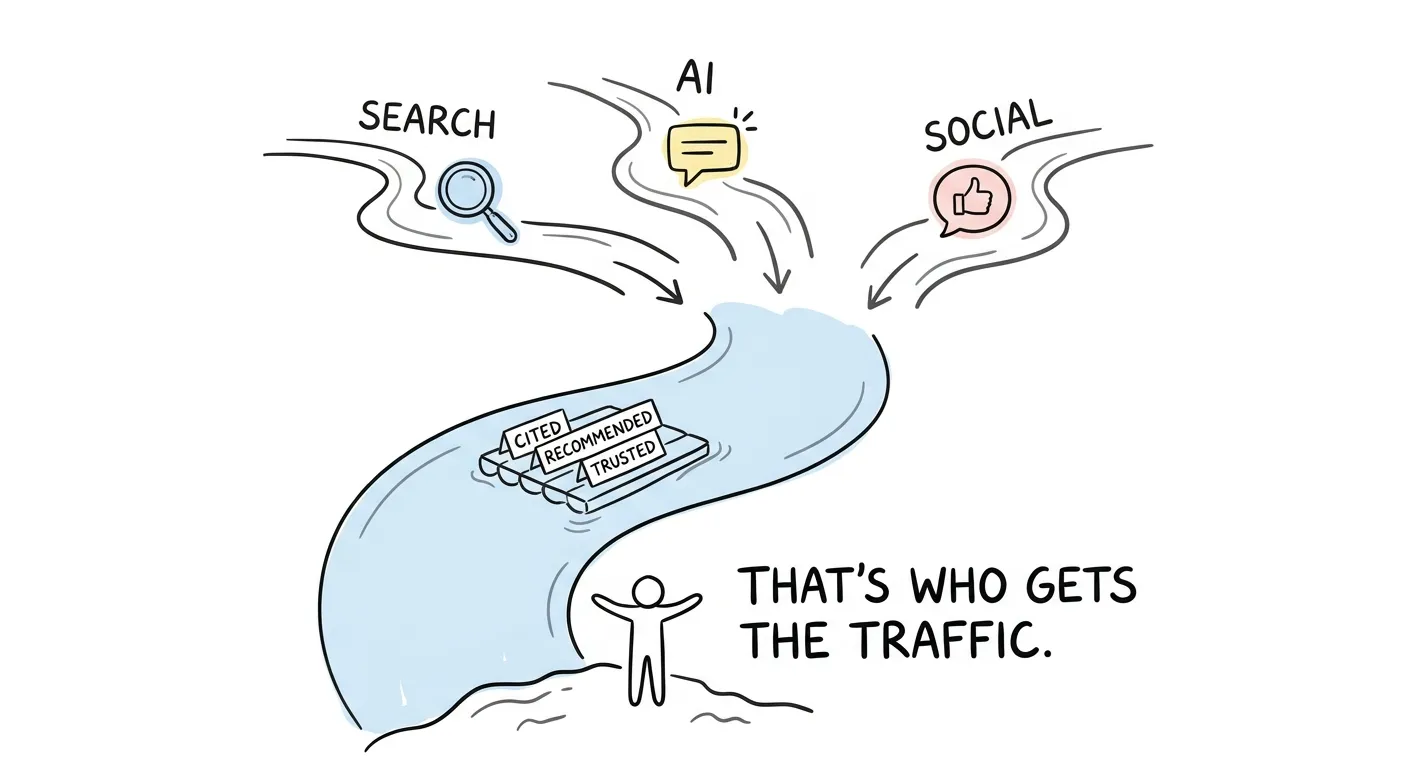
The direction is actually very clear: search, AI, and social media — three streams are converging into one river.
Whoever AI cites, whoever social media recommends, whoever users trust — that's who gets the traffic.
The last time I saw my friend, he said something else that stuck with me. He told me that before writing any article now, he first asks AI one question: "If a user asked you this question, how would you answer?"
If AI's answer doesn't include him, then he knows exactly what that article needs to be.
Here's to you, too, being "cited" by AI.
Continue reading
Related articles

It's 2026: Stop "Buying" AI Tools for Your Marketing Team — Start "Hiring" AI Agents
This learn article explains how AI agents differ from standalone AI tools in marketing, outlines three agent categories — build-your-own platforms, CRM-native agents, and vertical tools — and covers use cases across SEO, social media, advertising, and reporting, plus criteria for choosing one.

What Is GEO? How Your Brand Gets "Mentioned" in the Age of AI Search
An explainer on GEO (Generative Engine Optimization) for e-commerce and DTC brands: how it differs from SEO and AEO, why AI answers shape brand visibility, and eight practices covering question-focused content, consistent brand messaging, structured pages, external evidence, comparisons, and AI mention tracking.

AI Is Already Making Decisions for Your Customers. Are You on the List?
A learn article explains GEO (Generative Engine Optimization): why AI-generated answers now shape which brands customers see, and how SEO fundamentals, entity clarity, citable evidence, and monthly measurement affect visibility in AI answers.