
Does AI Marketing Actually Work? I Ran the Numbers from 10 Companies for You
A learn article reviewing publicly disclosed AI marketing results from 10 companies, covering faster creative production, personalized recommendations, and cost savings, plus an SME SEO case, and arguing AI amplifies rather than replaces human judgment.
A while back I was at dinner with a friend and the talk turned to AI marketing. He waved his hand: it's all smoke and mirrors. Keynotes blare their promises, but what actually lands is pure concept.
I said, don't jump to conclusions. I had just gone through the AI marketing cases of 10 companies, and every number was publicly disclosed by the company itself — not a forecast from some consulting report.
Conversion rates up 11%. Production time cut in half. Customer acquisition costs down 25%. A billion dollars saved in a year.
Guess which of these comes closest to the truth?
If you want to judge whether something is genuinely useful, look at whether it dares to show you its numbers.
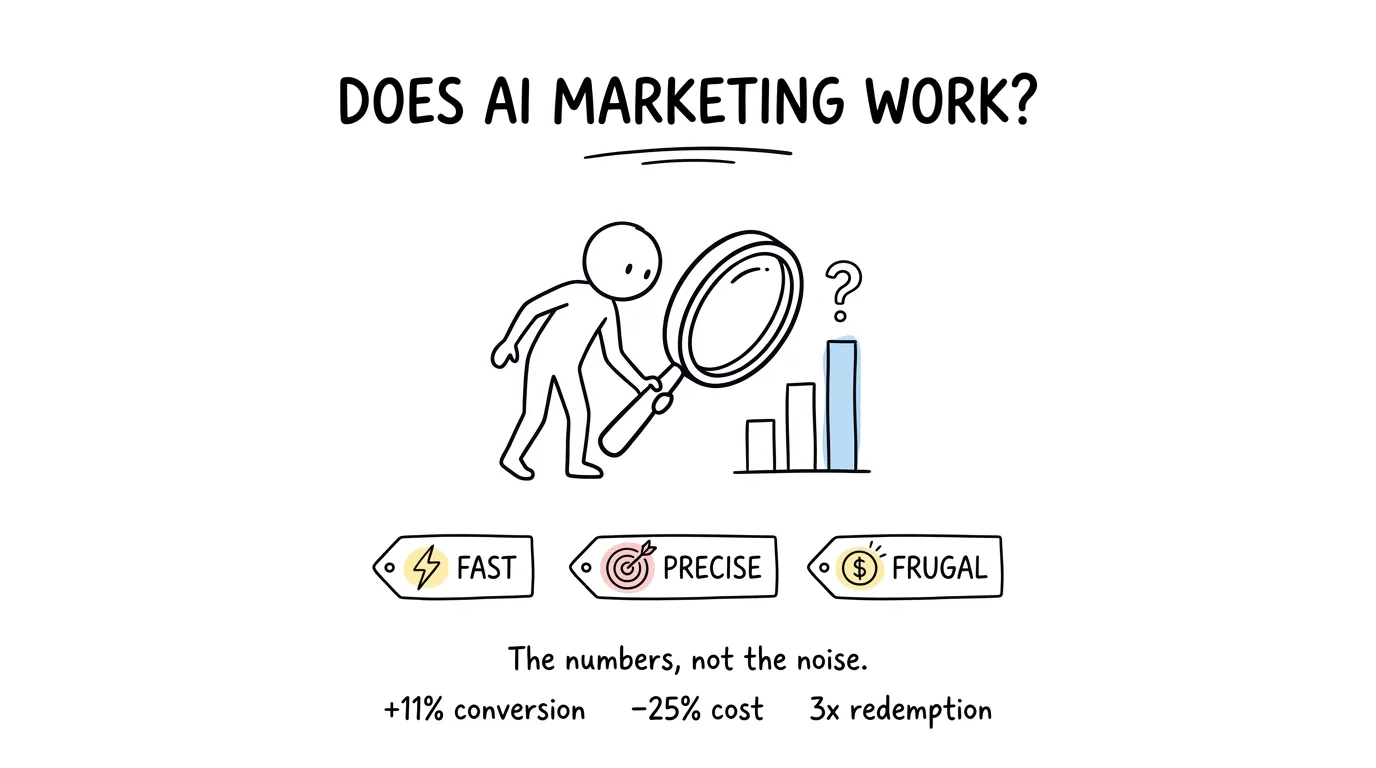
These 10 companies come from industries far apart: cosmetics, beverages, coffee, streaming, banking, software. But put the numbers side by side and you'll find three patterns that keep recurring. Let me walk you through them one by one.
Pattern One: Speed First, Quality Second
Let's start with the Coca-Cola story.
Coca-Cola runs marketing across dozens of markets at the same time, and getting one piece of creative content out used to take forever. Then it started using GPT-4 and DALL-E for creative production — and cut content production time in half.
What does cutting it in half mean? Think about it: a brand running campaigns in 30 markets at once needs localized assets for every market. In the past, you could only obsess over a few priority markets and make do everywhere else. Now that speed is no longer the constraint, every market can test a version fast and swap it out if it flops.
What you save is cost. What you gain is rhythm.
Alibaba pushed this logic to the extreme. Its AI copywriting system can generate 20,000 lines of ad copy in one second.
What does 20,000 lines mean? A skilled copywriter does well to write a few hundred lines a day. A whole team grinding for a year might not catch up to this system's output in one second.
And here's the kicker: this machine-written copy has a click-through rate 8% higher than what humans write.
Honestly, I didn't believe "machines write better copy than people" at first either. Later I figured it out: AI isn't more talented than a copywriter — it just runs more trials than an entire copy team combined. Picking 1 out of 100, it can run that selection tens of thousands of times a day. How do you compete with that?
JPMorgan Chase has tested something similar: AI-generated ad copy achieved more than twice the click-through rate of the human version.
Humans compete on creativity; machines compete on volume. When volume gets big enough, volume itself becomes creativity.
Pattern Two: Treat "a Group of People" as "One Person"
The second story is about Sephora.
Sephora's personalization engine did something disarmingly simple: the products and content recommended to every customer were aimed at that one person. No more crude grouping like "women aged 25 to 35."
The result: conversion rates rose 11%, which works out to $100 million in incremental revenue.
Eleven percent doesn't sound like much? Think about it: traffic unchanged, goods unchanged, prices unchanged — just by making recommendations more accurate, it earned $100 million more. That's the power of moving the granularity from "a group of people" down to "one person."
Starbucks has been at this even longer. It has an internal system called Deep Brew that pushes personalized coupons and recommendations to every customer. Offers pushed through it get redeemed at three times the rate of ordinary promotions.
Three times. How?
My take: Deep Brew isn't some freshly launched gimmick; it has been iterating on real transaction data for many years. Every latte you buy, what time you arrive, whether you add an espresso shot — all of it feeds the system. It knows better than you what you'll want to drink on a Thursday afternoon.
Spotify runs the same playbook. Its marketing emails are written from each user's own listening data: the songs you have on repeat, the playlists you saved. Open rates run 2 to 3 times those of ordinary marketing emails.
A lot of people assumed the email channel died long ago. But watch those open rates and you realize what died was the mass blast, not email.
Put these stories together and the logic emerges: marketing used to be "talking to a group of people"; now it can "talk to one person." The granularity changed, and with it the results.
Personalization isn't about whether you have it — it's about how deep it goes.
So how far has Netflix taken this?
Its recommendation engine contributes roughly $1 billion in retention value every year.
What is retention value? It's the subscribers who were about to cancel but stayed because they always found something they wanted to watch. That $1 billion is all those "people who didn't leave."
A recommendation system is, by itself, a retention business.
Pattern Three: Some Money Is Money You Save
The first two stories were about earning more; the third is about spending less.
Unilever used programmatic advertising optimization, letting the system automatically move money to the best-performing placements and audiences. Customer acquisition costs fell 25%.
Note that there's no new technology here and no new channel. The budget is still the same budget; what changed is only how the money gets spent.
The HubSpot story is more interesting. It used AI to score sales leads, putting the ones most likely to close at the front so sales would talk to those people first. Lead conversion rates rose 30%.
Here's the key part: the number of leads didn't grow by one. What changed is whom the sales time went to. Sales used to be like casting a net, chatting with everyone; now it's like sniping, taking the surest shot first.
ROI doesn't always come from new capabilities. Much of the time, it hides in the old budget.
These three patterns — fast, precise, frugal — all point to the same thing in the end: compounding.
Why do Starbucks' and Netflix's models get more accurate the more they're used? Because the data is snowballing. Every time a user takes an action, the model gains a bit more training material; the next recommendation is a little more accurate; the more it's used, the denser the behavioral data. Once this snowball starts rolling, it doesn't stop on its own.
Can Small Companies Play Too?
By now you may be thinking: these are all giants. Netflix has hundreds of millions of subscribers; Starbucks has stores all over the globe. My company has a few dozen people — what does this have to do with me?
There really is one case whose protagonist is a small and medium-sized business (SME).
It's based in Singapore, and it's not big. It rebuilt its website's content and technical SEO around how search works in the AI era. The result: organic traffic up 340%, and the conversion rate of qualified leads up 58%.
This is a client of Hashmeta, a marketing technology company. No big budget, no massive data — what it relied on was getting the fundamentals right.
So don't use "we don't have Netflix's data volume" as an excuse. Same principle — small companies just play it a different way.
Back to That Dinner
When I finished running all these numbers, I went back and asked my friend: do you still think it's smoke and mirrors?
He thought for a moment and said: the numbers are real. But I already know these companies are impressive at using AI — and then?
That question hit the nail on the head.
Having gone through so many cases, I found they share one even more fundamental trait: not one of them treats AI as a replacement for people.
Behind Sephora's personalization engine is merchandising strategy. Behind HubSpot's lead scoring is a sales process that already had to run smoothly. Coca-Cola generates images with GPT-4, but what tone to use and what story to tell is still decided by people.
Machines are in charge of running fast; people are in charge of thinking clearly about where to run.
AI amplifies human expertise; it cannot replace human judgment.
My friend finally asked: where should I start?
I said, don't start by asking what AI can do for you. First ask, in your business, which part is the slowest, the most expensive, and the most dependent on luck. Find that part, then see whether AI can reach it. The answer is often right there.
Here's to running the numbers on your own business, too.
Continue reading
Related articles

It's 2026: Stop "Buying" AI Tools for Your Marketing Team — Start "Hiring" AI Agents
This learn article explains how AI agents differ from standalone AI tools in marketing, outlines three agent categories — build-your-own platforms, CRM-native agents, and vertical tools — and covers use cases across SEO, social media, advertising, and reporting, plus criteria for choosing one.

What Is GEO? How Your Brand Gets "Mentioned" in the Age of AI Search
An explainer on GEO (Generative Engine Optimization) for e-commerce and DTC brands: how it differs from SEO and AEO, why AI answers shape brand visibility, and eight practices covering question-focused content, consistent brand messaging, structured pages, external evidence, comparisons, and AI mention tracking.

AI Is Already Making Decisions for Your Customers. Are You on the List?
A learn article explains GEO (Generative Engine Optimization): why AI-generated answers now shape which brands customers see, and how SEO fundamentals, entity clarity, citable evidence, and monthly measurement affect visibility in AI answers.