
Behind Every "Perfectly Timed" Moment Is a Real-Time Machine
An explainer of how Salesforce Marketing Cloud Personalization works: real-time behavioral profiles, Einstein-driven email personalization, its Evergage acquisition history, enterprise positioning, and a closing note that the technology's use is not neutral.
A few days ago, on an e-commerce site, I fell for a pair of running shoes.
I looked at them for three minutes, didn't buy, and closed the page.
The next morning I opened my inbox, and there was a promo email — and the hero image was those very shoes.
Doesn't that give you the creeps?
It gave me the creeps too, at first. But then I went and studied how this thing actually works, and I realized "creepy" is the wrong reaction. The right one is: Oh — so that's how it works.
The thing in question is called Marketing Cloud Personalization (MCP), a Salesforce product.
Today, in plain language, I'll walk you through how it does its job.
One
What is "batch marketing"?
It's what the vast majority of companies used to do: cram a million people into one list and send them all the same email. Hello, valued user — 50% off storewide.
A million people. One email.
The problem: among that million, some are browsing running shoes, some are looking at diapers, some bought just last week, some haven't shown up in three years.
One message, said to a million people. That isn't marketing; that's broadcasting.
The endgame of marketing is that no two people hear the same thing.
That's what "real-time personalization" is after: one-to-one. A million people, a million "perfectly timed" messages.
Two
So how do you get there?
Think about it: how does a veteran clerk in a brick-and-mortar store manage to serve regulars so well?
By remembering. What you bought last time, what you're into, when you usually come by, which section you linger in. Once all of that is stored, he can say exactly the right thing the moment you walk in.
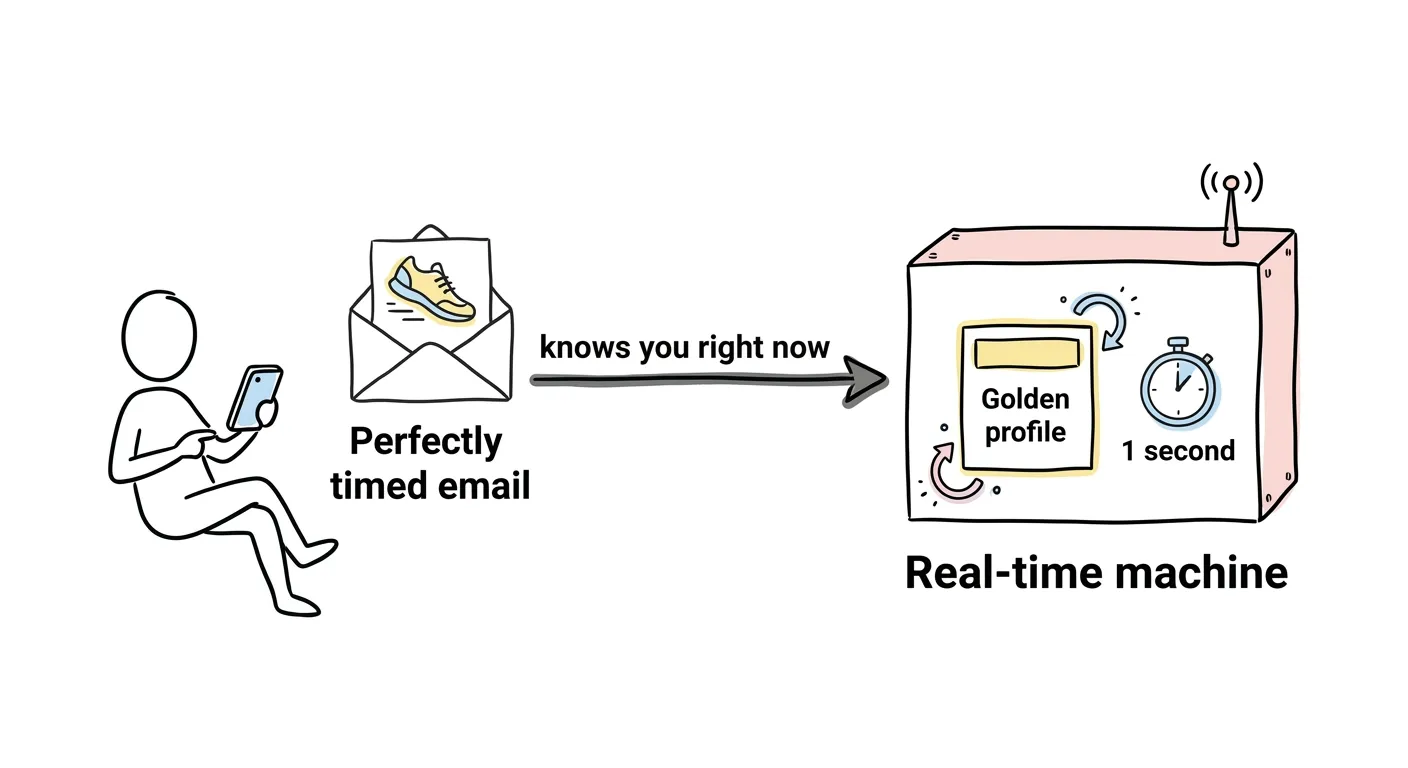
Marketing Cloud Personalization hands that remembering over to machines — and makes it happen in seconds.
Every click, every view, every purchase on a webpage — all of that behavioral data flows into the system in real time, like a stream.
The system pieces it together into a "golden profile."
What's a golden profile?
It's the complete picture of this person at this very moment: new customer or returning one, how far down the page they've scrolled, what's lying in the cart, how long since the last order.
And the profile is alive. Every tap updates it.
Not "by tomorrow morning we know you looked at running shoes yesterday" — but "we know this very second that you're looking at them right now."
That's the most fundamental difference between it and traditional email marketing systems: one is recall after the fact; the other is perception in real time.
Three
So the profile exists. Who puts it to work?
Salesforce has an AI engine called Einstein.
Armed with that real-time profile, it first guesses what you're most likely to do next. Then it runs tests for you to see which of two approaches performs better. And finally it wires up rules of the form: "the moment this behavior appears, send that automatically."
An example. You drop a pair of running shoes into your cart, and then, you're gone.
Traditional system: three days later, if your email address is on the "abandoned-cart win-back" list, you get a template email.
Einstein: a few seconds later, an email is already on its way — and it doesn't just contain those shoes; it comes pre-loaded with the running socks you'd most likely also care about. Why? Because your profile says you're a running enthusiast.
One more example, and this one I find even cleverer.
Email personalization, it turns out, can go all the way to "the moment you open it."
What does that mean?
In the past, an email's content was locked in before it ever reached you. Not this one: the email is rendered on the spot, at the instant you open it, based on your profile at that moment.
Open it at 8 in the morning, you see A. Open it again at 9 at night, you see B. Same email, two opens, two "perfectly timed" hits.
Honestly, that's impressive. This is "real time" taken to its absolute extreme.
Four
While we're here, its origin story is quite interesting.
Boston had a personalization company called Evergage — a few years into the business and fairly well known.
In February 2020, Salesforce bought it.
After the acquisition came the first rename: Interaction Studio. Then in November 2022 it was renamed again — that's how it became today's Marketing Cloud Personalization.
So you see, this isn't a product Salesforce painstakingly built from zero. It's an acquisition, grafted into its own ecosystem and nurtured there for a few years.
By the way — when big companies buy products, what are they actually buying?
Time. Personalization — the data, the algorithms, the scenarios — none of it can be rushed. Build it from scratch and it's three years, minimum. Buy a mature company, wire it into your CRM, and you can sell it that same year.
Build it yourself, and you're building capability. Buy it, and you're buying time.
Five
So who is this thing sold to?
Priced by subscription, it's enterprise-grade SaaS. The target customers are big enterprises and mid-to-large brands: retail, finance, travel, media, B2B.
Put bluntly: small businesses have no use for it, and can't afford it anyway.
Its core selling point really comes down to one thing: deep, native integration with Salesforce's CRM and Data Cloud.
There are standalone personalization tools on the market. On point features, they don't necessarily lose. What MCP plays for is lineage: sales, service, and commerce data are born inside the same system.
Think about it: a company whose data sits scattered across four systems, where nobody can say for sure who any given customer actually is.
MCP's play is to stitch the anonymous visitor and the known customer into one person.
While you're wandering the web anonymously, you're a visitor ID; when you log in and place an order, you become Mr. Zhang; when you call customer service, you're a member number. The system stitches those three strands into a single profile.
Only once the stitching is done does personalization truly begin.
Before you can understand someone, you first have to recognize them.
It has also cleared the compliance bar. SOC 2, ISO 27001, HIPAA — the enterprise-grade security certifications are all there. For customers in finance and healthcare, if compliance doesn't pass, no product — however strong — gets through the door.
Six
Finally, a bit of my own take.
Systems like this are genuinely powerful. But I want to offer one reminder: tools don't carry values.
The same real-time profile can be used to hand you a coupon at the moment you want running shoes — or to hound you at every step while you hesitate. The technology is neutral; the use of it isn't.
You might ask: what about offline?
Here's the interesting part — it even covers offline. On a store associate's tablet, your profile can be pulled up in real time: who you are, what you've bought, what you've probably come to look at this time. The associate glances at you, then glances at the tablet, and can say exactly the right thing.
Machines do the math behind the scenes; people do the talking up front.
That's roughly what marketing looks like from here on: the system knows the data, the associate knows how far to go — and you can't do without either.
So the next time you receive one of those "perfectly timed" emails, don't be so quick to get the creeps.
There's no magician behind it — only a living profile, updating once a second, remembering your every move on behalf of some merchant who knows the trade.
And may you, too, be gently, tactfully, perfectly understood — just once.
Continue reading
Related articles

What Is AI Marketing Automation? It Starts With a 40-Point Gap
A learn article explaining what AI marketing automation is: how learning-based systems differ from rule-based automation, how AI decisioning optimizes message, channel, and timing choices, what data it depends on, and where it applies across the customer lifecycle.

Marketing Automation Is Shifting from "You Do It" to "You Say It"
This article explains how marketing automation is shifting from rule-based platforms that merely execute toward AI agents that plan, create, publish, and review campaigns, covering delegable tasks, underlying technologies, tool categories, adoption steps, and risks such as privacy and automating without strategy.

Rankings Are Taking a Dive, Customers Are Sprinting Ahead: This November, I Re-Ran the Numbers on AI Search
A learn article on how AI search reshapes marketing measurement, covering reported mismatches between rank-tracking tools and live Google results, ChatGPT's business profile test, single-page visitors as high-intent leads, and CRO plus GA4 tracking verification practices.