
In an Inbox of 120 Emails a Day, Why Would Anyone Open Yours?
A learn article explaining how AI email tools differ from traditional blast platforms, grouping ten B2B AI email tools into four categories, and covering selection criteria, pricing tiers, common pitfalls, and rollout guidance.
Last month, a friend of mine who runs marketing at a B2B software company invited me out for tea.
Cold email is his job. Last quarter he sent 2,000 of them and got about 20 replies.
"Is email just dead?" he asked. "Nobody reads it anymore."
I told him email isn't dead. His writing is.
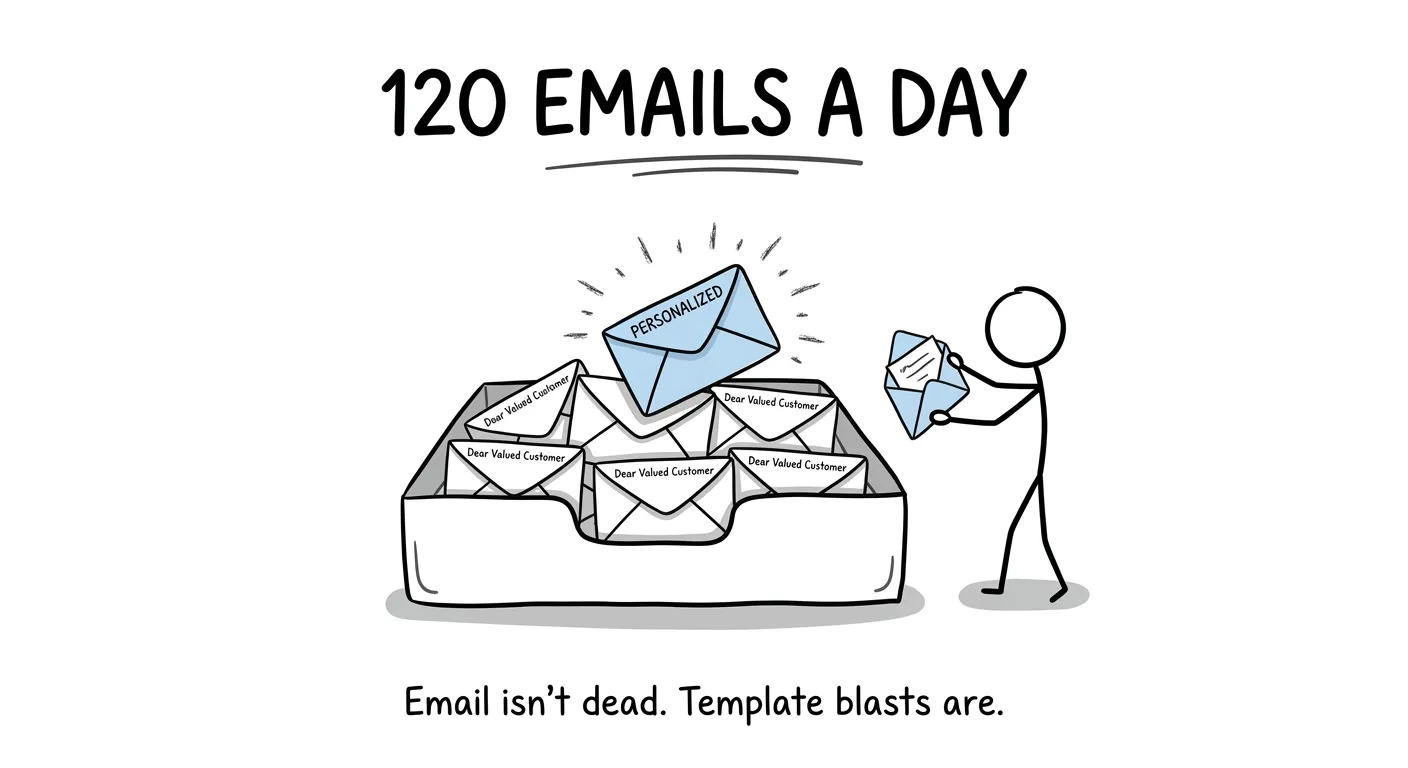
Think about it: how many emails does a B2B buying decision-maker get in a day?
More than 120.
And within those 120, they all look the same: same template, swapped-in name, "Dear Valued Customer" replaced with the recipient's first name. Those emails have exactly one fate in the inbox — they lie there for three seconds and get swiped away.
Email isn't dead. The template blast is.
Midway through this year, someone ran the full sweep of the B2B AI email tools on the market — ten of them in total. I've taken that list apart, added my own judgment, and I'm going to walk you through it.
First, Get Clear: What Counts as an AI Email Tool?
A lot of people hear "AI email tool" and assume it just writes subject lines for you.
Not even close.
What do you do with a traditional email platform? Build templates, set schedules, blast to the whole list in one click. It's a photocopier. Whatever you feed in, it copies a thousand times and sends them out. Done.
An AI email tool is different. It's a photocopier that learns.
You send out a thousand emails, and every open, every click, every reply gets fed back into it. It remembers: for CMOs in logistics, this subject line works; for IT managers at fintech companies, Tuesday morning beats Friday afternoon. The next send is already different.
Yes — the whole thing comes down to one sentence: every send is training, and it gets sharper the more you use it.
Traditional platforms only execute. They never learn. On that alone, the gap between the two widens every quarter.
Why You Can't Skip It Now: Run Three Numbers
Number one, the personalization ledger.
The CMO at a logistics company and the IT manager at a fintech firm have completely different pain points. One worries about fleet dispatch; the other worries about system integration. Send them the same email and you've persuaded neither.
That's exactly what AI does: it produces different versions automatically — by industry, by role, by wherever the recipient is in the journey. You write one skeleton and it grows ten versions of flesh.
Number two, the labor ledger.
Hiring your own copy team to draft every round of emails is expensive and slow. AI produces a first draft in seconds; a human edits, a human approves. The whole workflow speeds up by more than 60%. What you save is an entire copywriter position.
Number three, the compliance ledger.
GDPR, CAN-SPAM, instant unsubscribe handling, list hygiene running automatically in the background. None of this is visible on a good day — but when something goes wrong, the fine costs far more than a year of tool subscriptions.
Run all three numbers and the conclusion is clear: this stopped being a nice-to-have. It's infrastructure.
Before You Buy, Look at Three Things
There are thousands of tools out there, but the selection criteria really come down to three.
First, the copy should read like a human wrote it. Have the tool produce a few sample emails and read them yourself. If they reek of robot, cut it on the spot. Once the machine smell shows up, the conversion is gone.
Second, segmentation has to be dynamic. People's behavior changes daily — ice-cold one week, freshly downloading your white paper the next. The list has to move with them. A dead list rots fast.
Third, two-way CRM sync. Salesforce, HubSpot, Pipedrive — your email tool must connect with them. What happens if it doesn't? Sales ends up sending a cold email to a lead marketing already converted. And the prospect thinks: did this company forget me? One bad experience hurts more than ten blasts.
Ten Tools, Four Camps, Plus One Power-Up
Reciting the roster one by one is boring, so I've grouped them by playbook.
Camp one: the all-in-ones. One platform, end to end.
HubSpot. Its AI assistant writes emails, suggests send times, and recommends audience segments automatically. Marketing, sales, and service data live under one roof, so every email carries the recipient's full profile. There are smart content blocks too: the version a VP sees and the version a mid-level manager sees are automatically different. For companies that want marketing and sales email inside one platform, this is it.
Salesforce Marketing Cloud. Under the hood sits Einstein AI. Its signature strength is ABM (account-based marketing) — playing the account: once a company makes your list, every person inside it receives messaging tailored to their role. The scale is top-tier as well: hundreds of millions of emails sent, each personalized down to the individual, on infrastructure that holds up. Large enterprises already inside the Salesforce ecosystem can barely avoid it.
Marketo Engage. It goes deeper than anyone on the account-based play: named lists deployed across every channel; engagement scoring tells you which accounts are already showing buying intent, and the moment a score runs high, the automated sequences kick off — sales hasn't even picked up the phone, yet the prospect has already been through a full nurture cycle. All content flows out of a single asset library, so the brand never drifts. Built for mid-size and large companies formally running ABM.
Camp two: the fortune-tellers. Let the data talk first.
Klaviyo. Born in e-commerce, now used comfortably in B2B as well. Its prediction engine computes two numbers: what a customer is worth, and whether that customer is about to churn. Once the numbers are out, the email follows automatically: the about-to-leave get a win-back sequence; the active ones get accelerated nurturing. Data-heavy teams with very large contact lists — look here.
ActiveCampaign. Automation depth is its sharpest edge. Visual flow maps lay out complex nurture paths, branch by branch. The killer feature is predictive sending: calculated for each individual — what time of day this specific person is most likely to open, rather than one send time for everyone. Lead scoring runs in the background too, and hot leads surface on their own. Companies with long sales cycles: this is the one for you.
Camp three: the value picks. Small teams, running fast.
Mailchimp. Long past its newsletter-sending days. The AI writing assistant turns out subject lines, preview text, and body copy directly. Small teams with no dedicated copywriter can run their whole email program on it. Clean interface, zero fuss.
Brevo. Formerly Sendinblue, and in recent years it has built a CRM inside. That means a small team doesn't need to buy a separate CRM — one platform covers it. Machine-learning send-time optimization, automatic segmentation, marketing email and transactional email running on the same engine. Pricing is friendly to the mid-market.
Camp four: cold outreach. The attack-first playbook.
Instantly.ai. Focuses on exactly one thing: cold email at volume. It manages multiple sending accounts, warms up domains automatically, and has the AI write a different first line for every prospect. The moment someone replies, the sequence pauses — no pestering. Its real moat is deliverability: sending accounts rotate, domain health holds, and volume stays steady.
Lemlist. The craftsman of cold email. The AI writes a personalized icebreaker for every person, and it can generate personalized images and videos to tuck inside the email. One email with a "made just for you" image stands out in a wall of plain text. Email, LinkedIn, and phone pass the baton in sequence — and data decides when to switch channels. For outreach teams who want their email to not read like a blast, this is the pick.
And finally, one power-up.
Seventh Sense. It doesn't send email for you. It does exactly one thing: figures out when each person is most likely to open, then delivers the message at precisely that moment. It sits on top of HubSpot or Marketo — no platform change, the platform just suddenly gets accurate. Teams that have deployed it report open-rate lifts of 30% to 50%, often visible within two sends.
Strong.
How to Choose? Ask Yourself Three Questions
Question one: is your goal cold outreach, or nurturing the pipeline you already have?
These two plays use fundamentally different tools. Building from zero — look at Instantly.ai and Lemlist. Ripening the leads in hand — look at ActiveCampaign and HubSpot. Want both? Don't pick a single-point tool; go straight to the all-in-ones.
Question two: how big is your team?
Five people? Don't touch enterprise platforms — the complexity will drag you under. Mailchimp and Brevo get you moving faster. A few hundred people? Then start looking at the Salesforce Marketing Cloud and Marketo tier.
Question three — and the most important: how deep is its CRM sync, really?
However beautiful the tool, no sync means manual work, and every manual step dilutes the whole point of automation.
Four Traps, Sidestep Them Early
Buying the right tool is only the passing grade. What actually separates teams is execution. Four traps, one at a time.
Trap one: you never clean the list. AI feeds on data. Feed it a drawer of expired business cards and duplicate contacts, and everything it learns comes out wrong. Clean the list before you start.
Trap two: no ideal customer defined. If you haven't thought through what your ideal customer looks like, AI is aiming for you with no target — wherever it lands, it lands. Draw the profile first, then let AI pull the trigger.
Trap three: set it and forget it. AI is not a perpetual motion machine. A human needs to look at the data every week and feed back "which subject lines worked, which audiences don't respond." Leave it alone, and it stays at day-one level forever.
Trap four: skipping the fundamentals. Domain authentication, sending limits, warm-up routines — none of these old chores can be skipped. No matter how clever the AI, it cannot rescue an email sitting in the spam folder.
How to Spend the Money? Three Tiers
Let me lay the pricing out straight.
Entry tier: Mailchimp and Brevo — you can start for under $100 a month. Middle tier: ActiveCampaign and its kind — $200 to $800 a month. Enterprise tier: Salesforce Marketing Cloud — several thousand dollars a month to start.
Most teams are fine in the middle tier.
Two more things to flag. First, the rhythm of results: 30 to 60 days before open and click rates climb; deals lag behind — the B2B cycle is what it is, and no amount of rushing shortens it. Second, AI-written first drafts must pass human review before sending. Brand voice and fact-checking — machines cannot cover that layer.
Looking Ahead: The Next 18 Months
This category is still sprinting. A few things you can pretty much bank on.
Personalization pushed to the limit: AI weaves real-time signals from the recipient's public activity straight into the copy, until every email borders on mind-reading.
Intent data becomes standard equipment: before a prospect touches any of your content, the tool can already judge whether their company has entered a buying cycle. Get your move in first.
Video email is on the rise: AI-generated personalized video thumbnails tucked into cold emails — engagement numbers already leave plain text behind by a mile.
Privacy-first becomes a selling point: as compliance tightens, platforms that keep data clean gain points on enterprise buyers' shortlists.
Back to That Friend from the Opening
The advice I gave him later was one sentence: don't rush to replace your whole system. Pick the scenario that hurts most, run one tool as a 30-day pilot, and let the data make the decision.
Email is still the highest-ROI channel in B2B marketing. That hasn't changed. What's changed is that some people are still using a photocopier, while others are already using an assistant that learns.
AI won't write a great email for you. It only amplifies the strategy you already have. A fuzzy strategy, amplified, stays fuzzy.
May every email you send land at the exact moment the other person is most willing to click.
Continue reading
Related articles

What Is AI Marketing Automation? It Starts With a 40-Point Gap
A learn article explaining what AI marketing automation is: how learning-based systems differ from rule-based automation, how AI decisioning optimizes message, channel, and timing choices, what data it depends on, and where it applies across the customer lifecycle.

Marketing Automation Is Shifting from "You Do It" to "You Say It"
This article explains how marketing automation is shifting from rule-based platforms that merely execute toward AI agents that plan, create, publish, and review campaigns, covering delegable tasks, underlying technologies, tool categories, adoption steps, and risks such as privacy and automating without strategy.

Rankings Are Taking a Dive, Customers Are Sprinting Ahead: This November, I Re-Ran the Numbers on AI Search
A learn article on how AI search reshapes marketing measurement, covering reported mismatches between rank-tracking tools and live Google results, ChatGPT's business profile test, single-page visitors as high-intent leads, and CRO plus GA4 tracking verification practices.