
Brand Strategy Is Being Rewritten by AI: Let Me Tell You 5 Stories
Explains AI-driven brand strategy through five brand case studies — Coca-Cola, Nike, Netflix, Starbucks, and Sephora — then covers how AI answers increasingly screen which brands get named, with metrics, tools, and pitfalls for staying visible.
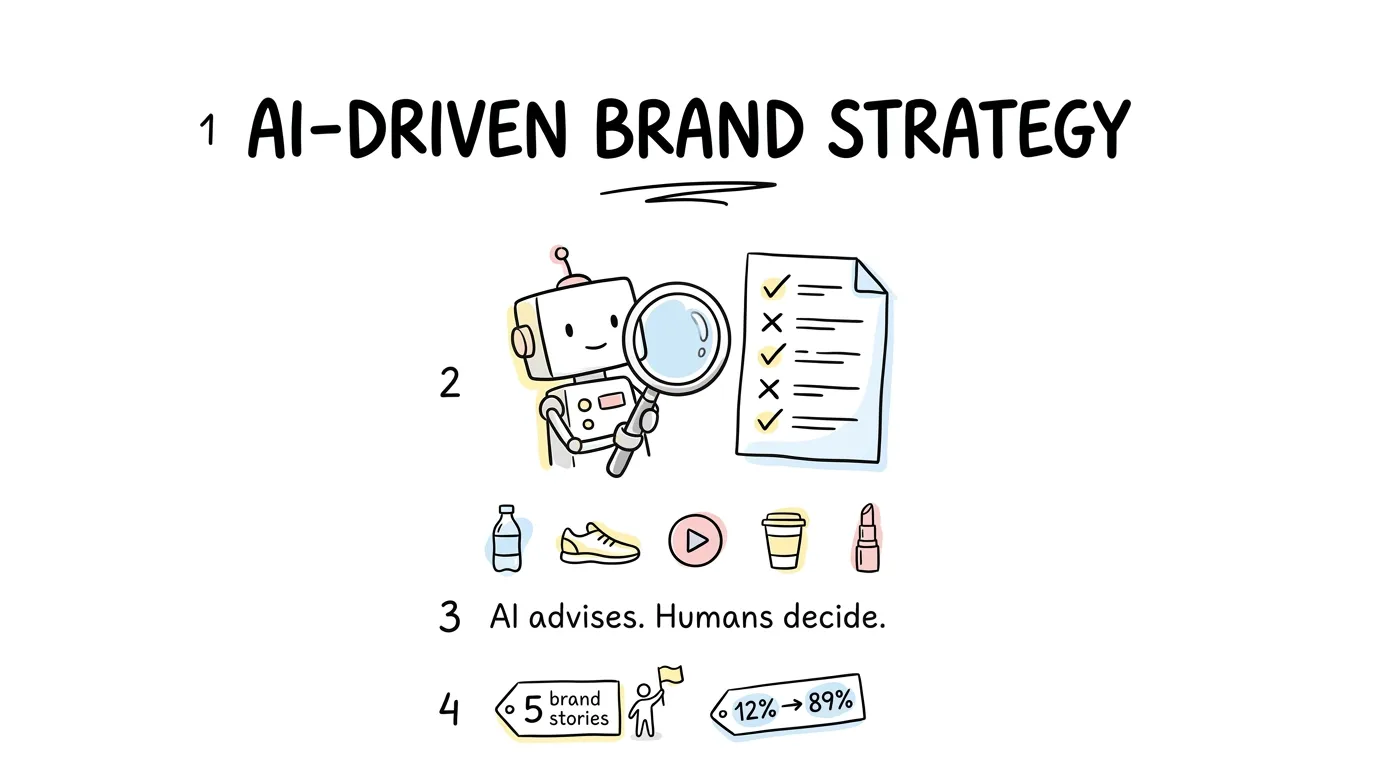
A few days ago, I asked AI to recommend a pair of running shoes.
It didn't hand me ten blue links. It just said: buy these two, and here's why.
In that moment, I suddenly realized something: before a brand ever gets to say hello to a consumer, AI has already screened it once.
Consumers ask AI, and AI only names a handful of brands. Whoever gets named is the one who gets a seat at the table.
Behind this is a fundamental shift in how brand strategy works. I recently went through a batch of case studies, every one of them verifiable. Today, I'll tell you 5 stories. And when we're done, we'll talk about a new battlefield that's opening up right now.
What Is "AI-Driven Brand Strategy," Anyway?
How does traditional brand strategy work?
A group of people locks itself in a conference room, settles on a positioning by gut feel, then spends hundreds of millions blasting a single slogan at everyone. You decide once, and it holds for a year.
Here's the problem.
Consumer trends now rise and fall within weeks. Competitors launch new products faster than your annual plan can even move. Are you really going to fight a battle that changes every few weeks using a judgment call you made a year ago?
So companies started bringing AI in.
AI-driven brand strategy, in plain terms, means using machine learning, natural language processing, and predictive algorithms to answer three questions: How should my brand be positioned? What experience should each customer get? Where is demand heading?
AI looks at the data and finds the patterns. Humans make the final call.
It sounds simple. In practice, every company picks a completely different path.
Let me tell you 5 stories.
Story One: Coca-Cola Handed Over Its Own Crown Jewels
A brand with more than a century of history did something that looked almost crazy: it took its most valuable assets — the contour bottle, the polar bear — and handed them over for creators everywhere to play with.
In March 2023, Coca-Cola launched Create Real Magic, a creative platform built on GPT-4 and DALL-E, with OpenAI and Bain standing behind it. Creators could make images with these iconic brand assets, and their work had the chance to appear on the giant digital screens of New York's Times Square and London's Piccadilly Circus. Later, Coca-Cola invited more than 30 creators to Atlanta for a creator academy.
One detail worth noting: throughout the whole campaign, the company never published participation numbers or reach figures.
So what were they after? What they were after was a different role. In the past, the brand story was written by ad agencies, and consumers could only take it in. Now, consumers write it themselves.
Old brands fear nothing more than becoming dated. But letting customers help write the brand is fresher than any nostalgia ad.
Story Two: Nike Didn't Build It — It Bought It
Consumers wanted personalization; Nike wanted algorithms. How long would it take to build a data team from scratch? Nike's answer: trade money for time.
In August 2019, Nike acquired Celect, a predictive analytics company. It could forecast which shoe or which clothing item would take off, when it would take off, and where it would actually sell.
By August 2024, Nike had also launched NikeAI (beta) in its U.S. app, recommending different products to every single user.
A company that sells athletic gear is quietly becoming your "personal sports companion." The gear is still the same gear, but it increasingly knows what you're going to buy next.
From selling gear to being your training partner — a set of predictive algorithms sits in between.
Story Three: Netflix, Where Even the Posters Are Personalized
When I first found this out, it stopped me for a second.
You and I can open Netflix, watch the same show, and see completely different posters.
Since 2017, Netflix has served each member personalized stills. Behind it is an algorithm called contextual bandits (an algorithm family that keeps running small, fast experiments and adjusts based on what gets clicked). Think of it as an experimenter who never stops testing: nobody clicking this poster? Swap it out, try the next one, keep going until it finds the version that makes your heart skip.
Machine learning also helps its content team find similar shows and estimate audience size.
But Netflix itself keeps repeating one thing: whether to buy a show or greenlight a production is decided by executives in content, market, and production roles. The algorithm just passes notes.
AI gives the advice. Humans make the decision.
Its positioning has also shifted — from "a streaming service with a lot of content" to "a personal curator who gets you."
Story Four: Starbucks Put AI Inside Every Store
Starbucks built an AI system called Deep Brew, running on Microsoft's cloud.
In November 2019, GeekWire reported on what it does: serving members personalized offers, placing replenishment orders automatically, scheduling store shifts, and even predicting which equipment is about to break down and needs repair.
That same year, Starbucks membership grew 15%, reaching 17.6 million people.
But note the caution: the company never officially claimed that 15% was Deep Brew's doing. You can't run sloppy math on this.
The direction, though, is clear: a coffee company is working hard to become a life companion that knows what you'll want to drink next. Before you've even spoken, it already has your offer ready.
Story Five: Sephora Lets You Try Before You Buy
What's the biggest pain point in buying makeup?
Shades. Blushes, bronzers, highlighters — thousands of shades, and every wrong purchase is a quiet loss you eat on your own.
Sephora and ModiFace built a Virtual Artist together: open your phone's camera, scan your face, and watch the makeup get "painted" onto your face in real time. A June 2017 update added blush try-on, with more than 1,000 shades to play with, plus an AI shade finder — snap a photo, and it identifies the dominant tones and matches you with products.
Again, no usage or sales figures were ever published.
But the positioning changed: from a company that sells cosmetics to a beauty advisor who gives you ideas. Being willing to order without trying anything first comes down to the customer's feeling that "it gets me."
The New 2026 Battlefield: AI Is Now Screening Brands
The 5 stories above were all brands using AI on their own initiative.
Today, the tables have turned. More and more people ask AI before they buy anything. And AI only names a limited set of brands: if you get mentioned, you're automatically on the shortlist; if you don't, you may never even get considered.
I've seen two public client cases, and the numbers are startling.
One is Vance, a payments product focused on IMPS and UTR transfer queries (India's instant payment rails). In Google's AI Overviews (the AI-generated answers now shown at the top of Google search), its visibility jumped from 12% to 89%, and its average ranking climbed from 8th to 1st; organic traffic went from 1,800 in March 2024 to 5,600 that May.
The other is Fi.Money, a smart savings product that became the top answer in AI Overviews for "smart savings"–type questions.
The pattern is simple: AI cites brands that answer questions clearly and consistently. If you explain the questions customers most often ask thoroughly and steadily, AI will dare to put you in front of more people.
Across All 7 Case Studies, What Actually Changed?
Summing it up, three things are shifting.
First, positioning goes from "decide once, hold for a year" to "adjust in real time as signals come in." Nike predicting demand ahead of restocking is exactly this logic.
Second, brand stories go from "we tell them" to "everyone writes them together." Coca-Cola handing over its brand assets is exactly this logic.
Third, marketing goes from "one shout to everyone" to "one message per person." Netflix's posters and Starbucks' offers both follow this logic.
Want to Do This Yourself? Start With 5 Metrics and One Reminder
How do you judge whether your AI brand strategy is working? Watch 5 metrics, and compare each one against where things stood before launch.
Engagement lift: how much more customers interact with you after AI goes live. Customer lifetime value: whether personalized experiences keep people around longer and buying more. New-product adoption rate: how quickly the market accepts your new positioning. Sentiment shift: use natural language processing to listen to what people are saying about you — is the praise growing or fading? Differentiation index: compared with your direct competitors, does your story actually sound different?
One reminder: record your baseline before launch. Otherwise, when the numbers rise, you won't know whether to credit the AI or the season.
The tools are already there: use IBM SPSS Modeler to forecast demand, Google Trends to watch trends, Crayon to keep an eye on competitors, Brandwatch and Talkwalker to listen to word-of-mouth, Dynamic Yield or Adobe Target for personalization, and Jasper to keep copy from drifting off track. No algorithm team? No problem. Google Trends is free to use, and you can start with one question: how do your customers describe your industry?
Of course, there are 4 pitfalls. First, data — with poor data quality, AI is just garbage in, garbage out. Second, money — this stuff takes serious investment, so budget before you build. Third, and the most hidden of all: when everyone runs the same AI playbook, everything starts to look the same, and differentiation quietly disappears. Fourth, restraint — push data too far and customers get scared. Trust builds slowly and collapses fast.
Finally
Back to those running shoes at the start.
AI is doing the filtering for your customers — and it's doing the filtering for your brand, too. What it screens for isn't who shouts loudest, but who speaks clearly, consistently, and credibly.
Netflix says the key decisions are always made by humans. I believe that. AI is an amplifier — it amplifies your judgment. But what your brand actually stands for? That's a decision no machine can make for you.
So instead of worrying about being replaced by AI, ask yourself: are you willing to hand over the keys to your brand the way Coca-Cola did; to trade money for time the way Nike did; to let the algorithm pass notes while humans make the call, the way Netflix does?
Here's my wish for you: whenever a question comes to AI's mind, may yours be the first name it says out loud.
Continue reading
Related articles

What Is GEO? How Your Brand Gets "Mentioned" in the Age of AI Search
An explainer on GEO (Generative Engine Optimization) for e-commerce and DTC brands: how it differs from SEO and AEO, why AI answers shape brand visibility, and eight practices covering question-focused content, consistent brand messaging, structured pages, external evidence, comparisons, and AI mention tracking.

AI Is Already Making Decisions for Your Customers. Are You on the List?
A learn article explains GEO (Generative Engine Optimization): why AI-generated answers now shape which brands customers see, and how SEO fundamentals, entity clarity, citable evidence, and monthly measurement affect visibility in AI answers.

Google Is Stuffing Ads Into AI Search: These Recent Stories Are Really One Story
A news roundup linking recent AI marketing stories—Google adding ads to AI Mode, Amazon's Ads Agent, ChatGPT image updates, a UK startup tracking brand mentions in AI answers, and an AI ransomware warning—arguing that control over ad data and visibility is shifting toward platforms.