
68% of searches now end with zero clicks: I dug through 11 GEO tools — here's how to choose
A learning article that compares 11 GEO tools for tracking brand visibility in AI answers, outlining five selection criteria covering platform coverage, data quality, actionability, workflow fit, and pricing, plus brief notes on featured tools and upcoming trends.
A few days ago, a friend who has run a foreign-trade business for over a decade invited me out for tea. The first thing he said when we sat down stopped me cold: "Customers don't click links when they search anymore — they just ask ChatGPT. Who on earth is my six-figure SEO budget even for?"
I didn't rush to answer. First, I showed him a number.
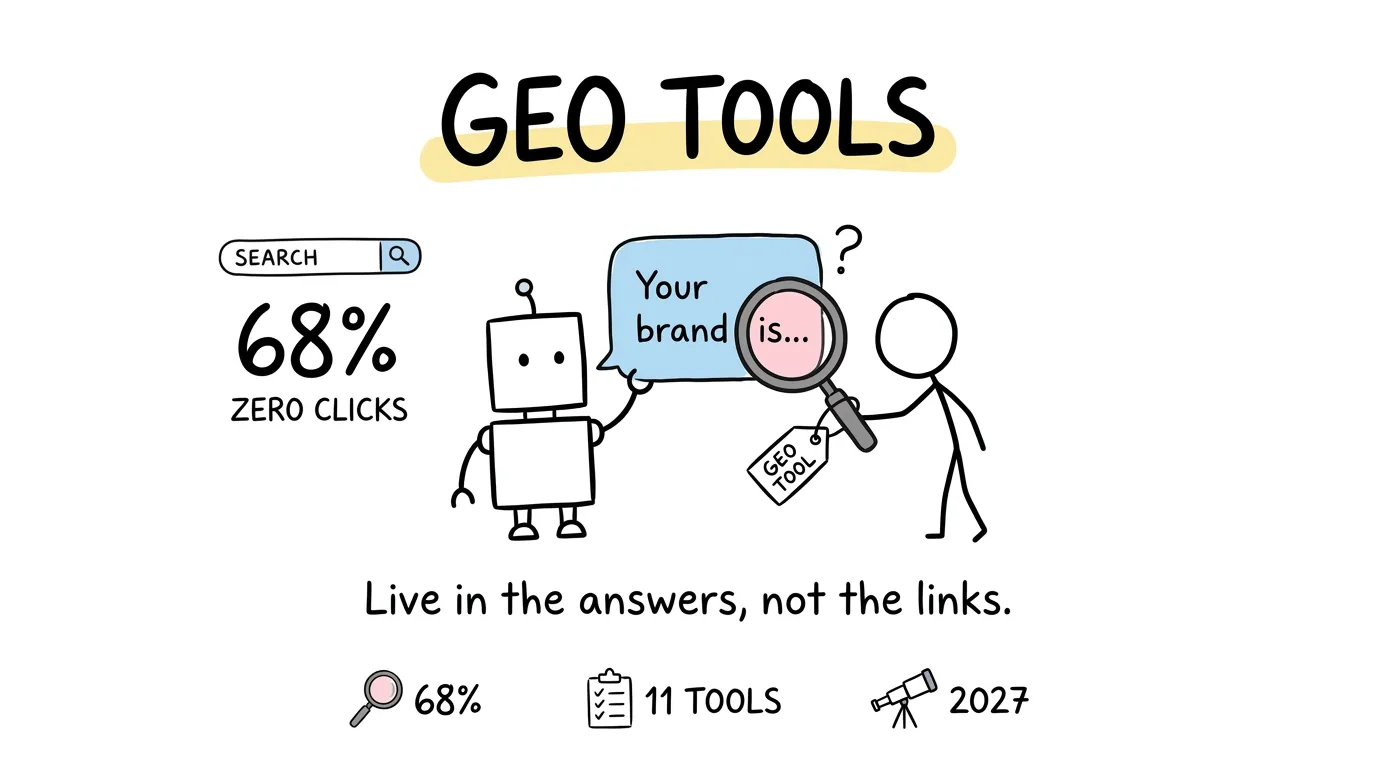
SparkToro ran a zero-click search study: in the first four months of 2026, 68% of Google searches ended with zero clicks. In 2024, that figure was still around 60%. Out of ten searches, nearly seven end with the user reading the AI's answer and walking away — not a single link clicked.
If your brand shows up in the answers from Google AI Overviews, ChatGPT, Gemini, or Perplexity, you exist. If it doesn't, you're effectively invisible in the user's world.
Here's an analogy. SEO used to be like opening your storefront on the street with the most foot traffic. Now AI is the adviser who walks customers down that street — the one whose word the customer takes on faith. Whether the adviser's mouth ever carries your shop's name, and how it's described, is the new make-or-break line.
The craft that governs this line is called GEO.
What is GEO?
GEO, Generative Engine Optimization — in plain terms, it means making AI willing to mention you, cite you, and treat you as a credible source when it answers user questions.
So what's its relationship with SEO? Do you need to learn a whole new playbook?
Interestingly, Google's own developer documentation doesn't quite agree that "GEO is a new discipline." The docs are blunt: optimizing for generative AI search is optimizing the search experience — at its core it's still SEO, no new schema markup needed, no new file format to invent.
My judgment: GEO isn't reinventing the wheel. It's the part of SEO that puts extra weight on "being cited and being described correctly." Rankings only care about what position you hold; GEO cares about what happens when AI talks about your brand — whether it mentions you, whether it gets the story right, and where it puts you.
While we're at it, let's untangle a few terms that are easy to confuse, because they run on different mechanisms.
SEO relies on keywords to win rankings on traditional search pages. AI SEO uses tools to automate the traditional-search content grind, and some also glance at AI search visibility. AEO (Answer Engine Optimization) targets zero-click answers, like voice assistants and Google's quick-answer boxes. GEO governs the narrative inside AI answers themselves — whether your brand is in there at all, and whether it's being described as a credible source.
Four terms, each one digging a layer deeper into the AI answer. Today it's GEO — and the tools.
How I picked
There are at least a dozen GEO tools with name recognition on the market. Going through all of them in detail would take all day, so I set myself five rules and scored by weight.
First, platform coverage, worth 30%. ChatGPT, Gemini, Perplexity, AI Mode, AI Overviews — plenty of tools claim support; check what they actually track.
Second, data quality, worth 25%. Does it capture real AI responses or simulated ones? Can you see which sources and domains the AI actually cites?
Third, can it take action, worth 20%. Tools that only report numbers lose points. Tools that tell you what's broken and how to fix it gain them.
Fourth, workflow fit, worth 15%. Can it slot into your existing SEO and content workflows, or does it force you to maintain an entirely separate process?
Fifth, price and scalability, worth 10%. I deliberately weighted this lowest. A visibility tool with hard data at an awkward price is still worth using; a tool with soft data isn't worth taking even for free.
Hard data is worth paying a little more for; soft data isn't worth taking even for free.
Now for the tools. Three get the detailed treatment first; the remaining eight get a quick pass.
The first three
SE Visible: The clearest view of them all
SE Visible is a product from SE Ranking. SE Ranking has built rank tracking for many years and built its name on data accuracy, and it carried that obsession with data quality straight into SE Visible.
Its defining trait: it captures real AI responses, not simulated ones. Whatever the user sees in ChatGPT, Perplexity, Gemini, AI Mode, or AI Overviews is what it shows you.
What exactly can you see? A visibility score that tells you how often your brand appears and which layer of the answer it lands in. Competitor benchmarking: who else is competing for the same answer, and how their share of voice and sentiment stack up against yours. Source insights: which websites the AI actually leans on when answering questions about you. Sentiment analysis: whether the AI is talking you up or talking you down, at a glance. Plus prompt and topic insights: which questions are driving AI to mention you, seen clearly.
Pricing: the Base plan is $99 a month for 200 prompts and 3 projects; Core is $189 for 450 prompts and 5 projects; Plus is $355 for 1,000 prompts and 10 projects. Larger needs go through sales. A 10-day free trial, no card required.
The shortcomings, stated plainly: data export currently supports CSV only, and it doesn't do optimization itself — you pair it with SE Ranking. Fortunately, SE Ranking covers keyword research, site audits, and content creation in one suite, and the two together make a tidy closed loop: SE Visible tells you where you stand, SE Ranking moves you to where you want to be.
Who's it for? CMOs, agencies that want to build GEO into a new line of business, and teams that want clear insight without fussing with technology.
Peec AI: Simple, but just the right kind of simple
Peec AI is the kind of tool that doesn't dazzle at first glance but feels right once you're using it. One G2 user put it plainly: it's fast to pick up, insights arrive immediately, and you finally have data showing how your brand gets mentioned across the major models.
Its best quality: daily tracking that actually updates every day. Any tremor in AI visibility, and you know quickly. You can choose which models to track, see which sources competitors rely on for their exposure, and get actionable recommendations. Every plan except Starter includes API access and a native MCP server (a protocol that lets AI assistants pull data directly), so you can query AI search data straight from your own AI assistant — a genuinely forward-looking touch. The enterprise plan has SSO.
Pricing: from $95 a month; Pro $245; Advanced $495; 5% off with annual billing. A 7-day trial.
Shortcomings: it won't tell you the deeper logic of why a given source gets picked by an AI, and it can't measure how much traffic the large models actually send you.
Who's it for? Marketing teams with people in-house who can act on the data. The data's handed to you; the work is yours to do.
Otterly AI: The starter option for small teams
If the budget is tight and you want to test the waters first, look at Otterly.
The entry plan is just $29 a month with 15 search prompts, and out of the box it covers four engines: ChatGPT, Google AI Overviews, Perplexity, and Microsoft Copilot. What's rarest: every plan has no cap on team size, the entry plan included. API and MCP access open up at the Standard tier ($189 a month, 100 prompts) — no need to wait for the most expensive tier. Premium is $489 a month for 400 prompts; above 1,000 prompts, talk to the enterprise plan. It also tracks paid ad slots inside ChatGPT — you can see when ads appear alongside organic AI answers.
Two points to note: Claude, Google AI Mode, and Gemini are paid add-ons, not included in the base plans; and the entry plan's 15-prompt quota barely covers a brand's core questions — tracking more means moving up a tier.
Who's it for? Solo marketers and small teams. Spend a little money first to get AI visibility tracking running; don't jump to enterprise pricing right away.
The remaining eight, in quick passes
Rankscale AI leads with brand reputation monitoring. It turns AI responses into reportable data — how different models cite you and which websites the citations come from, with snapshots kept as evidence — plus a website AI-readiness audit. Pricing is the lowest on this list: Essential $20 a month, Pro $99, Growth $385, Enterprise $780, 15% off annual. G2 users grumble that the UI takes some getting used to at first, but concede the team keeps improving it; value for money currently sits in the top tier. One caution: visibility scores fluctuate as AI models update. Don't panic when you see a score jump — that's a common trait of every tool of this kind.
GetCito sells open-source transparency — the code is right there, no black box. Local and regional GEO tracking is done well, and you can see which AI crawlers visited your site and which pages they crawled; it can even identify fake crawlers. Growth is $599 a month, Scale $999, 20% off annual, plus a free self-hosted option. Users report a clean interface and quick setup. Shortcomings: no API, no multi-user collaboration features, and few integrations with other tools. Suited to B2B companies and agencies that care about transparency.
Writesonic folds traditional SEO and GEO into one platform. Its Action Center finds citation gaps and tells you how to fill them so you can outrank competitors in the answers; AI crawler analysis catches crawler visits that ordinary tools miss. Starting at $99, then $249, then $499. Note: sentiment analysis only arrives with the $499 Growth tier; it's web-only; and the content it generates still needs human editing and fact-checking.
AthenaHQ suits teams that want the impact of AI search attributed directly to website performance — e-commerce especially; it has a Shopify integration, can publish GEO-friendly content, and calculates conversions brought by AI search. A unified GEO score, prompt-volume tracking, and a Pitch Workspace for agencies doing client reports are all there. Self-Serve is $295 a month, 17% off annual. Support has a good reputation; one enterprise user said they respond fast and proactively help with strategic guidance, like an unofficial member of their own team. Shortcomings: some users report that prompt-volume data is inaccurate; version upgrades ship so often you have to keep relearning the product.
Goodie AI is aimed at global brands: multiple countries, multiple languages, and visibility can be broken out and compared by region. Content Studio drafts content directly for AI engines, and there's an Agentic Commerce suite that watches how products get exposure in shopping results. The price isn't cheap: Core is $478.80 a month, Pro $1,198.80, two months free with annual billing. Shortcomings: no backlink crawler, no site audits, and content recommendations also need a human to land them. Suited to growth teams and PR doing global markets.
Profound AI is built for the enterprise. SOC 2 Type II security compliance, integrations with AWS and Cloudflare, real-time AI search volume data. Context Manager governs brand narrative, and the Agents feature generates optimization content based on real visibility data. There's a free plan: 7 days, 50 prompts a day, covering ChatGPT, Gemini, and Google AI Overviews; formal use means talking to sales about custom enterprise pricing. Shortcomings: the advanced features are essentially locked behind the enterprise tier; the interface is data-heavy and needs an analyst to read it.
Scrunch AI is one of the few on this list with technical diagnostics: it doesn't just track visibility, it also audits whether your website's structure and content are friendly to AI crawlers, and can even generate machine-readable versions of pages (it calls this AXP), making it easier for AI agents to crawl. Its coverage is among the widest of the whole list too: ChatGPT, Claude, Gemini, Perplexity, AI Mode, AI Overviews, Copilot, Grok, Meta AI. Core is $250 a month (125 prompts, 5 site audits, 4 LLMs supported, 5 seats), Agency Core is $500 (250 custom prompts, 3 brand workspaces, unlimited seats), the enterprise version supports 9 LLMs, with a 7-day trial. To note: diagnostics and tracking are sold as a package — teams that only need one side will feel they paid extra.
HubSpot AEO is the product HubSpot built after acquiring XFunnel, made for marketing teams already in the HubSpot system. The benefit is that AI visibility data hangs directly on your existing CRM and marketing data; its recommendations are prioritized by "which change moves visibility most," not an even-weighted list. $50 a month ($45 with annual billing) for 25 prompts, with overages bought by volume; the free trial doesn't require a card, and the quota matches the paid version. Shortcomings: it covers only ChatGPT, Gemini, and Perplexity; outside the HubSpot ecosystem, its value drops sharply.
The one-line shortlist: large enterprises, look at Profound. Want clear data and are willing to pair with SE Ranking for a closed loop — SE Visible. Growth teams — Goodie. Want simple and worry-free — Peec AI. Small teams still figuring it out: start with Otterly at $29 and test the waters.
Looking toward 2027, watch three signals
You can't call trends on gut feel. Look at where AI's answers come from, and you'll know where GEO tools are headed.
The first signal: AI traffic is still small, but growing at a furious clip. SE Ranking's June 2026 AI traffic study: in 2026, AI platforms sent 0.32% of traffic to websites; in 2024 it was only 0.02%. A sixteen-fold jump in two years. Granted, organic search still brings 134 times as many visitors. What's interesting is quality: visitors brought by AI spend 68% more time on site than organic-search visitors. So you'll see an odd mismatch — AI traffic's share is still under 1%, but every AI visibility report has it. The reason is simple: these visitors are high quality.
The second signal: AI's answers depend heavily on organic rankings. SE Ranking's August 2026 study of AI Overviews in France: of the pages cited, 60.46% came from the organic top 10. ChatGPT likewise shows favoritism toward established sites — websites whose homepage organic visitors exceed 7,900 have roughly double the probability of being cited. This pretty much kills the notion that "SEO and GEO are two separate crafts." For most brands, organic ranking is the ticket into AI answers.
The third signal: social platforms have entered the AI citation pool. Still that French study: of the top ten most-cited domains, half are social and video platforms, with YouTube alone accounting for 14.33%. For ChatGPT, domains with brand mentions on Reddit and Quora reaching the million level have a citation probability roughly 4 times that of small sites. And those tables are still connected: after Google's core update in May 2026, Reddit claimed 10.24% of the top-three positions in organic search. Doing Reddit well feeds both organic rankings and AI visibility.
Following these three signals, here are three of my calls for 2027. These are predictions; the market changes fast, and one or two may miss.
One: source analysis will matter more than mention counts. Just counting "how many times you were mentioned" is meaningless; what matters is which sources the AI assembles its story about you from.
Two: GEO reports will merge with SEO reports and social reports. Since AI's answers come from organic rankings and social platforms, looking at AI visibility alone shows you a third of the picture.
Three: AI share of voice will become a standard KPI, reported right next to rankings. It's the most direct measure of "whether your brand is in the answer at all."
Your brand: living in the links, or living in the answers
Back to the tea-drinking friend from the beginning. My advice: don't overturn your SEO budget yet — split it into three parts. The big share keeps funding organic rankings; that's the ticket into AI citations. One share goes to social content — Reddit, YouTube — that's the AI citation pool. The last share: pick a GEO tool and keep three things under watch — visibility, citation sources, and sentiment.
As I said earlier: organic ranking is your ticket into AI answers, social platforms are your road into the AI citation pool, and the GEO tool is the pair of eyes that lets you see how you're playing at the table.
There's a question that gets asked often, so let me field it here: AI answers often don't give links — do linkless mentions count? They count. Better GEO tools can recognize "linkless citations" — your company gets mentioned, and even without a URL attached, it still counts as visible. Also, GEO isn't just about watching ChatGPT alone; mainstream tools cover at least Gemini, Perplexity, and Claude, so when choosing, make platform coverage the first weight you check.
Write down the three metrics that matter most: AI share of voice, citation frequency, and sentiment. Clicks will disappear; these three won't.
From here on, your brand has two ways to live: living in the links, or living in the answers. The links are shrinking; the answers are multiplying.
If you can't decide just yet, start with SE Visible's 10-day trial — no card required — and see what your brand looks like in AI's eyes right now. Being seen is the first step of every kind of optimization.
Here's to always living in the answers.
Continue reading
Related articles

It's 2026: Stop "Buying" AI Tools for Your Marketing Team — Start "Hiring" AI Agents
This learn article explains how AI agents differ from standalone AI tools in marketing, outlines three agent categories — build-your-own platforms, CRM-native agents, and vertical tools — and covers use cases across SEO, social media, advertising, and reporting, plus criteria for choosing one.

What Is GEO? How Your Brand Gets "Mentioned" in the Age of AI Search
An explainer on GEO (Generative Engine Optimization) for e-commerce and DTC brands: how it differs from SEO and AEO, why AI answers shape brand visibility, and eight practices covering question-focused content, consistent brand messaging, structured pages, external evidence, comparisons, and AI mention tracking.

AI Is Already Making Decisions for Your Customers. Are You on the List?
A learn article explains GEO (Generative Engine Optimization): why AI-generated answers now shape which brands customers see, and how SEO fundamentals, entity clarity, citable evidence, and monthly measurement affect visibility in AI answers.