
Your Painstakingly Optimized Website Might Not Get a Single Glance from AI Search
A learn article reviews a 2025 study comparing how Google and AI engines like ChatGPT, Perplexity, Gemini, and Claude cite sources across shopping and local queries, highlighting their strong reliance on third-party authorities and introducing GEO as a complement to SEO.
A few days ago, I wanted to buy a pair of noise-canceling headphones, so I casually asked an AI: recommend me the ten best noise-canceling headphones.
It handed me a list. Every pick came with a reason, and the sources were attached too.
Then I opened Google and searched the same keywords, and got ten blue links.
I put the two side by side, and my heart sank: barely any of them overlapped.
Same question, two systems, looking at essentially two different worlds.
Was that a fluke, or the new normal?
Last summer, a study set out to answer exactly this question. The researchers put the web-connected AIs — ChatGPT, Perplexity, Gemini, Claude — side by side with Google, fed them all the same few thousand questions, and then counted, one by one: which sites A cited, which B cited, where they overlapped, where they split.
The conclusion surprised me.
If you work in branding, content, or SEO, I recommend you read this piece to the end. Because the playbook you have relied on most may be quietly failing when it comes to AI search.
First, Some Background
Users, it turns out, are packing up and moving.
In traditional web search, Google still holds around ninety percent of the market. But the numbers on the other side deserve a closer look.
A 2025 Pew Research Center study found that once an AI summary appears on a Google results page, the share of users who click a link drops from 15% to 8%. More than halved. And about a quarter of those searches end with zero clicks at all — the user takes the answer and walks away.
Meanwhile, AI is taking over the act of asking itself. By mid-2025, one in three American adults had used ChatGPT, nearly double the figure from two years earlier. Perplexity disclosed in May 2025 that it processes 780 million queries a month.
More and more people are bypassing the search box and asking AI directly.
So here's the question: when users hand their purchasing decisions to AI, whose website is behind every choice AI makes on their behalf?
For brands, this is the new shelf.
What Are Users Asking AI?
The study mapped this territory first. From several Reddit communities dedicated to discussing AI usage, the researchers scraped thousands of real questions and sorted them into twelve broad categories: writing code, refining prompts, creative work, business plans, learning new things, casual companionship, and so on.
One category stood out: shopping.
The study pulled shopping questions out for a closer look and identified fourteen distinct patterns. Some people ask AI to recommend products based on their budget and use case. Some have AI pull prices across platforms and run comparisons. Some outsource the entire haggling process to AI — one person walked into a dealership armed with AI-run numbers and talked the price down. Some even asked whether ChatGPT could place an order for them directly.
Think about what this means.
What users ask of AI has shifted from "what is this?" to "which one should I buy, why, how much, and where?"
AI isn't doing search. It's making decisions.
And decisions are the real battlefield for brands.
AI's Eyes Live on Other People's Sites
Next comes the most consequential finding of the whole study.
First, a quick taxonomy of sources. The researchers divided web pages into three types: brand-owned — manufacturer sites and retailers' own pages; social — Reddit, Quora, YouTube, the places built on user-generated content; and third-party authority — review organizations, independent media, and professional sites like Consumer Reports and NerdWallet.
Then they had Google and the AIs answer the same questions and counted how often each cited these three types of sources.
Google's answers were fairly balanced — all three types showed up, and in some categories manufacturer sites even took the largest share. In the software category, for example, more than half of Google's results in Canada came from manufacturer websites.
And AI search?
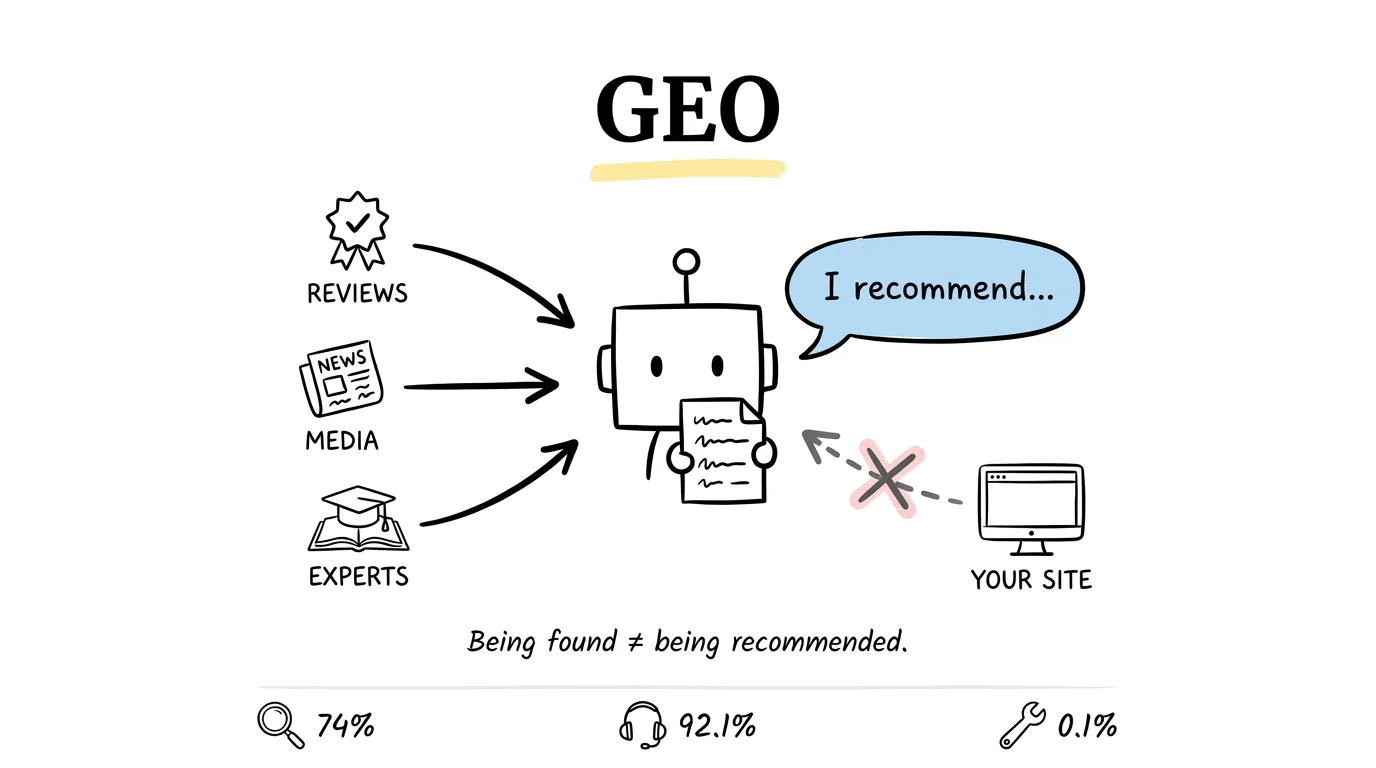
Same category, same country: in AI's citations, third-party authorities took 74%, official sites under 26%, and social — zero.
The automotive category was more extreme. In the US, 81.9% of AI's citations came from third-party authorities. Consumer electronics: 92.1%.
Almost every category, every region, showed the same shape: AI leans wildly toward third-party authorities, social content gets squeezed to nearly nothing, while Google happily serves all three.
Why? Put yourself in AI's position and it becomes obvious. Google is a shelf: it hands you ten links and you choose; if you choose wrong, that's on you. AI is an advisor: the list it gives will be taken on faith, and it cannot afford to be wrong. So it only dares to cite sources that are widely recognized, independent, and professional.
In AI's eyes, your praising yourself is worth nothing; a third party praising you is what counts.
That one sentence basically flattened a decade-plus of the "make your own website bigger and prettier" content strategy.
Local Businesses: Two Worlds, Even Further Apart
If consumer brands diverge this much, local services diverge harder.
The study had Google and AI answer questions like "where's the best house cleaner, mechanic, or dentist near me," and measured how much the two lists of businesses overlapped.
The result was brutal.
House cleaning: 20.6% overlap. Roof repair: 17.1%. Tax preparation: 15.4%. Dentists: 11.9%.
Auto repair: 2.5%. On-site IT services: 0.1%.
Think about what 0.1% means. Out of a thousand times AI recommends a repair shop, only one matches Google's list. The local SEO you paid dearly for, on AI's side, essentially doesn't exist.
Four Engines, Four Personalities
Worse still, the AIs aren't on one team themselves, either.
The study put the mainstream engines side by side and found they behave like four people with utterly different personalities.
Claude and ChatGPT are two especially exacting experts. For well-known brands, 93.5% of ChatGPT's citations came from third-party authorities, and it never touched a social source. Ask about niche brands and the ratio rose to 95.1% — it couldn't even be bothered with official sites. They almost exclusively trust textbook-grade sources like Wikipedia, the Associated Press, TechRadar, and Tom's Guide.
Perplexity is the omnivore willing to look at everything. Social content can make up nearly a quarter of its citations; YouTube and retailer pages are both on its menu. It looks less "clean" than the first two, but it sees a much bigger world.
Gemini is the one most generous to brands. Official sites can account for about a quarter of its citations.
And what about the brand lists themselves? The researchers ran a fascinating experiment. Taking the cola category, they asked fifty questions stripped of any brand bias: What's the most popular cola? Which sodas sell best worldwide? Then they counted how many big brands versus niche brands appeared in the answers.
In ChatGPT's answers, big names like Coca-Cola and Pepsi took 56.3%, niche brands just 12.3%. Perplexity was harsher: 67.9% big, 5.8% niche.
Nothing guided it toward recommending Coca-Cola. Yet there Coca-Cola was, all the same.
That's big-brand bias. AI has no agenda, but the third-party sources it trusts already mention big brands most often. More mentions breed more trust; more trust breeds more recommendations. A self-reinforcing loop.
Oh, and the four engines don't copy each other's homework either. On well-known brands, their answers agree 76% to 81% of the time; on niche brands, agreement falls to 71% to 76%. With big brands, there is consensus; with niche ones, everyone tells their own story.
Switch the Language, and the Ecosystem Gets New Blood
If you do global business, there is one more thing to know: the authority you have accumulated in one language may be worth nothing in another.
The researchers asked the same batch of questions in Chinese, Japanese, German, French, Spanish, and English, and watched whether each engine's cited websites changed.
Claude is the creature of habit of the four. Even when it switches languages, it reuses the same batch of English-language authority sites in large numbers. The cost: even when you ask it in Chinese, most of what it cites is English content.
GPT is the most radical of all — it swaps out its entire ecosystem. Ask in Chinese, it gives you the Chinese-language web; ask in Japanese, the Japanese-language web. Cross-language overlap is nearly zero. The trust you built in the English-speaking world gets wiped clean the moment you switch languages.
Perplexity and Gemini sit between the two, and they localize heavily too.
Google has an exception of its own: when users ask in Chinese, English-language websites actually take more than seventy percent of its citations.
So there is no one-size-fits-all playbook for multilingual markets. To win over GPT and Perplexity, you have to earn the recognition of local authority media, language by language. Merely translating your own content over? Useless.
One More Problem: AI's Knowledge Is a Bit Stale
On freshness, the study dug up one more layer of data.
In consumer electronics, the content AI cites averages 117 days old, with a median of 62 days. Not bad.
In the automotive category, the picture changes abruptly: what Claude cites averages 331 days old — reviews from nearly a year ago. For almost 40% of the links, no publish date could be detected at all.
In other words, when AI answers "what's the best electric car," it may be citing last year's rankings.
Two reminders for brands here. First, old content doesn't die — an in-depth review from two years ago may still be cited over and over. Second, whoever manages to get fresh content into that pool gains the edge.
So What Should You Do?
The second half of the study translates these findings into a playbook. One word keeps coming up in it: GEO.
What is GEO? Generative Engine Optimization.
It's one letter away from SEO. SEO is about ranking high in Google's list of links. GEO is about getting onto AI's reasoned list of recommendations.
One governs "being found." The other governs "being recommended."
How do you actually do it? Here are the most hard-hitting ones.
1. Treat your website as an interface, not a facade.
If AI is going to make decisions on a user's behalf, it has to be able to read you: prices, specs, inventory, warranties, ratings — all of it must be structured data a machine can grasp at a glance. The industry calls this Schema.org markup; plainly put, you attach labels to your site's content so AI doesn't have to guess. Your content also needs to supply the "why choose you" reasons: comparison tables, pros and cons, a value proposition you can state in one sentence. A beautiful website is useless; a "readable" one is what pays.
2. Treat PR as your main business, not a side job.
Since AI only trusts third parties, the center of gravity of your investment has to move: from "producing your own content" to "getting the authoritative places to talk about you." Reviews, industry coverage, expert endorsements, citations from high-authority sites — in AI's eyes, these are your credit score.
3. Abandon the one-playbook-for-everything approach.
Claude is set in its ways and grinds away at only those few top authority sites; Perplexity is an omnivore, and YouTube reviews and retailer pages all offer openings; Gemini gives official sites their due, so deep content on your own site still works there. You have to learn each engine's temperament and place your bets separately.
4. Be present the whole way through.
One detail from the study: when users ask after-sales questions like "how do I fix this product," and you have no content on the subject, AI pivots and recommends the brand that does. From first interest and price comparison to purchase, after-sales, and resale — every step is an opportunity, one more chance for AI to put your name — or your competitor's — in front of the user.
Do Small Brands Still Have a Way Out?
Honestly? It's hard. In open questions stripped of brand bias, big brands naturally own the leaderboard.
But there are seams.
If you can't beat the big brands on "share of conversation," then go narrow. In a niche narrow enough, produce the deepest expert content, win reviews from vertical media, and hold your small hilltop. When the question is specific enough, the options are few, and the big brands' steamroller effect weakens.
Another opening: omnivorous engines like Perplexity are more tolerant of YouTube and community content. Building genuine word of mouth through grassroots channels is a relatively cheap place to start.
Finally
One caveat from the researchers themselves: the data was collected in August 2025, and the engines' algorithms keep changing. Those percentages are slices in time, not laws. The direction is more reliable than the numbers.
Back to those headphones.
I stopped dwelling on that list. What I kept thinking about was something else: the brands on it probably have no idea how they got chosen. They never spent a cent on AI advertising. They were simply talked about, tested, and cited by enough third parties.
In the search era, the competition was about being found. In the AI era, it's about being recommended.
Being found runs on keywords. Being recommended runs on other people's trust in you.
Most people are still studying how to use AI to write articles. A few have already started studying how to get AI to talk about them. By the time everyone else catches on, that pool of trust will long since have been filled — and claimed.
Here's to you becoming the one AI keeps mentioning.
Continue reading
Related articles

It's 2026: Stop "Buying" AI Tools for Your Marketing Team — Start "Hiring" AI Agents
This learn article explains how AI agents differ from standalone AI tools in marketing, outlines three agent categories — build-your-own platforms, CRM-native agents, and vertical tools — and covers use cases across SEO, social media, advertising, and reporting, plus criteria for choosing one.

What Is GEO? How Your Brand Gets "Mentioned" in the Age of AI Search
An explainer on GEO (Generative Engine Optimization) for e-commerce and DTC brands: how it differs from SEO and AEO, why AI answers shape brand visibility, and eight practices covering question-focused content, consistent brand messaging, structured pages, external evidence, comparisons, and AI mention tracking.

AI Is Already Making Decisions for Your Customers. Are You on the List?
A learn article explains GEO (Generative Engine Optimization): why AI-generated answers now shape which brands customers see, and how SEO fundamentals, entity clarity, citable evidence, and monthly measurement affect visibility in AI answers.