
AI Marketing Daily · 2026-10-18
Today's throughline is tool selection.
Today's throughline is tool selection. HubSpot ranks 11 B2B AI tools on first-party survey data, an AI-agent lead-generation guide puts hard numbers on deployment costs and failure rates, and platform roundups have started touting governance as a selling point. Meanwhile, European regulators have set their sights on email tracking pixels — the 3-month transition clock is already ticking. Tools, budgets, compliance: three threads, one daily read.
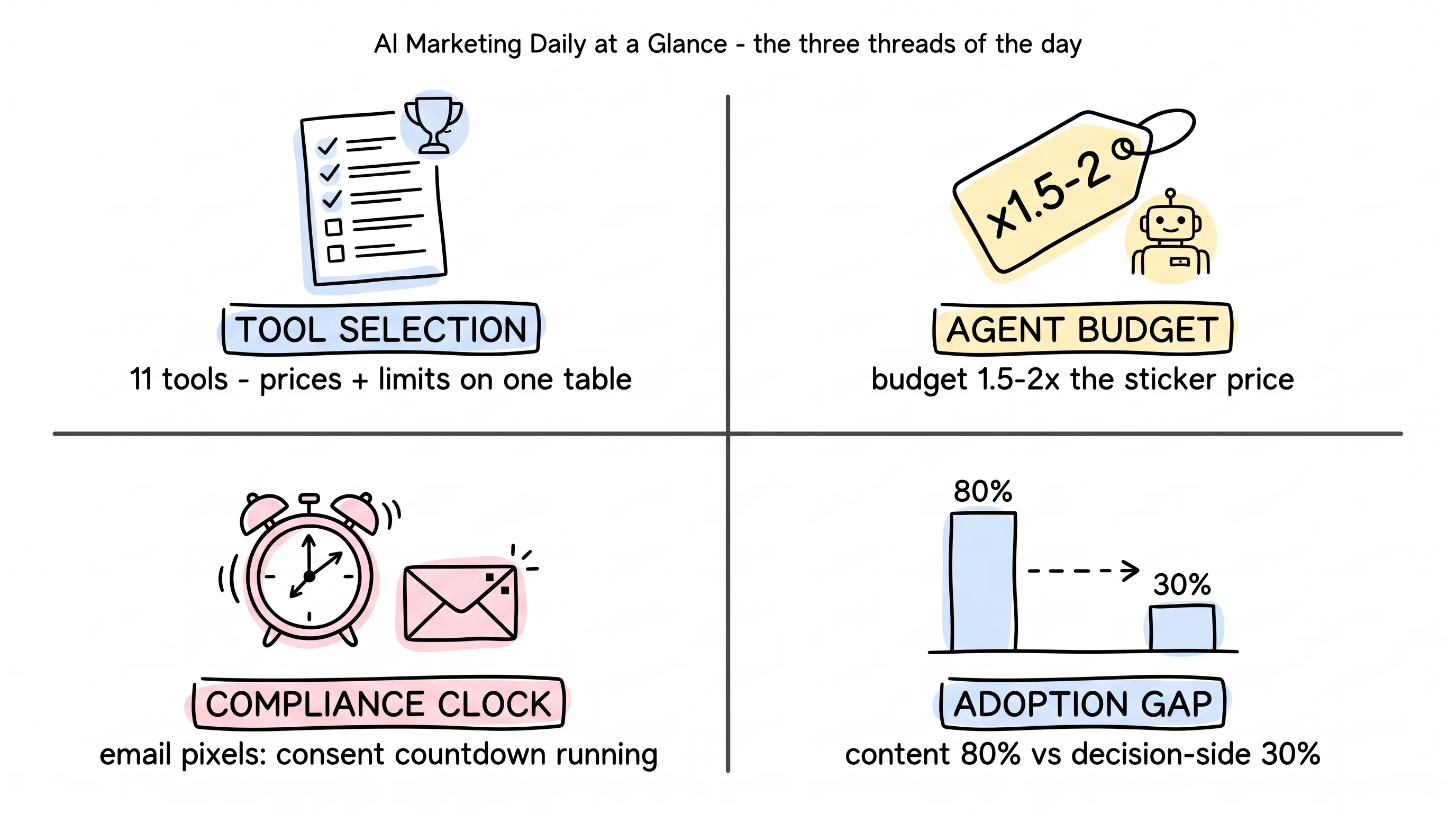
🎯 Today's Headline
HubSpot's 2026 B2B AI Tool Rankings, Dissected: First-Party Survey Data, With Prices and Limitations for All 11 Tools on the Table
HubSpot refreshed its annual B2B AI tools guide on its official blog in mid-September. Author Lipsa Das uses the company's own 2026 State of Marketing survey as the skeleton, carving B2B AI adoption into three buckets: content automation, lead generation, and data analysis. The adoption numbers are refreshingly specific: 42% of marketers use AI heavily for content creation, with another 38% using it occasionally. In lead scoring and audience segmentation, 27.2% are heavy users and 40.55% occasional ones; data analysis has 32.96% heavy use, and market research and competitive analysis 33.24%. The list covers 11 tools, each with its use case, limitations, and starting price: ChatGPT Plus at $20/month, LinkedIn Sales Navigator at $29.99/month, Microsoft Clarity free outright, and WriterZen a one-time $75 buyout. Notice, too, how the tools cluster: the meeting-notes lane is crowded with Loom, Fireflies, and Sembly; project management has ClickUp and Motion; collaboration goes to Slack, and telephony to CloudTalk. The author pairs each tool with a hands-on scenario — using WriterZen to generate topic briefs, having ChatGPT produce a blog outline complete with FAQ and CTA, then handing the draft to a writer for fact-checking.
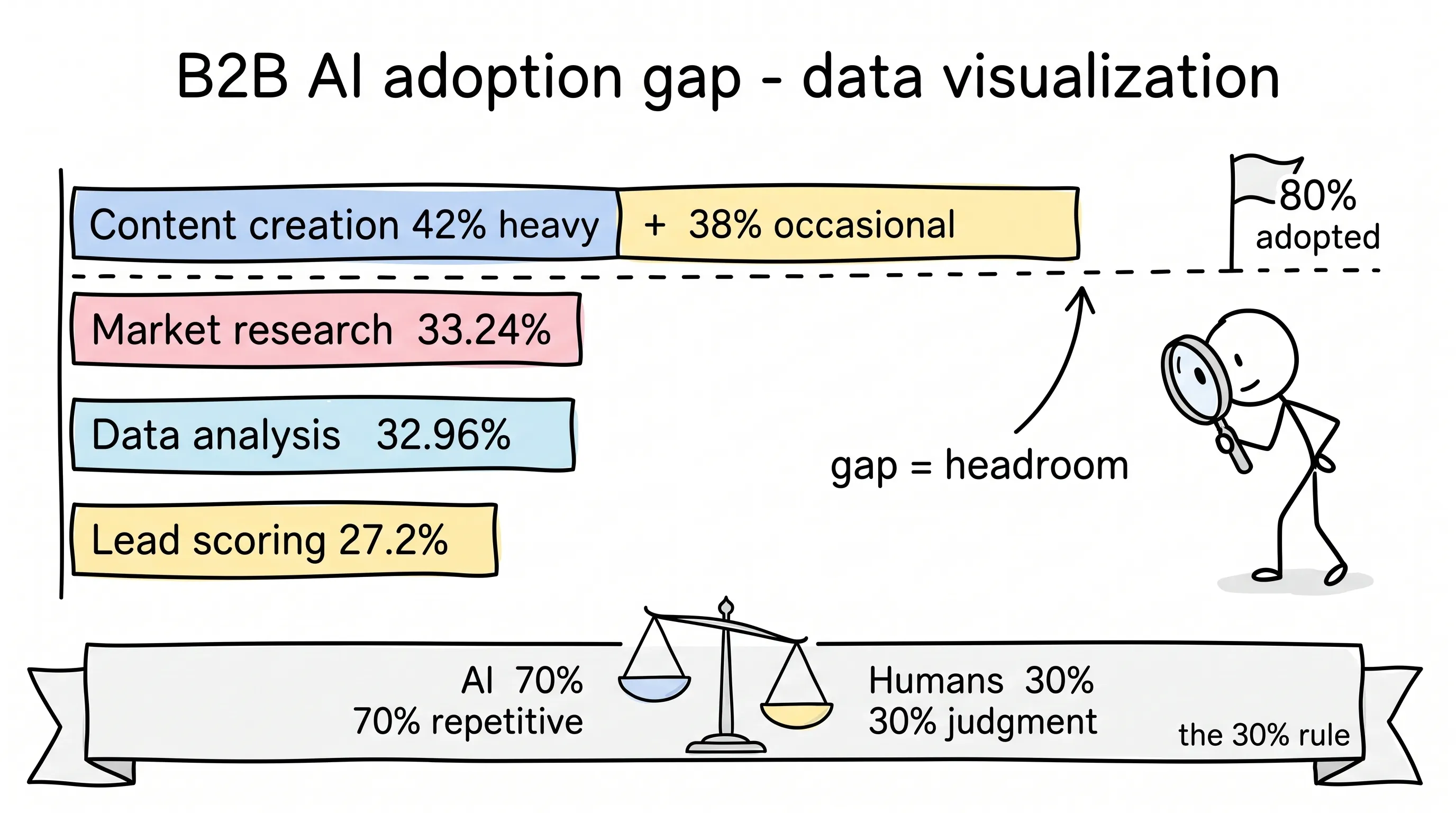
What gives this guide its weight is the complete trio: survey data, pricing, and limitations laid out in the same table. Most rankings tout features and skip the flaws; this one lists a pitfall for every tool — WriterZen's keyword research trails Semrush and Ahrefs, ClickUp has a steep learning curve, Sembly's AI meeting notes occasionally miss or garble. Keep one caveat in mind, though: HubSpot's own products thread through the entire piece and take the only perfect score, so read the vendor's stance with a grain of salt. What's truly worth remembering is the structural signal in the survey: content automation has the highest penetration, while heavy use of lead scoring and data analysis still hovers around 30% — a wide adoption gap in between, and that gap is the headroom.
The direct implication for marketers is that the division of labor is now clear. On the content side, the "should we use AI" debate is over — eight in ten marketers already do, and the only question left is heavy versus occasional use; what's being tested now is editorial judgment and a nose for topic selection. Lead generation and data analysis are still climbing, heavy users remain the minority, so early movers are banking a data advantage — and entering a year late means a year of accumulation lost. Two hands-on reminders from the piece belong in your team handbook. First, train AI agents on the freshest CRM data you have; stale data makes outreach mention pain points customers have already moved past, essentially paying to generate resentment. Second, let AI process the raw data before you draw conclusions; sorting large datasets by hand is error-prone. The piece closes with a 30% rule: AI takes over 70% of the repetitive work, and humans keep the 30% for judgment and creativity. That ratio matches most teams' gut feel and can serve directly as a baseline for dividing the work. The CloudTalk customer numbers in the article also speak for the outbound-calling lane: Trevo reached 20x more customers per campaign, Kourse doubled its connect rate and tripled meetings booked, and Autenti cut calls reaching human agents by 30%. When weighing whether to buy a tool, look for results backed by named companies like these — they're more honest than feature lists.
The on-the-ground moves break down like this. Start by self-assessing your team against the four adoption benchmarks, and give budget priority to whichever workflow lags furthest behind the average. Then pick tools by use case — no need to chase the full list: if meetings generate a lot of notes, bring in Fireflies at $10 per seat per month; add fred@fireflies.ai to your calendar and it joins calls to transcribe automatically. For website behavior analytics, try Microsoft Clarity first — free, with heatmaps and session replays that cover the basics; its weak spots are real-time data and event tracking. Outbound teams should look at CloudTalk's AI receptionist: the Receptionist tier starts at $99/month with 200 minutes included — use the free allowance to take after-hours calls and see how it performs. Finally, re-score your shortlist with the article's scorecard — accuracy, ease of use, completeness of results, efficiency, and special features each weighted at 20% — and only then enter procurement, so no single vendor's live demo steers the decision.
My take: this ranking is content marketing at heart — just down-weight the HubSpot-adjacent entries when selecting. But the survey data is first-party and worth archiving for quarterly comparisons. The gap it exposes is worth more than the ranking itself: content adoption is saturated while decision-side usage lags, so next year's B2B efficiency dividend hides in catching up on lead scoring and data analysis — tilt tool budgets toward those two. A second judgment concerns procurement cadence: the article's five-dimension scorecard puts ease of use and completeness of results on equal footing with accuracy, which quietly concedes a reality — whether a tool is pleasant to use determines whether anyone keeps using it. Don't let the feature checklist dominate procurement reviews anymore.
🔗 Further reading: Read the full article
🏷 Marketing Tools & Selection
The AI-Agent Lead-Gen Guide: Budget 1.5–2x the Sticker Price for Deployment
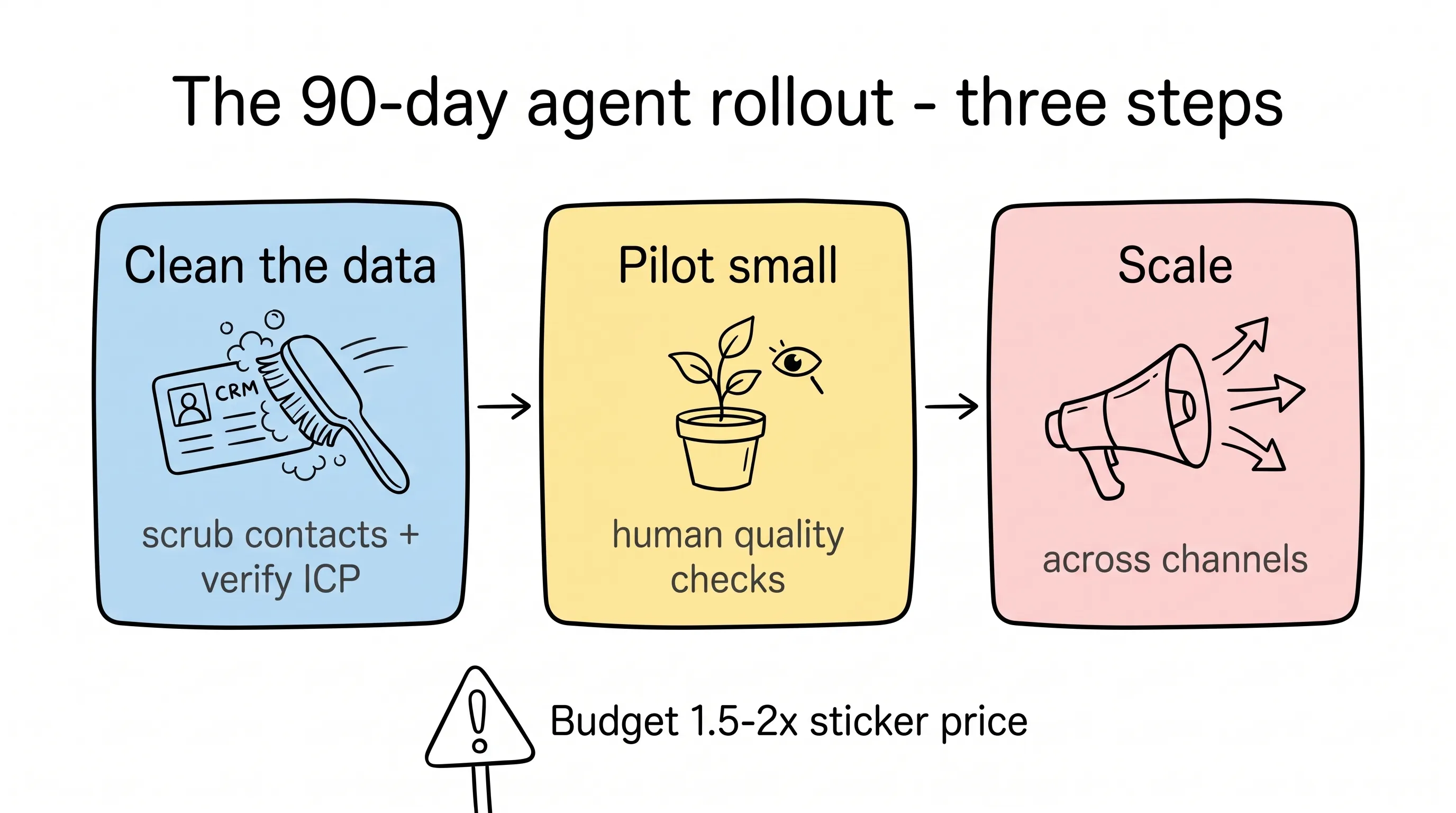
The 2026 lead-generation guide from Span Global Services pours cold water on AI agents. Gartner predicts that by 2028 at least 15% of routine business decisions will be made autonomously by agentic AI — but it also forecasts that more than 40% of badly executed projects will be scrapped by 2027 over unclear ROI. The comparison table is blunt: a full-time human SDR (sales development rep) costs $7,000–$11,000 a month; an AI agent runs $900–$5,000, with deployment in 1–3 weeks. The four high-ROI use cases come with hard numbers: AI compresses prospect research from an SDR's 30 minutes to 30 seconds; responding to inbound leads within 60 seconds lifts conversion by up to 70%; AI lead scoring improves conversion 20–30% over rule-based scoring; and teams doing this well can send 5,000 high-quality personalized emails a month. The costs are spelled out too: AI SDR tools churn at 50–70% annually, so any selection process must demand references from same-industry customers of at least 12 months. The guide pins failure on the data layer: poor B2B data distorts personalization, drags down deliverability, damages sender reputation, and contaminates the CRM behind it. Rollout runs on a 90-day plan: clean the CRM and verify contacts and ICP (ideal customer profile) first, then pilot small with human quality checks, and only then scale across channels. The data layer itself is built in five tiers — verified contact data, firmographic profiles, technographic intelligence, intent signals, and compliance infrastructure — and most teams attempt agents with only one or two of those tiers in place. Pricing comes in three tiers: entry-level at $600–$1,500/month (AiSDR, Salesforge, Apollo, Clay and the like), mid-market at $1,500–$5,000 (Artisan, 11x, Amplemarket, Landbase), and enterprise at $5,000–$50,000 and above (Agentforce, Sierra AI, 1mind) — and year-one total cost should be budgeted at 1.5–2x the subscription price.
💬 Fix the data before you buy the tool — that one discipline will keep you out of next year's pile of abandoned agent projects. What you can do this week: scrub contacts from your CRM that have shown no activity in 18+ months, then talk deployment. Report the budget at double the sticker price so finance doesn't jam you mid-project with a top-up request. And in vendor interviews, open with one question: how often is your data refreshed? A vague answer is your cue to walk.
🔗 Further reading: Read the full article
AI Marketing Agent Platforms, Reviewed: Three Criteria to Separate Real Agents from Rebadged Automation
Deployed Labs reviewed 10 AI marketing agent platforms, first laying down three screening criteria: autonomous cross-channel orchestration, adaptive execution driven by real-time signals, and impact attributable to pipeline and revenue. Salesforce Agentforce bills roughly $2 per conversation, unifies sales, service, and marketing data through Data Cloud, and its Atlas engine supports multi-step reasoning. HubSpot Breeze bundles content, social, and prospecting agents into Marketing Hub Pro ($800/month) and Enterprise ($3,600/month). Adobe AEP's AI Assistant supports querying data in natural language, generating audience segments, and executing workflows, with Marketo Engage starting at $895/month. The piece repeatedly warns enterprise buyers to check governance: autonomous agents without audit trails and human escalation points carry compliance and brand risk. In the lightweight tier, Jasper runs content production at $49–$125 per seat per month, Copy.ai has pivoted to a GTM (go-to-market) workflow platform starting at $36/month, Klaviyo feeds off e-commerce first-party behavioral data for send-time optimization and churn prediction, 6sense triggers autonomous outreach at the account level using intent data, and Metadata.io specializes in B2B paid-media automation with CRM-connected revenue attribution. The article also draws the line between agents and automation: automation fires on rules a human predefined, while an agent takes a goal, breaks it into steps, picks channels, and adjusts its next move based on replies. For enterprise deployment, it recommends starting with one high-volume, clearly rule-bound workflow, and recording baselines before launch — current conversion rate, response time, cost per lead — otherwise ROI is unmeasurable. The publisher lists its own offering first, so apply that discount as you read.
💬 Run your current automation through the three criteria — odds are you'll find it's a rules engine wearing an AI costume. In procurement, write audit trails into a contract annex, and let legal see the product before marketing does. Teams on tight budgets should start with seat-priced Jasper or Copy.ai rather than jumping straight into enterprise custom builds.
🔗 Further reading: Read the full article
The GWI Roundup: Score Your Team's AI Maturity in Three Stages
GWI's overview of AI in digital marketing (published April 2025, back in view this cycle) divides team AI maturity into three stages: small-scale pilots, partial workflow integration, and full embedding into strategy and execution. It offers a four-question selection checklist: build or buy? Can it plug into your existing CRM and CDP (customer data platform)? Is its operation transparent? And can it stay compliant as you scale? On the industry side, the observation is that Meta, Google, and Adobe have already welded AI into their flagship tools — teams can't route around them, and routing around means losing speed and scale together. The risk list flags targeting bias from biased training data, inconsistent industry standards for AI content disclosure, and hallucinations threatening brand safety, against a regulatory backdrop of the EU AI Act and fresh FTC guidance — and audiences can smell lazy AI content too. On skills, the upgrade path runs through data literacy, AI ethics, and prompt writing; strategist, analyst, and media-buyer roles are changing fastest, and internal bootcamps and hands-on workshops are displacing one-off purchased training. One caution: the article plants its own GWI Spark consumer-insight product throughout, so it is not fully independent — but the maturity model and the four questions can be lifted and used on their own.
💬 Take the three-stage model into your quarterly review — ten minutes to locate your team. Most teams are stuck between pilot and partial integration, and what's missing usually isn't tools; it's someone willing to operate on the workflows. Print the four selection questions into your procurement process, and answer the compliance question first — it saves the rework later. Pick one or two people to serve as prompt coaches; it's cheaper and more effective than company-wide external training.
🔗 Further reading: Read the full article
Five Generative-AI Use Cases: AI Visibility Data Sounds the Alarm for SEO Teams
SOCi's generative AI marketing guide sorts 2026 applications into five blocks: content creation, search-everywhere optimization, data-driven customer-experience personalization, customer-support efficiency, and AI agents executing workflows. Citing industry data, it says over 75% of marketers already use AI in their workflows, more than half of them for content alone. The search section introduces a new framing: search is now everywhere — beyond Google there are communities like Reddit and Quora, social platforms like TikTok and Instagram, plus AI engines driven by ChatGPT, Claude, and Gemini, and every channel has its own intent patterns and ranking mechanics. One data point jumps out: SOCi's 2026 Local Visibility Index found that the same set of brands appears in Google's local 3-pack 36% of the time but only 11% of the time in Gemini recommendations, and brand locations get recommended by AI systems a mere 6.5% of the time. AI engines are far pickier about what they recommend than traditional search, and the one-size-fits-all content strategy is already dead across channels. The article adds disclosure data: 76% of consumers believe local businesses should clearly disclose AI use in customer service and advertising. The report keeps its case study: Nestlé and Ogilvy Paris used DALL-E 2 to extend Vermeer's The Milkmaid into a video in the same painterly style. Agents are framed as the next phase: from generating content to executing tasks on the user's behalf — replying to reviews, running analyses, even taking over a stretch of workflow.
💬 SEO teams should add a KPI this week: sample how often the brand gets recommended inside ChatGPT and Gemini, and read it next to your Google rankings. The 11% versus 36% gap says the old playbook fails inside AI engines; content needs to be rebuilt around each channel's intent patterns, with Reddit and Quora first on the schedule. Your external AI-disclosure language needs settling too — consumers already assume you'll say it.
🔗 Further reading: Read the full article
🏷 Acquisition & Paid Media
Nine Ad Platforms Compared: First, Know Whether You're Capturing Demand or Creating It
Softtrix's paid-media lesson sorts nine ad platforms by capability, on a single framework: is your category capturing existing demand, or creating demand from zero? Google Ads is the king of high-intent capture, covering Search, YouTube, Maps, and over 2 million display sites, with PMax (Performance Max) running real-time bid optimization — but it can't manufacture search demand; for categories nobody searches, Google money goes nowhere. Bing handles over 23 billion desktop searches a month, skews toward professional and higher-income users, and exclusively offers LinkedIn job-title targeting that filters people by function and industry, at a lower CPC; its flaw is a visible scale ceiling. Meta predicts demand from social-interaction signals across its 3 billion monthly active users, with Advantage+ as the automation safety net; the piece warns that it rewards attention, not logic — creative fatigue burns through budget, and fixing creative fatigue matters more than tweaking targeting. TikTok does discovery on immersive entertainment signals at 1.6 billion users; most brands get swiped away for looking like ads, and staying visible to the algorithm takes continuous content churn. Pinterest users arrive with planning intent — 70% are women — a fit for home, fashion, and lifestyle brands that want to be present at the moment users decide what their future living room will look like. LinkedIn reaches 98% of Fortune 500 CEOs, with user purchasing power twice that of the average web user and a CPC high enough to make finance wince; it needs a strong downstream conversion funnel to pay for itself. Reddit penetrates trust through 100,000 niche communities — ad-heavy voices get publicly roasted by the community. Amazon and Apple Search Ads sit right at the purchase decision point: for the former, success hinges on reviews, pricing, and listing quality; the latter has 800 million weekly App Store visitors but expensive acquisition and weak retention. X is only good for riding real-time trends — a conversation engine, not a conversion machine.
💬 Budget conversations should open with one question: is this money buying demand capture or demand creation? The answer picks the platform. A B2B stack you can copy outright: Bing for low-cost traffic, LinkedIn for precision reach — together they often beat going all-in on Google. Teams on Meta should put creative-refresh frequency into the weekly report; creative fatigue is the number-one budget killer. Don't trial all nine platforms — first slot your category into one of the four intent classes, then run small-budget comparison tests within that class.
🔗 Further reading: Read the full article
🏷 Customer Experience & Personalization
Field Notes from the Customer-Journey Gap: AI Delivers the Answer, the Website Still Wants a Form
Progress's MartechNEXT roadshow hit St. Louis on October 16. Opening with her own story, speaker Sara Fetts described asking ChatGPT to plan an Athens itinerary — a complete guide in minutes — then getting bounced back into rigid forms and fixed navigation the moment she tried to book tickets and guides: in her words, kicked back to the pre-AI era. Her thesis: marketers are no longer competing only with other marketers, but with the experience AI gives users. The event laid out a progressive path in four layers — no need to tear the site down all at once. Layer one: embed RAG-powered (retrieval-augmented generation) on-site search, grounding answers in trusted company content so replies come with citations. Layer two: conversational assistants deeply bound to enterprise knowledge, a tier above ordinary chatbots. Layer three: generative CMS assembling pages dynamically. Layer four: hyper-personalization. Progress published its own post-RAG-search numbers on stage: visitors who use search average 27 minutes per session, and search queries double as a ready-made demand-insight goldmine, feeding straight back into the product roadmap and go-to-market strategy — no more pulling focus groups to guess what users want. In a window-and-door manufacturer case, a seven-step product-selection form was replaced by a single goal-oriented question: users could say they're designing a large commercial entrance and need energy-efficient double doors that meet ADA standards, and the system instantly returned an answer with document citations — no filters, no hierarchies, no guessing. In another demo, a bank site assembled pages dynamically by visitor intent: homeowners looking for a mortgage saw banners, content blocks, and calculators all configured to their goal. The speaker's framing: marketers set intent, constraints, tone, and guardrails, and the system auto-assembles thousands of page variants from approved content — the rule-writing and audience-mapping work goes back to the machine.
💬 Start with the zero-cost move: export a week of on-site search queries — needs written in users' own words beat any survey. RAG search is the lowest-risk, fastest-paying layer of the four; a small team can ship it in two to three weeks, and the query log doubles as a content-topic backlog. Don't rush to fully generative pages; first make search understand plain language, and any product-selection form over three steps deserves to become a single question.
🔗 Further reading: Read the full article
IBM in Conversation with Adobe: Don't Let Personalization Scare Customers Off (thin coverage)
IBM's podcast released a 40-minute conversation with Emily McReynolds, Adobe's global head of AI strategy, and Pierre Charchaflian, IBM's global lead for its marketing practice, on how generative AI is reshaping marketing automation and personalization. The video description flags the most valuable proposition of the session: how to generate personalized content at scale without spooking consumers — the moment relevance crosses a certain line it becomes the feeling of being watched, and there is no industry-standard answer for where that line sits; every brand has to draw its own. The two tied in the enterprise generative-AI risk-management report published by the IBM Institute for Business Value with Adobe and AWS, whose conclusion is that leading firms release creative value on the back of a solid risk-management framework — fix governance first, scale later. This item's capture covered the video description only; the full transcript could not be parsed, so details may be incomplete — defer to the original video.
💬 Give personalization a boundary test: if you said this to the customer face-to-face, would it feel like you know too much? If the answer embarrasses you, pull it — even when the data clearly supports it. Don't wait for an incident to build the risk-management framework; start by listing which actions require human review, agreed and signed jointly by marketing and legal. Half a day of that work can head off a major incident later.
🔗 Further reading: Read the full article
🏷 Industry Data
The AI Marketing Market: Starting from $32.7 Billion, Nearly 7x in Eight Years
Precedence Research updated its AI marketing market report page in mid-September: the global market stands at $32.73 billion in 2026 and is projected to reach $217.33 billion by 2034, a CAGR (compound annual growth rate) of 26.7% — against $25.83 billion in 2025, a one-year jump of about a quarter. North America is the largest market and Asia-Pacific the fastest-growing, driven by e-commerce expansion and rising AI investment. By technology, machine learning holds the dominant share and computer vision grows fastest; by application, content curation is the largest segment, with social-media advertising growing at a notable clip; among verticals, media and entertainment lead — the report's example is Cadbury's early program letting small merchants generate ads for free with celebrity voices and faces. Surveys cited in the report show 48% of marketing executives believe AI has most transformed how they interact with consumers, and Forrester says 70% of enterprises plan to deploy AI within a year. The US market on its own: $5.97 billion in 2025, projected to reach $51.33 billion by 2034, growing at 26.98%, slightly above the global average. The report also lists the headwinds: the upfront-investment threshold for SMEs adopting AI, and data-privacy pressure behind personalization. One caution: this is a report sales page — the numbers cannot be independently verified, and the roster of major vendors stops at the usual faces: NVIDIA, Salesforce, Google.
💬 For your own deck, the $32.7 billion-to-$217.3 billion anchor pair is enough — but footnote it as coming from Precedence's forecast model, and don't present it as established fact. Two signals are more useful to marketers: content curation ranks as the largest application segment, so shifting budget toward content operations now has data behind it; and the headwinds section names cost and privacy explicitly, so SME AI budget requests should have a privacy-compliance memo prepared in advance.
🔗 Further reading: Read the full article
🏷 Policy & Compliance
Global Privacy Enforcement Monthly: The Email-Pixel Consent Countdown Has Begun
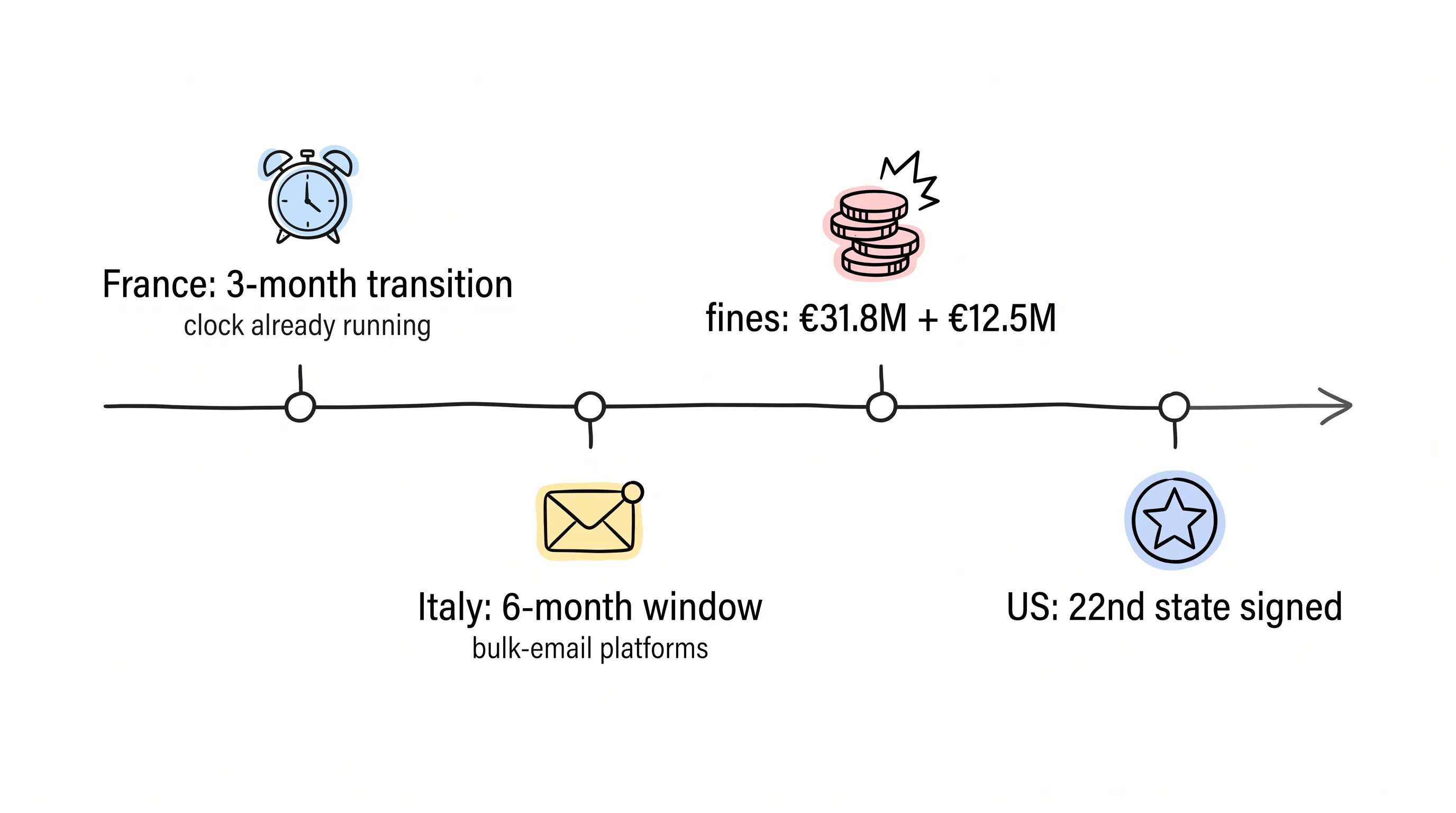
Securiti's global privacy monthly covers 28 developments across three continents, and the two most directly relevant to marketing both carry deadlines. France's CNIL issued its final recommendation on email tracking pixels on April 14: deploying pixels requires prior consent, with a 3-month transition period for email addresses collected before the recommendation was published — the clock is already running. Italy's Garante followed right behind, requiring email operators to obtain user consent before deploying tracking pixels, with a 6-month compliance window for bulk-email platforms. The fines have reached serious magnitude too: Intesa Sanpaolo was fined €31.8 million after employees made more than 6,600 unauthorized queries into customer banking records with internal systems noticing nothing, and Poste Italiane was fined €12.5 million for forcing users to allow monitoring of every app on their phones — the regulator's wording was "excessively intrusive." In the US, Alabama signed its personal data protection act on April 17, becoming the 22nd state with a comprehensive privacy law; Kenya classified smart-TV viewing data as sensitive; Virginia is advancing a ban on selling precise location data — the finer the behavioral tracking, the more easily it lands in the sensitive category. Latvia's regulator made clear that scraping public business-register data for commercial purposes grants no exemption from GDPR obligations — anyone in the data business should take note. AI automated-decision regulation is tightening as well: the UK's ICO updated its automated decision-making guidance under the Data Use and Access Act, adding sections on safeguards and individual rights, and its recruitment-industry report calls out gaps in bias monitoring and human oversight of automated decision tools; Malaysia published detailed rules on DPIA (data protection impact assessment), privacy by design, and automated decision-making at month-end; China proposed simplified compliance rules for small and micro data processors — regulators have begun tiered enforcement.
💬 If you run email marketing, inventory your pixel list this week: if open-rate tracking for European recipients lacks explicit consent, use the transition window to secure authorization or take it offline — don't gamble on enforcement pacing. Run a transparency self-audit on automated-decision tools and write the human-review step into the process; the ICO's guidance is a ready-made checklist. Teams scraping data for leads should add an internal red line: a public source does not mean free for commercial use.
🔗 Further reading: Read the full article
💡 Today's Big Picture
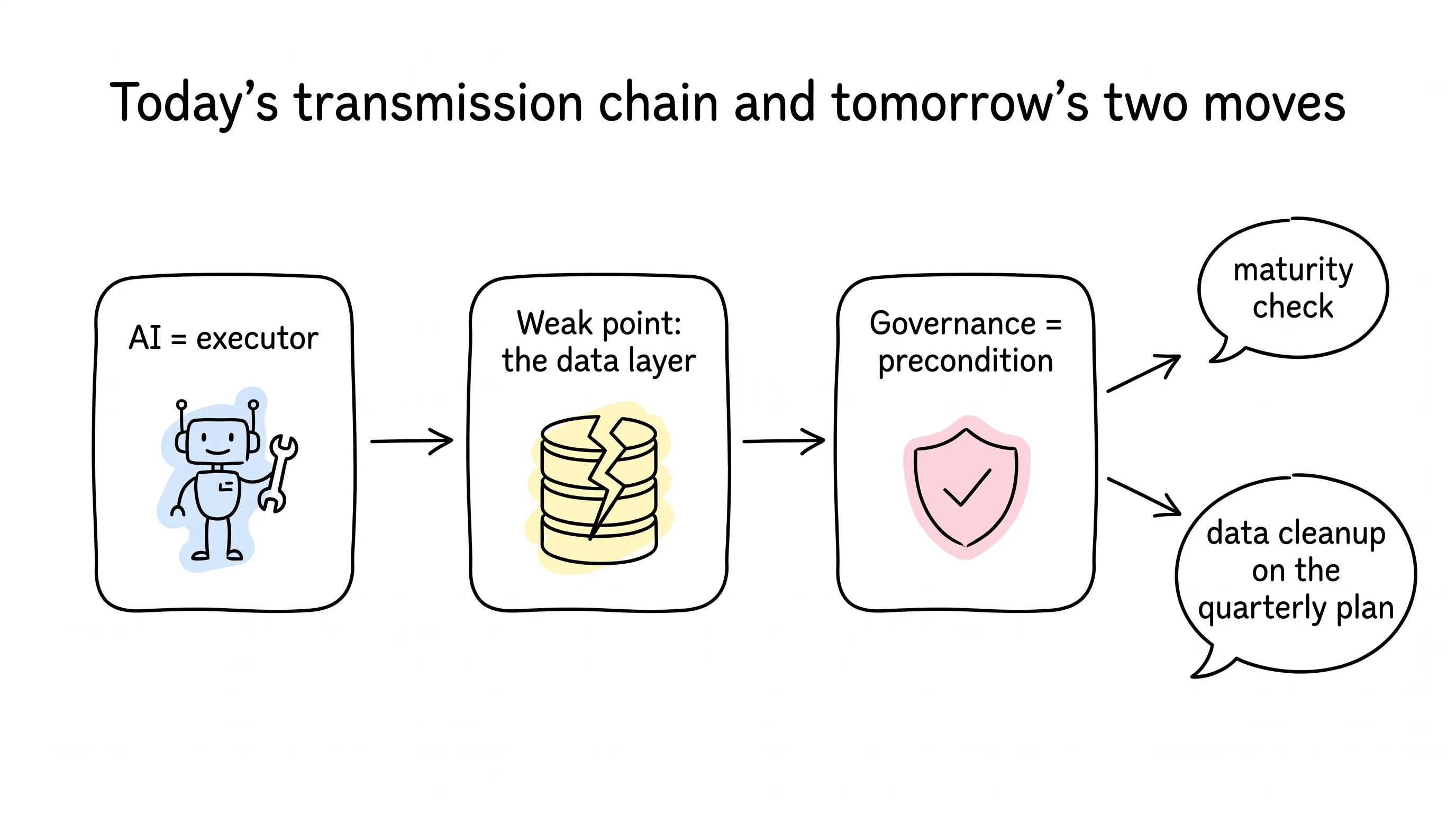
Laying today's ten items side by side reveals a clear transmission chain: AI has grown from a writing tool into an executor, and the executor's weak point isn't the model — it's the data. HubSpot's survey shows content-side penetration at 80%, while heavy use of lead scoring and data analysis sits around 30%; the lead-gen guide pins failure squarely on the data layer, and Gartner flat-out predicts 40% of agent projects will be abandoned over unclear ROI. The platform roundup and the privacy monthly prescribe the same medicine from two directions: the former demands audit trails and human escalation points, the latter attaches transparency obligations to automated decisions. Governance is no longer a big-enterprise luxury — it is becoming the precondition for whether agents get to stay on the account.
The price signals deserve to be pulled out on their own. The tool layer's entry barrier is falling — Microsoft Clarity is free, Fireflies is $10 a seat, WriterZen is a one-time $75 buyout — while the agent layer's barrier is rising: AI SDR platforms start in the four figures a month, enterprise custom builds in the five, plus implementation money budgeted at 1.5x the sticker price. One side getting cheaper while the other gets dearer tells you value is moving from buying software to buying outcomes; next year, a pure tool-buying mindset will be a much harder sell to finance.
Two things for tomorrow morning. First, run an AI-maturity positioning for the team and find the workflow lagging furthest behind the adoption averages — that is where next year's budget should go. Second, put data-quality remediation on the quarterly plan: CRM cleaning, contact verification, plus intent-signal layering and compliance documentation — those are what decide the ceiling on what agents can produce.
One more easily missed signal: the 27-minute session length on RAG on-site search shows users are willing to linger in an interface that understands plain language. In 2026 the competition has changed faces — the rival is the feeling of being understood users just experienced inside ChatGPT. Whoever ports that feeling into their own touchpoints first takes next quarter's conversion rate.
Continue reading
Related articles
AI Marketing Daily · 2026-11-03
No new model launches today.
AI Marketing Daily · 2026-10-31
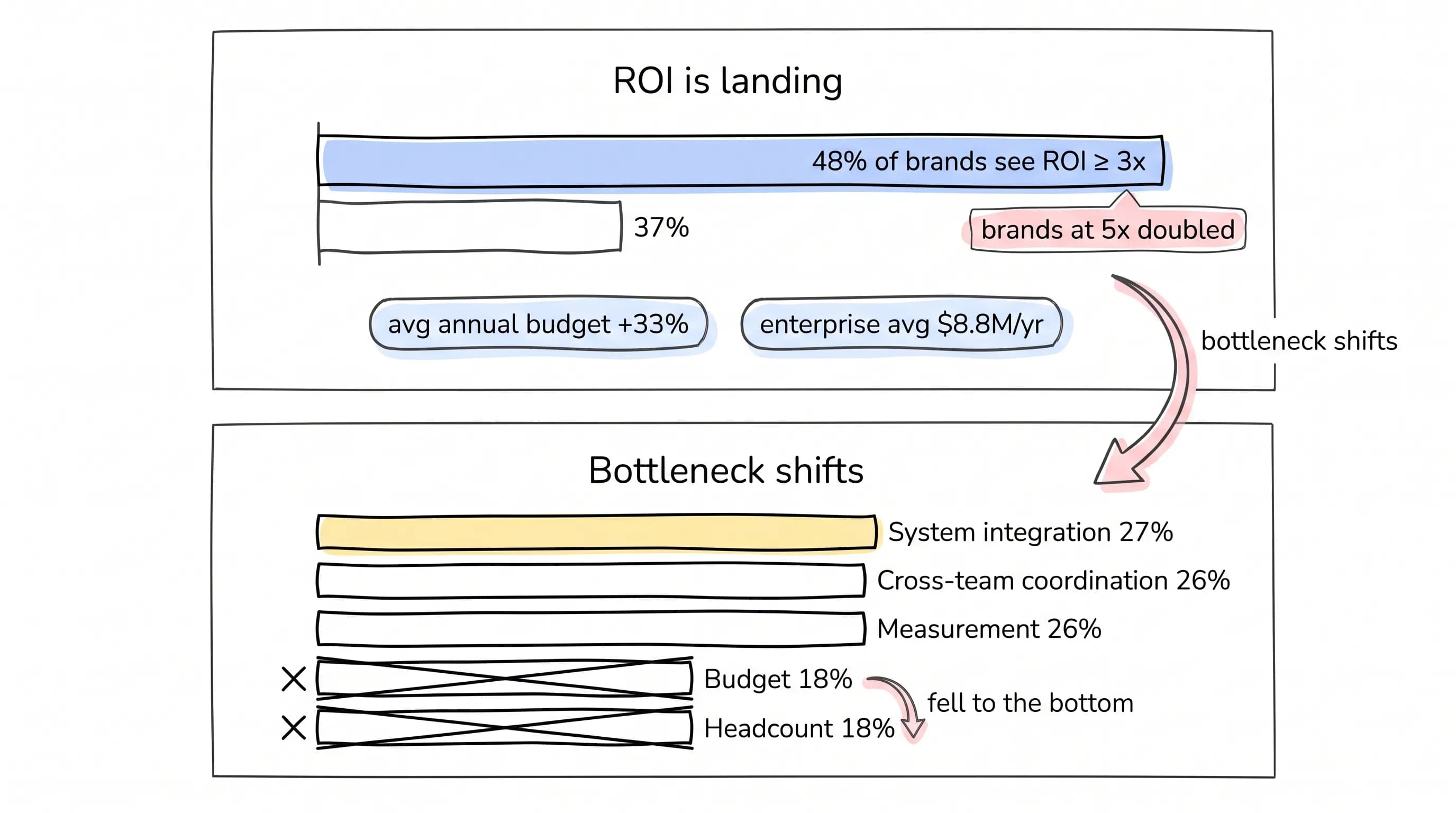
Today's protagonist is measurement.
AI Marketing Daily · 2026-10-25
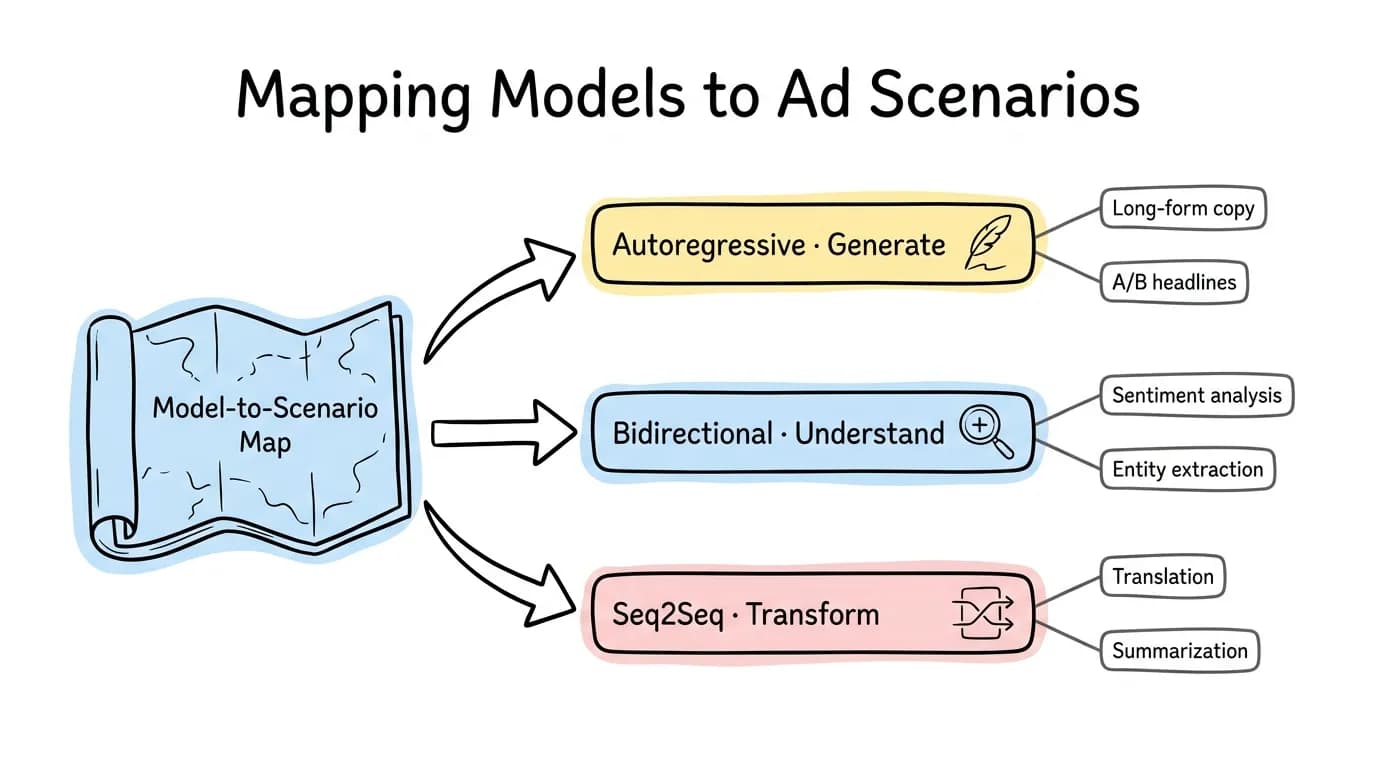
Daily briefing on nine AI marketing items: the IAB generative AI advertising playbook, a 16-vendor B2B selection list, Meta ads automation rollout guidance, cross-border TikTok and Amazon playbooks, and an academic study on AIGC localization, with cautions on unverified vendor-reported numbers.