
6.6x in 8 Years: Just How Big Is the AI Marketing Business?
An overview of the AI marketing industry, covering its projected market growth, key drivers, real-world adoption cases, regional and technology trends, and the challenges of cost and data privacy.
A few days ago, an old friend who has spent more than a decade in e-commerce invited me out for tea.
I thought he wanted to talk supply chain. Instead, his opening line was: "I've handed half of my company's ad budget over to the algorithm."
He said he used to hire ten optimization specialists to babysit the backend all day — adjusting bids, swapping creatives, refining audiences — working themselves to the bone. Now AI does all of that faster and more steadily than humans, and it never asks for overtime pay.
I asked how much he saved. He held up one finger. I guessed one million. "More than that," he said. "Efficiency doubled."
I'm not the only one with a friend like this. Behind these stories stands a business that is swelling fast.
First, Do the Math
How big is this business?
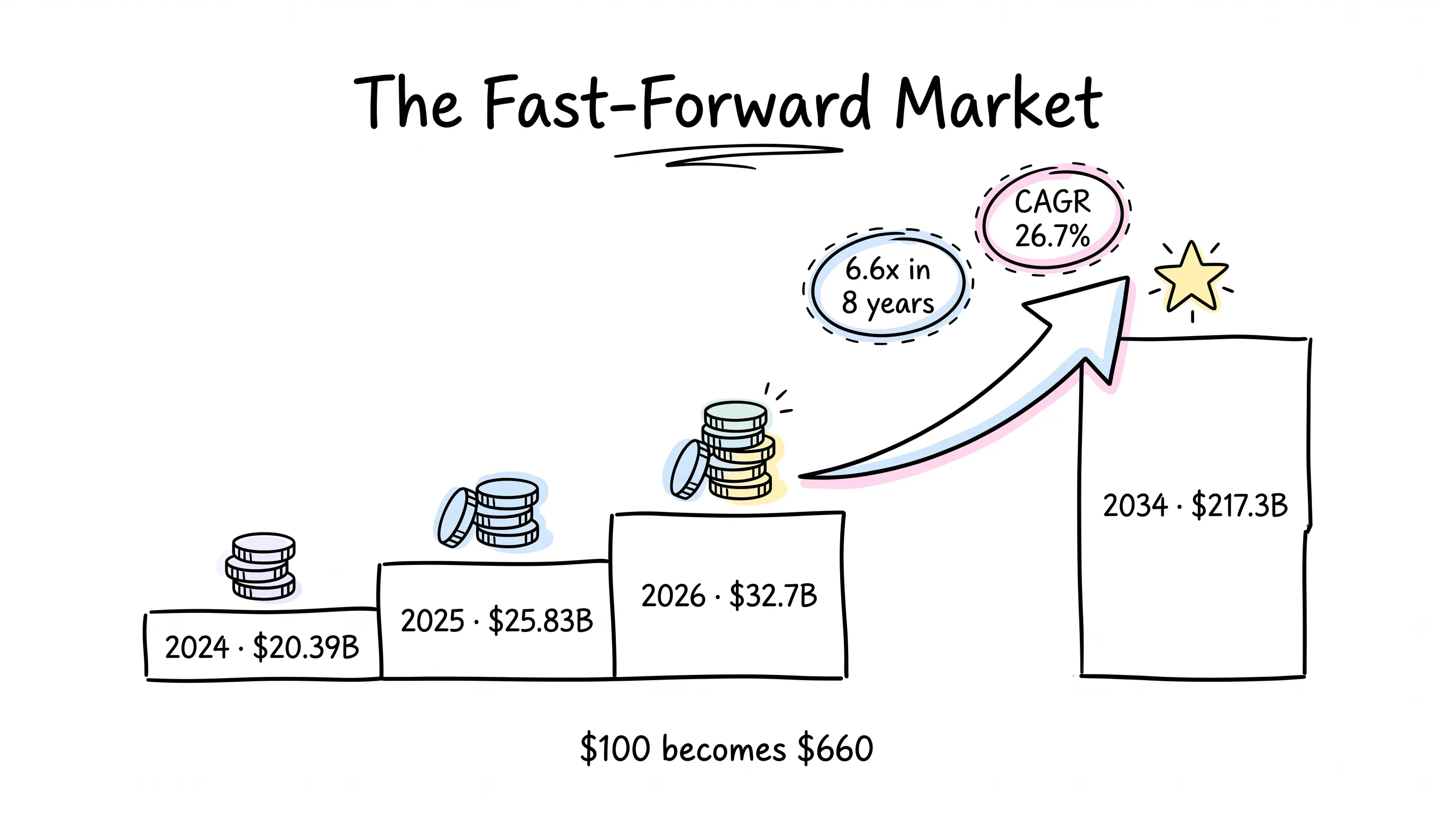
By the industry's mainstream estimates, the global AI marketing market will be worth roughly $32.7 billion in 2026. By 2034, it will grow to $217.3 billion.
Eight years, 6.6x, a compound annual growth rate (CAGR) of 26.7%.
What does that mean? Put in $100, do nothing, and eight years later you have $660. The market isn't your savings account — the analogy isn't rigorous — but it gives you the feeling: this is not a market growing slowly; this is a market with the fast-forward button pressed.
And it didn't appear out of nowhere. 2024: $20.39 billion. 2025: $25.83 billion. 2026: $32.7 billion. One step a year, visibly leaping upward.
The money is already in. Only one question remains: what exactly is fueling this growth?
What Is AI Marketing?
When most people hear the term, the picture in their head is large models helping write copy.
That's just the tip of the iceberg above the water.
So what is AI marketing?
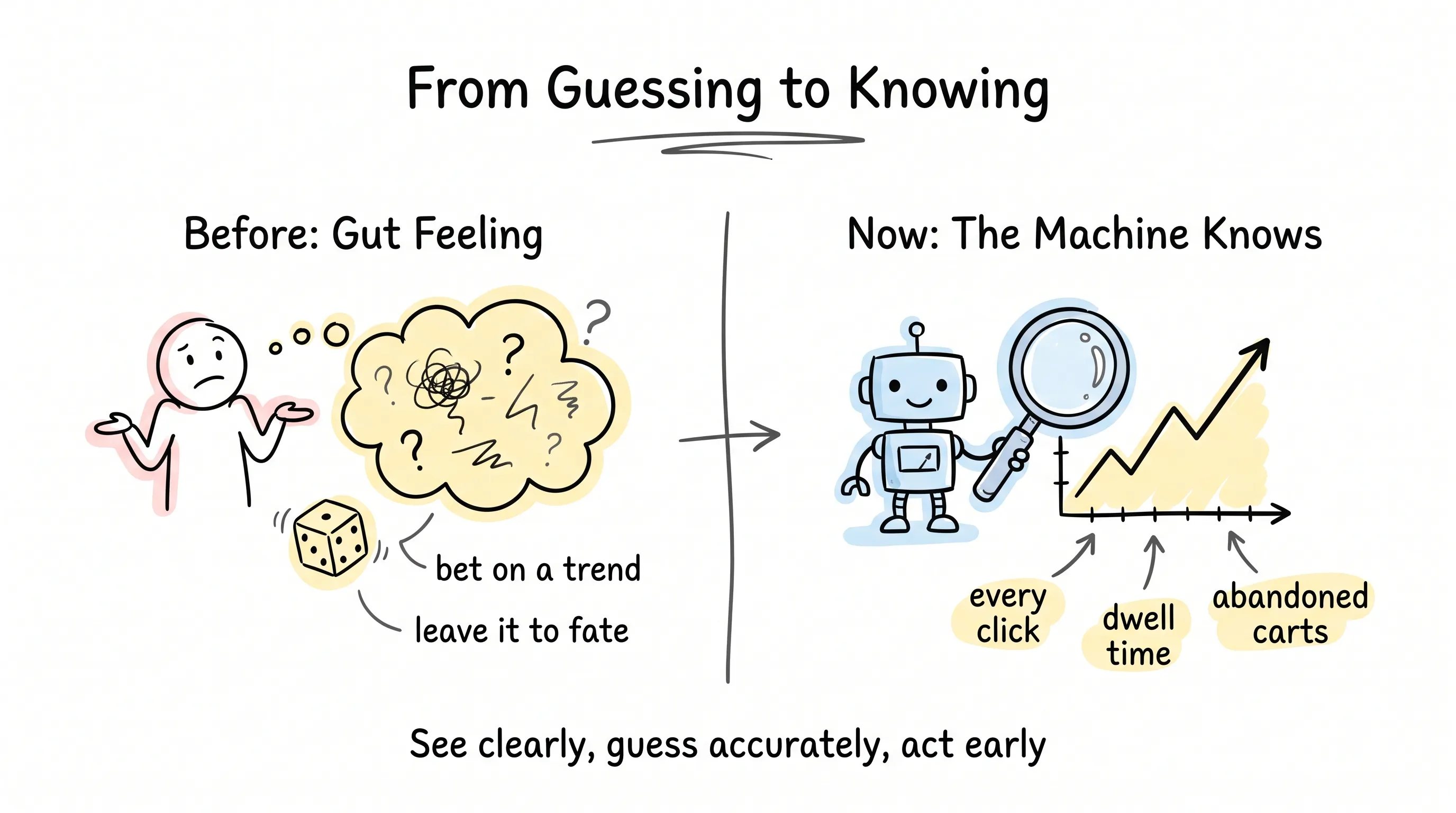
AI marketing means handing "guessing" over to the machine.
What was marketing like before? Gut feeling. The boss said young people love China-chic (guochao, China's homegrown trend brands), so the team bet everything on China-chic. Whether the campaign worked was left to fate.
Now? The machine records every click, every second of dwell time, every shopping cart that was filled and then emptied, and finds the patterns in it: what this person will most likely buy, when that person will most likely churn, which coupon tier works best on which type of customer.
See clearly, and you can guess accurately. Guess accurately, and you can act early.
That is AI marketing. What it changes isn't what ads look like, but how decisions are made.
The people in the middle of it can feel the change too. In one survey of marketing executives, 48% of respondents said that among all the changes, AI's impact on "how consumers and marketers interact" is the greatest. Research firm Forrester has also offered a judgment: seven in ten companies plan to put AI to work within a year.
Half are already feeling the change; seven in ten plan to catch up. The tide's direction leaves little suspense.
Why Is It Growing? Let Me Tell You Three Stories
Arguments are abstract; stories are concrete. Here are three — feel the capillaries of this business.
The first story is a piece of chocolate.
In January 2022, the British confectioner Cadbury did one thing: it launched a free tool for small business owners. You pick a celebrity, and the tool uses that celebrity's voice and face to generate an ad for your little shop.
Note two words: small business owners, free.
Hiring a spokesperson and a production team is a budget a small shop would never dare imagine. AI cut that cost straight to zero. Overnight, tens of millions of mom-and-pop stores got their hands on a marketing weapon that once only giants could afford.
You tell me — would anyone want something like this?
The second story comes from Salesforce.
In June 2023, this CRM company launched Marketing GPT and Commerce GPT. Writing a personalized email, segmenting an audience, designing a customer journey — the marketer's work went from "takes days" to "say a sentence."
Shopping is the same. GPT-powered dynamic shopping journeys adjust products and offers on the spot based on each customer's real-time behavior. The store you browse and the store your neighbor browses are no longer the same store.
The third story happened on a can of cola.
In February 2023, consulting firm Bain formed a partnership with OpenAI to help enterprise clients truly put AI's potential to use. Coca-Cola immediately followed, planning to use ChatGPT and DALL-E to customize the copy, images, and content in its ads.
On one side a century-old brand; on the other a just-sprouting AI company. Giants vote with their feet — more persuasive than any data.
A piece of chocolate, an email, a can of cola. Behind the three stories is the same thing: AI is turning marketing from a craft industry into a machine industry. Every industry industrialization has transformed has to have its scale recalculated. That's where the 26.7% comes from.
But There's Always a Flip Side
I know you might be feeling a bit fired up right now, ready to bet everything. Hold on.
This business has two soft spots.
First, it's expensive. Wiring AI into the marketing process means buying infrastructure up front and raising people who know how to use it. Big companies grit their teeth and go; small companies look at the bill and turn and walk. The Cadbury story moves us precisely because it cut the cost to zero. Flip it around and it proves one thing: the industry itself knows cost is the biggest barrier.
Second, privacy. Why does AI guess so accurately? Because it feeds on data. The more it eats, the sharper the guesses; the sharper the guesses, the more uneasy users get. Data protection rules tighten year by year, and marketers must chase more accurate algorithms while tiptoeing around red lines.
Until these two problems are solved, the 26.7% comes with a discount. So I never urge people to charge just because they see a growth curve. On the back of a growth curve, a price is often written.
A Battlefield You Might Not Expect
When people talk AI marketing, they talk e-commerce, FMCG, social media. There's one industry whose room may be seriously underestimated.
Healthcare.
Think about it: what do hospitals lack most? Not technology — communication with patients. Put a chatbot on the website to guide prospective patients to answers, and one online consultation may become one in-clinic visit. Predictive analytics can also read patterns in demographics: which region, which groups, at what times demand for care will cluster — and health education and outreach campaigns get laid out there in advance.
Some have already started. A company called Youper, focused on mental health, uses AI to continuously track and improve users' emotional states through short personalized conversations.
Healthcare is an industry with an extremely high demand for "trust." And the end point of marketing is exactly trust. Once this market opens, its momentum may well rival retail's.
Where Will the Money Go? Turf and Players
If this business is destined to grow, where will the money flow first?
Geographically, North America is the largest market. Data analytics, personalized experiences, programmatic advertising, chatbots — these plays are already spread widely across North American retail, finance, media, and healthcare. The US alone: $5.97 billion in 2025, projected to reach $51.33 billion by 2034, an annual growth rate of 26.98% — a touch hotter than the global average.
But the fastest runner is Asia-Pacific. The more prosperous e-commerce is, the stronger the demand for personalized marketing; investment in AI is climbing, and enterprise awareness is catching up. China especially — at this pace, running at the front of AI technology is most likely only a matter of time. Retail and e-commerce will take the biggest bite of demand in this region.
By product form, cloud deployment is the fastest-growing segment. The logic is simple: no servers to buy, pay as you go, turn on and use. But on-premises deployment won't die either. Companies holding sensitive data, the ones who insist their data never leaves their own walls, will still install systems in their own server rooms — for control, and for low latency.
By technology route, machine learning is the foundation and holds the largest share. Analyzing user behavior, predicting churn, anticipating sales trends — all of it rests on machine learning. The fastest grower is computer vision. For example, Meta trained vision models with a method called DINO, so machines can automatically recognize and classify objects in images and videos. Images and short video are becoming marketing's main battlefield, and AI that can understand the picture rises with the tide.
By application, content curation holds the largest share — plainly put, machines sift the ocean of information for what your audience loves to see. Rising fastest is social media advertising: the data volume on platforms is so vast, tailor-made for algorithmic fine-tuning. On the end-user side, media and entertainment are the biggest buyers — every drama the algorithm serves you on a streaming platform has this machine behind it.
Finally, look at who sits at the table: NVIDIA, Salesforce, Google, Intel, IBM, Microsoft, Amazon, Oracle, Baidu, Twitter. Chips, software, cloud, platforms — each guards its own hill. The entry tickets to this card game had names written on them long ago.
Finally, Back to My Friend
That day after tea, I asked him one last question: AI has done the optimization specialists' work — what about your people?
His answer I remember to this day. He said what gets cut is "the hands that press buttons," and what stays is "the brain that thinks strategy." The stronger the tool, the more valuable the people who can use it.
Eight years, 6.6x — a sexy number. But let me remind you: market size never equals your opportunity. The market is rising, and you have to evolve along with it — otherwise not one cent of that $217.3 billion has anything to do with you.
Tools are always being swapped; judgment is always scarce.
Here's wishing you the one holding the steering wheel — not the one letting the algorithm hold it for you.
Continue reading
Related articles

It's 2026: Stop "Buying" AI Tools for Your Marketing Team — Start "Hiring" AI Agents
This learn article explains how AI agents differ from standalone AI tools in marketing, outlines three agent categories — build-your-own platforms, CRM-native agents, and vertical tools — and covers use cases across SEO, social media, advertising, and reporting, plus criteria for choosing one.

Did the Money You Spent on AI Marketing Ever Come Back?
A guide to measuring AI marketing ROI across three layers: ad reports, sales pipeline, and the financial ledger. Covers metrics such as ROAS and CPA, eight dashboard metrics, industry benchmarks, and common measurement mistakes.

How to Pick a Creative Automation Platform: First, Figure Out What These Eleven Actually Do
A learn article sorts eleven creative automation platforms — including Bannerflow, Celtra, Smartly.io, and Storyteq — into four functional groups and proposes five evaluation questions covering publishing reach, automation depth, ease of adoption, team fit, and verifiable evidence.