
AI Just Rebuilt Personalization From the Ground Up. So, Where Do You Draw the Line?
An article on how generative AI changes personalized marketing, where the line between helpful and creepy personalization sits, and why risk controls should come before scaling AI-generated messages.
Has this ever happened to you?
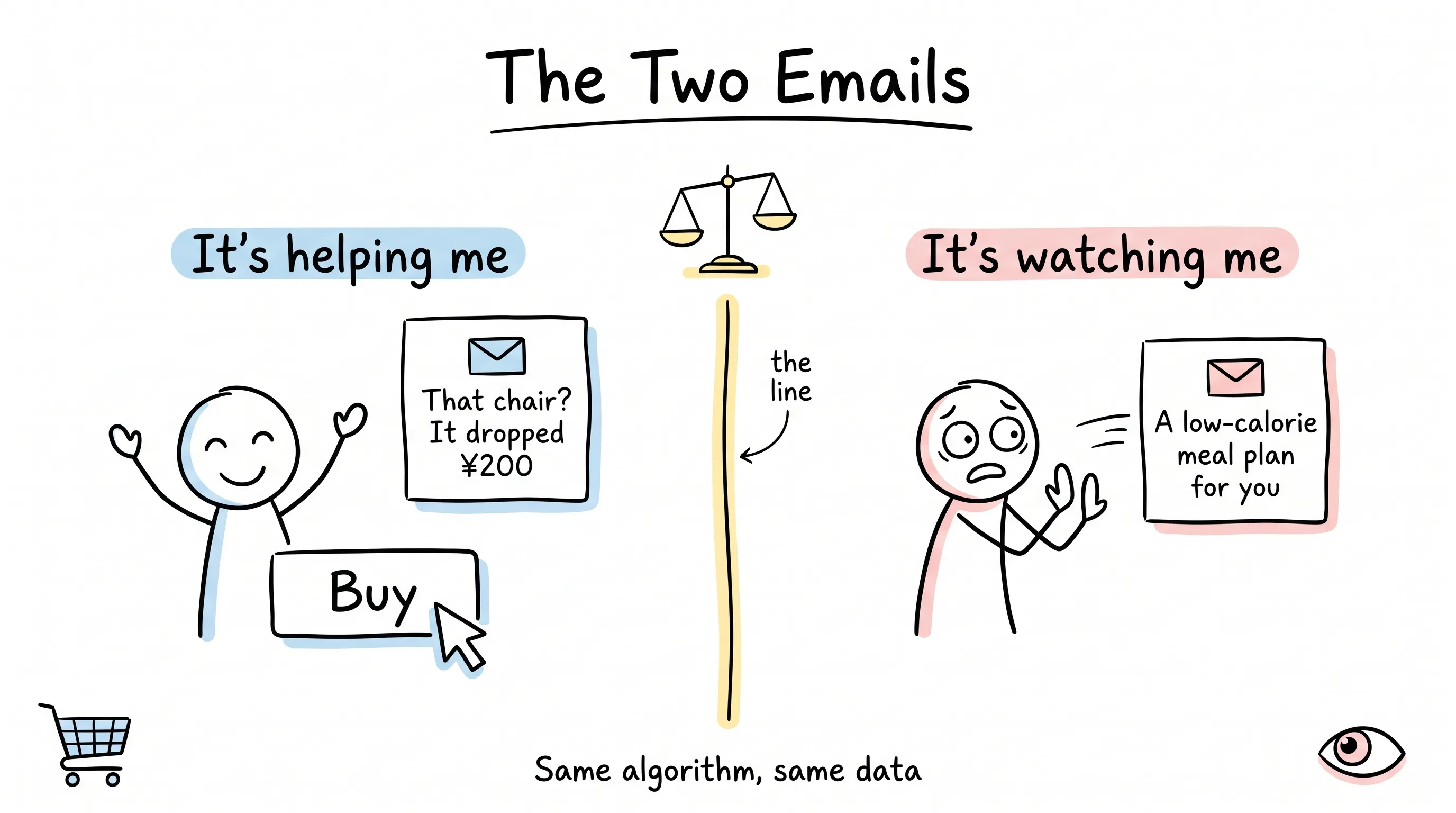
It's midnight, you're scrolling on your phone, and you spot a gaming chair you like. You hem and haw for ages, and you don't buy it. The next morning, there's an email in your inbox: "That chair you looked at last week? It just dropped ¥200."
Your heart skips a beat. You click. You buy.
Feels good, right? Comforting. Accurate.
But then there's the other email, the not-so-comfortable kind: "We noticed you've been watching your diet, so we've put together a low-calorie meal plan for you."
You never told a soul you were dieting.
In that moment, comfort turns into cold dread.
That's personalization for you. Nudge too lightly and it reads as lazy. Nudge too hard and it reads as creepy. The line between them is thinner than a hair, yet every single consumer carries one inside their head.
What I want to talk about today is that line.
What Is Personalization, Exactly?
Personalization, stripped down to its essence, is turning "a crowd" back into "a person."
Marketing used to be broadcasting. One ad, fired at ten million faces, and every one of them saw the same sentence. The advertiser's logic was simple: I don't care who you are — someone out there needs this.
Then came data and automation. The system recognized you: when you're active, what you like, what you'll pay for. The moment a trigger condition was met, out went the message. That's marketing automation.
Automation solved "efficiency." Ten million customers, and you don't need ten million salespeople. The content was built in advance; the system just handled delivering the right message at the right time.
But then generative AI showed up, and things changed.
Changed how? In the past, the system could only pick a ready-made message from a content library. Now, the AI writes you a brand-new one.
The copy you're reading was written for you. Your city, your shopping cart, that jacket you hesitated over for three seconds yesterday — it's all in that one sentence.
A thousand faces, a thousand messages — became a thousand faces, a thousand drafts.
Do the math. Say you have 10 million users. In the old days, a content team grinding out 50 sets of creative assets a day was already impressive. Now? Generative AI can turn out several million variations a day, and no two people receive the same thing.
Output is up tens of thousands of times.
And judgment? Flat.
God. That's the most dangerous part. The pen is free now — but send the wrong letter, and you pay for it.
When Cost Approaches Zero, Judgment Becomes the Only Gatekeeper
Why do I say that?
Think about it: once writing costs nothing at all, what decides success or failure is no longer "can you write it" but "do you dare send it."
What do I mean? Go back to that low-calorie meal plan.
What made that email chilling wasn't the prose. It was the fact that it exposed how much you know. A consumer is willing to let you see their shopping cart — that doesn't mean they're willing to let you see their medical checkup.
Between those two sits an invisible line.
Above the line: what you're looking at, what you like, what you've bought. In the user's mind, this is part of the deal — I give you my data, you give me convenience.
Below the line: my feelings, my situation, my soft spots. Touch those, and this is no longer service.
What I hand over willingly is data. What you piece together on your own is snooping.
Let me give you an analogy.
Say you run a coffee shop and you hire a star barista. This barista never forgets a thing: every regular's order, their dietary restrictions, the private things they mentioned in passing last time — all of it.
One day, a woman walks in with a colleague. The barista greets her warmly: "Back again! Still half-sugar, no ice? Oh, and you mentioned last time that you're gearing up for a divorce — feeling any better?"
The color drains from her face.
A great memory is skill. Knowing what to say in front of whom — that's a sense of proportion.
The data all sits in the system while the AI writes letters one by one and sends them one by one. Knowing when to use which piece of data — that is the line.
And this line has a name: the uncanny valley of personalization (the point where "impressively accurate" tips over into "how do they know that?"). Step across it, and no amount of accuracy will save you. The user won't argue with you. They'll just quietly switch off the "personalized recommendations" toggle — or uninstall the app outright.
And they'll never tell you why.
The Ones Bold Enough to Let Loose Filled Their Potholes First
So what's the move? Retreat back to the broadcast era?
No company is that foolish. The benefits of personalization are laid bare: higher conversion, better experience, stickier retention. Everyone wants to squeeze every drop out of generative AI.
But here's a genuinely interesting phenomenon.
The IBM Institute for Business Value, working with Adobe and AWS, published a report on precisely this question: what do the companies that have gone furthest with generative AI — the ones using it most boldly — have in common?
Not boldness.
It's that they fixed their risk controls first.
The report's conclusion boils down to one sentence: leading organizations use a sufficiently solid risk-management strategy to fill in the potholes one by one first — and only then let generative AI's creativity loose.
First get crystal clear on "what you must not do" — only then dare to unleash "what you can do."
That sounds a little counterintuitive. Risk management — what a mood-killer. Everyone else is flooring the accelerator, and you're buckling your seatbelt first.
But flip it around: generative AI hands every marketer a pen that can write 100 million letters a day. Send one wrong, and it's an apology statement. Send 100 million wrong, and it's a brand catastrophe. Try to write the rules after disaster strikes, and the damage is long since done.
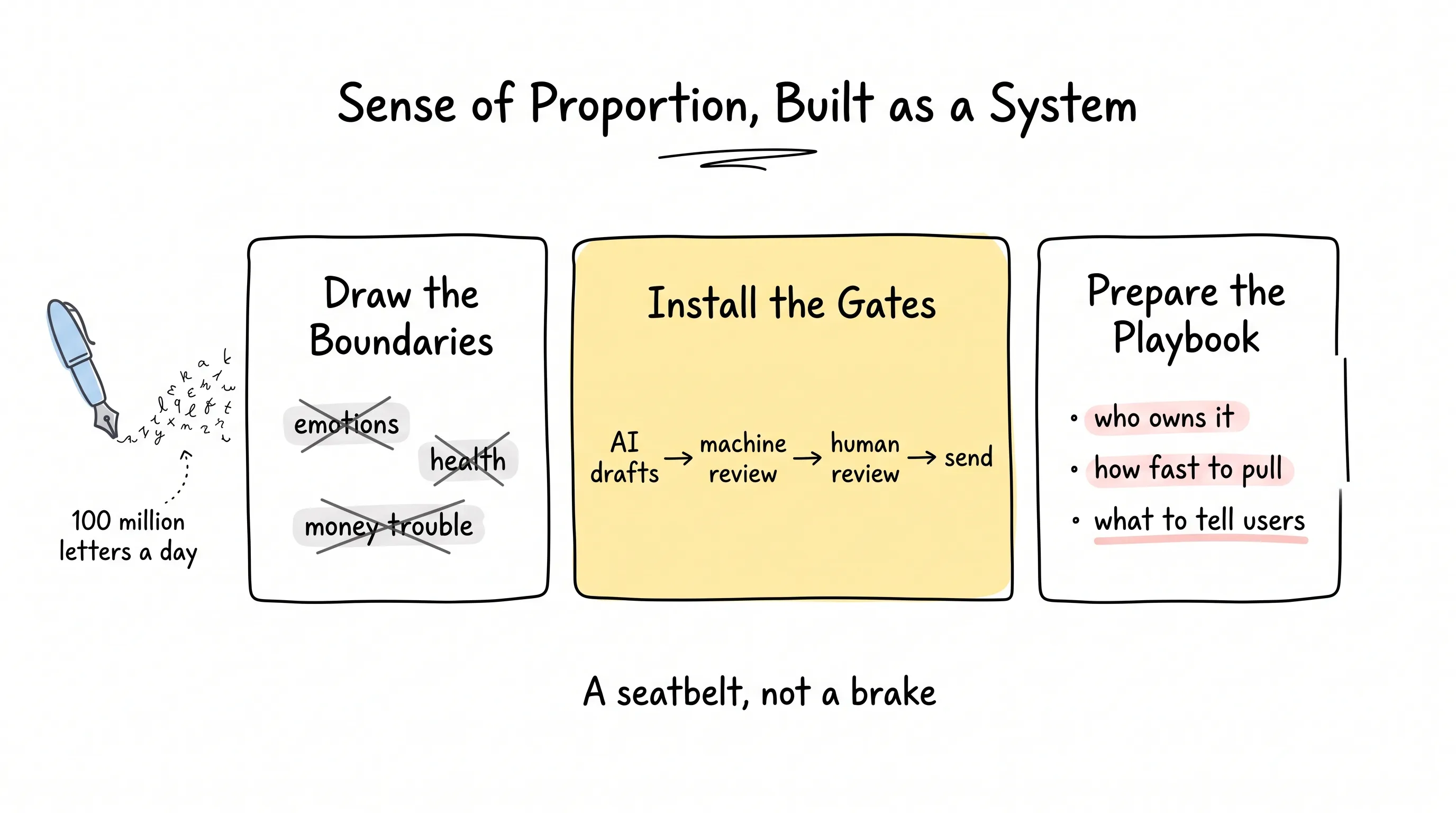
Risk control isn't a brake. It's a seatbelt.
Only people wearing seatbelts can hold down the accelerator.
So How Do You Build a Sense of Proportion?
How, concretely? I'd break it into three assignments. None of them is glamorous. All of them are grunt work.
Assignment one: draw the boundaries.
Which data can be used, which can't — get it down in black and white, and don't wait for a disaster to convene that meeting. Emotions, health, financial hardship: don't touch that data at all, no matter how valuable it looks. The more valuable it is, the harder it detonates.
Assignment two: install the gates.
What the AI writes must not flow straight into the production pipeline. There has to be a review in between: Are the facts right? Is the tone right? Is anything offensive? Pure human review is too slow, so machine review first and human review second is fine — but the gate itself is non-negotiable. Better to be half a day slower than to get 100 million things wrong.
Assignment three: prepare the playbook.
Among millions of variations, one is bound to go wrong. When it does, who takes responsibility? How fast can it be pulled? And once it's pulled, what do you tell users? The answers to these three questions must live in your process, not in someone's head.
You might say: that's it?
That's it.
And look at why IBM, Adobe, and AWS put their research reports and methodologies out there for everyone to see. Because on this road, whoever falls into a pothole first slows down the whole road. Users' trust in "AI marketing" is an asset the entire industry shares — when one company smashes it, everyone foots the bill.
A Final Word
Back to those two emails from the start.
The chair dropped ¥200; you clicked and bought it. Because what you felt was: it's helping me.
The low-calorie meal plan — you closed it. Because what you felt was: it's watching me.
Same algorithm, same data. The only thing between them is that sliver of perception.
So in the age of generative AI, the endgame of personalization is no longer a contest of technology. It's a contest of proportion.
Whoever can build that sense of proportion into a system capability — boundaries written down, gates installed, playbooks on the shelf — is the one bold enough to use AI to the fullest, so that of those 100 million messages, every single one reads like a greeting an old friend brought by in passing, not a cold stare from behind.
Wishing you pushes that land dead-on — and leave people feeling a warm breeze.
Continue reading
Related articles

What Is AI Marketing Automation? It Starts With a 40-Point Gap
A learn article explaining what AI marketing automation is: how learning-based systems differ from rule-based automation, how AI decisioning optimizes message, channel, and timing choices, what data it depends on, and where it applies across the customer lifecycle.

Marketing Automation Is Shifting from "You Do It" to "You Say It"
This article explains how marketing automation is shifting from rule-based platforms that merely execute toward AI agents that plan, create, publish, and review campaigns, covering delegable tasks, underlying technologies, tool categories, adoption steps, and risks such as privacy and automating without strategy.

Rankings Are Taking a Dive, Customers Are Sprinting Ahead: This November, I Re-Ran the Numbers on AI Search
A learn article on how AI search reshapes marketing measurement, covering reported mismatches between rank-tracking tools and live Google results, ChatGPT's business profile test, single-page visitors as high-intent leads, and CRO plus GA4 tracking verification practices.