
Fines, Tiny Bugs, and Lights Going Out: What Global Privacy Regulators Were Busy With in Spring 2026
A roundup of global privacy and data regulation developments from spring 2026, covering fines, new state privacy laws in the US, email tracking pixel consent rules in Europe, and enforcement and guidance across the Asia-Pacific region.
A while back, I set aside an evening to go through what data regulators around the world had been up to in the first half of 2026.
When I got to April, two numbers pinned me to my screen.
€31.8 million.
6,600 times.
One looks like a fine; the other, a count of lookups. On the surface, the two have nothing to do with each other. But fill in the news story that sits between them, and you'll see: these two numbers are actually the same story.
What story? Let me walk you through it.
First, a Story About an Insider
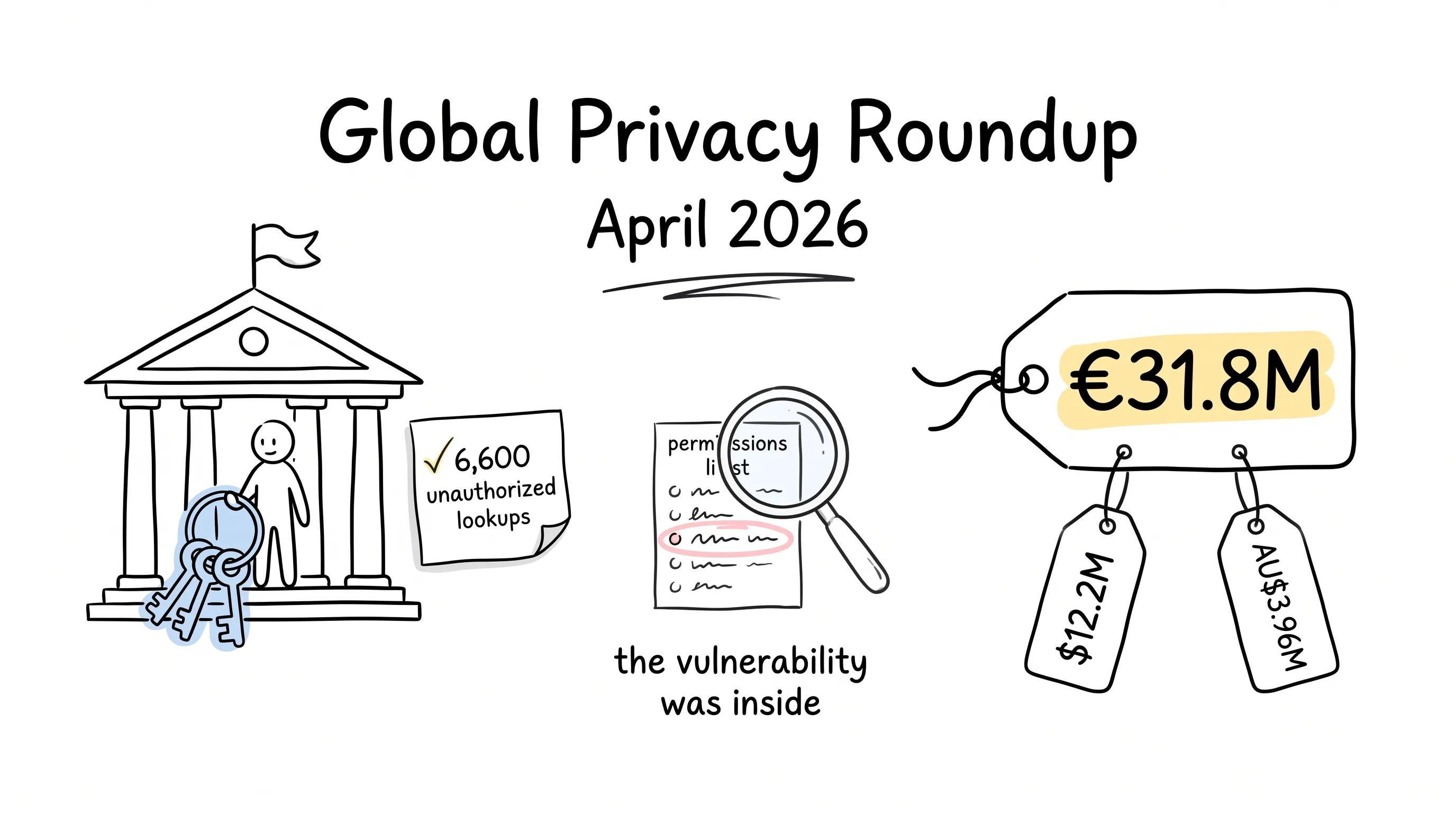
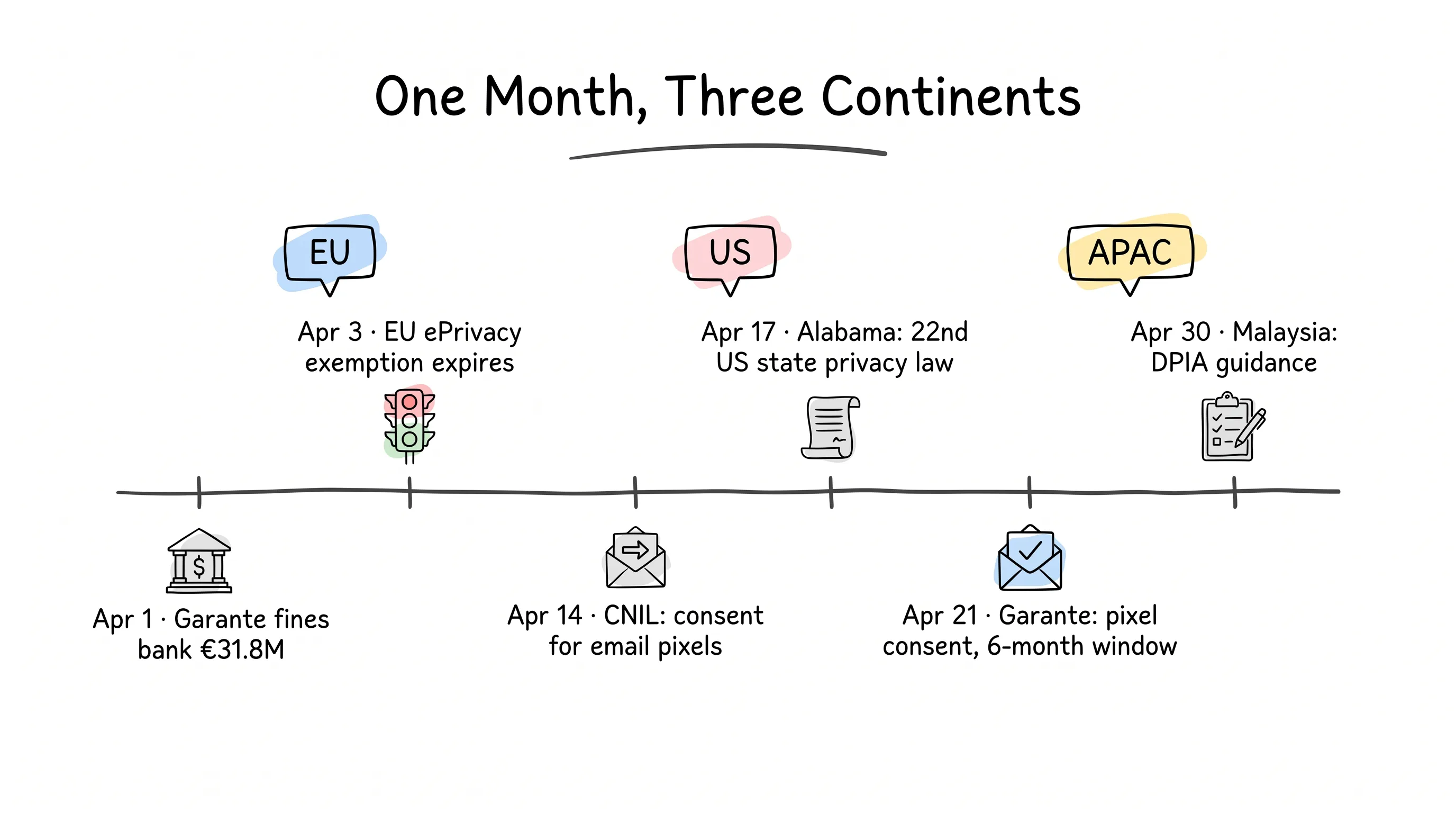
On April 1, 2026, Italy's data protection authority, the Garante, fined the bank Intesa Sanpaolo €31.8 million.
The reason? You might not believe it when you hear it.
An employee at the bank had looked up customer banking records more than 6,600 times without authorization. And with that much activity under the roof, the bank's internal monitoring system never noticed a thing.
Six thousand six hundred. Not a casual peek or two — 6,600 times.
Think about what this is like. It's like having the sturdiest security door on your home, only to discover that the babysitter holds a whole ring of spare keys — coming and going 6,600 times over half a year, without the alarm going off once.
So what was the fine for — the door lock?
Not the lock. The management.
The biggest vulnerability is often not in the walls, but in the internal permissions list.
United States: Passing Laws One After Another
Having looked at Europe's fine, let's swing the camera over to the Americas. Over there, they're busy with something else: legislation.
On April 17, 2026, Alabama signed its Personal Data Protection Act into law — the 22nd state in the country with a comprehensive privacy law.
Twenty-two. Nearly halfway there.
It's like a residential compound installing access gates. When the first few households put them in, everyone else watched and waited; by the time 22 had installed them, the holdouts started looking like the odd ones out. For companies doing business across state lines, it's a headache of the highest order: 50 states, 50 sets of rules — like having to earn 50 driver's licenses.
A few days earlier, on April 13, two states made moves worth noting.
Kentucky put smart-TV viewing data into the sensitive-data basket.
Virginia, meanwhile, moved to ban the sale of precise geolocation data.
What counts as sensitive data? Put plainly, it's data regulators believe must be handled with extra care. Your viewing history, your precise location at this very moment — both are in that basket now.
Think about what's behind this: TVs understand you better and better. They know what you replay at midnight; they know your whole family's tastes. This data used to be treated as ordinary commercial data, free to use at will. Now it is being formally, deliberately protected.
What you watch is becoming something that needs protecting.
On children, the moves were more direct. On April 21, the Alabama Attorney General reached a $12.2 million settlement with Roblox over child-safety issues on the gaming platform. Fines are never the point — but nothing makes people prick up their ears quite like one.
The federal level wasn't idle either. On April 22, the House Energy and Commerce Committee and the Financial Services Committee announced they would join forces to push two bills through Congress: one on financial data (the Guard Financial Data Act), one on data security (the Secure Data Act).
From up north came one more detail. On April 20, the Office of the Information and Privacy Commissioner for British Columbia, Canada, issued guidance for small and mid-sized businesses, teaching them how to handle a data breach. Big companies keep an entire floor of legal staff — what do small businesses have? So regulators started walking them through it, step by step.
The Tiny Bug in Your Email
Back to Europe. This month, one thing in Europe got singled out in turn by regulators in two countries: the tracking pixel.
On April 14, France's CNIL issued its final recommendations on email tracking pixels: if you want to use them, get user consent first; for email addresses collected before that, a three-month transition period was granted.
Eight days later, on April 21, Italy's Garante followed suit: email providers must obtain user consent before deploying tracking pixels, with a six-month compliance window.
What is a tracking pixel?
You mail a letter to a friend, and on the letter paper sits a tiny bug invisible to the naked eye. The moment your friend opens the envelope, the bug flies straight back to report: he opened it, in which city, at what time, and how many times he opened and re-opened it.
That's a tracking pixel — a long-standing staple of marketing emails.
This used to happen by default. Now, regulators in two countries have spoken up in the same month: default is not OK; consent comes first.
Tracking used to be the default. Now the default is: no.
The Streetlights Went Out
One more thing happened in Europe in April. It drew less buzz, but I think it carries no less weight.
On April 3, the EU's temporary ePrivacy exemption expired. The European Parliament voted not to extend it.
What does that mean? It means the practice of platforms "voluntarily scanning" private messages for child sexual abuse material has lost its legal basis. Keep scanning, and you're treading the edge of breaking the law; stop scanning, and you might miss real criminal leads. Platforms have law at one end and duty at the other, and they dare not let go of either.
Like what? Like a stretch of road where running the red light was specially permitted — now the permit has expired and the red light shines again, yet there are still children on the road who need to cross. What do you do?
There is no ready answer. That's what "legal vacuum" means.
Europe in the Details
Taken one by one, Europe's other moves this month don't look big. Woven together, they are a net that keeps getting tighter.
On April 1 alone, the UK's ICO (Information Commissioner's Office) did two things: it published a report called Recruitment Rewired, reminding employers that when automated tools screen candidates, bias monitoring, transparency, and human oversight — not one of them can go missing; and the same day, it updated its automated decision-making guidance to keep up with the changes brought by the Data (Use and Access) Act.
On April 2, France's CNIL handed HR teams a practical framework: how long can employee data actually be kept? From hiring to departure, every category of document now has a statutory retention period.
On April 16, Latvia's data protection authority made one thing clear: scraping data from the public company register to run a business does not get you around your GDPR (the EU's General Data Protection Regulation) obligations. Public does not mean free for commercial use.
Over in Africa, Mozambique passed two laws in one go on April 16 — a Cybersecurity Law and a Cybercrimes Law — critical-infrastructure protection and cross-border cybercrime governance, fitted out in a single stroke.
And on April 27, Germany's Federal Office for Information Security launched the C3 framework, setting verifiable standards for "cloud autonomy" and "data localization". Put plainly: "digital sovereignty" just went from a slogan to an exam paper that can be graded.
Asia-Pacific: From Writing the Rules to Making Them Stick
The Asia-Pacific logic runs a little differently. The frameworks are mostly on the books; this month's keyword is implementation.
On April 3, China proposed simplified compliance rules for small data processors. The thinking is pragmatic: a grand hotel and a little noodle shop cannot be inspected with the same hygiene checklist. Regulation is starting to come in tiers.
South Korea had the densest month of all. On April 7, it expanded its "personal data innovation zones"; on April 9, it fined Christie's over weak security controls — how much high-net-worth client information an auction house holds in its hands, you know just by thinking; on April 10, it overhauled the ISMS (Information Security Management System) certification system, replacing "get certified once, coast for life" with continuous, risk-based spot checks; on April 20, it approved 75 institutions to process encrypted identity data; on April 28, it kept pushing its updated privacy policy into effect.
Australia, meanwhile, didn't go soft on fines. On April 16, Latitude Finance was hit with an AU$3.96 million penalty. Six days later, the regulator ruled that businesses must not over-collect data; one day after that, the privacy regulator and the online-safety regulator announced tighter coordination. Two patrol teams, now walking the same beat side by side.
On April 30, Malaysia closed out the month: it released detailed guidance on data protection impact assessments, privacy by design, and automated decision-making — effectively handing down the answer key for "how to do the homework".
What's Still on the Calendar
Looking past late April, there's still plenty scheduled on everyone's calendars.
In the U.S., Connecticut's Senate Bill 4 and Delaware's House Bill 380 are both moving forward. The California Privacy Protection Agency had public consultations open at the time on its spot-audit and notice frameworks, with deadlines of May 7 and May 20 respectively.
In Europe and Africa, the European Data Protection Board's consultation on its guidelines for the scientific-research provisions stays open until June 25, and next to it sits a draft template for data protection impact assessments and an updated scope for the EuroPrivacy certification. Kenya's data protection authority closes its consultation on sector guidelines on May 15. The Dutch data protection authority's consultation on algorithmic transparency closes on May 26.
The one to watch most closely is Norway. Norway plans to legislate before the end of 2026 to force social platforms to run age verification. If this actually lands, will the rest of Europe follow?
I believe they will. A red light in one country will, sooner or later, become a red light for an entire continent.
And Back to Where We Started
Now you can turn back and look again at those two numbers from the beginning.
€31.8 million, fining "an insider looked up records 6,600 times, and nobody noticed".
$12.2 million, settling "whether children are safe on the platform".
AU$3.96 million, fining "the data security didn't hold".
Different labels, but the logic underneath is the same one: whoever holds the data holds the responsibility. Companies used to treat data as an asset, hugging it tightly to their chests; now, the more you hug it, the more closely you're watched.
In this one month of spring 2026, regulators across three continents each said the same sentence in their own way:
Regulation doesn't wait until you're ready. It only keeps the deadline.
So — don't wait.
Here's hoping your users' data stays safe and sound, and that not a single red circle ever appears on your compliance calendar.
Continue reading
Related articles

What Is an AI Marketing Agent? From "Using AI" to "Delegating to AI"
A learn article explaining what an AI marketing agent is, how it differs from rule-based automation, and which repetitive tasks such as lead qualification, reporting, and campaign monitoring can be delegated while humans keep key decisions.

Marketing Automation Is Shifting from "You Do It" to "You Say It"
This article explains how marketing automation is shifting from rule-based platforms that merely execute toward AI agents that plan, create, publish, and review campaigns, covering delegable tasks, underlying technologies, tool categories, adoption steps, and risks such as privacy and automating without strategy.

When AI Does the Creative, Mistakes Come in Batches Too
A learn article on the risks of using generative AI for marketing creative across brand, legal, compliance, and operational layers, with case examples and seven practices for review, rights clearance, documentation, and vendor governance.