
Don't Worry About AI Taking Your Job — It's Coming for Something Else
A learn article arguing that AI takes over repetitive marketing tasks rather than replacing marketers, covering content generation, personalization, insights, SEO, ad automation, and adoption pitfalls like bias and brand safety.
A few days ago I had dinner with a friend who works in marketing. He runs a sizable brand, with a budget of several hundred million a year. Halfway through the meal, he put down his chopsticks and sighed: his whole team was on edge, everyone whispering that AI was about to replace marketers, and some had quietly started learning other skills to hedge their bets.
I told him: don't panic just yet. I've thought about this a lot, and the answer might be the exact opposite of what you fear.
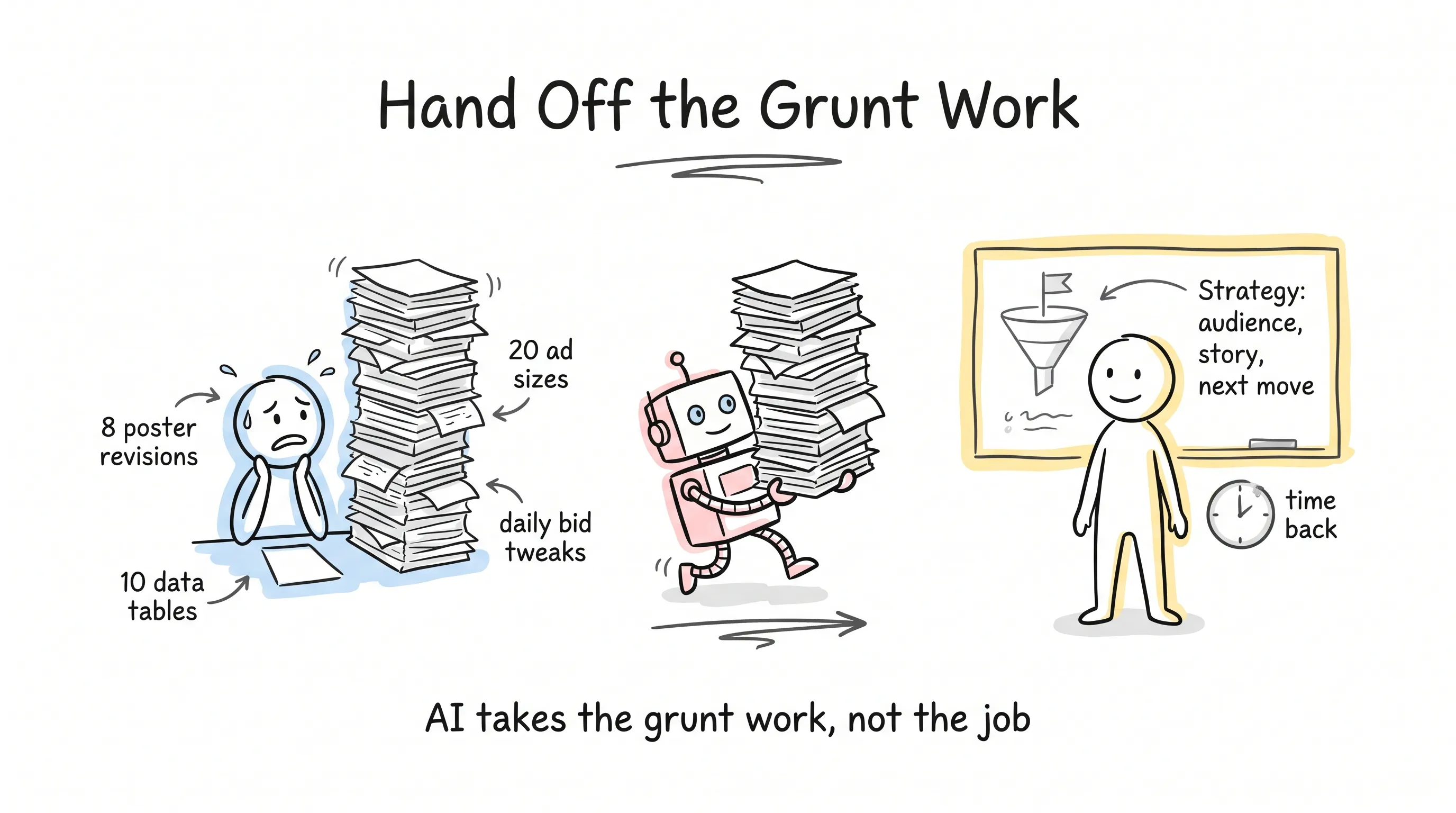
AI isn't here to take marketers' jobs. It's here to take the grunt work off their hands.
What do I mean by grunt work?
All the business-as-usual stuff. Revising poster copy eight times, pulling ten data tables, cutting a single asset into twenty sizes for twenty different channels, manually adjusting bids in the backend every day. Do these tasks matter? Yes. But they aren't the core of marketing — they're just its cost.
That's exactly what AI does. It takes away the grunt work and hands your time back. And what do you do with the time you get back? Strategy. Deciding which audience is worth going after, which story is worth telling, where the next move lands.
I'm not saying this to make you feel better. Just look at Meta, Google, Adobe — the platforms themselves. They didn't bolt AI on as a plug-in; they welded it into the foundation of their tools. Ad bidding, creative testing, targeting optimization — all running in the background on their own. When the platforms have committed this hard, sitting in meetings debating whether to use AI is a bit like debating whether to "go mobile" back in 2015.
Where exactly is AI showing up in marketing?
Let me walk you through it.
Start with content. ChatGPT, Midjourney, Runway — these tools can generate everything from headlines and key visuals to a finished video. A video that used to sit in the queue for days from script to final cut? Now you brief them in the afternoon and review a draft by evening. Plenty of teams already work this way.
Then personalization. "One-to-one at scale" used to be a slogan, because there were never enough hands — you could only slice your audience into broad segments and treat them all the same. Now AI can do dynamic recommendations and tailor copy person by person, without adding a single hour of overtime.
Then there's insights — personally, the most interesting part to me. Take GWI Spark, an assistant that uses generative AI for consumer insights, plugged into years of global consumer survey data. Ask it a question in plain language and get results in seconds. No need to be a research expert, no need to know SQL, no need to wait three weeks for a report. What do decision-makers lack most? Speed and precision. Tools like this put both directly in your hands — and whoever plugs them into their stack first runs first.
SEO is the same. Platforms like Clearscope and Surfer analyze search results, keywords, and content gaps for you. What used to rest on an editor's gut feel now has data underneath it.
The change in ad buying is even more direct. In Google's and Meta's ad platforms, automated bidding, creative testing, and precision targeting are the default — the campaign optimizes itself, no need for a human to adjust it eight times a day.
And the results? Brands like Nestlé, L'Oréal, and Coca-Cola have already put AI to work in real business: producing content faster, optimizing smarter, communicating with users more promptly and more relevantly. The leaders are investing real money. That signal is clearer than any report.
But there's always a flip side
Let me give you three pitfalls — any one of them can wreck a beautiful campaign.
Pit number one: bias. The quality of AI's output is capped by its training data. Biased data in, biased output out. What does that look like in marketing? Off-target segmentation, skewed personalization — and in serious cases, damage to your brand's reputation. So don't blindly trust what the tool tells you. Ask one more question: what data is this conclusion based on? Is this model right for my scenario?
Pit number two: disclosure. Should you tell your audience that content was AI-generated? It sounds trivial, but it touches trust. Transparency builds trust, but standards vary across industries and regions right now. Where your industry draws the line, you'll have to figure that out yourself — don't wait for regulators to teach you.
Pit number three: brand safety. AI will state nonsense with a perfectly straight face. Hallucinations, misinformation, copy that drifts off-message — any one of them can derail a campaign. And your audience isn't naive: most users can spot that hollow, half-hearted AI-generated feel at a glance. Regulation is tightening too — the EU's AI Act, the FTC's new guidance in the US — all still evolving. As you scale, keep one eye on the legal line.
So here's my judgment: using AI responsibly matters just as much as innovating with it. The smartest teams build trust into the system from day one, instead of patching it up after something goes wrong.
Looking ahead: co-creation, not replacement
A lot of people say the next chapter of AI is replacing marketers. I disagree.
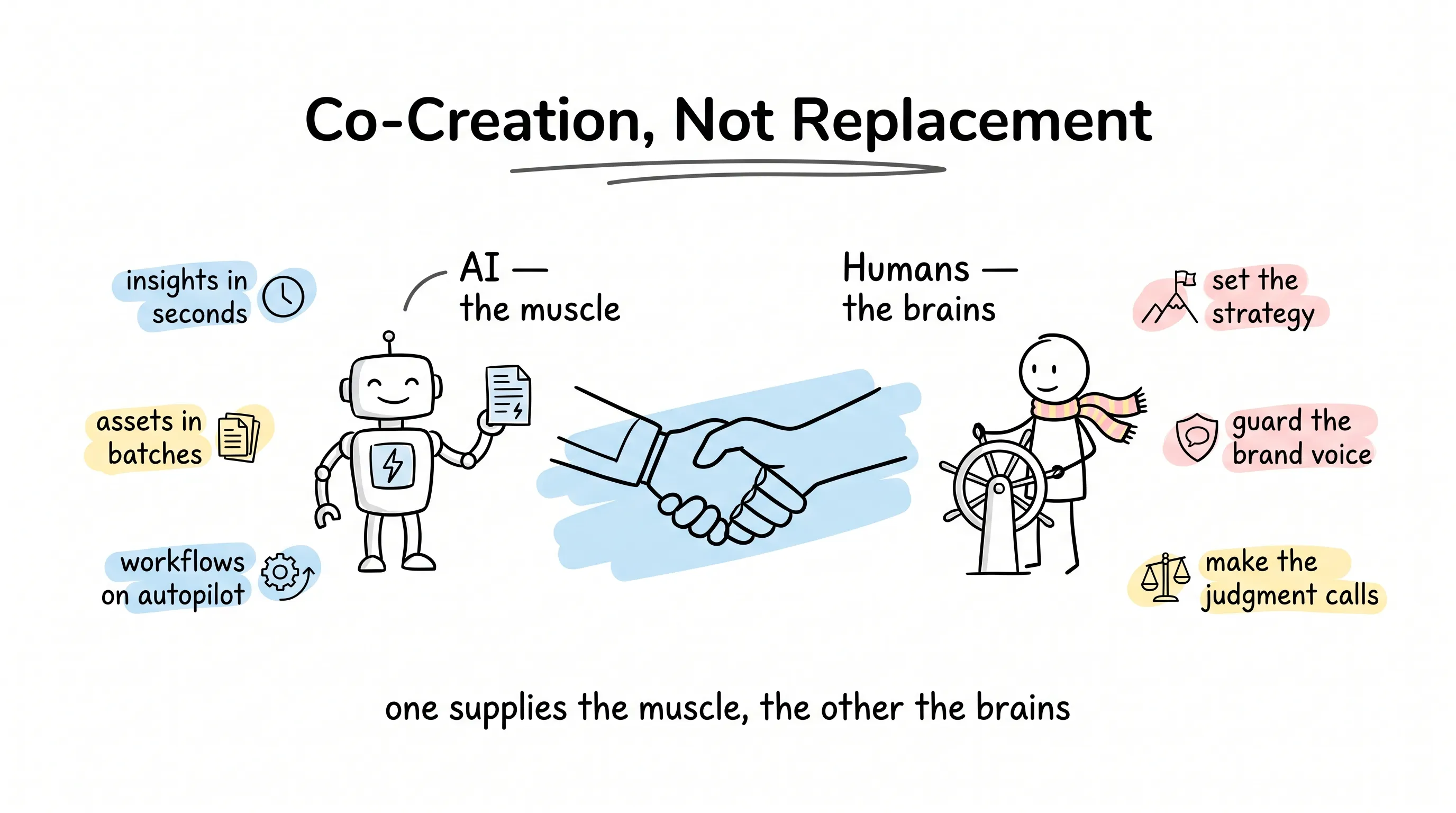
The next chapter is co-creation: machines and humans teaming up on the work.
The division of labor is clear. AI does the heavy lifting: insights in seconds, assets in batches, workflows on autopilot. Humans steer: set the strategy, guard the brand voice, make the judgment calls. One supplies the muscle, the other the brains.
Go one step further and you'll see two things happen.
One is predictive personalization. Before the user even clicks, the message is already there, figured out for them.
The other is autonomous media buying. The system tunes itself — no one needs to hit pause.
The whole way marketing works will shift from "reacting" to "orchestrating." This isn't some distant vision — it's happening right now.
So how does your team actually get started?
Don't rush to buy tools. First figure out where you stand.
A team's AI maturity basically has three stages. Stage one, piloting: trying tools in a few small campaigns. Stage two, partial integration: embedding AI into a handful of key workflows. Stage three, full integration: AI across the whole chain, from strategy to execution.
Most teams are stuck between stage one and two. That's fine. What matters is knowing where you are, then moving to the next step. Use a maturity matrix to benchmark yourself and see where the gaps are — don't go by gut feel.
When picking tools, ask yourself four questions.
One: build or buy? Building gives you control; buying gets you started fast. Most teams should use off-the-shelf first, and talk about building once it works.
Two: does it plug into your tech stack? CRM, CDP, ad platforms, analytics tools — if it doesn't connect, it's just another data silo.
Three: is it transparent? How does it compute its answers, where does your data go — can you explain it clearly?
Four: can it scale? Is it compliant? The tool has to match your ambition — and your legal liability.
The best tools share one more trait: they grow with you. The more fluent your team gets with AI, the more value the tool can squeeze out.
More important than tools: the people
Marketers who know how to use AI will beat marketers who don't. That's not a prediction — it's already happening.
That's why leading brands are running training proactively. Strategists, analysts, media buyers — the skill lists for all these roles are being rewritten: data literacy, AI ethics, and yes, prompt writing. That's right — writing a good prompt is becoming a craft in its own right.
Many companies start with internal bootcamps: small in-house classes, hands-on work, letting the team build muscle memory on the tools they already use every day. The goal isn't to turn everyone into a data scientist — it's to make using AI feel as natural as breathing, not like facing a scary monster.
A different industry, same flavor
AI lands differently in each industry, but the core is the same.
Retail: virtual stylists, dynamic pricing, inventory forecasting. Customers buy more smoothly, brands hold their margins tighter.
Finance: automated customer service, fraud detection, risk modeling — fast and accurate.
FMCG: generative AI to design packaging, predict trends, shorten the new-product pipeline — tracking real-time consumption signals.
Entertainment and media: personalized recommendations, generated trailers, content orchestration. By the time you realize what you want to watch, it's already in front of you.
The common thread comes down to one line: faster insights, sharper execution, and a better experience for the user.
Coming back to that friend of mine
After that dinner, he went back and did one thing: he gathered his team together, and instead of talking about "will we be replaced," they talked about "which tasks we hand off, and what we do with the time we free up." Three months later he told me: not a single person had left — and they'd hired two stronger ones.
So back to the original question. Will AI replace marketers?
AI won't replace marketers. Marketers who master AI will replace marketers who don't.
Anxiety is useless; getting hands-on is what works. Start with the first prompt you write today.
Here's to handing off the grunt work soon — and keeping your brain for where it's worth the most.
Continue reading
Related articles

It's 2026: Stop "Buying" AI Tools for Your Marketing Team — Start "Hiring" AI Agents
This learn article explains how AI agents differ from standalone AI tools in marketing, outlines three agent categories — build-your-own platforms, CRM-native agents, and vertical tools — and covers use cases across SEO, social media, advertising, and reporting, plus criteria for choosing one.

What Is GEO? How Your Brand Gets "Mentioned" in the Age of AI Search
An explainer on GEO (Generative Engine Optimization) for e-commerce and DTC brands: how it differs from SEO and AEO, why AI answers shape brand visibility, and eight practices covering question-focused content, consistent brand messaging, structured pages, external evidence, comparisons, and AI mention tracking.

AI Is Already Making Decisions for Your Customers. Are You on the List?
A learn article explains GEO (Generative Engine Optimization): why AI-generated answers now shape which brands customers see, and how SEO fundamentals, entity clarity, citable evidence, and monthly measurement affect visibility in AI answers.