
Google, Meta, or TikTok: Where Should Your Ad Budget Go?
A guide to matching ad platforms to customer intent, comparing Google, Bing, Meta, TikTok, Pinterest, LinkedIn, Reddit, Amazon, Apple, and X, and explaining when search, social, community, or purchase-point platforms fit different ad budgets.
A while back, an old friend of mine who runs a home-furnishings e-commerce business invited me to dinner. Halfway through the meal, he started sighing.
In the first half of the year, he had poured more than 600,000 yuan into Meta. It went okay at first, then the losses kept growing. He asked me: should he switch to a new agency?
I told him: don't rush to swap people. Let me ask you one question first: would your customers actively search for what you sell?
He froze.
He thought for a long while, then said: apparently, no. Nobody sits at home searching for "solid wood dining table" out of nowhere.
That was exactly the problem.
He didn't lack advertising. What he lacked was the right pond. The fish he was after never lived in Meta's ocean in the first place.
Today, I want to share with you what I figured out over that dinner.
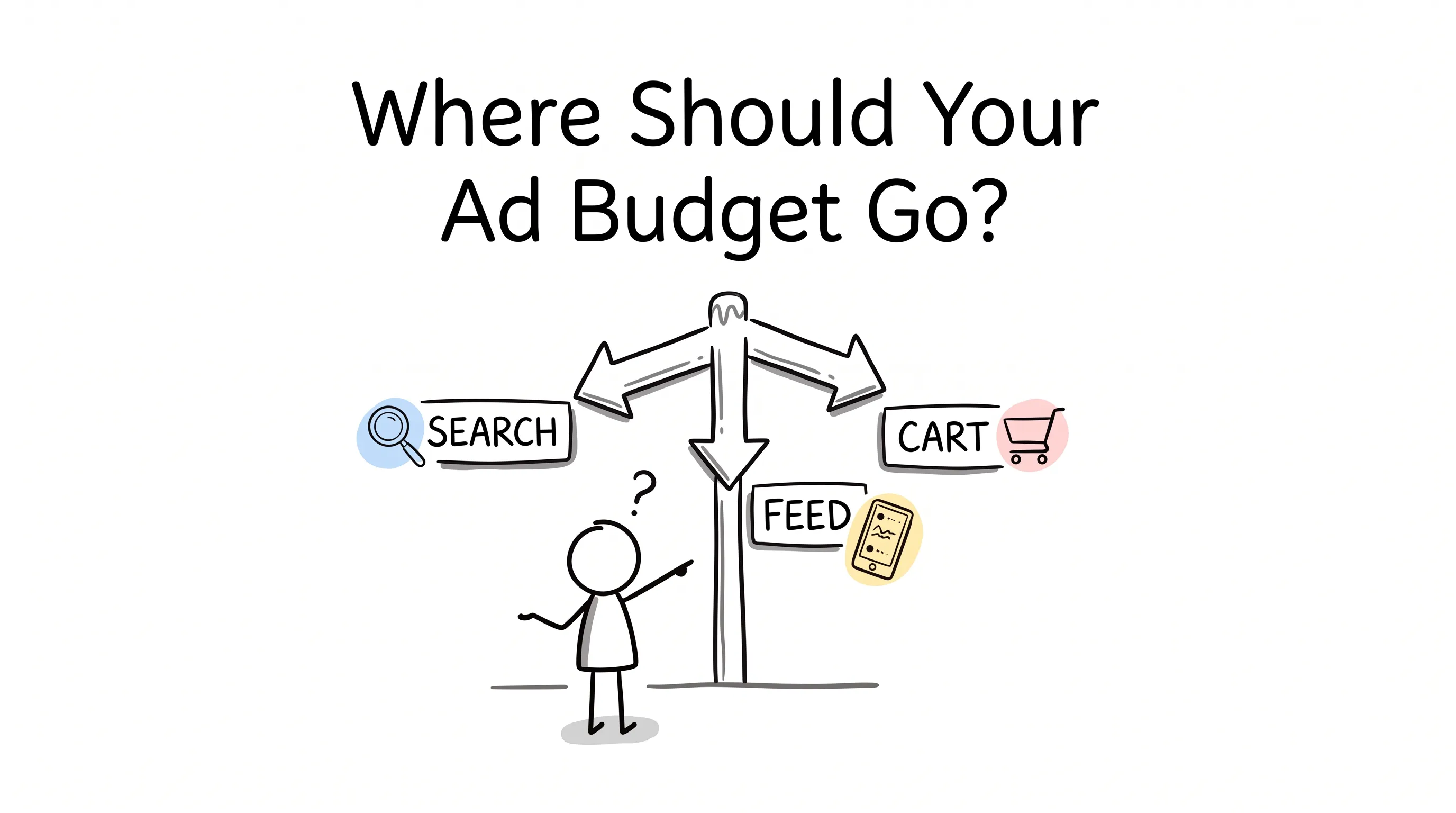
What Are You Actually Choosing When You Pick a Platform?
What does it mean to choose an ad platform?
Most people think choosing a platform means choosing traffic. Go wherever the crowds are.
Wrong. Choosing a platform means choosing intent.
What is intent? It's what your customer has on their mind at the very moment they open that platform.
Some people open one app with a question in mind, looking for an answer. Others open a different app purely bored, killing time. Throw the same ad at these two kinds of people, and the outcomes are worlds apart.
Think about it: handing out flyers at the entrance of a convenience store, versus handing them out at a building-materials market. Same paper, same person — same results?
Not the same. Because the people walking by have different things on their minds.
And there's a new twist to this today: almost every mainstream ad platform has stuffed AI and automation into its system. Smart bidding, automated creative, real-time optimization — the platform itself will push your ads to the people it believes are right.
What does that mean?
It means the gap in "how to run ads" keeps shrinking. What actually separates winners now comes down to a single question:
Which platform do your customers actually live on?
All right, let's go through them one by one. Who lives on each of these platforms, and what kind of intent does each reward?
Your Customers Are Already Hungry: Google and Bing
The first kind of intent: the person is already hungry and looking for food.
Here, Google is the undisputed king.
Why? When people anywhere in the world want to know something, their first instinct is still to search. Google Search, plus YouTube, plus Maps, plus a Display Network of more than two million websites — no rival matches that reach. Its AI delivery system can also optimize for you in real time on every single auction.
Sounds perfect?
But Google has a fatal weak spot that many people never think through.
Google can only catch demand. It cannot create demand.
What do I mean? Someone has to search first before Google has anything to catch. If hardly anyone in the world searches for what you sell, then no matter how much you spend on Google, you're casting a net into a pond with no fish.
In one sentence: Google is where you harvest demand, not where you plant it.
So, friends planning to launch a brand-new category and educate the market out of thin air — don't stake everything on Google yet. Don't worry; later we'll cover who can build demand for you.
What about Google's old rival, Bing?
Bing is the runner-up, with 23 billion searches a month on desktop. It truly can't match the leader on volume, but it holds two cards nobody else has.
First, the people are different. Many Bing users are office professionals and the people who manage the household money — disposable income runs higher on average.
Second, it holds a hidden card: you can target people by their LinkedIn professional profiles. Want to advertise only to "procurement directors in manufacturing"? You can.
Add in cheaper clicks, and for many businesses Bing is an overlooked bargain.
Of course, it has a ceiling. In scale, Bing will never grow into a Google. It's a supplement, not a pillar.
Your Customers Aren't Awake Yet: Meta, TikTok, Pinterest
Okay, so where does demand actually come from?
From scrolling.
There's a category of platforms where users never planned to buy anything — they scroll along, and somewhere in the feed, the craving gets planted. If you're building a new brand or creating demand, this is where you come.
Meta first.
Facebook plus Instagram: three billion monthly active users. Meta's strongest suit isn't the size of the crowd — it's that the platform holds your likes, your saves, how long you linger. These behavioral signals let it guess what users want before the users themselves ever search. Its automation system then takes over all the chores: expanding audiences, matching creatives — the machine runs itself.
For e-commerce, for direct-to-consumer brands, this is a gold mine.
But a gold mine comes with mining conditions.
Your creative must be strong, and your offer must be crystal clear. If either one is weak, your budget is money thrown into the fire.
Why? Because Meta doesn't reward logic. Meta rewards attention.
When a user scrolls onto your ad and isn't hooked within three seconds, one flick of the thumb and it's gone. And creatives fatigue: however good an ad is, it goes dull after two weeks, and you have to keep swapping in new ones.
Making content nonstop is exhausting. But that is the cost of war on Meta.
Now TikTok.
1.6 billion users, with young people as the main force. On TikTok, "search intent" doesn't exist. It's all about immersion: users soak in entertainment content, and the algorithm guesses what you want from what you watched and how long you watched.
For brands that understand content and dare to play, TikTok's algorithm is a hit-making machine. One short video can push you in front of millions of people overnight.
But let me pour a bucket of cold water on that.
Most brands on TikTok look like ads at first glance. And users swipe past ads far faster than you think.
To survive, you have to keep producing content that doesn't look like ads. Most teams can't carry that intensity.
There's another treasure ground that's easy to overlook: Pinterest.
If you run a business in home goods, fashion, or lifestyle, look at it seriously. Because it's special: users come here carrying planning intent. They're mulling over what their future home should look like and what next season's wardrobe should hold.
Seventy percent of the audience is female, and younger users keep growing. Your product appears at the moment right before they make their decision. That timing can't be bought anywhere else.
You Only Need a Hundred Right People: LinkedIn and Reddit
Some businesses don't need a million passersby — just a hundred of the right people.
That's when it's LinkedIn's turn.
1.5 billion professionals gather here, and by LinkedIn's own numbers it can reach 98% of Fortune 500 CEOs. Users here have twice the purchasing power of ordinary internet users. Target by job title, by company size, by seniority — for B2B customer acquisition, this capability has no rival.
But look at your wallet before entering.
LinkedIn's cost per click can keep your finance person awake at midnight. If your backend can't catch what comes in — if the sales process and conversion funnel can't keep up — that money burns for nothing. It's heavy artillery for B2B, and not everyone can lift it.
The other one is Reddit.
A hundred thousand small interest communities, from tech gadgets to one specific game mode of one specific game — every circle you can think of. The people here chat in earnest and sweat the details.
If your business lives on word of mouth, or serves one very specific circle, Reddit lets you join a conversation that's already in progress.
But Reddit has an iron rule: you have to behave like a community member, not like an ad.
Users here are extremely sensitive to the smell of marketing. Once you're caught pretending, at best your ad gets ignored; at worst you get exposed and dragged through the mud in public. Contribute first, talk business later — the order cannot be reversed.
Your Customers Are Reaching for Their Wallets: Amazon, Apple, X
The last category of platforms stands right where the purchase happens.
First, Amazon.
The consumer is already at the shopping cart, about to check out — this is intent itself. Amazon sits on mountains of real transaction data, and its AI can push your product to people who are comparing prices and about to place an order.
The cost is that competition here is cutthroat. Whether you make it depends on your reviews, your price, the quality of your product page. The platform is only a shelf; the hard fight on the shelf is still yours to fight.
For app businesses, look at Apple's App Store search ads.
Eight hundred million people visit the App Store every week. The instant a user searches for a solution, your app happens to be right in front of their eyes. The environment is clean, and the installs are high quality.
The weakness is obvious too: hot placements are frighteningly expensive, and it's easy to acquire new users but hard to keep them.
Last, X — formerly known as Twitter.
X is where real-time moments happen live. Product launches, big news, the moments when the whole internet piles in to watch — the world's attention gathers here. If you want to ride cultural moments and do event marketing, it's the right place.
But it only handles the buzz, not the deals. X is a conversation engine, not a conversion machine. Count on it to bring you conversions directly, and you will be disappointed.
So, Which One Do You Choose?
Back to my friend.
After that dinner, one thing became clear to him: it's not that Meta is bad — it's that his customers aren't waiting for him there. His customers are the people who arrive searching "compact apartment solid wood dining table."
Later he moved his budget over to search, and only then did his campaigns recover.
So stop asking "which platform is best."
There is no best platform, only the platform that matches.
Every platform rewards a different intent. Customers already hungry — put money into Google and Amazon. Customers not yet awake — go plant the craving on Meta and TikTok. Want precision, not scale — go with LinkedIn and Reddit. Customers reaching for their wallets — hold your ground at Amazon and the App Store. Chasing real-time hot moments — that's when X gets its turn.
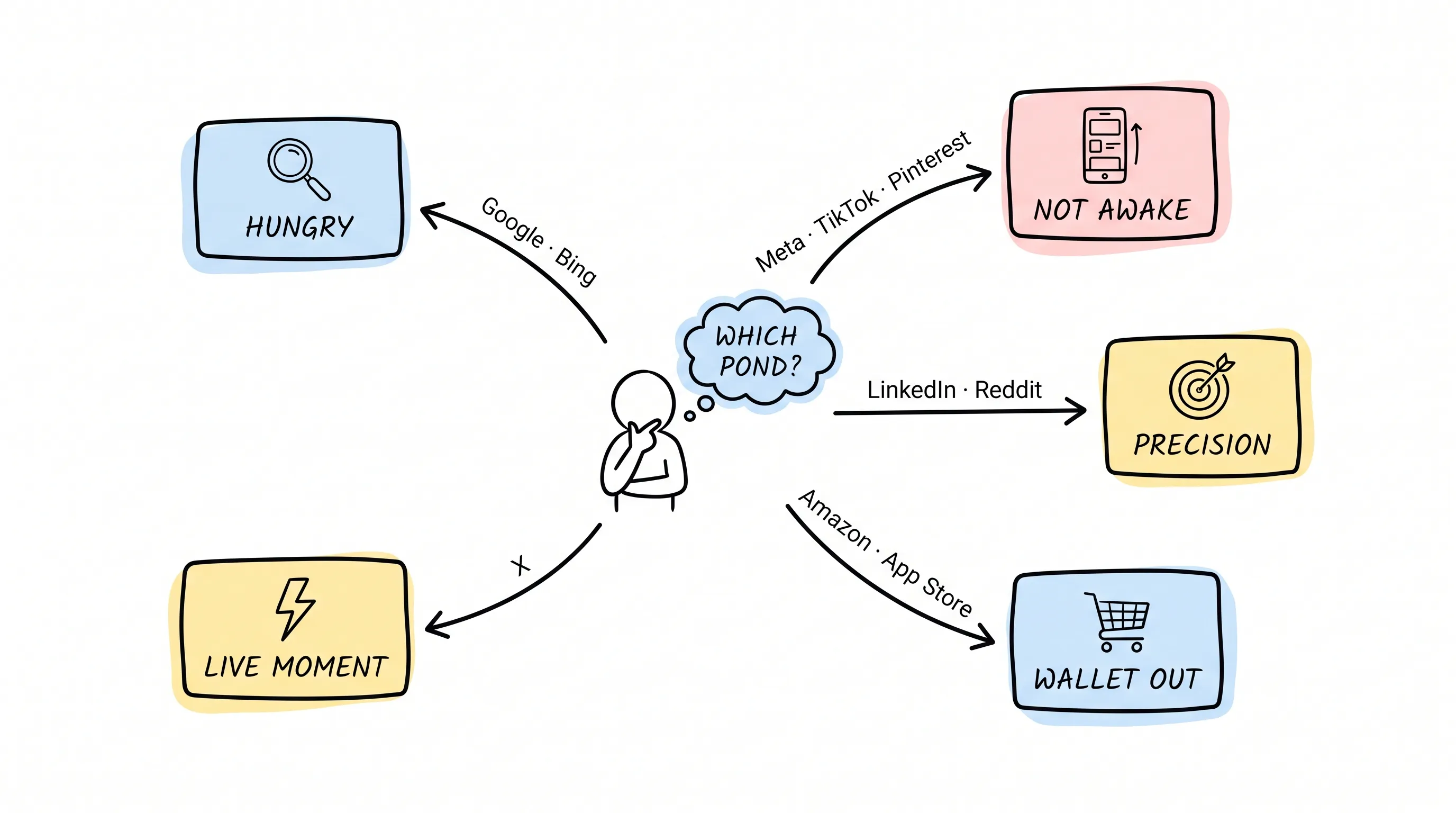
Choose right, and the platform's algorithm helps you roll a snowball.
Choose wrong? You're not just burning money. You are training the algorithm to fail harder.
Finally, here's one criterion to take with you. Before every payment, ask yourself only one question:
Which platform lets me bring the right customers through the door at a price I can sustain?
The answer isn't in any ranking. It's in the screen your customer scrolls before bed tonight.
May every cent of your next ad budget be spent where your customers truly are.
Continue reading
Related articles

It's 2026: Stop "Buying" AI Tools for Your Marketing Team — Start "Hiring" AI Agents
This learn article explains how AI agents differ from standalone AI tools in marketing, outlines three agent categories — build-your-own platforms, CRM-native agents, and vertical tools — and covers use cases across SEO, social media, advertising, and reporting, plus criteria for choosing one.

Did the Money You Spent on AI Marketing Ever Come Back?
A guide to measuring AI marketing ROI across three layers: ad reports, sales pipeline, and the financial ledger. Covers metrics such as ROAS and CPA, eight dashboard metrics, industry benchmarks, and common measurement mistakes.

How to Pick a Creative Automation Platform: First, Figure Out What These Eleven Actually Do
A learn article sorts eleven creative automation platforms — including Bannerflow, Celtra, Smartly.io, and Storyteq — into four functional groups and proposes five evaluation questions covering publishing reach, automation depth, ease of adoption, team fit, and verifiable evidence.