
In the Age of AI, Your Competitor Is No Longer in Your Industry
You're on a business trip. The London meeting just wrapped up, and the next stop is your company's office in Bulgaria.
Picture this.
You're on a business trip. The London meeting just wrapped up, and the next stop is your company's office in Bulgaria. You have a few days to spare in between, so you decide to detour through Athens — the points and miles are sitting idle anyway. What to see, how to plan it? You don't dig through travel guides. You just open an AI assistant and pour everything out in one breath: how many days, what you want to see, what your budget is — now build me the itinerary.
A few seconds later, a perfectly presentable itinerary appears. Which day to visit the Acropolis, which day for the hot springs, which neighborhood to dine in each evening — even the booking order is arranged for you.
Pretty great, right?
But here comes the part you know all too well: now you have to take that itinerary and execute it piece by piece — on flight booking sites, hotel pages, restaurant reservation forms. Checking one site after another, filling out one form after another.
In that moment, you're thrown back into the pre-AI world.
The First Half Is the Future. The Second Half Is the Past.
What makes this interesting is that it exposes our most honest state right now: the experience is broken in two.
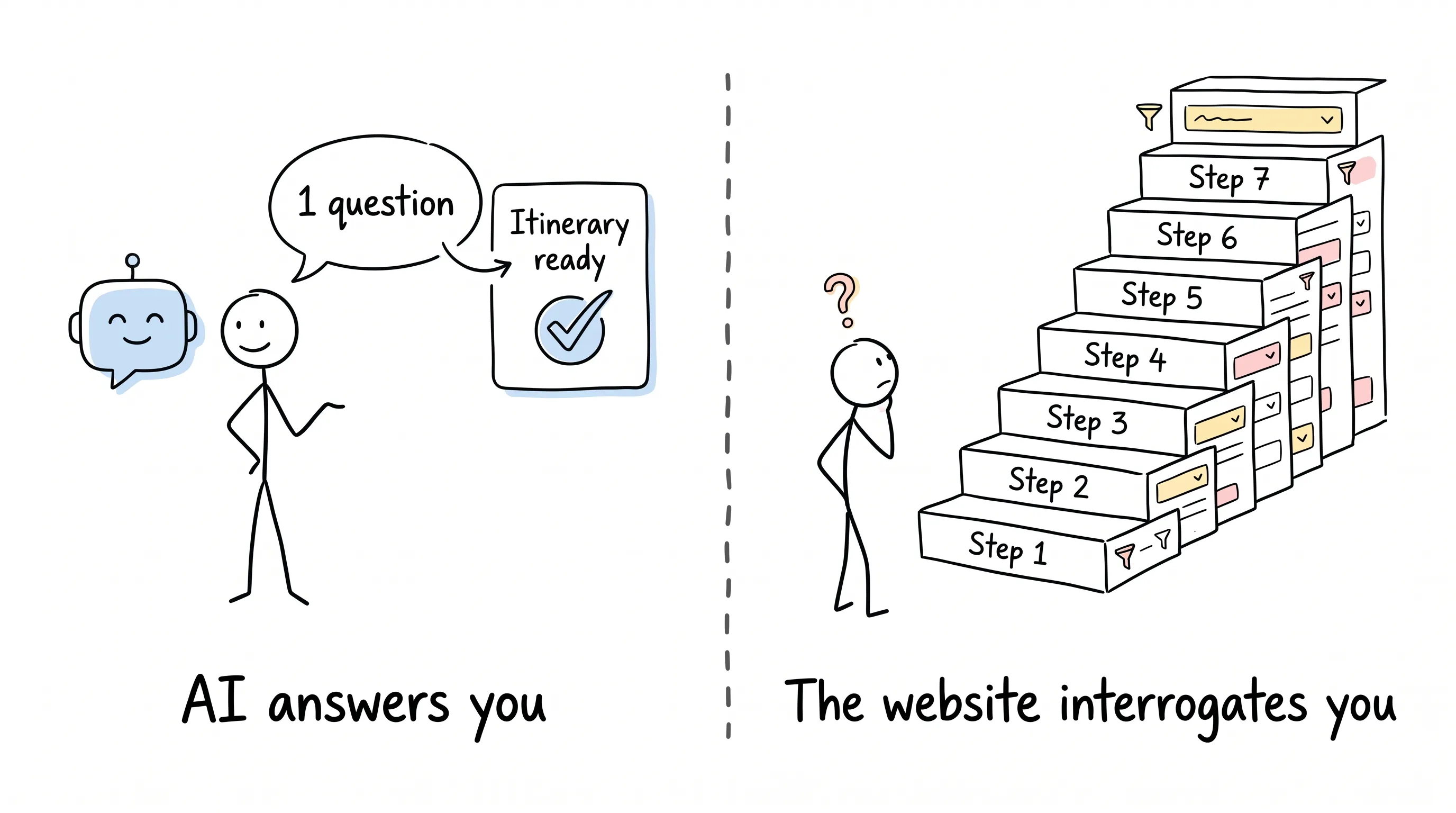
In the first half, AI chats with you, understands your context, answers your questions in seconds. In the second half, the moment things get real — paying, placing an order — you fall into a rigid pipeline a company designed for you long ago: dropdown menus, filters, page after page of forms, one step at a time.
Put bluntly: the AI answers you. The website interrogates you.
And these two experiences force you to do exactly opposite things. The logic of the old-style website is that the company designs a path, and along the way you synthesize the information and find the answers yourself. The logic of AI is that you just say the question out loud, and the answer is handed to you.
The former makes the customer do the work. The latter makes the company do it.
Which one do you think customers will choose?
Expectations, Once Raised, Never Go Back
Why is this serious? Because expectations, once spoiled, never go back.
Think about what has happened these past few years. The pandemic turned a lot of "nice to have" things into "can't live without" things. Ordering online, food delivery, doorstep shipping. Is the pandemic over? It is. Did users go back?
No.
Once convenience becomes a habit, there is no going back.
AI is doing the same thing to websites. Your customers use AI every day and are already used to describing their problem in one sentence and getting an answer. When they come back and face your seven-step forms and four levels of filters, they won't curse you out. They'll just quietly close the page.
And the part that stings most is still to come: your competitor has changed.
You're no longer just competing with your industry peers. If your customer is a heavy AI user, what are you actually competing against? Against the kind of experience AI gives them. Instant answers, full context. What about your website?
Marketers have an old habit of assuming the customer journey belongs to them — drawn on a whiteboard, one stage linked into the next. Honestly, they may never have truly owned it. Users simply had no other choice back then, so they played along and finished the show.
Now they have AI.
You might say, my industry is different, my customer base is different. True — every company is on its own AI journey, moving at its own pace and playing by its own rules. But one thing is common to all: don't use your own progress to guess your customer's patience.
Customers already behave this way today. Just imagine: what will they still put up with by 2030?
So What Do You Do? Climb by Levels, Not by Leaps
Hearing all this, you might be a little anxious: do I need to tear everything down and rebuild the entire website?
No.
My advice is: start from the places where risk is low and returns are high; once it's proven, move up one level. Don't try to jump to the finish line in one go.
I break this into four levels.
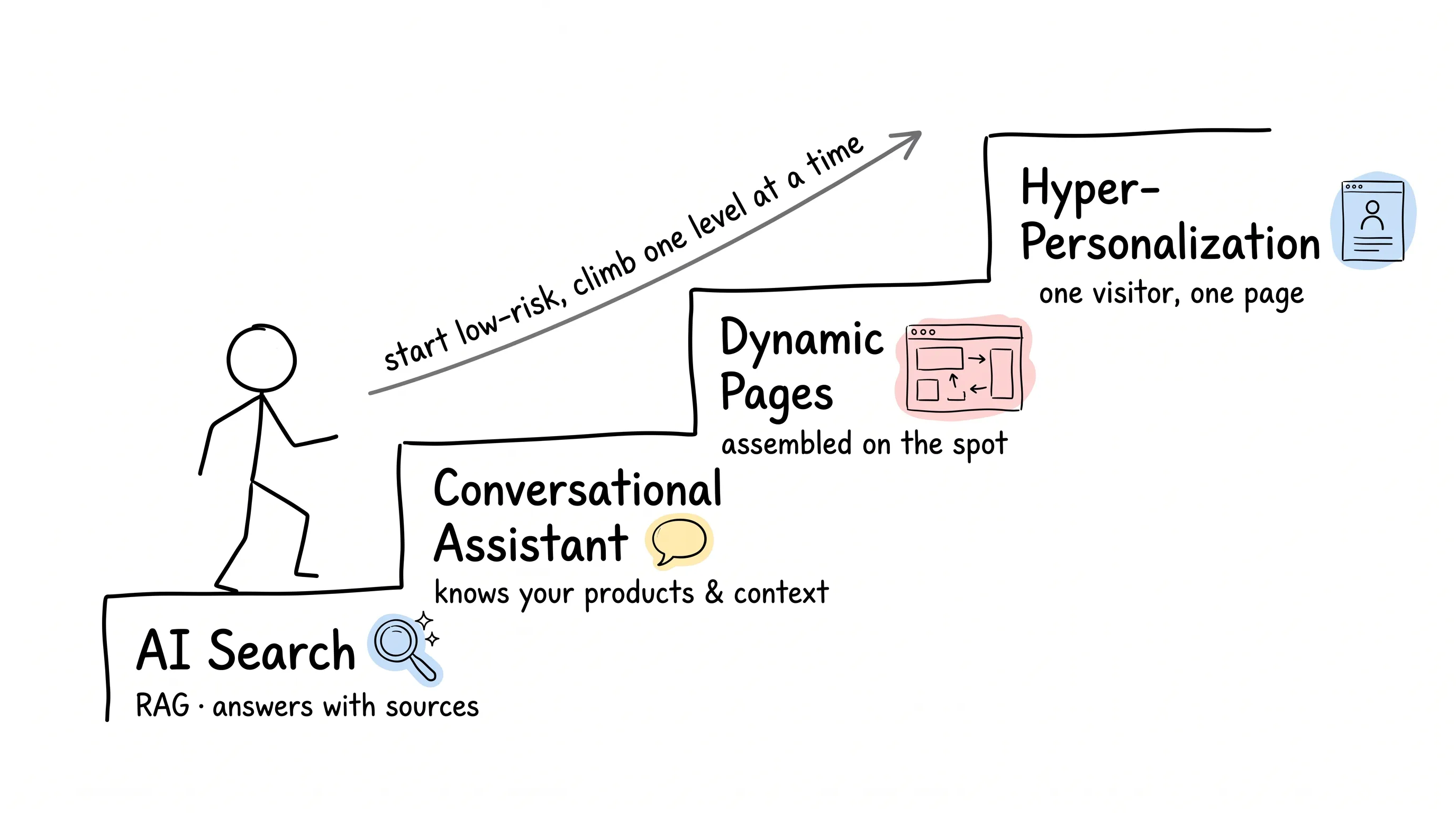
Level one: put AI search on your website. The technology behind it is called RAG — retrieval-augmented generation. What is RAG? In plain terms, it means the AI answers questions using only content you yourself have approved, and every answer is marked with its source. That way it doesn't make things up, and everything it says is something you can stand behind.
Level two: conversational assistants. Note — this is not the traditional kind of customer-service bot that answers everything except your actual question. It's an assistant deeply rooted in your company's knowledge and business context. It knows your products, knows your documents, and also knows who's asking.
Level three: dynamic pages. Pages are no longer built in advance; they are assembled on the spot according to the intent of the visitor in front of you.
Level four: hyper-personalization. At this level, what every visitor sees is a page generated for that one person alone. This is the ultimate form. The technology already exists, the data already exists — what's holding it back is how well people understand and put that data to use.
Every company starts from a different place, with different governance rules and different data boundaries — there's no need to copy each other's homework. It comes down to one question: what is your customer actually anxious about? And at which level can you catch them first?
Let's start with level one. There's a ready-made example.
27 Minutes
Progress is a company that has been making software for forty-five years, with more than fifty product lines and annual revenue past one billion US dollars; in October 2026 it just completed its acquisition of the data company Domo. The AI search capability on its website comes from Nucleus, acquired in 2025, now called Sitefinity RAG.
The company ran an experiment on itself: it embedded Sitefinity RAG into its own homepage and swapped out the traditional search box. In their own words, this is called "drinking your own champagne."
And the result?
Users who searched with RAG spent an average of 27 minutes per session on the website.
Twenty-seven minutes. Go take a look at the average session duration in your own website's backend analytics. For most websites, getting past two minutes would already be good.
But what's worth more than the 27 minutes is something else: what users are actually asking.
All the questions went into the same search box. So for the first time, without running user interviews or convening focus groups, they could see it unfiltered: what words do users use to describe their problems? Do we have content that can catch them? Can our products actually solve what they care about?
Marketers have been shouting "know your customer" for decades. Now, a single search box delivers the answer straight to you. These real questions are, in turn, helping them set the product roadmap and the market strategy.
By the way, on the other end of the data, this is exactly what Domo — the company they acquired in October 2026 — is in charge of: seeing clearly from behavioral data what customers actually need. On one end, data tells you what customers want; on the other, the search box lets customers tell you in person what they want. Put the two ends together, and the answer writes itself.
One Sentence Instead of Seven Steps
Now look at one of their customers, a global manufacturer of doors and windows (name withheld). This company has an enormous volume of content: all kinds of certifications, installation specifications, plus variant versions for different regions. And its customers come in three types: door and window fabricators, architects, and ordinary homeowners.
They first did level one, embedding RAG search into their website. Customers asked questions in plain everyday language, and the answers they got came with citations attached, clickable back to the original documents.
Then comes the part that strikes me as truly brilliant: the product selector.
Before, if a customer wanted to choose a product, they had to fill out a seven-step form, passing through filters, categories, and decision points, with conditions that were all hard-coded. Now, they have connected Progress's Agentic RAG inside Sitefinity, and the user only needs to ask one question:
"I'm designing a large commercial entrance, and I need an energy-efficient double door that meets ADA (the Americans with Disabilities Act, the U.S. accessibility standard) accessibility requirements. Which model should I choose?"
The system understands the question, and within seconds it brings out the product information together with the accompanying documentation. No filters, no hierarchies, no guessing — and definitely no seven steps.
From seven steps, to one sentence. A small change — but for the customer journey, an enormous one.
There's a principle here worth writing down for everyone doing digital work: The customer is sacred. If you can give them the answer they want, with guardrails in place, you win.
The word "guardrails" is not said in passing. The AI must not make things up; answers must come from content you have approved, with sources attached. That is the bottom line.
Pages Start to Come Alive
One level further up: dynamic pages. Let me describe a contrast for you.
On the left is an ordinary bank website. The pages are built in advance — whether you're here to deposit, to take out a loan, or just wandering around, you're shown the same face.
On the right, it's still this website, but the pages have started to move. A homeowner comes in looking at mortgages, and the system automatically assembles the page for them: the right banner, relevant content blocks, the loan calculator, the application materials — everything aimed at the single goal of "getting a mortgage."
The word "personalization" is not new; marketers have been shouting it for decades. What's new is the way it gets done.
Personalization used to mean marketers manually building rules, sketching out segments, and pre-defining every single path — work so endless it was never finished. Now, marketers are only responsible for defining four things: intent, constraints, tone, and guardrails. The rest is done by the system, which assembles in real time using content you have reviewed. One visitor, one kind of page; ten thousand visitors, ten thousand pages.
The work has shifted from "building the house" to "drawing the blueprint."
The Last Mile
Back to the scene at the beginning.
The AI has planned your Athens itinerary, clever and thoughtful. But the last step — payment — still sends you back to one old website after another: filling in forms, filtering options, waiting for confirmation.
That stretch of last mile is the opportunity for every website.
No need for one giant leap. Find a low-risk, high-return entry point, get it running first, get the results, then climb one more level. By the time your peers are still watching from the sidelines, you'll already know what your customers are asking.
Here's to the day when customers gladly spend those 27 minutes on your website.
Continue reading
Related articles
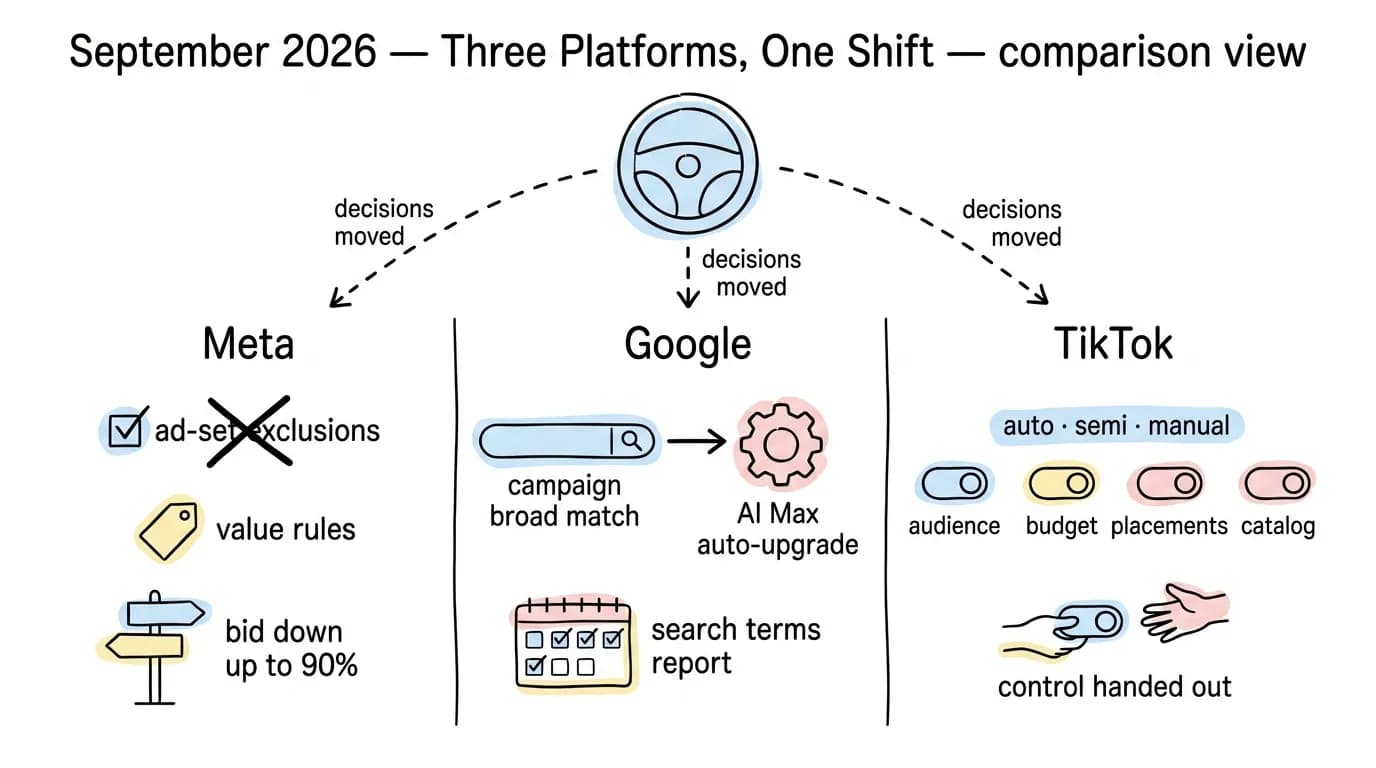
In September, Three Platforms Took Away Part of Your Steering Wheel
A few days ago, I went through everything the three big ad platforms did in September 2026. And I noticed a remarkably interesting coincidence.
Meta's New Terms Hit the Pause Button on the Eve of the Effective Date
A while back, I was helping a friend of mine who runs a cross-border e-commerce business go through the compliance checklist for his ad account.
Google and Meta changed 17 ad rules this week. 6 of them need checking today.
A few days ago, I was helping a friend who runs a cross-border e-commerce business go through his ad accounts.