
Marketing AI Agents: What Are They, Really? I Went Through the Ten Major Players
An explainer distinguishing marketing AI agents from rule-based automation, with three checks for spotting real agents and a grouped look at ten platforms including Salesforce Agentforce, HubSpot Breeze, and Klaviyo, plus pre-launch advice on baselines and human review.
A few nights ago, an old friend who has spent over a decade in marketing messaged me on WeChat in the middle of the night.
His exact words: next year the AI budget doubles, and his boss wants a plan on the table within three months. He had gone through the websites of more than twenty platforms, and the more he read, the dizzier he got.
His question for me: which one should I actually buy?
I told him: don't start with which one to buy. First answer me this — can you tell "marketing automation" and "marketing AI agents" apart?
He froze.
You can't blame him. Nearly every platform on the market calls itself an AI agent, but what's inside varies: some are real agents, others are just old rule engines wearing a new shell. You can't tell from the outside — you only find out after the money is spent.
So I took a careful pass through the ten major players on the market. By the time I was done, I'd realized the starting point isn't picking a platform at all — it's getting clear on a far more basic question.
What exactly is a marketing AI agent?
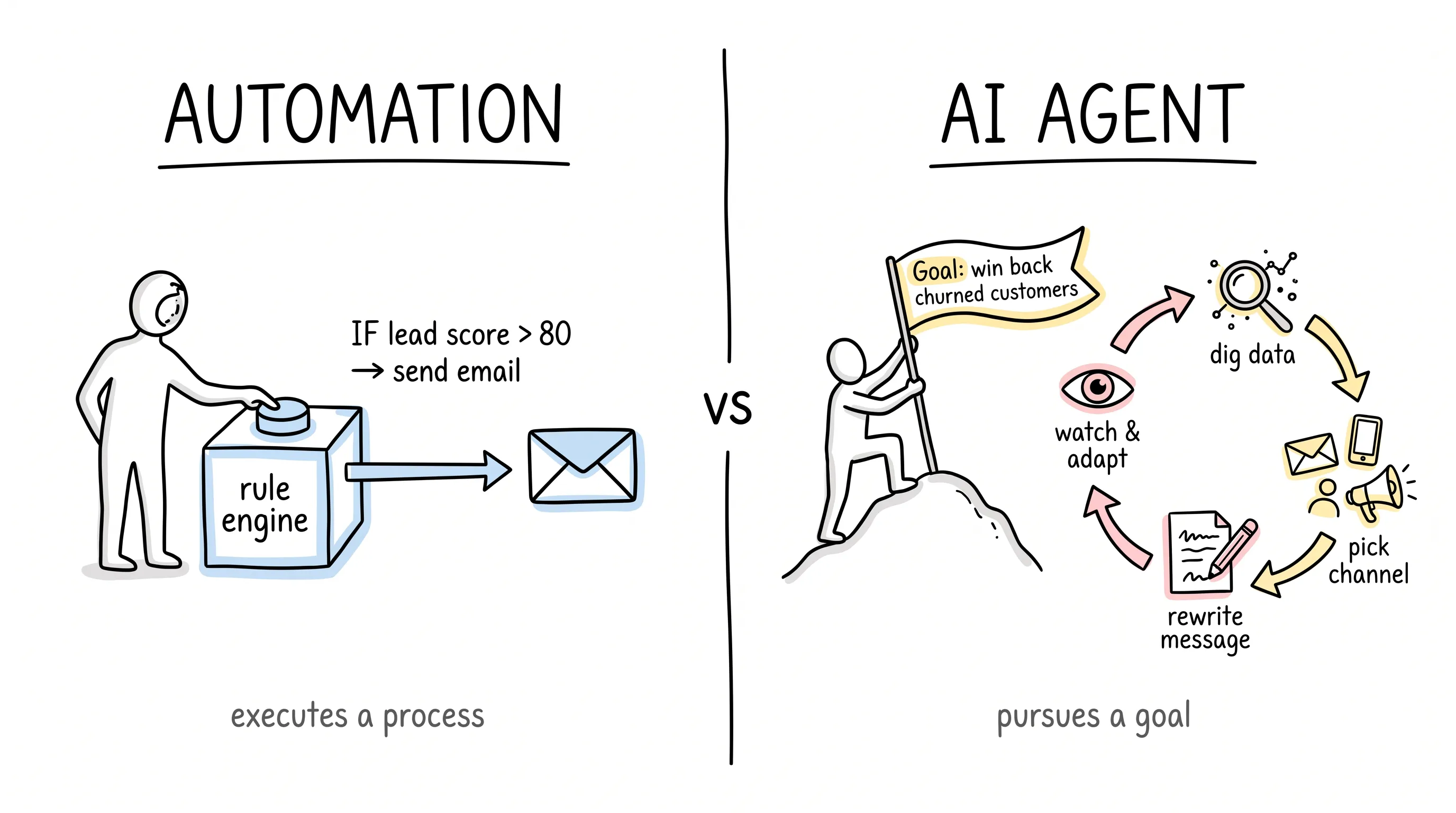
Start with automation. You set a rule in your system in advance: when a lead's score tops 80, send an email automatically. Condition met, action fires; condition not met, nothing happens. It's reliable and obedient, because it only ever does what you wrote into the rule — not a single step more.
So what's a marketing AI agent?
An agent is handed a goal, not a rule.
Say you hand it a task: win back the customers who churned over the past year.
An automation system's answer is to stuff those people into a pre-built win-back sequence, blast it out, done.
An agent's approach: first it digs through their behavioral data to see how each person slipped away; then it decides who gets email, who gets SMS, who gets ads; then it rewrites what to say based on each person's history; after sending, it watches the responses — who clicked, who replied, who deleted — and lets the next round of actions change accordingly. Think about it: not one step in that whole chain needs a human standing by.
One executes a process; the other pursues a goal. That is the dividing line between automation and agents.
That dividing line is worth a lot of money right now. Whatever you've thought of, your competitors have thought of it too, and what everyone is racing on is who moves faster, in finer detail, closer to each individual person.
So how do you tell a real agent from old wine in a new bottle? I look at three things.
First: can it orchestrate actions across channels and systems on its own, or does it just pace around its own backyard?
Second: does it adjust to real-time signals? When the data changes, its next move changes too — that's what adaptation means.
Third — and the easiest to overlook: can its results be tied to revenue? Sending ten thousand emails isn't a result. How many qualified leads and closed deals it brought in — that's a result.
Then there's the lesson most teams only learn after getting burned: why does governance matter so much? Because the faster an agent runs without being able to explain why it made a decision, without an audit trail, and without a human hand on the brake, the bigger the risk. For any serious enterprise deployment, autonomy and oversight have to come as a pair.
Ten players — how do you actually choose?
Now for the main event.
First, my evaluation criteria: degree of true autonomy (does it reason, or does it follow rules?), how deeply it meshes with your existing tech stack, whether personalization can scale, cross-channel orchestration capability, and how transparent the pricing is. For enterprise scenarios, I weight governance and transparency heavily.
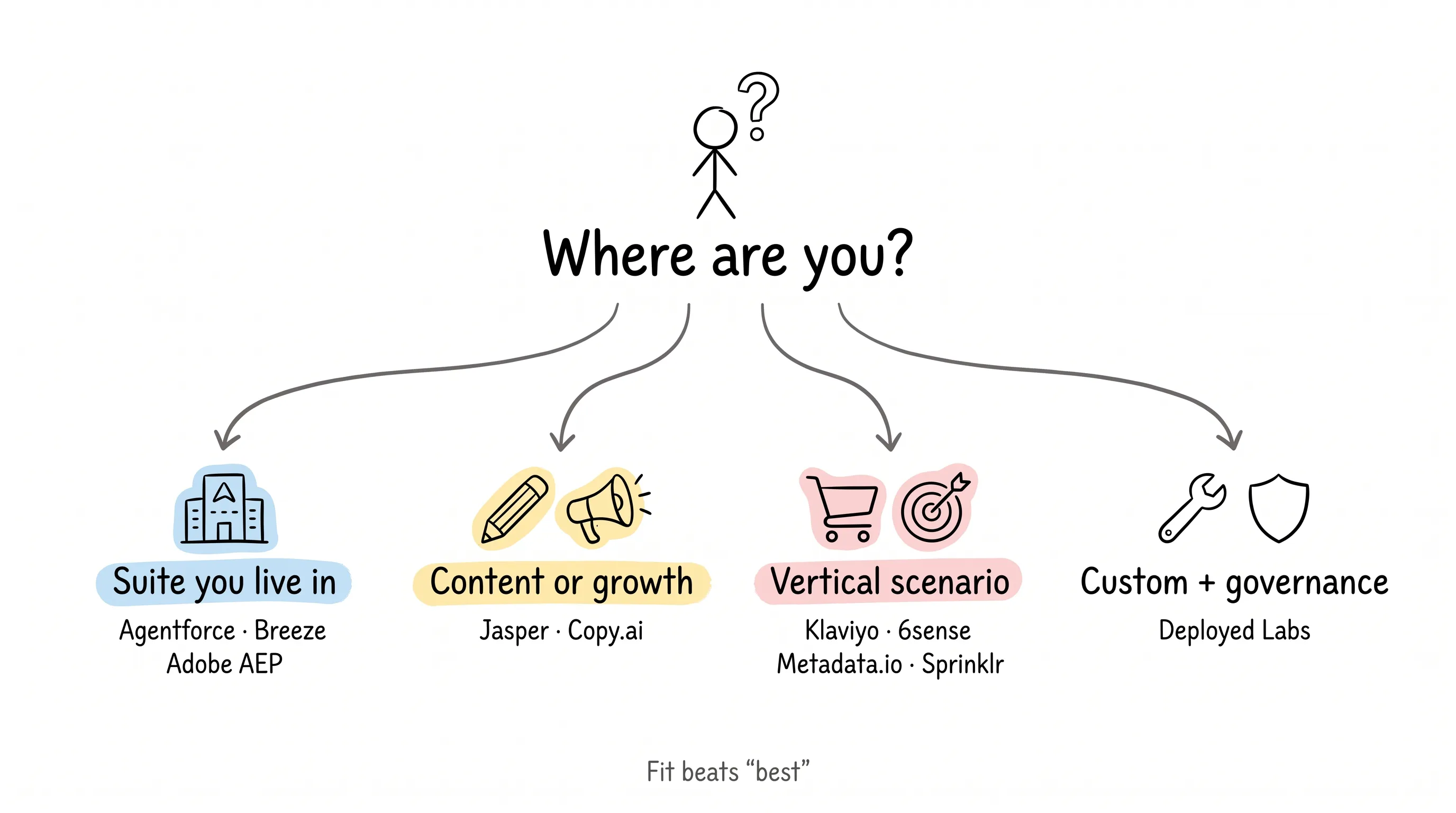
But honestly, the criteria are secondary — your starting point is what matters. You're not picking the best of ten platforms; you're picking the one that meshes best with the systems you already run.
So no ranked list. I'll group them by your situation.
Start with the suite you already live in
If you're already deep on Salesforce, look at Agentforce first. It launched in 2024 and is now one of the most mature enterprise agent platforms. Its marketing agents run on Data Cloud, where sales, service, and marketing data all live in one place, handling lead qualification, campaign personalization, and follow-up sequences with genuine multi-step reasoning powered by its own Atlas Reasoning Engine. Pricing is per conversation — about $2 each — and it's included outright in the higher-end suites. The weakness is just as clear: it was born inside the Salesforce ecosystem. If you don't have the full Salesforce foundation, expect a serious stretch of catch-up before you can switch it on.
Mid-size teams with HubSpot as their home base should look at Breeze. It rolled out in 2024 and expanded in 2025. Agents for content, social, prospecting, and data enrichment all live inside the HubSpot platform, working off the same data your sales and service teams already hold. The pricing is refreshingly straightforward: $800 a month for Professional, $3,600 for Enterprise, agents included. The trade-off: integration is excellent inside the ecosystem, but don't expect much beyond it — there's limited room to customize for complex enterprise stacks.
Large enterprises running the Adobe stack should look at Experience Platform plus AI Assistant. Under the hood is Sensei GenAI: segmentation, content, customer journeys, and real-time personalization end to end, and marketers can query data, build segments, and run workflows in natural language. Marketo starts at $895 a month; AEP is priced separately by enterprise scale. The capability is real, and so are the complexity and total cost of ownership — mid-size teams should weigh that carefully.
Is your main battlefield content, or growth?
Teams producing content at volume should look at Jasper. Its center of gravity is content workflow automation: give Campaigns a campaign concept and it turns out a full set of matching assets — ad copy, landing pages, email sequences, social content — with the brand voice held steady the whole way. From $49 per seat per month, $125 for the Pro tier, and it connects to Surfer SEO and Google Docs. In one line: bring it your content capacity problem; don't count on it for full-funnel orchestration.
Teams running growth and go-to-market (GTM) plays should look at Copy.ai. It has pivoted from a writing tool into a GTM agent platform, chaining research, content, data enrichment, and outreach into multi-step workflows, with plenty of prebuilt templates you can assemble without code. Starter runs $36 a month, Advanced $186. A good fit for outreach-heavy teams; enterprise-grade orchestration across multiple systems is not its thing.
When your scenario is vertical, pick a vertical tool
For e-commerce and direct-to-consumer (DTC) brands, there's basically one answer: Klaviyo. It spreads AI across email and SMS — predicting customer lifetime value, predicting churn, optimizing send times, generating copy — and it's all built on first-party behavioral data. For high-frequency engagement scenarios, this playbook is finely tuned. Priced by contact, from $45 a month. But it's a blade built for e-commerce; B2B teams will find its channel coverage too narrow.
For B2B enterprise sales, look at 6sense. Its AI works at the account level, using intent data to find accounts that are "in-market," then coordinating multichannel outreach. Its agents can now send outbound emails and book meetings on their own. Custom pricing. For enterprise teams doing account-based marketing (ABM), this is first-tier; if you sell consumer goods, keep walking.
B2B teams that lean on paid campaigns should look at Metadata.io. Audience targeting, creative testing, budget allocation, bid management — all handed to agents to run automatically — and it connects to your CRM to attribute spend straight to pipeline. Custom pricing. It's a sharp point solution, and precisely because it's a point solution, broader multichannel orchestration has to be assembled separately.
Large enterprises with multiple brands and a global footprint should look at Sprinklr. Marketing, advertising, customer service, and social listening unified under one AI layer, dozens of channels managed from a single interface, with governance and brand-safety controls that rank among the best in the market. Custom pricing, with the mid-market entry point somewhere north of $1,500 a month. The bigger your footprint, the more it pays off — and the heavier the implementation gets.
When you need deep customization — with governance built in
The first nine are all standard products. But some teams run a messy mix of systems under heavy compliance requirements, and no standard product fits their workflows.
That's when you look at the custom camp, such as Deployed Labs. Its approach: hand you 30-plus prebuilt marketing agents, each one adapted to your workflows, data sources, and compliance requirements, with governance, audit, and permissions built into the architecture from the ground up, not patched on afterward. The commercial playbook is equally direct: lock down the ROI target before work starts, run a working demo on your own workflows before any commitment, and deliver against milestones rather than handing you a report at the end. The stated goal is $10 million to $20 million in returns within 9 to 12 months, with project investments typically between $500,000 and $2 million. Behind it sits the Christian & Timbers AI executive search network, which lets deployments draw on the live playbooks of leading AI-native organizations.
The selection logic really comes down to one sentence: off-the-shelf platforms buy you time; custom builds buy you fit. There is no third answer.
Four reminders before you go live
Picking a platform is only step one. The teams that have actually seen returns all tend to do the same things.
One: start with a high-volume process with clear rules. Lead nurturing, content reuse, campaign optimization — any of these work. When inputs and outputs are clear and the before-and-after data lines up, results can actually be demonstrated.
Two: measure a baseline before launch. Your current conversion rates, response times, cost per result — write them down first. Without a baseline, the ROI math never adds up to anything you can trust.
Three: draw the human-review red lines in advance. Which actions require a human sign-off? Every piece of outbound content, budget commitments above a certain amount — the moves that affect brand and customer relationships need to be defined before the system runs. Don't wait for an incident to patch this in.
Four: deployment is not the finish line. The team needs to know what the agents are doing and why — that's what makes the tools feel natural to use and makes mistakes surface early. Training people to manage agents matters as much as installing the system.
I've also seen plenty of the opposite: brand-sensitive content going out with no human review; integrations shipped without ever being tested on production data; platforms chosen off a feature checklist with no reference to the team's actual workflows; and governance ignored by everyone right up until a compliance problem explodes.
Three frequently asked questions
Will agents replace marketers? No. What they replace is the repetitive execution inside a process, not judgment. Deployments that really work pull the team out of mechanical tasks and into strategy, creativity, and the decisions machines have no business making for people.
How do you run the numbers? Measure once before launch: lead response time, campaign cycle time, cost per lead, conversion rates, person-hours burned on manual work. Measure again after launch with the same yardstick, adjusted for seasonality. For enterprise deployments, tie the agents' actions directly to pipeline and revenue — don't settle for activity volume.
What's the rough price range? It varies enormously. Bundled-in-subscription models like HubSpot run $800 to $3,600 a month; per-seat models like Jasper run $49 to $125 per seat per month; enterprise platforms like Salesforce, 6sense, and Sprinklr essentially always require a negotiation; custom deployments, as covered above, are projects in the hundreds of thousands up to $2 million.
Finally
When I finished this piece, I sent it to the friend who messaged me at midnight.
I never asked what he ended up choosing. But he replied with one line that I find more useful than any buying guide: first pick out the most annoying piece of repetitive work on your team, then see which tool can take it over.
The right order is tools chasing problems. The reverse is paying to buy anxiety.
Here's to a smooth selection. And more than that — here's to always having a clear problem for your tools to chase.
Continue reading
Related articles

What Is AI Marketing Automation? It Starts With a 40-Point Gap
A learn article explaining what AI marketing automation is: how learning-based systems differ from rule-based automation, how AI decisioning optimizes message, channel, and timing choices, what data it depends on, and where it applies across the customer lifecycle.

Marketing Automation Is Shifting from "You Do It" to "You Say It"
This article explains how marketing automation is shifting from rule-based platforms that merely execute toward AI agents that plan, create, publish, and review campaigns, covering delegable tasks, underlying technologies, tool categories, adoption steps, and risks such as privacy and automating without strategy.

Rankings Are Taking a Dive, Customers Are Sprinting Ahead: This November, I Re-Ran the Numbers on AI Search
A learn article on how AI search reshapes marketing measurement, covering reported mismatches between rank-tracking tools and live Google results, ChatGPT's business profile test, single-page visitors as high-intent leads, and CRO plus GA4 tracking verification practices.