
AI Has Joined Your Marketing Team — How Many Jobs Can It Actually Do for You?
A learn article explaining what generative AI can do in a marketing department: writing, multichannel content, customer feedback analysis, customer service, and AI agents, along with pitfalls such as hallucination, brand consistency, and disclosure, and the growing role of AI visibility.
A while back, a friend of mine who runs a chain restaurant business invited me out for tea. As we chatted, he suddenly lowered his voice and asked me:
"Tell me — should I hire someone specifically to keep an eye on AI all day?"
I laughed. I said, the very fact that you're asking this question tells me you're already half a beat behind.
He looked wounded: How do you figure?
I said, AI was never a "one person" job. Right now it's already sitting at a desk in your marketing department, doing several jobs at once. If you don't know what it can actually do, hiring ten people won't get you anywhere.
In this article, I'm going to lay it all out for you. What is generative AI in marketing? How many jobs can it take off your hands? And which pitfalls should you see coming?
Let's take them one by one.
First, Let's Be Clear: What Is "Generative AI"?
What is generative AI?
Simply put, it's a class of machine learning models that has read vast amounts of material. You give it an instruction, and it "generates" something new for you: text, images, audio, code — anything.
Inside a marketing department, its main duties today are these: writing copy, drafting articles, producing social media posts, making images, organizing customer feedback, and digging insights out of piles of data.
Many people panic the moment they hear this: Are marketers about to lose their jobs?
My read is exactly the opposite.
AI isn't here to take your job — it's here to take your grunt work. It takes over the repetitive tasks so people are free to do the work that's actually valuable: setting strategy, making judgment calls, and stewarding the brand.
Nail this positioning down first; only then is the rest of the conversation worth having.
More People Are Using It Than You Think
Guess how many marketers are using AI today?
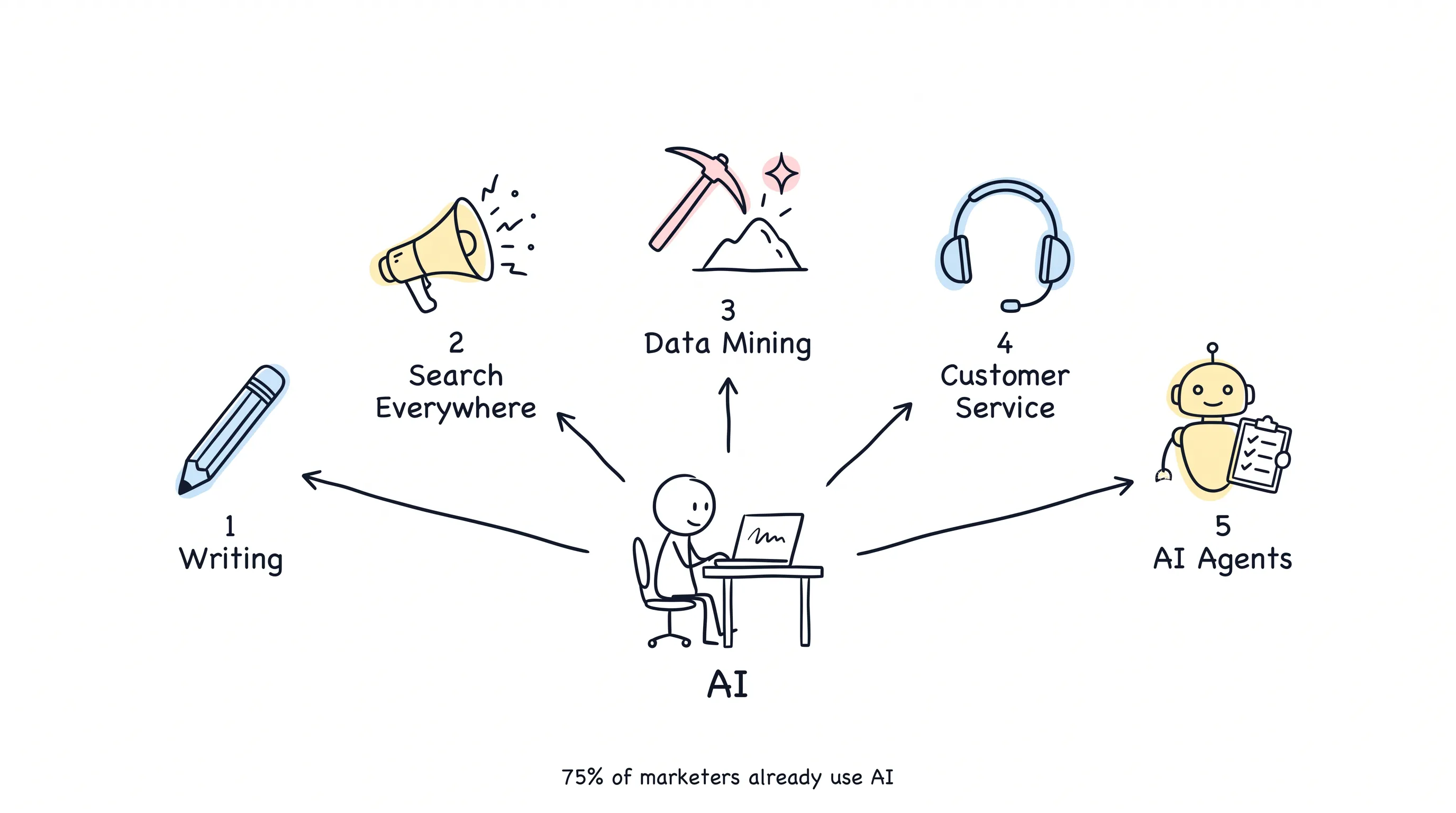
Industry surveys put the number at over 75%.
In other words, three out of every four marketers are already using AI to get work done — writing copy, analyzing customer reviews, personalizing pushes, summarizing campaign performance... And more than half of them use it specifically to produce content.
What does 75% mean? This is no longer early adoption — it's table stakes.
Once a capability becomes table stakes, there's only one question left to figure out: how to use it better than everyone else.
How? Let me break it down into five jobs.
Job One: Writing
This is the most basic use.
Article outlines, social media posts, emails, internal reports, meeting notes, images, videos... AI can lend a hand with nearly all of this grunt work. That's what the 75% did: they tucked AI into their toolbox for these things.
But what you may not know is that it can already touch "creative work" too.
Take one example. Nestlé and its ad agency Ogilvy Paris used OpenAI's DALL-E 2 to do something remarkable: they took Vermeer's famous painting The Milkmaid, upscaled and extended it, and turned it into a video — in a style identical to the original.
Wow. A 17th-century masterpiece, just like that, "came alive."
What does that tell us? That AI isn't just a typist anymore — it's starting to reach the edges of creativity.
But here's where I have to pour some cold water.
AI will make things up with complete confidence. The industry calls this hallucination: the model fabricates facts that don't exist, in a tone of absolute certainty. So anything AI generates must be reviewed by a human, item by item. I'll come back to this when we talk about risk.
Job Two: Making Sure Customers Can Find You Everywhere
The second job — many people haven't yet grasped how serious it is.
When we used to talk about customer acquisition, we meant SEO: getting your website to rank near the top of Google.
Now the game has changed.
The places where customers look for things have become too many to count. Traditional search engines like Google and Bing; voice and local search; communities like Reddit and Quora; social platforms like TikTok, Instagram, and YouTube; and AI answer engines like ChatGPT, Claude, and Gemini.
Every one of them plays by different rules. Different formats, different user intent, different ranking logic.
The era of one set of content ruling them all is over.
So what do you do? Hand-produce a version for every platform? Costs would explode.
That's exactly where generative AI earns its keep: it helps you create, optimize, and roll out content for every channel at scale.
In one sentence: Search is now everywhere — your content has to be everywhere too.
Job Three: Mining Your Data for Gold
The third job is, in my view, the most underrated.
What is generative AI good at? Reading oceans of data and boiling it down into plain language.
Picture a scenario. You run a multi-location retail business with dozens or even hundreds of stores. Every day, social media interactions, website inquiries, and online reviews come pouring in like a flood. Who used to read all that? Nobody could — you basically sampled it.
And now? Hand it to AI.
It can organize that messy pile of feedback, tag it, sort it by sentiment, and then tell you: which product line is drawing the most complaints? Which questions do customers keep asking that your FAQ never covers?
Those answers were always there for the taking — you just couldn't afford them. The cost was too high.
Now you can. Which means you can use them to shape your next generation of products, or fill in the gaps in your FAQ.
The same customer voice that used to be noise is now a goldmine. All that was missing was an AI shovel.
Job Four: Arming Your Customer Service
The fourth job: customer service.
Chatbots aren't new. This stuff existed back in the 1960s.
So why are they suddenly effective now?
Chatbots used to recite scripts. Today's bots, once you connect AI to your own customer data, actually understand the business. They learn from conversation history and behavioral patterns, and can give answers tailored to each customer.
What matters even more is omnichannel. Website chat boxes, social media DMs, email, phone — AI can handle them all. Wherever the customer is, that's where service opens.
Job Five: AI Agents — From "Helping You Write" to "Getting Things Done"
The fifth job is the one that truly points to the future.
In the first four jobs, what AI does is "produce content." The new generation of AI systems takes a big step forward: it starts to "execute tasks."
What is an AI agent?
An agent is AI that does the work for you. You set the boundaries, and it gets to work on its own: replying to customer reviews, generating content, analyzing ad data — running the whole chain end to end, all within the brand rules you've set.
Here's an analogy. Early AI was a pen — you held it in your hand, and you still had to do the writing yourself. An agent is an intern: you hand over the assignment, it does the work, and you just review and keep the final gate.
From "generating content" to "completing tasks" — that step is the next stage of AI in marketing.
Don't Rush to Go All In: Three Pitfalls, None of Which You Can Dodge
By now, you may be itching to dive in.
Hold on. However capable AI is, it has pitfalls. Three.
The first pitfall: content quality and accuracy. The hallucination we covered above is the biggest landmine. Once AI-fabricated information goes out the door, best case, you're embarrassed; worst case, you're facing a lawsuit. There's no shortcut to the countermeasure: human gatekeeping, ongoing spot checks, and continuous fine-tuning of the model based on user feedback.
The second pitfall: brand drift. AI writes fast, but it doesn't understand your brand's tone of voice. Without constraints, a hundred drafts can produce a hundred different personalities. Your brand's rules must be fed to it in advance.
The third pitfall: transparency and compliance. A survey by SOCi found that 76% of consumers believe businesses should clearly and plainly tell consumers when AI is used in customer service, advertising, or marketing.
76%. A two-thirds majority.
So don't use it in secret. Disclose it openly, and spell out your AI use in your privacy and security policies. At the same time, the regulatory red lines — CCPA, GDPR, FTC — not a single one can be crossed.
Using AI is a plus. Using it in a way nobody understands is a minus.
A New Battleground Opening Up: AI Visibility
Finally, something that has quietly become important.
The way customers discover brands is being rewritten by AI.
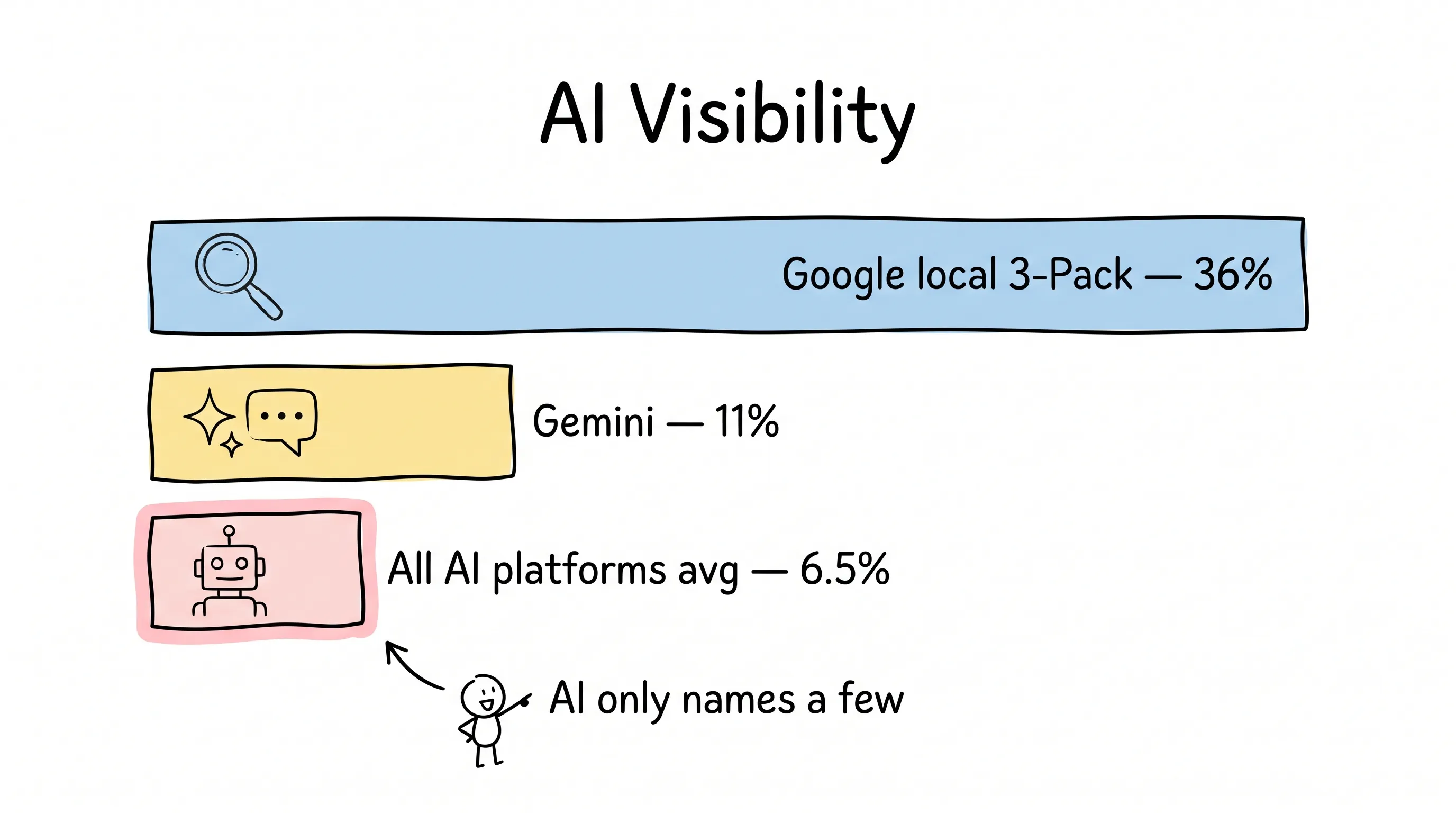
In SOCi's 2026 Local Visibility Index, one set of numbers held my attention for a long time. It compares the odds of a business being recommended by AI platforms versus traditional search engines:
For the same group of brands, the chance of making Google's local 3-Pack is 36%; the chance of being recommended by Gemini is just 11%. And averaged across all AI systems together, the probability that a given brand's locations get recommended is only 6.5%.
What does that mean?
AI is far pickier than traditional search about which businesses it recommends.
In the SEO era, squeezing into the front of search results meant being seen. Now customers bring their questions to AI, and AI only names a few. If you don't make that cut, you might as well not exist.
It's like shelf space in a shopping mall. There used to be twenty brands along one aisle, and there was always a place for you. Now AI leaves you a single shelf slot. Fail to get on it, and customers won't so much as glance your way.
The industry has a name for this "rate of being recommended by AI": AI visibility.
My call: AI visibility will become the battleground for marketers, just as SEO once was. And the window won't stay open long, because most people haven't caught on yet.
One Last Thing
Back to that friend's question from the beginning: should you hire someone specifically to watch AI?
My answer: whether to hire is a tactical question. There are two strategic ones: your marketing department — how far along is it in putting AI to work? Your brand — in the answers AI gives, does it hold a place?
The first decides your efficiency today. The second decides your foot traffic two years from now.
By the way, if you want to see a ready-made playbook, take a look at the company SOCi. It specializes in multi-location brands and has built AI capabilities into its platform: generating social media content at scale, auto-replying to reviews, analyzing sentiment across locations, and mining insights from data. If you run multiple locations, it's worth studying how others have systematized this.
The generative AI train has already left the station.
The ticket isn't expensive — but it won't wait.
Here's hoping you board early. And even more, here's hoping that in AI's answers, you always hold a good seat.
Continue reading
Related articles

It's 2026: Stop "Buying" AI Tools for Your Marketing Team — Start "Hiring" AI Agents
This learn article explains how AI agents differ from standalone AI tools in marketing, outlines three agent categories — build-your-own platforms, CRM-native agents, and vertical tools — and covers use cases across SEO, social media, advertising, and reporting, plus criteria for choosing one.

What Is GEO? How Your Brand Gets "Mentioned" in the Age of AI Search
An explainer on GEO (Generative Engine Optimization) for e-commerce and DTC brands: how it differs from SEO and AEO, why AI answers shape brand visibility, and eight practices covering question-focused content, consistent brand messaging, structured pages, external evidence, comparisons, and AI mention tracking.

AI Is Already Making Decisions for Your Customers. Are You on the List?
A learn article explains GEO (Generative Engine Optimization): why AI-generated answers now shape which brands customers see, and how SEO fundamentals, entity clarity, citable evidence, and monthly measurement affect visibility in AI answers.