
Before you pick an AI marketing company, get one thing straight: what job do you need it to do?
A guide to choosing an AI marketing company by starting from the job you need done. It distinguishes agencies from platforms, profiles 16 vendors across AI search and content, creative and media, AI visibility, paid media, automation, and inbound conversion, and offers three evaluation steps.
A friend of mine in B2B came to me venting recently.
His boss had assigned him a task: pick an AI marketing company. He opened a dozen or so websites and just stared.
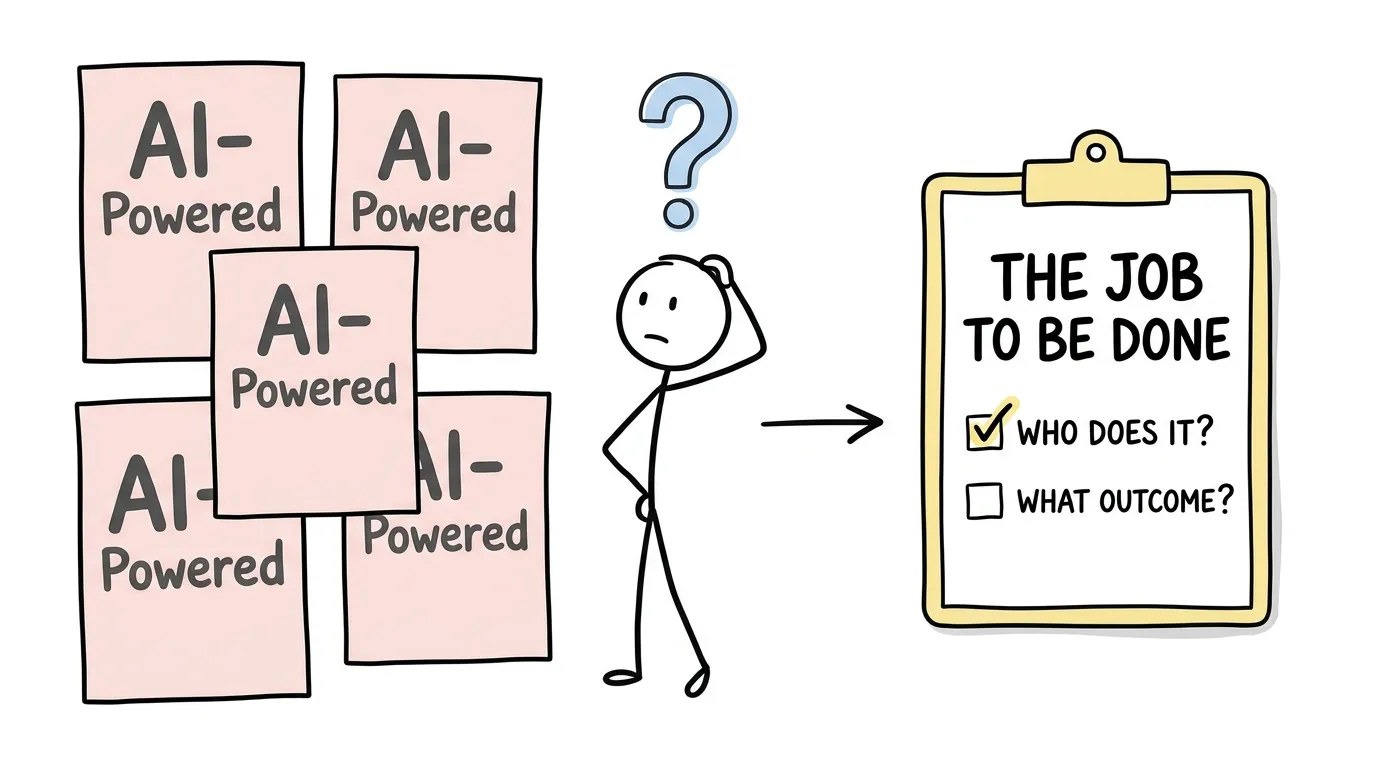
Every single homepage said the same thing: AI-Powered.
His take: that tells you nothing.
He's right. Today, that phrase is about as informative as every dish on a menu being stamped "safe to eat." Who doesn't write that?
But here's the thing — you can't just shrug this decision off. AI really has sunk its teeth into marketing. In the latest McKinsey State of AI survey, 88% of responding organizations said they use AI routinely in at least one business function. A year ago, that number was 78%.
Sounds like it's everywhere, right? Hold on. The same survey found that most organizations' AI use is still stuck at the pilot stage.
In other words: everyone's using it, but most haven't figured out how to use it well. And at a moment like this, the gap between the companies that choose right and the ones that choose wrong only keeps widening.
So what do you do?
Later, I gave that friend one piece of advice: don't go by what a company calls itself; start by getting clear on what job you need it to do.
Labels carry no information. Jobs do.
In this piece, I'm laying out 16 of the AI marketing companies that have made real headway, sorted into six groups by the job they do — who each one is, what they're strong at, and who they're right for. Just find yourself in the list.
First, get this clear: what is an AI marketing company?
What counts as an AI marketing company?
Put simply: a services or software vendor that uses AI to help other companies do marketing — planning, production, distribution, post-mortems; AI can touch any of it.
But under that one label hide two completely different businesses.
One sells people and services, with AI as the way they work. The other sells software, with AI running inside your team.
The trouble is, both call themselves "AI marketing companies," and their website copy is nearly word-for-word identical. So a lot of shortlists are muddled from the very start.
How do you tell them apart? One question is enough: is the job done by your people, or by their people?
An agency is outsourcing the job. If your team has no SEO lead and nobody who understands ad buying, bringing in an agency with its own crew is the fastest way to results.
A platform is bolting a turbocharger onto your team. You have the people, but they're not fast enough — or some jobs simply have to happen in real time. Like the instant a buyer asks a question on your website, someone has to answer. No human can watch that 24/7. Software can.
Many mature teams want both: the agency designs the playbook, the platform keeps it running day to day.
How I picked these companies
Let me show my cards first, so you don't think I picked these at random.
Three criteria:
The vendor has to serve B2B or enterprise marketing teams;
AI has to be genuinely in the work — a concrete product, process, or Agent, not an adjective from a launch event;
One company, one job. You should be comparing answers to the same problem, not two different trades stepping on each other.
Everything below comes from the companies' own websites and public claims. I've left out pricing and vendor-reported wins. The former changes daily; the latter can't be compared side by side. Grouping is by job, not ranking.
Group 1: AI search & content (agencies)
These companies do one job: make sure B2B brands rank in Google and get named in AI answers.
What is AEO? Answer Engine Optimization.
In the past you were fighting for a seat on the search results page. Now, more and more buyers never scroll results at all — they just ask ChatGPT or Perplexity. Whether your name shows up in the AI's offhand answer is do-or-die.
By the way, what separates an AI marketing agency from a traditional one? Traditional agencies scale by adding headcount. AI marketing agencies build AI into their workflow, so research, production, and optimization speed up without headcount growing in step. But verify this with your own eyes — some outfits flying the AI flag are really just using AI to write first drafts.
NoGood: a growth agency out of New York. Its defining trait is that it fuses content, SEO, social media, creative, and paid media into one team serving one client — instead of four departments pointing fingers at each other. Its AEO offering covers ChatGPT, Gemini, Perplexity, Claude, Copilot, and Google's AI summaries, without dropping traditional search. Contracts run monthly. Right for growth-stage brands that have raised funding and want AI search and paid growth handed to a single team.
Omniscient Digital: a B2B-only organic growth agency. SEO strategy, GEO (Generative Engine Optimization — making AI search aware of you), programmatic and technical SEO, digital PR, content production — they do it all. They have one obsession: everything is measured against qualified leads, pipeline, and revenue, never raw traffic. Right for B2B software companies that want search and content welded straight to the pipeline.
TripleDart: runs SEO, AI search, paid media, content, ABM, and RevOps as one system. Strategy is set by senior operators; execution is pushed down to Slate, their in-house AI execution layer. Clients range from seed-stage to public companies. Right for B2B SaaS looking for an external marketing department that takes full ownership of pipeline.
Group 2: creative & media (agencies)
This group solves a capacity problem.
One ad needs to become ten versions for ten markets. Staffing up to do that by hand gets expensive fast. AI happens to be built for it.
Monks: a global marketing and technology company. On its Monks.Flow platform runs a squad of dedicated AI Agents: strategy, creative production, multi-market adaptation, media buying, post-campaign analysis — each with its own role, all able to plug into a company's existing tools. The key is the delivery model: managed service. Monks' people operate these Agents alongside your people, rather than tossing you a stack of software to figure out on your own. Right for large enterprises planning to rebuild marketing operations around AI.
Jellyfish: a global digital marketing company, part of The Brandtech Group. It deploys AI in three places: Pencil generates ad creative; Now Next Soon simulates what a media plan is likely to deliver before you spend the money; Share of Model tracks what your brand is becoming inside the answers the major models give. Right for brands running big spends across multiple markets at once.
Superside: an AI-powered creative services company serving the in-house teams of enterprise clients. Projects run on Superspace, its creative management platform, and its homegrown AI, Brand Brain, learns each client's brand and feeds that back into briefs and output. On every project you choose: fully human, AI-augmented, or a mix. Right for teams with heavy design, ads, and video volume who don't want to hire like crazy.
Group 3: content & AI visibility (platforms)
Switching sides. From this group on, it's software. The work gets done by your own team, on the platform.
Jasper: an AI platform built specifically for marketing. It learns your brand voice and style, then applies them to everything it produces — high volume, one consistent tone. It ships with marketing Agents that take on jobs like SEO and personalization. Want to go further? In Jasper Studio you can build your own AI apps and workflows without writing code. Right for marketing teams producing content at scale that still has to sound like one company.
Writer: an enterprise AI platform for building and managing Agents grounded in company data. In the new release shipping in 2026, admins can write style guides and approved terminology directly into voice profiles, locking down AI's output standards at the source; plus a set of connectors that pull context from the tools marketing teams already use. Right for large enterprises that keep an iron grip on brand voice, terminology, and compliance.
Profound: an answer engine optimization platform. Its Answer Engine Insights tracks how ChatGPT, Perplexity, Google's AI summaries, and other AIs mention you, rank you, and describe you. The way it sources data is deliberate: it captures answers from real consumer browsing sessions, not the "polite answers" you get when you query a model's API. And when it finds a visibility gap, the platform has content workflows so you can close it on the spot. Right for brands that urgently need to know "what is AI actually saying about us?"
Group 4: paid media & intent (platforms)
6sense: a revenue marketing platform. Its Signalverse stitches third-party buying signals — anonymous visits, keyword-level intent — together with data from your CRM and marketing automation system, telling you which accounts are researching you and how far along they are. That intelligence then feeds its own AI applications, like advertising and AI email, and can be piped to other tools over MCP (Model Context Protocol — a standard way to hook AI tools into other software). Right for B2B teams running account-based marketing (ABM) and desperate to know "who's actively shopping."
Metadata: an enterprise B2B paid media execution platform. You describe the outcome you want, and its AI Agents set up the whole stack — audiences, creative, budget, experiments, reporting — and run campaigns across LinkedIn, Google, and Meta. Rest easy: before any money is spent, every step is laid out in front of you for approval. It also has an MCP server, so you can command it straight from AI tools. Right for demand-gen teams where paid channels are the main pipeline.
Group 5: marketing automation (platforms)
This is old territory: the system of record for campaigns and nurture flows, now with AI Agents living inside it.
HubSpot (Breeze): Breeze is HubSpot's AI one-two punch inside its customer platform. Breeze Agents do specialist jobs: content, social, prospecting, customer service; Breeze Copilot is on call inside the product; Breeze Intelligence handles data enrichment. One heads-up: Agents and advanced AI features sit behind the higher tiers. Right for teams already running the full HubSpot suite across marketing, sales, and service.
Adobe Marketo Engage: Adobe's AI marketing automation platform. Agentic AI helps you build and refine multi-touch journeys; generative AI drafts email copy, subject lines, and imagery; native CRM integration keeps sales and marketing data from fighting each other. Right for marketing ops teams running complex multi-touch B2B programs.
Group 6: inbound conversion (platforms)
Every group above is helping you manufacture demand: more content, more ads, more exposure.
This one is different. It handles what happens after someone has already landed on your website.
What is an AI website agent?
Software that stands in for you on your website and chats for real with visiting buyers. It answers questions, judges whether they're a fit, and hands the right ones to sales.
Nobody's there the moment a buyer's interest peaks; by the time the reply email goes out the next day, the warmth is long gone. This is the last checkpoint between traffic and pipeline — and the easiest place to bleed leads for nothing.
Qualified: its core product is Piper, an AI SDR (AI sales development rep). When a visitor lands, it engages them with chat, voice, or video and books the meeting on the spot — no endless back-and-forth over email about times. And after someone has engaged, it sends follow-up emails; the AI never logs off, so the lead never goes dark. On April 1, 2026, Salesforce completed its acquisition of the company. Right for enterprise inbound teams that want one AI SDR watching both the website and the inbox.
Chili Piper: calls itself a demand conversion platform serving B2B go-to-market teams. Two things at its core: routing and scheduling. A lead comes in and gets assigned to the right person by account ownership, territory, or custom rules — across forms, chat, phone, and video. Among its AI capabilities is Chat AI, which answers questions, qualifies leads, and books meetings in one go; there's also a spam checker that filters out junk form data before it ever reaches routing. Right for revenue teams with complex routing rules where not a single lead can be dropped in the wrong place.
Docket: positioned as an Inbound Demand Platform; its flagship product is an AI website agent that turns the traditional form-and-chat-box into a conversation that can answer questions and book the right meetings.
A few of its design choices strike me as genuinely thoughtful.
First, it only draws answers from content your team has chosen. If it can't answer, it falls back to a scripted response — it doesn't make things up.
Second, qualification questions are written in plain language. BANT, MEDDIC, or your own house definition of "fit" — all fine.
Third, routing checks CRM ownership first, then applies your rules, then books the meeting right in the conversation onto a rep's Google or Outlook calendar. Already using Chili Piper? It runs on your existing routing as-is — no rebuild.
After the conversation, the summary and qualification answers write back to the CRM. The meeting reaches sales as an AQL (Agent Qualified Lead): a buyer whose need is spelled out, whose match is verified, and whose next step is booked — with the full conversation transcript attached.
Let's run the numbers. One of its customers is Zenity, which does security governance for agentic AI. In its first active cycle after going live, it racked up 206 AI conversations over four weeks and booked 10 meetings — with not a single front-line BDR (business development rep) assigned, and every data point written back to the CRM, attributable to opportunities. Roughly twenty conversations per real meeting. Its director of growth marketing, Maya Kamoshita, said: "We now have some deals in the discovery stage that came from Docket."
Fair warning too: Docket needs your website to actually have meaningful inbound traffic; silent visitors are invisible to it and out of its reach. It's not a customer-service bot, and it isn't out to replace SDRs — the meeting itself is still run by your sales team.
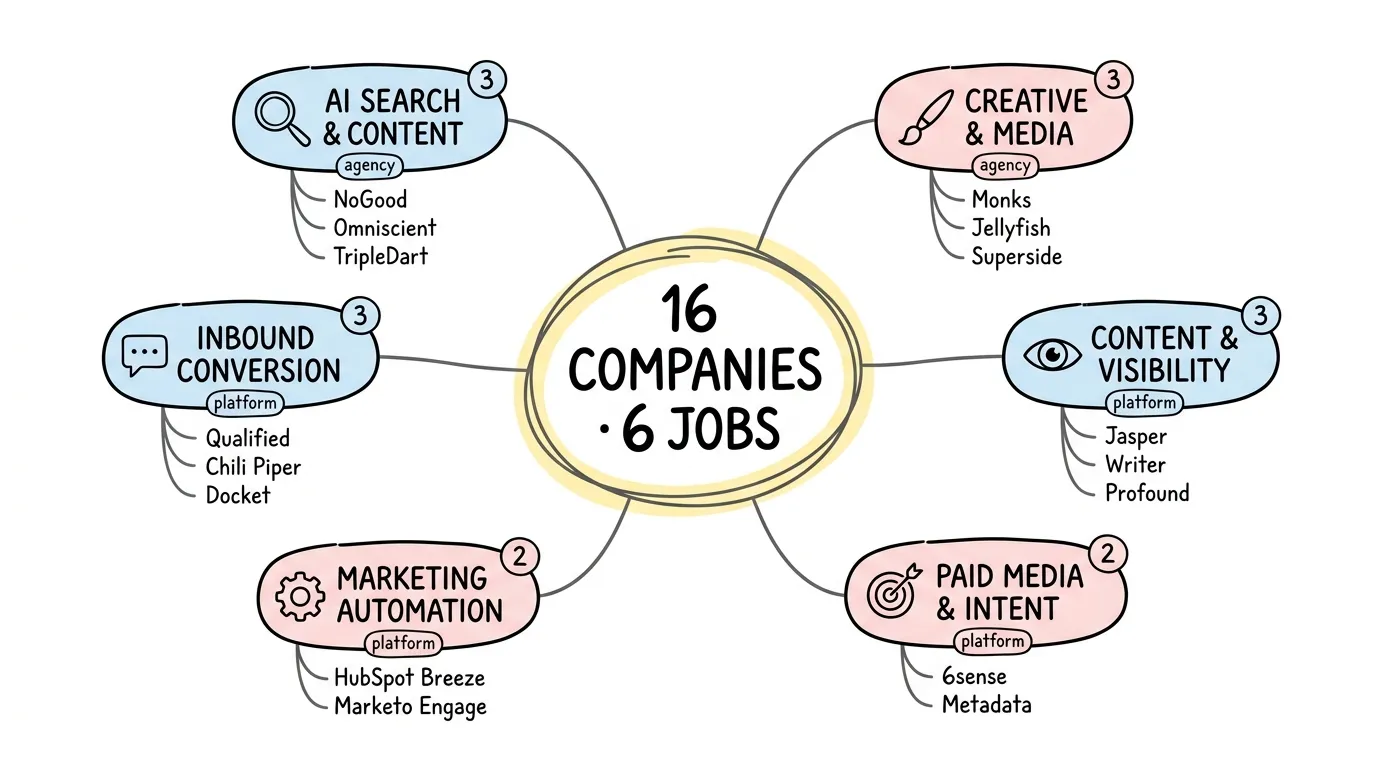
All 16, at one table
| Company | Type | The job | Who it's for |
|---|---|---|---|
| NoGood | Agency | AI search & content | Growth-stage brands that want one team running AEO and paid media |
| Omniscient Digital | Agency | AI search & content | B2B software companies that want SEO and GEO welded to the pipeline |
| TripleDart | Agency | AI search & content | Funded B2B SaaS that wants SEO, paid media, and RevOps in one go |
| Monks | Agency | Creative & media | Global enterprises rebuilding marketing operations around AI Agents |
| Jellyfish | Agency | Creative & media | Brands running large spends across many markets |
| Superside | Agency | Creative & media | In-house teams starved for creative capacity who don't want to stack headcount |
| Jasper | Platform | Content & AI visibility | High-volume content production in one consistent voice |
| Writer | Platform | Content & AI visibility | Enterprises with a tight grip on messaging and compliance |
| Profound | Platform | Content & AI visibility | Brands that want to know how AI describes them |
| 6sense | Platform | Paid media & intent | ABM programs that need to know who's in the market |
| Metadata.io | Platform | Paid media & intent | B2B demand teams where paid channels carry the load |
| HubSpot (Breeze) | Platform | Marketing automation | Teams already running the full HubSpot suite |
| Adobe Marketo Engage | Platform | Marketing automation | Enterprise-grade multi-touch B2B programs |
| Qualified | Platform | Inbound conversion | One AI SDR watching both the website and the inbox |
| Chili Piper | Platform | Inbound conversion | Lead routing and scheduling with complex rules |
| Docket | Platform | Inbound conversion | B2B sites with real inbound traffic but a shortage of qualified pipeline |
So how do you actually choose? Three steps
Step one: write the problem as an outcome, not a channel.
"When buyers ask AI about our industry, do we come up?" That's a job for an AI search agency or a visibility platform.
"We have traffic but no meetings." That's a job for inbound conversion.
If you can't even state the job you need done, don't pick anyone yet — you're not ready to be choosing companies.
Step two: get clear on whether you're missing people or missing speed.
If nobody owns this area at all today, an agency is usually the faster starting point. If you have the people but they're stretched thin, a platform can amplify them. Whichever side you choose, decide who will run it after the contract is signed. Software nobody owns is software nobody uses.
Step three: interrogate the AI claims.
Ask every candidate the same five questions:
Can you demo it live? Use inputs close to my business and have the AI actually do the job.
Where do the answers come from? What data and content is it fed, and who controls it?
What happens when it's wrong? Is there a review step, a fallback, or a way to correct course fast?
Where does it connect? Do results write back into my CRM and automation systems, or do they stop at yet another data island?
Who is actually doing the work? Our team, your team, or the AI itself? Get it in writing.
And while we're at it, a question that comes up all the time: will an AI marketing company replace my marketing team?
No. Agencies and platforms take over execution, but someone still has to set strategy, guard the brand, and decide what's good and what isn't. These 16 companies were built to give marketing teams an edge, not to step onto the field for you.
Finally, back to my friend
How did he end up choosing?
He didn't let "AI-Powered" lead him around by the nose. He wrote "the jobs we need done" on a single sheet, dropped it into a group chat, and let the candidate companies claim them.
A week later, he had locked in three.
It really is that simple. Figure out what job you need done, then let the companies come claim it.
Here's hoping that next time you open those websites, you no longer see a wall of "AI-Powered" — but instead recognize at a glance: ah — this one does my kind of work.
Continue reading
Related articles

It's 2026: Stop "Buying" AI Tools for Your Marketing Team — Start "Hiring" AI Agents
This learn article explains how AI agents differ from standalone AI tools in marketing, outlines three agent categories — build-your-own platforms, CRM-native agents, and vertical tools — and covers use cases across SEO, social media, advertising, and reporting, plus criteria for choosing one.

What Is GEO? How Your Brand Gets "Mentioned" in the Age of AI Search
An explainer on GEO (Generative Engine Optimization) for e-commerce and DTC brands: how it differs from SEO and AEO, why AI answers shape brand visibility, and eight practices covering question-focused content, consistent brand messaging, structured pages, external evidence, comparisons, and AI mention tracking.

AI Is Already Making Decisions for Your Customers. Are You on the List?
A learn article explains GEO (Generative Engine Optimization): why AI-generated answers now shape which brands customers see, and how SEO fundamentals, entity clarity, citable evidence, and monthly measurement affect visibility in AI answers.