
Which Kind of AI Are You Using? Get It Wrong, and Ad Buying Is Shooting Blind
A learn article distills an IAB guide on generative AI in advertising, explaining how autoregressive, bidirectional, and sequence-to-sequence models differ, how supervised, unsupervised, and reinforcement learning support ad work, and outlining use cases, rollout steps, and responsible-use checkpoints.
The other day, I spent an entire afternoon chewing through a report.
The Interactive Advertising Bureau—IAB—has released an industry guide on how generative AI gets used in advertising. It runs dozens of pages, from how the models work down to rollout checklists, and it's remarkably solid.
Honestly, there's no shortage of articles about AI. Most of them talk about how impressive AI is. This guide is different. It answers a stubbornly simple question:
What is the AI in your hands actually for?
The question sounds redundant. But think about it: haven't plenty of people bought a power drill and gone right on using it as a hammer?
I've picked out the most valuable parts, and I'm going to walk you through them properly.
First, Get This Straight: AI Is Not One Thing
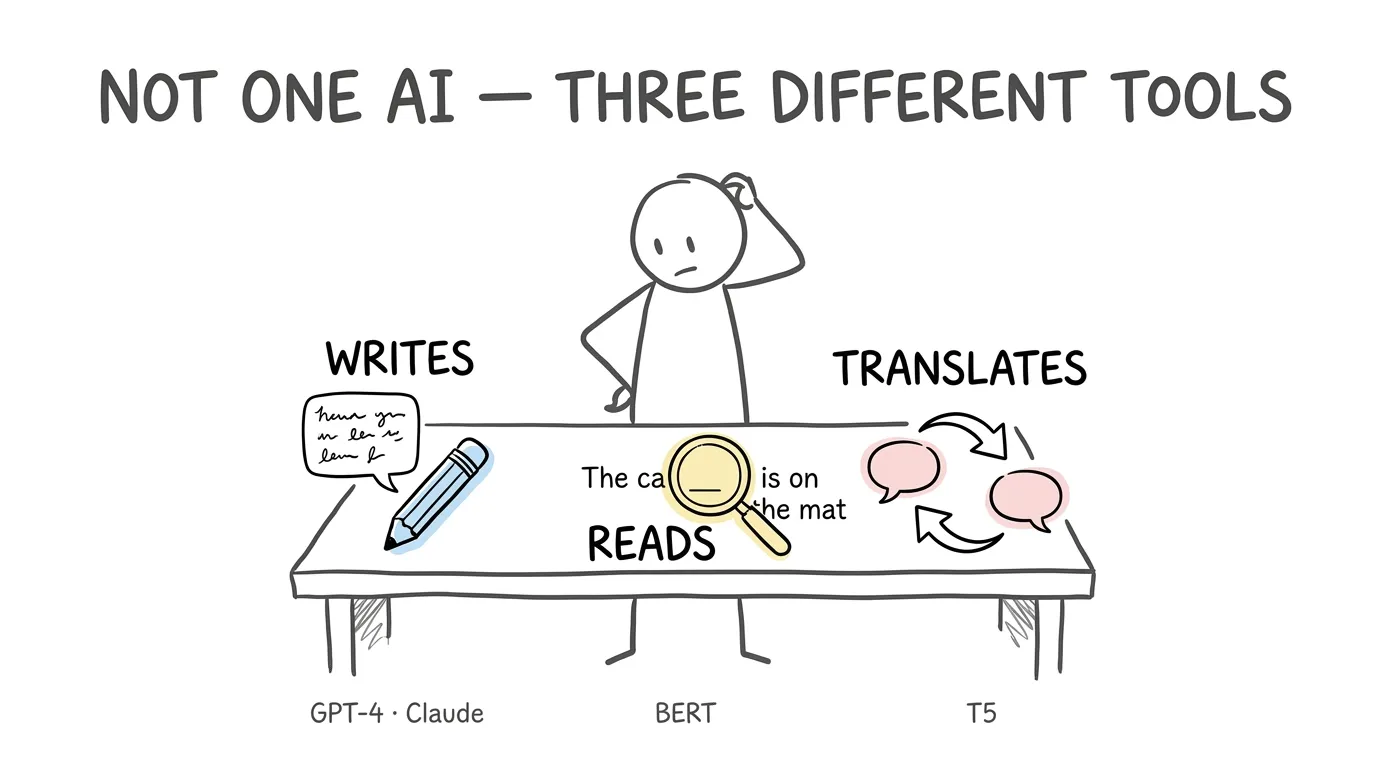
When we casually say we're "using AI," what we're actually holding are three entirely different tools.
The first kind: autoregressive models.
What does autoregressive mean? It keeps the conversation going. Think of it as a friend who can really talk: you give an opening line, they take it from there, writing forward one word at a time. GPT-4, Claude, Gemini, Mistral, and Grok on X (whose API testing only opened in November 2024) all belong to this family.
What is it good at? Writing. Long-form copy, building chatbots, brainstorming creative ideas, and turning out a whole batch of headline options for A/B testing in one go.
Remember its temperament: it looks backward to write forward.
The second kind: bidirectional models.
What does bidirectional mean? It's the fill-in-the-blank exercise you did as a kid. Knock a word out of the middle of a sentence, and you have to guess it from the surrounding context. That's exactly how these models are trained: randomly mask words in a text and make the model reconstruct them from context. BERT and RoBERTa both work this way.
They aren't great at "writing," but they excel at "reading": classifying, tagging, gauging sentiment, and pulling names, dates, and places out of piles of material. Nike uses them to monitor social media—watching who's talking about its products and its competitors—and pivots the moment the winds shift. Amazon runs them over customer reviews to find product flaws and fine-tune its product pages along the way.
The third kind: sequence-to-sequence models.
The name is a mouthful, but the idea is simple: a translator. It holds the meaning of a passage in mind (encoding), then expresses it another way (decoding). The flagship is T5, whose multilingual variant mT5 can handle 101 languages.
By now the picture should be clear—
Models aren't good or bad; they're either right for the job or not. Writing copy? Autoregressive. Classification? Bidirectional. Translation? Sequence-to-sequence. Grab the wrong tool and blame the tool for being useless—that's the user's problem, not the tool's.
Talking Well Isn't Enough—Advertising Is a Job of Doing the Math
All three of the above fall under "generative." But more than half the work in advertising isn't generating—it's judging. Time to bring in machine learning.
Machine learning comes in three kinds. I'll use students as the analogy, and you'll get it immediately.
Supervised learning is the student who drills problems with the answer key in hand. Feed it large volumes of historical data pairing delivery actions with final outcomes, and it learns to predict. Sales forecasting and targeted delivery are both its turf. On the tools front, time-series models like ARIMA, Prophet, and LSTM are good at capturing seasonal patterns, while the combo punches of random forests and gradient boosting—play many hands and take the average—push accuracy up another notch.
Unsupervised learning is the student nobody gives answers to, who sorts things into piles on their own. Nothing in the data tells it who is who; it finds the patterns itself. Its biggest use in advertising is audience segmentation.
Traditional segmentation leans on demographics: age, gender, city. Crude. Generative AI can build new "synthetic features" on top of that: purchase intent, brand affinity. Mix those engineered features back into the data, and you can dig up audiences that were simply invisible before—not "women aged 25 to 34" anymore, but "hesitant buyers who watched two reviews without ordering and bookmarked a competitor."
What you say to that group, versus what you shout at a crowd—those conversion rates belong to two different worlds.
Reinforcement learning is the student who grows up through trial and error. The learning method is brutally primitive: do something, look at the result, do more of what works, switch what doesn't.
It has a classic framework called the multi-armed bandit. What's a multi-armed bandit? Imagine a row of slot machines in front of you. You don't know which one has the best payout rate, so all you can do is try as you play. The smart strategy hedges both ways: probe the new machines (exploration) while placing bigger bets on the machines proven to win (exploitation). Thompson sampling and UCB are the algorithms that do exactly this.
Put into advertising, this is the underlying logic of dynamic creative optimization: the AI mass-produces dozens to hundreds of combinations of headlines, images, and buttons, sets them loose in real time, and adds budget to whichever ones run best. A traditional A/B test compares two or three options at a time; this approach casts a net across the entire space of possibilities.
Think about it: the answer to "which creative is most effective" goes from a gut call in the quarterly review to a real-time answer that refreshes every second.
Putting It to Work Boils Down to Three Things
Models covered. What do advertising companies actually do with them? I took apart the use-case section of the guide, and it boils down to three things: making content, tuning delivery, and measuring results.
First: making content.
Copy, images, videos, product descriptions, customer-service replies—all of it can go to AI. Feed it brand guidelines, color schemes, and product photos, and it can produce dozens of asset variants suited to different platforms in one go. Use tools like DALL-E and Runway for visuals: costs come down, output multiplies.
But there are a few potholes you need to know about. In heavily regulated industries like pharma and finance, AI-generated content must pass compliance review—not a single item can slip through. For visual assets, at critical moments you still need human hands to fine-polish—AI does the groundwork, humans deliver the finishing touches. Also, labeling AI-generated content as such is already an openly acknowledged consensus; don't wait until something goes wrong to learn that lesson.
Second: tuning delivery.
No human can babysit budgets screen by screen. Based on historical data and real-time performance, AI dynamically moves money to wherever it runs well. Click costs, engagement rates, conversion rates—it computes them faster than you do, and it doesn't clock off.
One counterintuitive reminder here: audience segmentation is not the finer the better. Slice it too fine, every group becomes tiny, the budget spreads thin, several sets of copy fight each other, and things turn messy instead. The guide issues a specific warning on precisely this point.
Third: measuring results.
This part is the most interesting. Let me ask you a question: of the sales your advertising brought in, how much came from "people who were going to buy anyway"?
This is called incrementality testing. Using causal-inference models, AI simulates a "you who never saw the ad" as a control group, and strips the true increment out of natural conversions. Millions of data points—user profiles, exposure records, purchase histories—computed together; without AI, human hands simply cannot carry the load.
Add another layer of automated reporting: data aggregates automatically, anomalies get flagged automatically, and conclusions are delivered to you in plain language. Teams get liberated from hauling numbers around and go do the work that actually requires a brain.
Oh, and one more thing: prediction. Before spending, let the model simulate, against historical data, the possible outcomes under several budget allocations. Prediction is not a guarantee—it is navigation. It tells you which road is likely smoother; the steering wheel stays in your hand the whole time.
Before You Saddle Up, Clear Four Gates
At this point, you may be raring to go. Don't rush. The back half of the guide offers a landing roadmap, and having read it through, I'd say it's worth even more than the tech primer before it.
Step one: take stock. Audit the pain points in your processes first; don't adopt AI for AI's sake. Whichever step is genuinely slow, genuinely expensive, genuinely error-prone—start there. At the same time, settle one thing: do you build this capability yourself, or buy it?
Step two: a small trial. Take one concrete use case and run it first—dynamic ad copy, say. Define the metrics: click-through rate, conversion rate, engagement rate. Run small and fast; don't adopt everything at once.
Step three: roll out. Expand to more campaigns once there are results, and train the team at the same time. However good the tool, a team that can't use it is worth zero.
Step four: tune. Shorten the feedback cycle, embed the tool into the daily workflow for real—don't let it turn into an island.
The Part Most Easily Skipped Is Exactly the Last Checklist
There's a section in the guide that takes up considerable space and talks about neither technology nor saving money, but "responsibility." Many articles about AI wave it past in a sentence. My advice: don't skip it.
Let me count how many bottom lines are in there.
Compliance. Europe's GDPR, California's CCPA—the red lines of data protection must not be crossed. Religious beliefs, ethnicity, minors' information—don't take them for training or profiling.
Transparency. AI-generated content must be disclosed as AI-generated. Consumers have the right to know whether what's on the other side of the screen is a person or a machine.
Fairness. AI carries the biases in its training data straight out with it. Test the outputs for bias regularly—this isn't sentimentality, it's insurance against a brand meltdown.
Quality. AI will talk nonsense with a perfectly straight face. All generated content facing the public must have human review. This one is non-negotiable.
Governance. Appoint a cross-department team to own this, audit regularly, and update the playbook the moment regulations change.
Stripped to the bone, it's one sentence:
AI can do the work for you, but it cannot take the responsibility for you.
Finally
That guide runs dozens of pages, and its technical detail is of course far denser than mine. But if you only take one insight away, I suggest it be this:
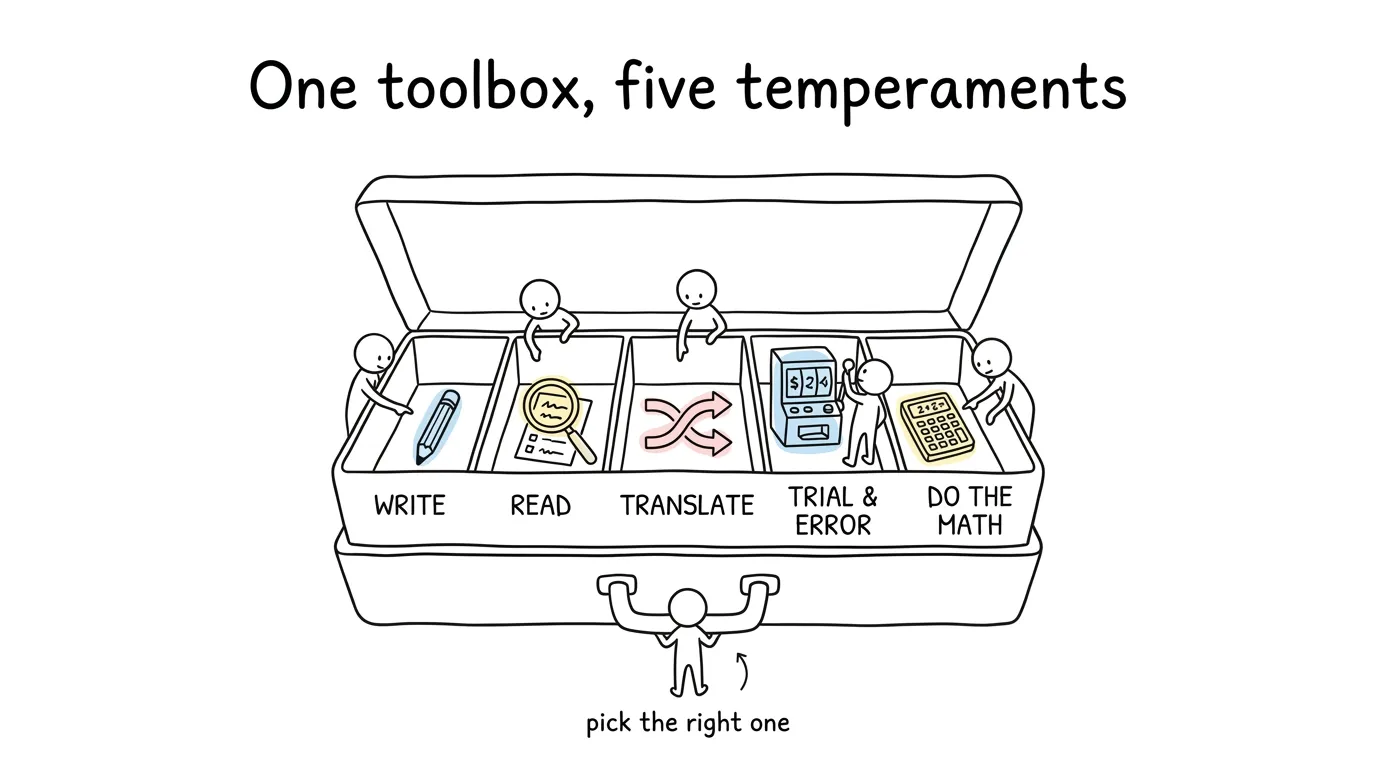
Don't treat AI as one monolithic magic box. It's a toolbox packed with characters of different temperaments—some are good at writing, some at reading, some at trial and error, some at doing the math. Only when you pick the right one can you even talk about using it well.
As for whether the advertising industry will be reshaped by AI? That question is already out of date. The reshaping is underway. The real watershed lies not in whether you use AI, but in whether you know what exactly you're using.
Lastly, may you come through this wave neither intimidated nor fooled.
Continue reading
Related articles

It's 2026: Stop "Buying" AI Tools for Your Marketing Team — Start "Hiring" AI Agents
This learn article explains how AI agents differ from standalone AI tools in marketing, outlines three agent categories — build-your-own platforms, CRM-native agents, and vertical tools — and covers use cases across SEO, social media, advertising, and reporting, plus criteria for choosing one.

Did the Money You Spent on AI Marketing Ever Come Back?
A guide to measuring AI marketing ROI across three layers: ad reports, sales pipeline, and the financial ledger. Covers metrics such as ROAS and CPA, eight dashboard metrics, industry benchmarks, and common measurement mistakes.

How to Pick a Creative Automation Platform: First, Figure Out What These Eleven Actually Do
A learn article sorts eleven creative automation platforms — including Bannerflow, Celtra, Smartly.io, and Storyteq — into four functional groups and proposes five evaluation questions covering publishing reach, automation depth, ease of adoption, team fit, and verifiable evidence.