
AI Marketing, Let Me Tell You a Few Stories
A plain-language AI marketing guide: how AI moved from task automation to decision-making, case stories from L'Oréal, Sephora, Cadbury, and Unilever, lessons from failed projects, budget ranges by company size, vendor selection criteria, and small first steps like a 90-day pilot.
A few days ago, an old friend of mine in the consumer goods business invited me out for tea.
Not five minutes after we sat down, he tossed out a question: "I want to set aside a dedicated budget for AI marketing. Is hiring an AI marketing company all it takes?"
I asked him right back: "What do you want AI to do for you?"
He paused, then came out with the honest truth: "Honestly, I hadn't thought about that. I just see everyone in my industry doing it."
I remember smiling at that. Not laughing at him — he'd put his finger on how most people actually feel: they know the wind has changed, but they don't know which way it's blowing.
On the way back, I went through in my head all the AI marketing cases I'd seen these past few years. Big brands, small shops, the ones that made money, the ones that crashed. Today I'm going to break it all down for you, in plain words.
First, Let's Get One Thing Straight: What Is AI Marketing?
Many people understand AI marketing as having AI write a few emails and fill in the social media calendar.
That's not wrong. But that's only AI marketing's "yesterday."
Yesterday's marketing automation did manual labor: sending emails on schedule, scoring leads, tagging by rules. It was an obedient tool — point it somewhere and it works; leave it alone and it stands still.
Today's AI has started making decisions on its own.
It digests customer data in real time, adjusts ad placements automatically, and can predict a customer's next move. You no longer need to tell it how to walk every step — you only need to tell it where to go.
Here's an analogy. Before, you hired an intern: one instruction in, one step done. Now you've hired an operator: you give the direction, and it finds the route itself.
The center of gravity in marketing is shifting from "running a campaign" to "operating the entire customer experience."
That sounds abstract. No matter — the stories are coming.
Let Me Tell You a Few Stories
The first story: L'Oréal.
L'Oréal owns a virtual makeup try-on technology called ModiFace, plus a companion AI skin analyzer, SkinConsult. You upload a selfie, the AI analyzes your skin, then tells you which product you should use.
And the result? By the company's official count, virtual try-ons worldwide have passed 1 billion cumulative uses, and users who go through the virtual try-on flow convert at roughly three times the rate of ordinary product pages.
What does 1 billion mean? One in every eight people on Earth has tried it. This was never about saving on customer-service headcount — it's that true one-to-one personalization is something human labor simply cannot deliver, and AI can.
The second story: Sephora.
Sephora has Virtual Artist, which kneads AI and AR together: you open your camera, it analyzes your face, and "paints" lipstick and eyeshadow on in real time.
Think about it: what's the biggest obstacle to buying makeup online? Not knowing how it looks on your face. That one stroke of "paint" dissolves the hesitation — and with it comes the confidence to click "order." Online sales followed.
The third story: Cadbury.
Ahead of Diwali, Cadbury used generative AI to mass-produce personalized video ads for small merchants across India — every region saw its own version.
One campaign later, reach topped 140 million people and engagement rose 32%.
My first reaction to those numbers: wow. An ad film used to be the privilege of big brands. Now a mom-and-pop shop can have a customized ad of its own. What AI truly changed isn't efficiency — it changed who gets to play.
The fourth story: Unilever.
Unilever built an internal platform of its own, called U-Studio, dedicated to predicting how creative assets will perform before they go live. Visuals, copy, audience data — all of it goes through.
By their own published figures, production costs fell about 30%, and time-to-launch was cut in half. One caveat from me: these are the vendor's own numbers — take the direction, not the guarantee; not everyone can replicate it.
And there's an even wilder one. BuzzFeed used AI to mass-produce interactive quizzes, multiplying content output nearly tenfold, feeding hyper-niche interest groups. Niche but sticky attention can be a perfectly good business.
Put these stories side by side and one common thread emerges:
None of them used AI to save a few bucks — they used AI to do what human hands fundamentally cannot.
That's the watershed. Think this through, and your budget won't be spent crooked.
But Everything Always Has a Flip Side
Some people cleaned up; others went home bloodied.
Healthcare has a famous crash: Watson for Oncology, a tumor-diagnosis support AI once loaded with high hopes, produced unsafe treatment recommendations after being trained on hypothetical data. It's not a marketing case, but the problem it exposes is exactly the same.
Amazon stumbled too. Its recruiting AI chewed through ten years of résumés, in which men predominated — so the AI learned to value men over women, and a perfectly good piece of technology was ruined on the spot.
Ask yourself: were these projects short of money? They weren't. Short of talent? Also no. So what was missing?
A goal thought through in advance, a set of clean data, a success standard you could actually write down — plus a human gatekeeper present the entire way.
AI will not save a business you haven't figured out. It will only amplify your existing problems — many times over, and much faster.
I've watched too many companies skip the goal conversation and go straight to buying tools. When the tools arrived, the problems arrived with them.
The Survivors All Look the Same
Enough of the crashes; look at the survivors. The teams that succeeded worked in strikingly similar ways.
They embed AI inside existing workflows instead of buying tools to be enshrined; they set the rules of the "brand voice" in advance — if AI-generated content turns so personalized it no longer sounds like you, it's negative equity no matter how fast; the process is repeatable, and at key checkpoints a human always makes the call; strike one concrete scenario at a time, lock the objective down, run it through before scaling.
That's all. It sounds plain — but in the vast majority of crash sites, it's precisely one of these that broke.
Then, Let's Do the Math
After adopting AI, how do you know whether it's working? Two moves.
Move one: before turning on AI, record your baseline — current conversion rate, customer acquisition cost, repeat purchase rate. Without a baseline, everything after is guesswork.
Move two: besides the main KPI, pair it with a second one. L'Oréal watches the conversions and engagement virtual try-on drives; Starbucks' Deep Brew system watches order frequency and customer lifetime value, not single-transaction sales. Then use attribution modeling to see clearly which stretch of the customer journey AI actually contributed to.
Meanwhile, here's a rough budget guide — the going market rates.
Small companies under 50 people: start with AI email tools and social scheduling tools; $500–$2,000 a month gets you going. Don't scoff at small. A restaurant used an AI bot to take orders and manage tables and lifted efficiency 40%; an online store used AI to personalize email and lifted conversion 25% — all without spending serious money.
Mid-size companies of 50 to 500 people: it's time for predictive analytics and customer segmentation; reserve $5,000–$15,000 a month.
Enterprises above 500 people: self-built AI infrastructure plus a dedicated team, $50,000 a month and up.
Incidentally, an even spicier number. Jasper, a company overseas that does AI writing, started from a $30,000 investment and grew revenue to $75 million. The need it solved was tiny: marketers can't write that much content. See — if the need is real, the market is real.
So How Do You Pick a Partner?
If you decide to hire an outside AI marketing company, remember one sentence: look at case studies, not slogans.
Concretely: demand cases from your own industry that actually match your situation; ask exactly how your data is handled while it's in their hands; confirm they can plug into your existing tools; check whether post-launch service keeps up. The most crucial item: does the other side genuinely understand your business model, or just carry one generic playbook everywhere?
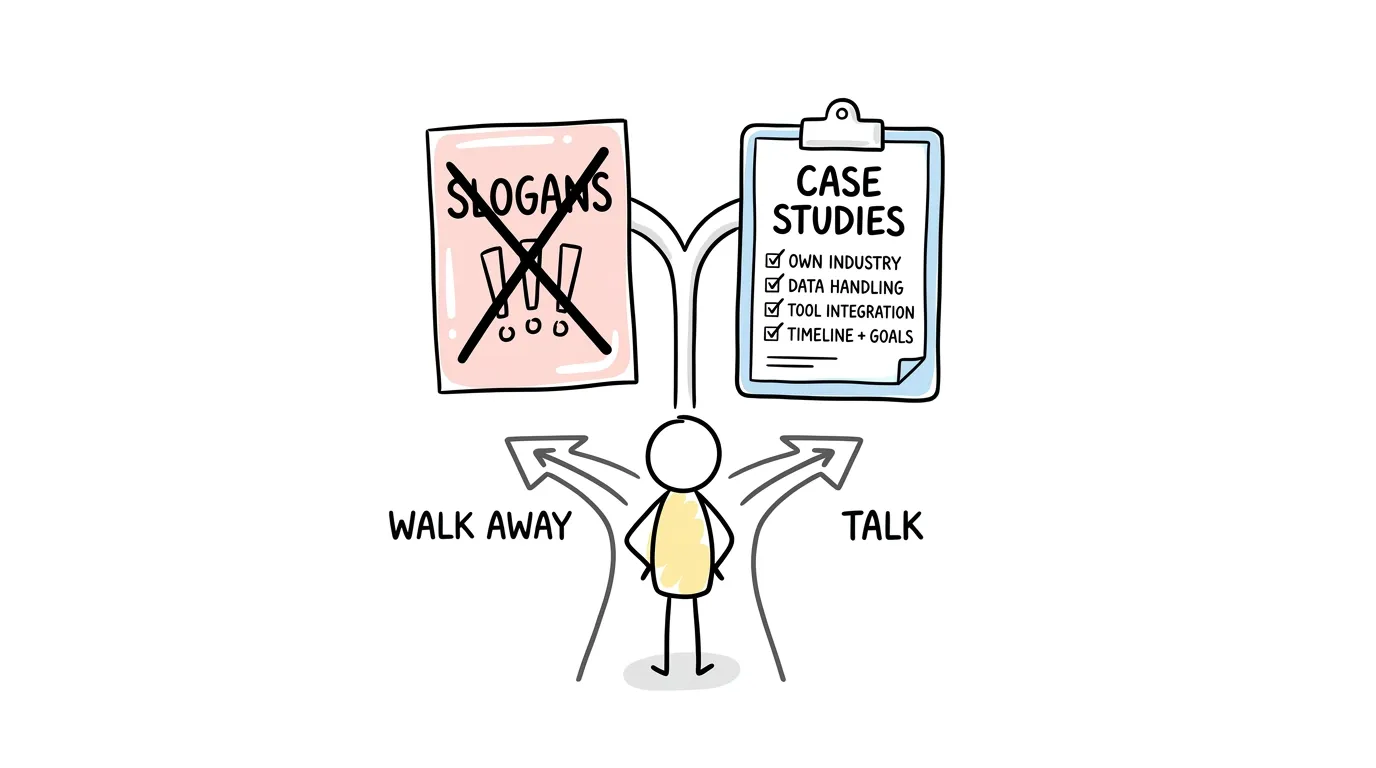
Before signing, get a detailed timeline and clearly written success criteria in hand. Whoever can't produce those two things — turn and walk away.
Looking One or Two Years Out, What Will the Team Look Like
Around 2027, several new faces will appear in marketing teams: prompt engineers who know how to coach AI, data analysts who understand machine learning, and ethics specialists who keep AI from crossing lines.
Old roles are morphing too. Content creators will become content directors directing AI to work; the campaign manager's main battlefield shifts to tuning AI workflows. The three departments — marketing, IT, and data science — sitting at the same table goes from exception to routine.
Things You Can Start Tomorrow
No grand plan. The things you can start tomorrow are actually quite small.
First, walk through your marketing process and list the repetitive labor item by item. Then pick the most annoying one — email subject-line optimization or customer segmentation — and do that one first. Find an experienced partner to help set it up, define success criteria, run a 90-day pilot, compute the ROI when it ends, and write down the lessons.
Once it runs through, scale it up. Just that plain.
Finally
A few days ago, I walked the tea-drinking friend through this whole line of thinking.
Last week he messaged me: no big vendor; he picked the most annoying step — initial screening of customer leads — and ran a 90-day trial. The numbers were good; he's preparing to expand.
I said, good. That's the right order.
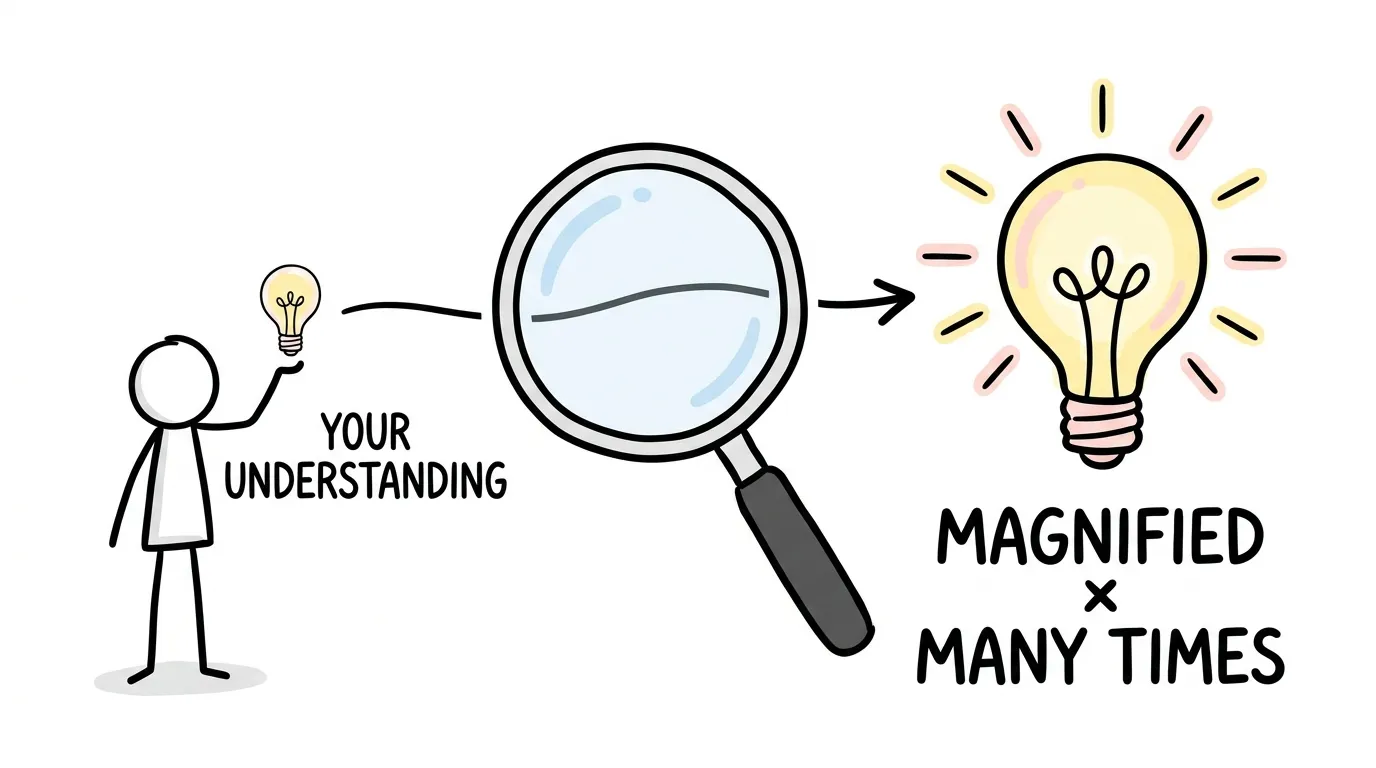
Tools were never the answer. Your understanding of the business is the answer. AI only magnifies your understanding, many times over.
If the understanding is right, magnification is a gift. If it's wrong, magnification is a disaster.
Here's wishing you'll always be the good news that gets amplified.
Continue reading
Related articles

It's 2026: Stop "Buying" AI Tools for Your Marketing Team — Start "Hiring" AI Agents
This learn article explains how AI agents differ from standalone AI tools in marketing, outlines three agent categories — build-your-own platforms, CRM-native agents, and vertical tools — and covers use cases across SEO, social media, advertising, and reporting, plus criteria for choosing one.

Did the Money You Spent on AI Marketing Ever Come Back?
A guide to measuring AI marketing ROI across three layers: ad reports, sales pipeline, and the financial ledger. Covers metrics such as ROAS and CPA, eight dashboard metrics, industry benchmarks, and common measurement mistakes.

How to Pick a Creative Automation Platform: First, Figure Out What These Eleven Actually Do
A learn article sorts eleven creative automation platforms — including Bannerflow, Celtra, Smartly.io, and Storyteq — into four functional groups and proposes five evaluation questions covering publishing reach, automation depth, ease of adoption, team fit, and verifiable evidence.