
AI Marketing Daily · 2026-10-29
A daily AI marketing briefing covering influencer AI disclosure rules across three jurisdictions, AEO tool comparisons, GEO's dependence on SEO, consumer trust survey data, and organizational moves for AI-first marketing.
There is a single thread running through today's eight items: the more stages of marketing AI moves into, the less room is left for sloppy operations. Disclosure rules for influencer marketing are now live in three markets at once, consumer research has put a price tag on transparency, AEO tools have laid their pricing and methodology on the table, and two directly comparable answers have emerged for how organizations should change. Read this one briefing and you'll know both the landmines to dodge today and the bargains to grab — every action item costs little, and any one of them can be started this week.
🎯 Today's Top Story
The AI disclosure red lines for influencer marketing are drawn: new rules now in force in three jurisdictions, with one lawsuit already in the queue
Hyperiser has put together a systematically solid rundown of where the regulation and ethics of AI in influencer content stand — the material is unusually rigorous. WFA's 2026 survey shows that 78% of multinational brands are already using AI in consumer-facing creative. That number says AI has moved from pilot project to routine production, and influencer content is no exception: swapping backgrounds, cloning voices, altering appearances, even putting words in an influencer's mouth — none of this requires a professional production crew anymore, and off-the-shelf tools can do it in minutes. For brands, that's efficiency: one ad video can be cheaply localized into many markets, and one piece of influencer footage can be cut into dozens of variants for repeated testing. For viewers, it's a detection problem: what they see is still that familiar face and voice, but an actual shoot may no longer exist behind it.
But efficiency now comes with a question that didn't exist before: at what point does AI's involvement in a piece of content require disclosure? The question looks simple, yet the answer reaches into every influencer collaboration's brief, approval flow, and contract terms.
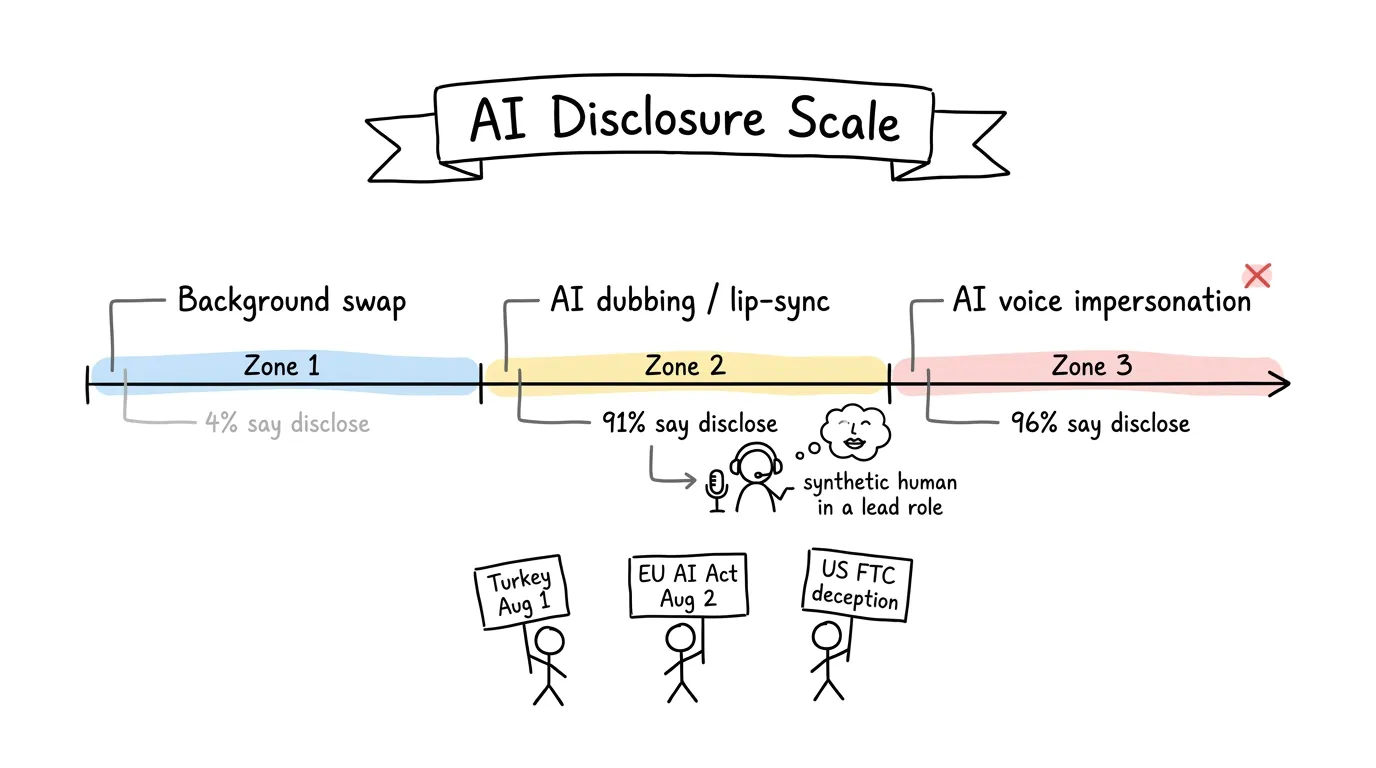
The industry's answer is layered by type of intervention. In the same WFA survey, 96% of brands believe hyper-realistic AI voices must be disclosed, and 91% believe synthetic humans in a lead role must be disclosed — but for purely decorative AI-generated backgrounds, only 4% say disclosure is needed. Same technology, wildly different verdicts depending on what gets altered. Regulators are tightening within the same window. Turkey's new advertising rules, effective August 1, require clearly identifiable disclosure under Article 18(8) and, under Article 27(12), bar AI digital replicas from impersonating real people to use or recommend products. The EU AI Act's transparency obligations started applying on August 2, and the European Commission's guidance, published July 20, lays out the factors for deeming something a deepfake: similarity, the message conveyed, context of use, and audience expectations. The US FTC takes a different route, with consumer deception as the axis — banning false endorsements, but not AI avatars themselves.
Three different frameworks, one shared conclusion: risk arises the moment AI's involvement could leave viewers unable to tell what's real. This is the first time the industry simultaneously holds first-party data, already-effective regulation, and litigation in motion — and the first time the gray zones have been spelled out this clearly. Changing a background is not the same as changing a face or a voice; re-dubbing audio and making an influencer say lines they never said are even less the same thing. One example from the EU guidance: background replacement and effects in ordinary film production are handled under different rules than deceptive deepfakes, so long as they don't manufacture the illusion that the image is reality — and influencer advertising, which lives precisely in the business of manufacturing authenticity, naturally lands in the deepfake zone far more often. When an influencer's approved raw footage is AI-edited into derivative versions, whether the initial license covers the new versions is both a disclosure question and a rights question.
The case is already in court. On June 9, 2026, influencer Molly Tranchin sued lingerie brand EBY, alleging that videos she produced under contract were altered with AI and then published on Instagram in a form she never approved — and the contract between the two parties did not permit unilateral edits. On August 28 she voluntarily dismissed the case without prejudice, because the federal court's jurisdiction had been challenged, and she plans to refile in a court that has it. No court has ruled, and there's no verdict on who's right or wrong — but the allegations alone have put the issue on the table: influencers want control over their own likeness and voice, brands want compliance and audience trust, and no existing process serves either side yet.
The direct impact on content teams lands on the approval flow. Between raw footage and multi-market, multi-language versions of an influencer video, every AI edit in between can cross a line — and an approval to change the language and one to change the persona should not carry the same weight. Disclosure is also far more complicated than slapping on a label: academic research suggests that disclosing AI use can sometimes actually lower audience trust in an ad — the harder the label, the more trust erodes. So the real question to answer is where to make the change, and to what degree. That's the open territory between the 96% and the 4%: the rules won't give you a standard answer; every brand has to draw its own line.
There are three actions to take, and all three can be done ahead of time. First, spell out in the brief which AI uses require disclosure and where in the content that disclosure appears — on-screen caption or spoken line — so an influencer knows exactly what to do the moment they get it. Second, fix in the production approval process who has authority to sign off on AI edits, and to what degree of alteration the influencer must be re-confirmed — don't let the post-production team make legal's decisions. Third, in the contract, specify whether the usage license covers AI-derived versions, with the scope written concretely: does a language swap count, a background swap, a lip-sync edit? That is exactly the clause at issue in the FashionVeggie case. The execution rule fits in one sentence: wherever viewers might not be able to tell what's real, disclose.
My read: disclosure will soon become the default move, and the real battlefield is contracts and approval flows. Brands that write the clauses in now are saving themselves litigation and PR costs two years out. Conversely, betting that audiences will never notice means betting your most expensive asset. Order matters too: settle the contract terms first, then discuss next quarter's influencer calendar — once the contract is clear, creative has boundaries to play within. Do it backwards and legal kills the creative halfway through, and what you lose is the launch window. AI's takeover of influencer marketing won't stop. What will stop is the partnerships that never wrote the terms clearly.
🔗 Further reading: Read the full article
🏷 Marketing Tools
AEO tools open their books: Profound, Peec AI, and the $50/month entry ticket
HubSpot published a comparison on October 28 of the two AEO (answer engine optimization) tools teams compare most often, and listed its own HubSpot AEO as the third option along the way. The two leading products collect data in completely different ways, and that decides whether you can trust the readings. Profound takes the enterprise route: API queries, CDN-level AI crawler logs (Agent Analytics), plus consumer panels to estimate search volume, priced via an Enterprise contract. The company closed a $180 million Series D in September 2026 at a $1.8 billion valuation; its engine coverage tops out at 9, and it also classifies cited URLs and identifies the important publishers within each category.
Peec AI approaches reality differently: browser automation simulates the view of a logged-out external user, pricing runs by prompt volume and number of countries, $95 to $495 per month, every plan with unlimited seats, engines from picking 3 of 6 up to 13. Starting with the $95 tier for a quarter costs you almost nothing to test the waters. Profound offers a 7-day trial, and on its Enterprise quote sheet, API, SSO, and data export are all locked to the top tier — list your requirements before you negotiate. One detail worth noting: it can distinguish between sources the model has read and sources it actually cited — two numbers that routinely get conflated in reporting.
HubSpot AEO starts at $50/month, tracks ChatGPT, Perplexity, and Gemini — the fixed three — and is designed to plug directly into Smart CRM and the content agent. The article ends with five data-methodology questions you should ask any vendor before buying, from how data is collected to how often it updates. The sharpest of the five: can the readings be reproduced? Run the same prompt again the next day — how far can the results drift? AEO readings have no unified audit standard today, and a brand-visibility report with poor reproducibility only adds noise to your decision-making when you take it upstairs.
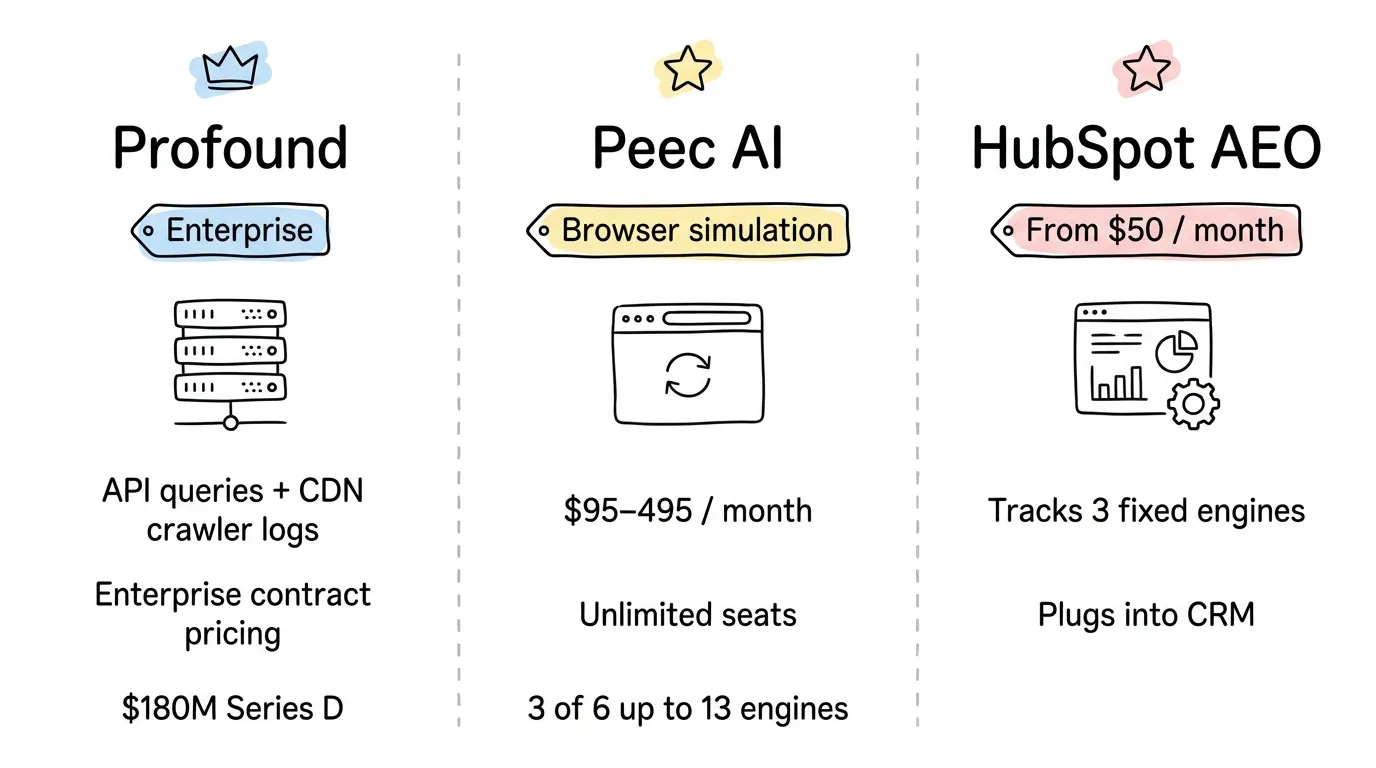
💬 Set your budget tier first, then look at data methodology. For small teams and agencies, Peec starts at $95/month with unlimited seats — clear value for money. If you need API, SSO, and server-side crawler logs, that's when you go negotiate Profound's Enterprise contract. Whoever you pick, first ask how the data is collected: browser simulation and real logs produce visibility readings that are not the same thing. If they can't answer that one, put the whole quote sheet aside. Teams on tight budgets can get monitoring running with HubSpot's $50 tier — better than leaving it empty.
🔗 Further reading: Read the full article
AI personalization starts with data fit — piling on more data won't save your model
Bloomreach's long-form piece, updated October 13, takes AI personalization down to the engineering layer — much harder-hitting than the usual five-examples-and-done articles. Every model eats different data signals: a co-purchase model wants roughly 6 months of purchase history, a co-view model wants about 2 months of browsing data, a purchase-propensity model wants sessions from the last 90 days. The article names the industry's biggest misconception: that the more data you pipe in, the smarter the model gets. The truth is that a field not mapped to the events a model reads is just noise, and stale fields are worse — they actively steer the model wrong.
The case numbers are concrete. Yves Rocher lifted purchase rate 11x with recommendations; TFG used a shopping agent to push Black Friday conversion up 35.2% and average order value up 39.8%; HP Tronic raised new-customer conversion 136%; Benefit Cosmetics saw email click-through up 50% and revenue up 40%; HMV's ad revenue rose 14% week over week. The HMV one deserves a second look: personalization didn't just work on on-site recommendations — it spilled over into the operating revenue of ad placements. Recommendation itself comes in tiers: "bought this, buy that next," based purely on products, doesn't count as personalization. The real thing fuses individual browsing, cart activity, and purchases with live session data into curated recommendations.
The methodology section is just as valuable. Results must come from randomized holdout tests, with a confidence threshold of roughly 98%. Gains from contextual personalization and gains measured by A/B tests need separate accounting — the former's incremental lift has to be measured against a control group; blend them and you get pretty numbers built on muddled accounting. What vendors call "real-time" is really five different clocks: event-level in milliseconds, profile updates per event, recommendation models retrained overnight, purchase propensity recalculated on demand, and in-session intent continuously refreshed. Aligning with a vendor on the definition of real-time saves you half the acceptance-testing arguments. The control layer comes first: business rules, pinning, and exclusions define the candidate set, and the model decides within those boundaries — so when something breaks, you can tell whether to fix the rules or tune the model. The article doesn't dodge overreach risk either: the pregnancy-congratulations-email style of embarrassment is personalization gone too far, and the mitigation is zero-party data — let users tell you which stage they're at.
💬 Before launching a personalization project, do one cheap thing first: list the models you plan to use, check your event tracking against the signal table, and where historical data falls short, backfill it before talking procurement. Reverse that order and the money's wasted. For results validation, accept only randomized holdouts — treat any lift number with no holdout design behind it as a story. And vendor case-study numbers: haircut every one of them 30% before it enters your plan.
🔗 Further reading: Read the full article
GEO's foundation is still SEO: what 75,000 brands' worth of data says about sequencing
Fractl's GEO (generative engine optimization) guide puts the discipline in its proper position: complementary to traditional SEO, not a replacement. Start with the consumer-side numbers: 49% of users already search with AI chatbots like ChatGPT, 38% rely on AI summaries, and among 18-to-24-year-olds, 66% use AI search nearly as often as Google. Younger audiences are moving their search habits fastest — for brands skewing young, that's not a nudge, it's a push.
The dependency is stated just as plainly. Semrush's experiments show ChatGPT pulls directly from pages Google has already indexed; sites with weak traditional SEO can't get cited in generative engines either — the old foundation is still the ticket into AI visibility. The guide also breaks down the citation logic of generative engines: getting crawled, understood, and cited is a seven-step workflow, and clear structure, authoritative citations, and schema markup influence whether the model uses you at every step. Ahrefs' study of 75,000 brands identifies the strong correlates: branded web mentions, anchor text, and search volume are all tied to content making it into AI Overviews — and how often your brand gets mentioned is earned through digital PR. You can't buy that.
The guide's best practices land on the content side: schema markup, clean heading structure, answering questions directly, citing authoritative sources. Put the three usage numbers side by side and AI search already counts as an installed habit — running both tracks in parallel (traditional search plus generative engines) is the norm for the period ahead, so budget and headcount should be allocated on that premise. The measurement system has to change with it: appearance rate inside AI answers, citations and earned media, cross-platform distribution, and durability of content authority have no column in any traditional SEO report — you'll need to build a separate table to track them. The article includes three client case studies; fine as reference material, and the methodological through-line isn't swayed by the case-study slant. There's an agency services pitch at the end — factor that bias in as you read, but the data sections remain citable.
💬 Slot GEO into your existing content calendar as an incremental task — don't spin up a separate project team. Step one: add schema and direct-answer blocks to your highest-value pages, then compare AI citations a month later — ROI you can actually see. When monitoring, watch several engines at once; don't draw conclusions from ChatGPT alone. Brands with younger audiences go first — that 66% usage frequency is your timetable. Have the existing SEO team absorb it; that's the lowest-cost option.
🔗 Further reading: Read the full article
Rehearse your talk on a walk: a voice AI workflow you can build in an afternoon
Mike Kaput of Marketing AI Institute shared a use case you can copy outright: ChatGPT Voice on your phone connected to Codex on your desktop. You go out for a walk, the AI practice partner walks through the slides page by page, and your hands stay free the whole time. The difference from reading your script off a screen: the AI knows what every page actually contains — visuals, animations, timing cues — it prompts you on the points to remember, files the phrasing that worked in rehearsal into your speaker notes, and can even edit the slides and notes on the spot.
Setup is five steps: give the AI access to the real deck — don't make do with a rough outline; build a dedicated skill for rehearsal that walks you through page by page, listens as you practice, and gives feedback; run a working MVP first, iterate by voice while walking, and tell it out loud to change the skill if you're not satisfied; connect your phone's voice to desktop Codex through ChatGPT; repeat until it's second nature. The combination transfers well — sales pitches, client proposals, podcast interviews, prepping key points before a media interview — swap in new material and it's reusable. It works for three reasons: the workflow follows people's natural habits instead of forcing habit changes; the skill fits your personal style better with every iteration; and the material is generic, so one setup serves many uses. The article frames it as a model case for designing AI use cases around real workflows, from the AI Use Case Spotlight segment, Episode 247 of The Artificial Intelligence Show.
💬 Setup cost is nearly zero — you can have a first version in an afternoon, and the skill only fits you better the more you use it. The real trick is step one: feed the AI the actual slides, not an outline. That's exactly where rehearsal quality diverges. This kind of skill is raised for one specific person; a colleague copying your version outright will get worse results, so it's more cost-effective for everyone to iterate once on their own script. Try a round before your next big pitch — saves the half-day of conference-room rehearsal, and gets your step count in along the way.
🔗 Further reading: Read the full article
🏷 Industry Data
A survey of 601 people: how deep the AI-influencer trust deficit runs
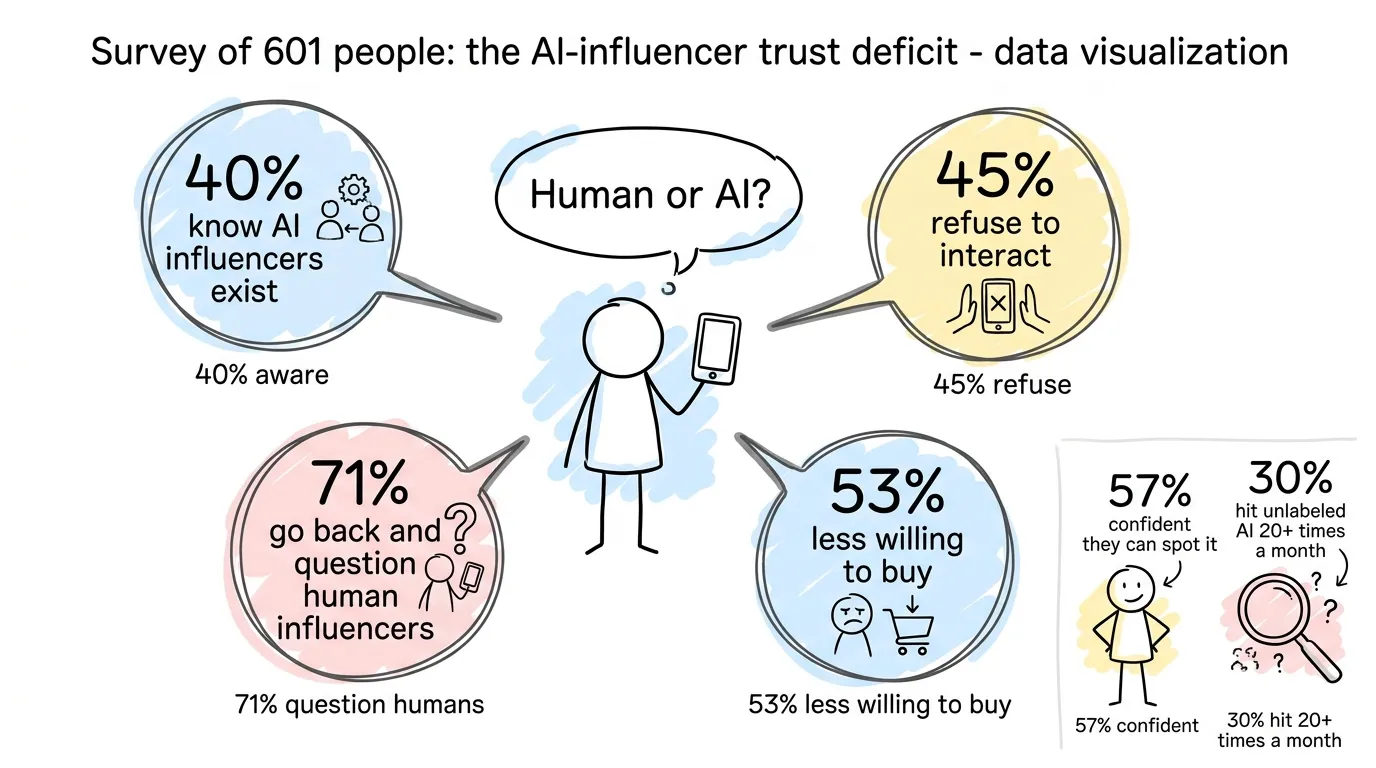
Based on a 2026 consumer survey of 601 people, Clutch draws the other side of generative AI in influencer marketing. Awareness is the first hurdle: only 40% of consumers know AI influencers exist. Attitudes are harder: 45% say outright they won't interact with AI influencers and don't trust recommendations from such accounts. The collateral damage is what brands should watch: 71% say that once they learn content used AI, they go back and question recommendations from human influencers too; 53% say they're less willing to buy from brands known to use AI. What readers are rejecting is opaque AI — brands that use AI transparently with clear labeling are not in the crosshairs.
Detection ability has padding too. 57% are confident they can spot AI-generated images and videos, but 30% encounter unlabeled AI content more than 20 times a month — confidence and actual detection skill are two different things. Trust hierarchies are shifting: consumers now lean toward brand recommendations (40%), while influencers get only 14%. But that edge is fragile — use AI opaquely and it vanishes. A sample of 601 isn't large, but this is rare first-party consumer attitude data at the intersection of influencer marketing and generative AI — enough for influencer teams to align their internal read on the landscape.
Positive cases exist too. In the AI doll trend, a beauty influencer partnered with Fanta, and UK retailer Primark had an employee with 150,000 TikTok followers take part — a single post cleared 2,000-plus likes. The cleverness of this kind of content is that AI is merely the pretext for participation; the person on camera is still human. Noorie Ana, with 140,000 Instagram followers, partnered with Adobe Firefly on tool tutorials — making content while teaching users to use the tool, turning a demonstration of AI capability into social proof; after all, 93% of consumers admit online reviews influence purchase decisions. In July 2025, H&M ran a social campaign with digital-twin imagery of 30 models, with the models keeping rights to their twins — how the likeness is used remains the person's call. That rights arrangement speaks directly to the question raised by the lawsuit in today's top story.
💬 Read the numbers together and the conclusion lands on disclosure strategy: AI behind the scenes for efficiency (editing, multilingual dubbing) is low-risk; AI front and center with a face swap is gambling away that 53% purchase intent. Write the disclosure terms into the brief before every campaign — don't bet that audiences won't notice. Those 30% who run into unlabeled AI content 20-plus times a month are the ones whose backlash is accruing interest. And there's a timing calculation: awareness is only 40%, meaning most viewers haven't yet formed fixed judgments about AI influencers. Standing up disclosure conventions now costs far less than correcting course after everyone knows. Use AI influencers to test interactive content first; leave product recommendation to humans for now.
🔗 Further reading: Read the full article
🏷 Strategy & Organization
Your best customers may never visit your website
A MarTech piece from October 28 opens with the author's own experience: last month he bought a phone without visiting any brand's website — an AI assistant compared five models, explained why one suited his workout habits better, and he went straight to Amazon to order. The brand knew what he bought, but not what he'd told the AI, which features he cared about, or which competitors he'd compared. When AI assistants start filtering, summarizing, and deciding for users, brands can lose their best customers without ever being visited.
The author, Ganapathy Sankarabaaham, argues that what catches management off guard has changed. Customers asking AI for recommendations: that debate ended long ago. What catches them off guard now is a marketing organization built around campaigns, calendars, and actively hunting for customers that can't keep up with AI-mediated journeys. He also flags an organizational pattern: when AI-first strategy is on the table, marketing is usually considered last — technology first, operations second, marketing at the tail — yet the entrance to the customer journey runs through marketing first. He leaves marketing organizations three moves. First, shift from a campaign-based model to a continuous growth engine spanning the customer lifecycle; McKinsey's data says human-AI collaboration can lift marketing ROI by up to 30%, on the condition that the freed-up time is explicitly redirected to growth work — send it to meetings and the gain evaporates. Second, market to machines: build a structured, verifiable knowledge engine for AI assistants — the GEO and AEO one-two punch — and name an internal owner; visibility with no one accountable equals visibility no one manages. Third, reorganize the organization around AI capabilities, mapping to McKinsey's five pillars: continuous insight, scaled creativity, hyper-personalization, agentic commerce, and always-on orchestration. Agentic commerce is the new path where AI completes purchases on the user's behalf; always-on orchestration means growth motions shift from monthly or quarterly scheduling to an always-on operating loop — both terms are worth memorizing on their own. Within that, true 1:1 hyper-personalization can deliver a 5% to 8% revenue lift; the brand's voice and visual guidelines need to be hardened into AI guardrails, and talent structure should drift toward a marketing-plus-data-plus-AI hybrid.
💬 One of these three things can be done this week: designate an owner for AI visibility, turning GEO and AEO from nobody's responsibility into a KPI somebody carries. If organizational restructuring won't move, move the responsibility chart first — it's the cheapest cut. Don't delay the brand-guidelines step either: while agent counts are still low, harden the voice and visual guardrails now; wait until every team has wired up its own agents and the rework multiplies several times over. The 5% to 8% revenue headroom hangs on hyper-personalization — run an ROI projection before the project proposal, and trade numbers for budget, not slogans for budget.
🔗 Further reading: Read the full article
97% of marketers use AI, yet lead follow-up still lags
Disclaimer first: this item comes from the show page of Episode 8 of the MarTech podcast Conversations with MarTech. The page is mostly a topic list with limited density; what follows is organized from its summary and key points, with details deferring to the full episode. The guest is Malinda Sandman, VP of Global Marketing at Typeform, and the theme is a single question: has AI actually made marketing easier?
Several of her judgments are worth writing down. In the shift toward zero-click environments, marketing actually gets harder in the short term — the explosion of AI ad platforms and tools adds chaos in the near term, not certainty. Whether AI inside paid ad platforms is net-positive or net-negative, this episode gives no standard answer either, leaving it as an open discussion. 97% of marketers already use AI, yet lead follow-up still lags — where teams are stuck is execution, not data supply. This is an action problem, and tools can't solve it. Also beware garbage in, garbage out with AI tools: if the insights you feed in are themselves distorted, the larger the output, the further off it lands. Piling more data together can mask a gap in customer understanding — there is no automatic conversion rate between data volume and understanding your customers. Typeform's own practice: use AI to run customer interviews at scale, completing Always-On customer research within 24 hours, then use video feedback to bridge the insight gap between B2B and B2C.
💬 Read the 97% number backwards: the tools are already universal; the gap is entirely at the execution layer. Pull one week of lead follow-up times to set a baseline first, then decide whether you need new tools — don't reverse the order. Add the garbage-in-garbage-out line to your operating procedures too: run every interview script you feed the AI through human review before scaling. The 24-hour research loop can run its first version this week — let AI draft the interview scripts, keep humans for final review, and spend the saved time actually following up on leads.
🔗 Further reading: Read the full article
💡 Today's Wrap-Up
Read today's eight items together and the main line surfaces: with each layer AI sinks into marketing, the price of loose operations goes up a notch. On the regulation side, disclosure is becoming a hard constraint — Turkey's and the EU's new rules took effect this month, leaving brands an adjustment window measured in weeks. The consumer side has priced transparency: the 53% purchase-intent discount comes with a posted price tag, and it aims at opaque use — brands that use AI transparently with clear labeling sit inside the trust zone instead. The tool side has put validation methods on the table too: holdout tests, the 98% confidence threshold, the five clocks of real-time — the era of scaling spend on gut feel is winding down, and whether the numbers look good now starts with whether the experimental design passes. And on the organization side, two answers that look different — MarTech's three AI-first moves and Typeform's execution-gap diagnosis — land in the same place: responsibility assigned to a person, validation backed by numbers. Tools are affordable for everyone; what separates teams is who answers for the results.
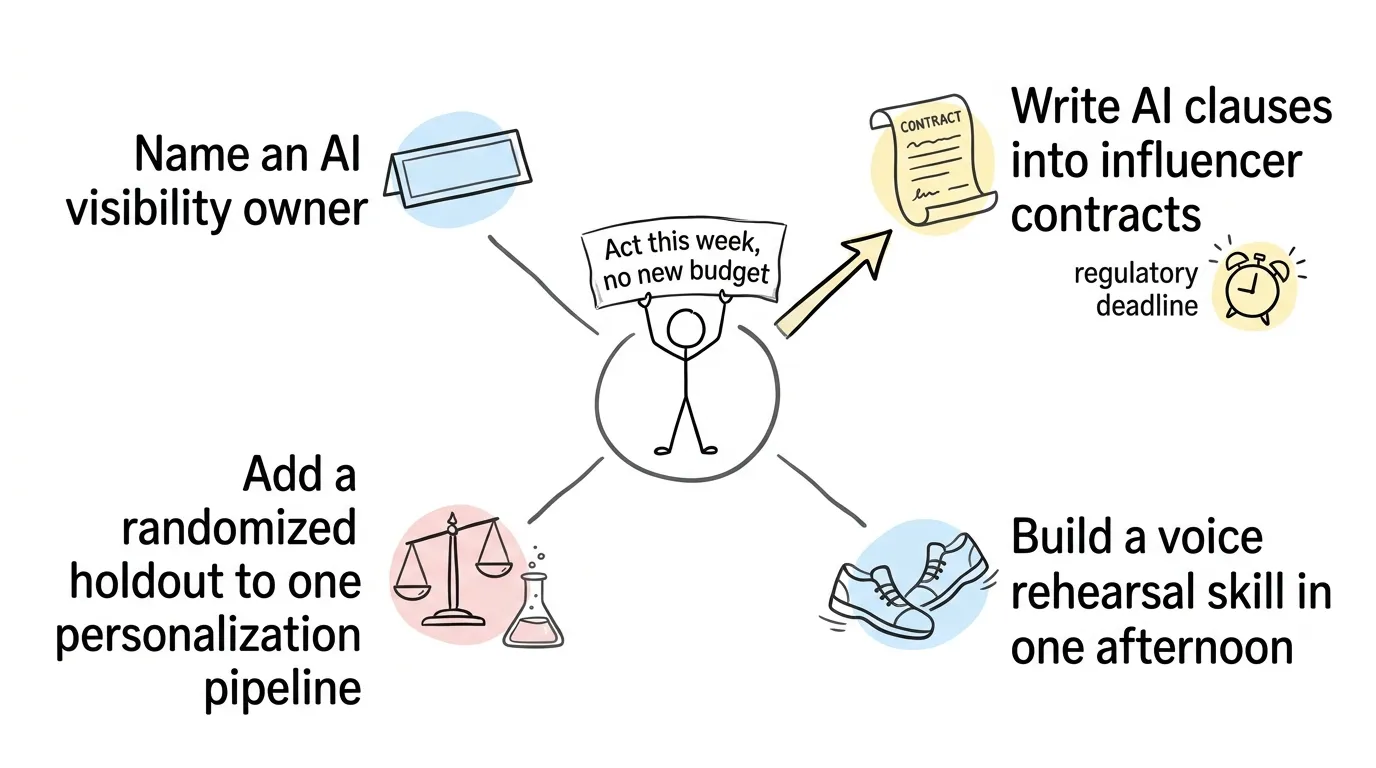
Turn these into actions, and none of them is expensive. Write AI clauses into your next influencer contract. Designate one person as the AI visibility owner. Add a randomized holdout to one personalization pipeline. Spend one afternoon building the first version of a voice rehearsal skill. Not one of these requires new budget. If you pick only one this week, pick the contract clauses — the rest can run in parallel at their own pace, and only this one carries a regulatory deadline. The genuinely expensive move is watching and waiting: once regulators start writing tickets and competitors have already debugged their processes, the cost is no longer one person and one afternoon. The direction is clear. From here on, what's left is a race to see who moves first.
Continue reading
Related articles
AI Marketing Daily · 2026-11-22
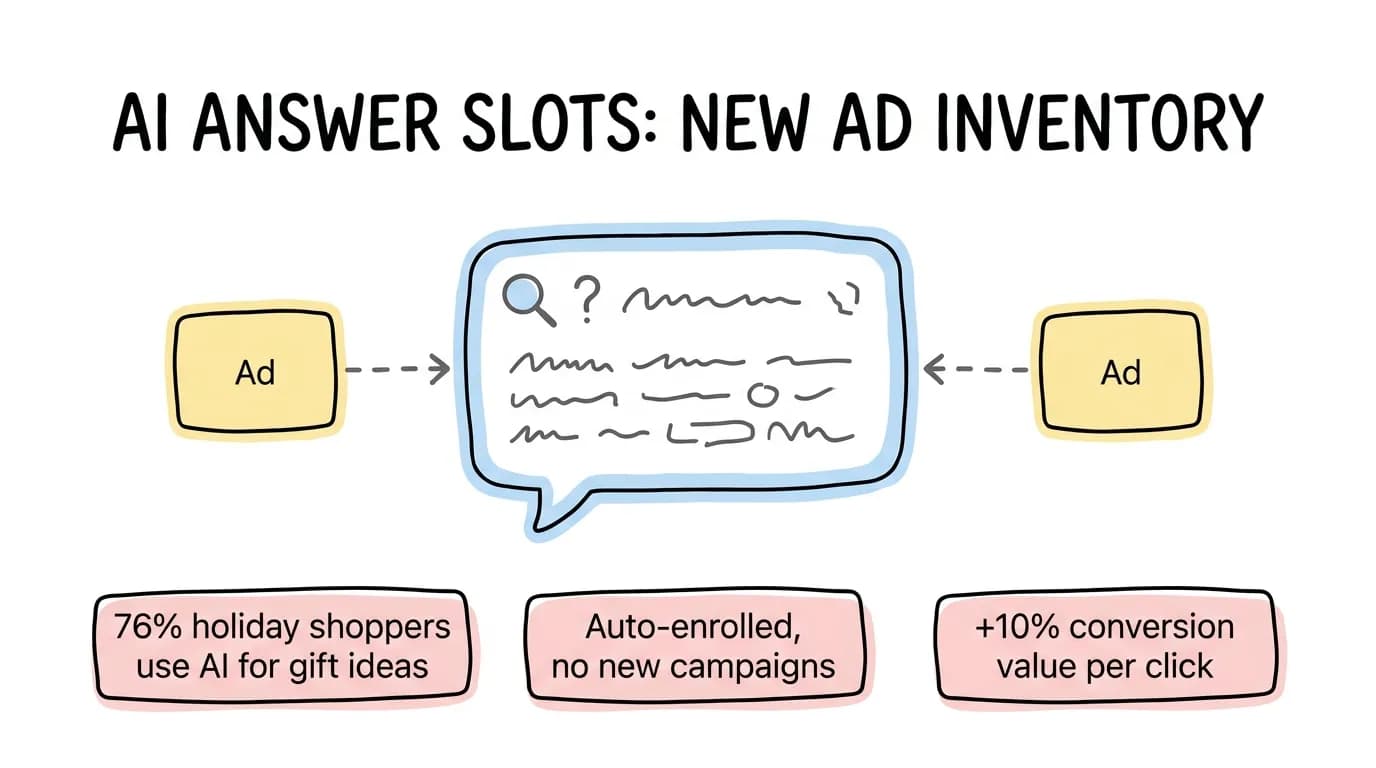
AI Marketing Daily for 2026-11-22 rounds up 20 items led by Microsoft opening Bing AI Overviews to ads and Google expanding AI Mode ads to ten countries, plus GEO guides, ad automation delegation guidance, AI Overviews CTR data, and a legal-risk checklist for AI-generated creative.
AI Marketing Daily · 2026-11-21
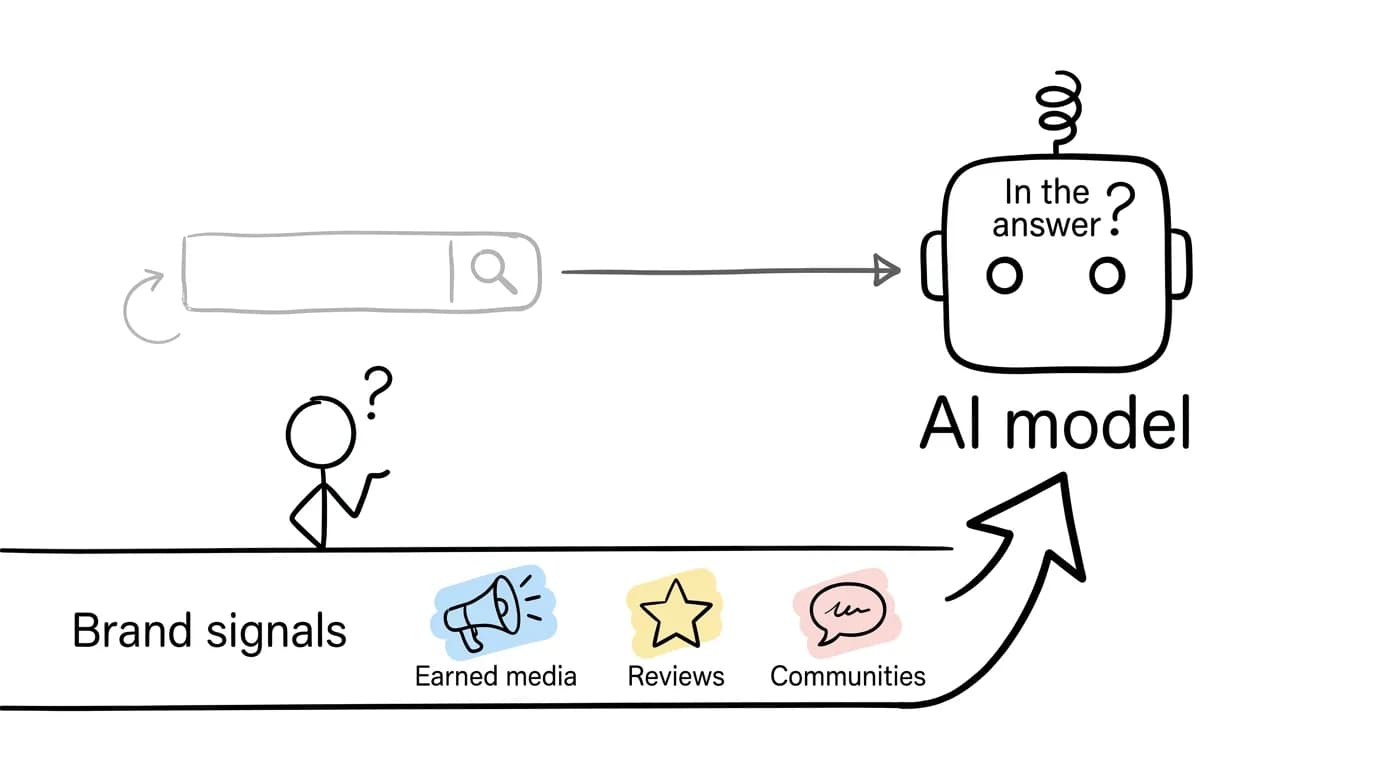
A November 21, 2026 AI-marketing daily covering AI search visibility, GEO methods, Google AI Mode ads expanding to ten countries, Meta's pre-Black Friday changes, agentic shopping, and industry adoption and ROI data.
AI Marketing Daily · 2026-11-20
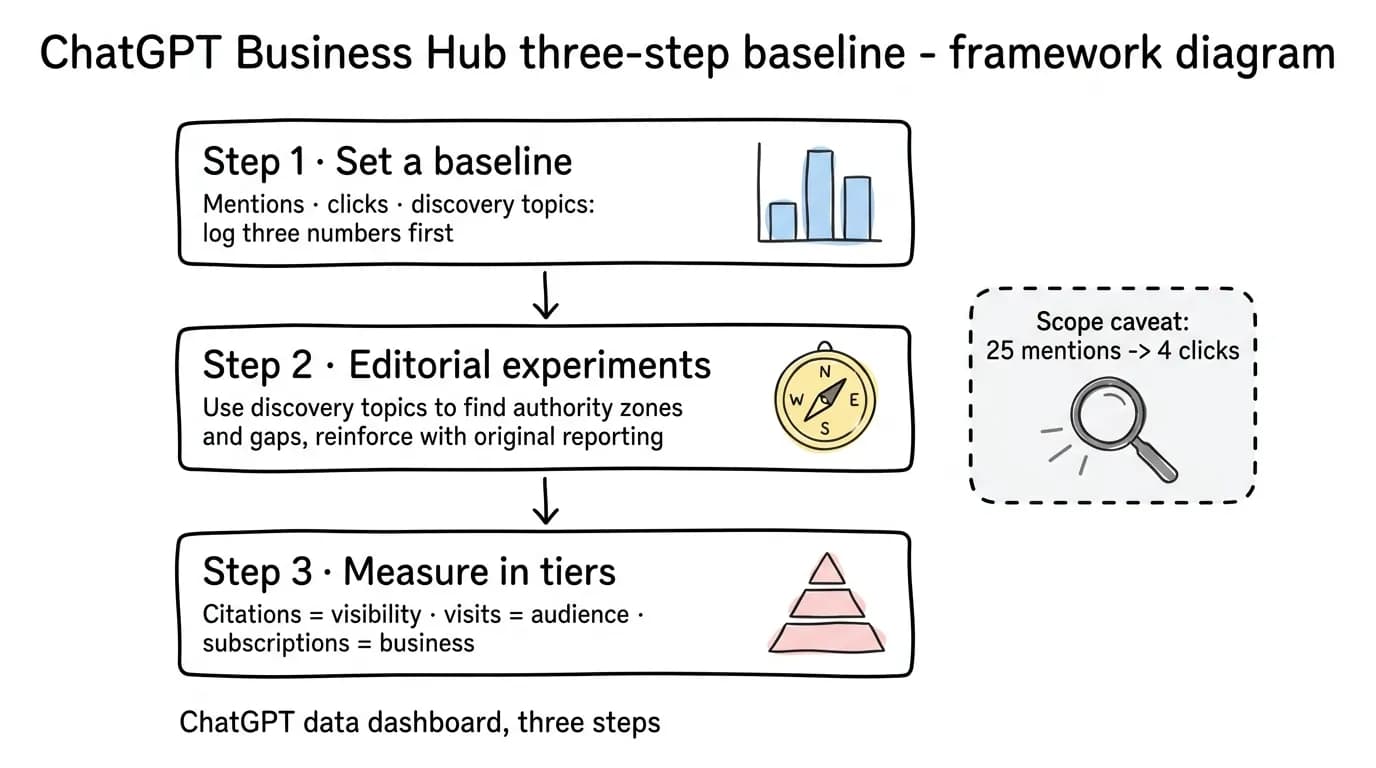
AI Marketing Daily for 2026-11-20 rounds up 19 items centered on measurement: OpenAI's ChatGPT Business Hub dashboard, EU rules for agent-mediated purchasing, Meta pausing four AI terms, and B2B data on shortlists and the dark funnel, each with action advice.