
Which AEO Tool Should You Buy? I Put Profound, Peec AI, and HubSpot Side by Side and Did the Math
A learn article comparing Profound, Peec AI, and HubSpot AEO tools, covering how visibility scores are measured, analysis and publishing capabilities, pricing tiers, and compliance certifications. It offers guidance on choosing a tool based on team size, markets, and existing platforms.
A couple of days ago, at midnight, a friend of mine who works in branding sent me a WeChat message that said, simply: help.
His company was about to buy an AEO tool, and they had spent two months on vendor selection. He had sat through demos from both Profound and Peec AI, and the more he watched, the more confused he got. Both sales teams claimed to be number one, and their quotes were worlds apart.
So he asked me: which one should we pick?
I told him: don't rush to choose. To think this through, you first have to think through a more fundamental question.
What exactly is AEO?
AEO — Answer Engine Optimization (the practice of optimizing so that AI systems mention and recommend your brand in their answers). In plain terms: you used to optimize for search rankings; now you have to watch how AI systems like ChatGPT and Gemini "answer" questions about you.
When a user asks an AI "which CRM is the best," it rattles off three names on the spot — and yours isn't one of them. And the user won't flip to page two, because there is no page two. That's the problem AEO exists to solve: getting the AI to mention you in its answers, and to say nice things about you.
This space is hot right now, and there's no shortage of tools. But the two that keep getting compared are Profound and Peec AI. What exactly is the difference between them? I went through both companies' materials with a fine-tooth comb, then pulled in HubSpot's AEO tool to make it a three-way comparison. In this piece, I'll do the math for you.
The Question Most People Skip
When many people evaluate tools, they start by comparing feature grids.
Wrong.
The first question to ask when choosing an AEO tool is: how exactly is that "visibility score" measured?
Why ask this? Because not every score means the same thing.
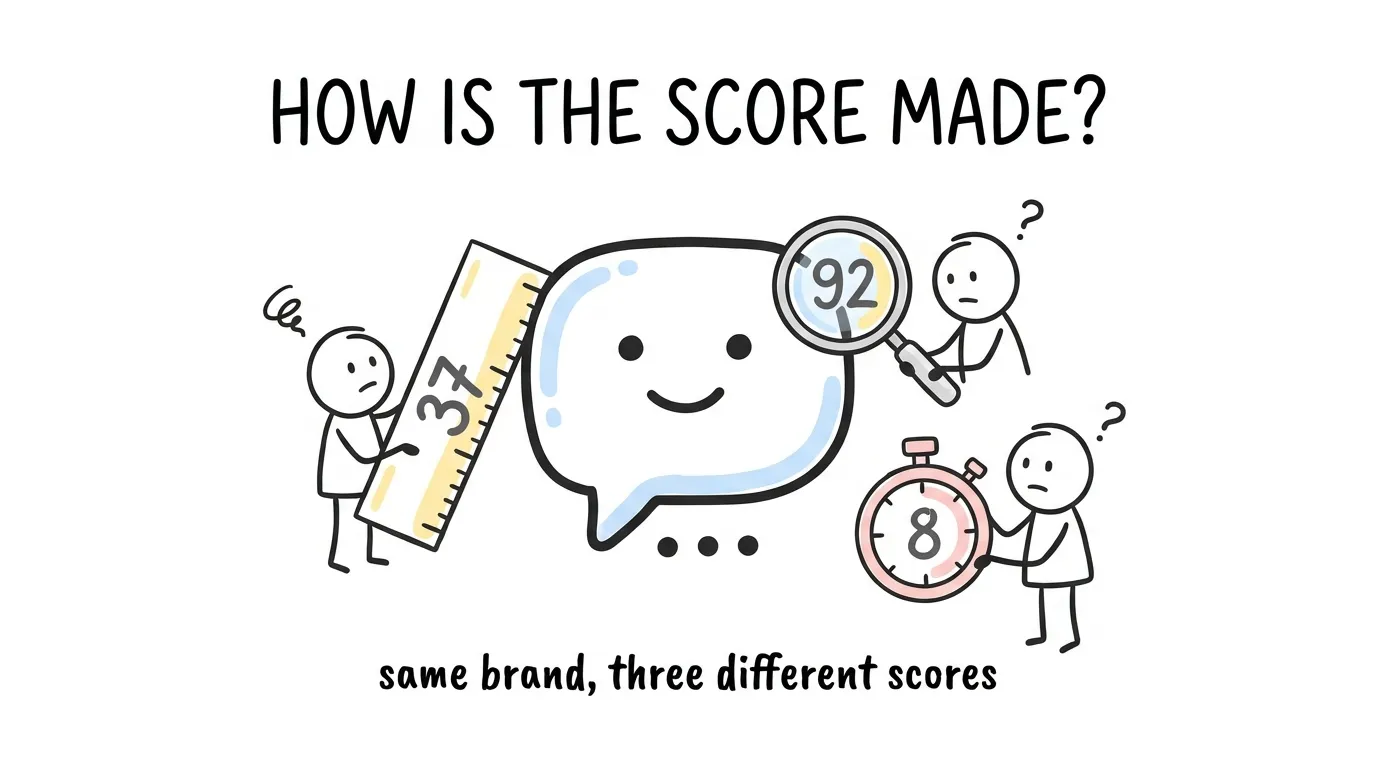
Think about it: say you want to know how you're looking today. One way is to check a mirror, another is to ask your mom, and another is to ask the gym salesman. All three will give you an answer — but can those three answers possibly be the same?
Measuring AI visibility works the same way. Behind the sentence "your brand was mentioned 37 times this month" can lie completely different ways of measuring.
Profound's approach is to go directly to the answer engines that real users actually use, rather than calling model APIs. Why? Because results returned through APIs are often "sanitized," and may not be the same as what an ordinary person sees on their screen. It also runs server-side tracking at the CDN layer, integrating with Cloudflare, Vercel, AWS, Fastly and others, logging every AI crawler that comes to scrape your website — it can even filter out fake visitors disguised as crawlers. On top of that, it pairs in consumer panel data to estimate how many people ask AI search about topics related to you each day.
Peec AI does exactly the opposite: it doesn't touch APIs at all, instead sending browser bots that pose as an ordinary visitor — not logged in, no browsing history — to the web pages of each engine, running through the prompt list every 24 hours from a local IP in your target country.
One takes the back channel; one plays the ordinary user. Which one measures more accurately? Both are legitimate. But the scores they produce mean different things.
So before you put any two vendors' scores side by side, I suggest you first fire these five questions at the sales rep:
- Are your queries made through the API, through browser simulation, or through real user sessions?
- How many times a day is one prompt tested? How do you smooth out intraday fluctuations?
- When testing overseas markets, are the IPs local?
- Can you distinguish between the sources the model has consumed and the sources it actually cites?
- When you say "visibility," do you mean being mentioned, ranking position, or share of voice?
If the sales rep can answer these five questions clearly, you're halfway to a trustworthy tool. If the answers are vague, move straight on to the next vendor.
You Can See the Problem. Now What?
Okay, suppose the scores are in: your brand's visibility on a certain engine is slipping, and sentiment is skewing negative.
Then what?
This brings us to the second dividing line: after you see the problem, how far can the tool help you go?
Profound's analysis goes deep. Its Answer Engine Insights module sorts mentions into positive, neutral, and negative, and it can catch hallucinations — that is, when the AI says false things about you with a perfectly straight face, for example inventing a feature you don't actually have. Citation sources are also sorted into several categories: your own official site, competitors, media and PR, social platforms. Which websites are driving your citations — it names them for you.
Peec AI's philosophy is fewer features, sharper clarity. It scores sentiment from 0 to 100, separately for each engine. One detail I really like: it separates the sources the model has consumed from the sources it actually cites. The difference between these two is huge — the AI having read your article doesn't mean it will attach your link in its answer. It also has an Actions framework that sorts to-dos like on-site fixes, owned content, and external share of voice by expected impact, so you just work your way down from the top.
But.
Both tools only handle "seeing," not "publishing."
Profound's Agents can draft content and push it toward CMSs like Contentful, Sanity, and WordPress, but that final human review cannot be skipped. Peec AI's editor can give you page rewrite suggestions; after you make the changes, you still have to carry the copy back to the CMS yourself. PR outreach, multi-channel distribution? All of it still takes people.
HubSpot's AEO tool fills exactly this gap. In the Professional and Enterprise tiers of Marketing Hub, the recommendations connect directly to the content agent, and drafts are written, reviewed, and published inside the same account. And its prompt suggestions aren't dreamed up out of thin air — they grow out of the contacts, deals, and customer segments in your Smart CRM. Of course, the catch is that you need to already be living in HubSpot.
Let's Do the Math
Alright — the numbers.
Peec AI, Starter tier, $95 a month: choose any 3 of 6 core engines, 50 prompts, 1 country, unlimited seats. Going up, Pro tier is $245, Advanced tier is $495; additional engines cost $35 to $165 each per month, and the Enterprise tier can monitor up to 13 engines. Unlimited seats is fantastic news for agencies: bring in ten client teams without paying per head.
Profound went to the other extreme. A 7-day free trial, 3 engines, 50 preset prompts, unlimited seats — but only 1 region and 1 language. And then? Then it jumps straight to custom Enterprise pricing. Exports, API, SSO — all locked behind the Enterprise gate. In the middle there is an Agency Growth tier, $99 base price, plus $399 for each client workspace. Note: it's not that they look down on small and mid-sized businesses; their product structure simply grew to fit large enterprises.
HubSpot AEO, $50 a month, $45 if you pay annually. 25 prompts per day, tracking three engines — ChatGPT, Perplexity, Gemini — 2 seats, and a 28-day trial that doesn't even ask for a credit card. If you're already on Marketing Hub Professional or Enterprise, this tool is included at no extra charge, and seats rise to 3 to 5.
Now look at their war chests. Profound is the funding winner: the Series D in September 2026 took in $180 million at a $1.8 billion valuation; while in the Series C at the beginning of 2026, at $96 million, the valuation was only $1 billion. In less than a year, it nearly doubled. Peec AI made its move earlier: the Series A in November 2025 was $21 million, with roughly $29 million raised in total. One is built to grow deep; the other is built to run fast.
Security: Nobody Thinks About It Until Something Breaks
Talking compliance can put anyone to sleep.
But if you're in finance, healthcare, or another regulated industry, this one criterion can cut your options in half on the spot.
Profound has SOC 2 Type II and HIPAA certifications, data is encrypted both at rest and in transit, and SSO supports mainstream identity services. The price: all of this is locked inside the Enterprise tier. Peec AI does GDPR compliance, but its SOC 2 and HIPAA certifications have not been made public.
On MCP, Peec is actually generous: all paid tiers include the MCP service (MCP — Model Context Protocol, a standard interface that lets data flow directly between AI tools and your existing software), so data can flow straight into the tools you're already using. Profound's REST API and developer kit are Enterprise-exclusive. The logic here is clear: for security endorsements, look at Profound; for flexible data flow, Peec has the lower barrier.
So Which One Should You Choose?
My verdict, straight up.
Large enterprises, regulated industries, need to cover as many engines as possible: Profound. The Enterprise tier monitors up to 9 engines, offers log-level crawler data, and has complete compliance. The cost: it's expensive, and many things simply can't be touched without signing an Enterprise contract. So before buying, ask yourself one question: crawler logs and CMS agents — will you actually use them? Or are you paying enterprise money just to buy a report?
Agencies, team collaboration, need multi-country tracking: Peec AI. Unlimited seats, multi-country coverage, low entry price. The cost: there's no publishing layer, and after revising, you have to move the copy out yourself.
Already inside the HubSpot ecosystem, want to string the whole operation together: HubSpot AEO. Starting at $50, CRM context plus on-site publishing; Enterprise's multi-touch attribution can even link AI-driven visits to closed deals. The cost: it only watches 3 fixed engines — Google AI Overviews, Claude, and Copilot are all ignored.
One warning, don't ignore it: no tool at all can map a single "zero-click" AI mention to one specific order. Zero-click visibility and sales attribution are correlated, not equal. If anyone promises you, with a straight face, that they can quantify down to the individual order, keep your guard up.
Finally, Three Practical Reminders
First, to verify whether the data is accurate, don't listen to the sales pitch — spend half an hour yourself. Fire up a VPN and switch to your target country, stay logged out, ask the same prompt across several engines for several consecutive days, note the timestamps and the answers, and check whether the direction matches the tool's data. Don't expect word-for-word agreement; check whether brand mentions and citations point in the same general direction.
Second, if you want to prove value to your boss, don't show up clutching dozens of pages of reports. Pick one prompt that happens to correspond to a customer segment or flagship product your boss is already watching, draw one visibility curve every week, and put the AI-driven traffic next to it. One number that moves beats ten static reports.
Third, guard against "dashboard fatigue." Assign one person to be responsible for AEO reporting, set a review rhythm, and set thresholds: act only when a metric crosses the line; if it doesn't, don't act. Track as many prompts as you genuinely need to track, but in reviews, group them by segment or theme and look at them in batches — don't grind through them one by one.
That night, my reply to my friend was a single sentence: first ask how the scores are produced, then ask whether you can act on what you see — and only then does price get its turn.
Which one he ended up choosing doesn't matter. What matters is that he finally knew what he was paying for.
Tools exist to make problems clearer. But if the process of choosing the tool itself leaves you more confused, then that money would be better saved and spent taking the team out to dinner.
Here's to getting your next tool decision right the first time.
Continue reading
Related articles

It's 2026: Stop "Buying" AI Tools for Your Marketing Team — Start "Hiring" AI Agents
This learn article explains how AI agents differ from standalone AI tools in marketing, outlines three agent categories — build-your-own platforms, CRM-native agents, and vertical tools — and covers use cases across SEO, social media, advertising, and reporting, plus criteria for choosing one.

What Is GEO? How Your Brand Gets "Mentioned" in the Age of AI Search
An explainer on GEO (Generative Engine Optimization) for e-commerce and DTC brands: how it differs from SEO and AEO, why AI answers shape brand visibility, and eight practices covering question-focused content, consistent brand messaging, structured pages, external evidence, comparisons, and AI mention tracking.

AI Is Already Making Decisions for Your Customers. Are You on the List?
A learn article explains GEO (Generative Engine Optimization): why AI-generated answers now shape which brands customers see, and how SEO fundamentals, entity clarity, citable evidence, and monthly measurement affect visibility in AI answers.