
Your customers are asking AI for directions now. Is your sign hanging in the right place?
A learn article explaining GEO (Generative Engine Optimization), how it relates to SEO, and why brands are optimizing content to be cited in AI-generated answers. It covers practical tactics such as making content easy for AI to find and cite, plus measurement shifts beyond rankings and traffic.
A while back, an old friend of mine who runs an e-commerce business invited me out for tea. He's been doing SEO for seven or eight years and runs a team of twenty to thirty people. Lately, he's been looking worried.
"Boss," he said, "something's strange. We're still publishing articles every week, still buying backlinks every month, and our rankings haven't dropped much — but traffic is down twenty percent. Weird, right?"
I told him it wasn't weird at all. Then I asked him a question: last week, when you wanted to get clear on a business concept you didn't know, did you open a search box and dig through ten blue links, or did you just ask an AI?
He froze. After a long pause, he managed: "I asked the AI first."
"See," I said, "you've changed. What makes you think your customers haven't?"
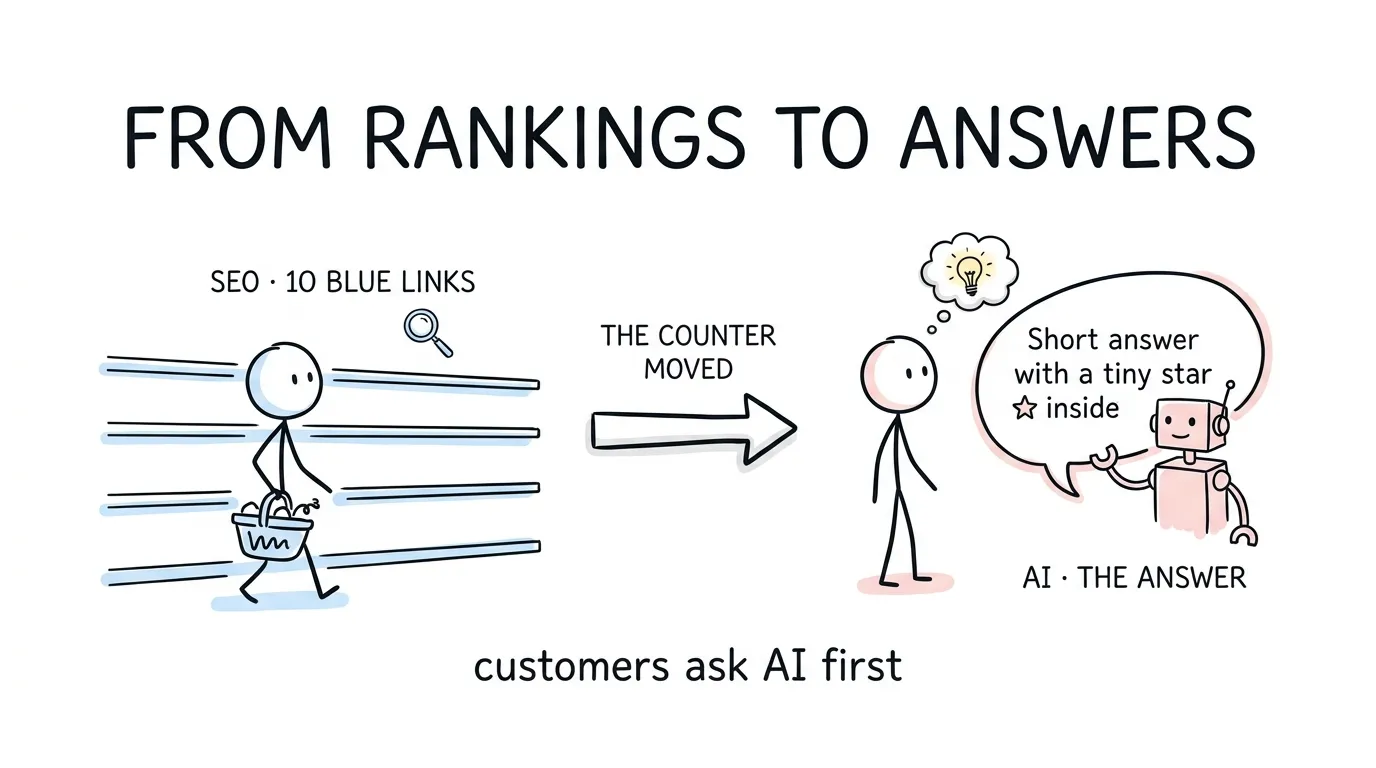
Your content is still minding the old counter, but your customers have already gone to the new one to ask for directions.
What exactly is GEO?
So what is GEO?
GEO stands for Generative Engine Optimization. Simply put, it's about giving your brand a chance to show up inside AI-generated answers.
You might ask: how is that different from SEO?
Let me draw you a picture.
Traditional search is like a shopper walking a mall. They have a rough idea of what they want, then browse the shelves row by row. If you want to be seen, you have to spruce up your storefront, rent a good spot, and light up your sign. That's what SEO does: pick keywords, build backlinks, tune your site structure and technical metrics until everything runs smoothly.
AI search is different. It's like having a knowledgeable friend standing beside you. The customer asks directly: "I want to buy X — tell me about it?" The friend doesn't walk them down the aisles; the friend just gives them an answer.
The question is: when that friend gives the answer, does your brand get named?
That's what GEO is here to solve. Before, you competed with ten rivals for ten shelf spots; now, you're fighting to get named inside an answer that's only three to five sentences long.
From "ranking in the top ten" to "being written into the answer."
The battlefield has moved.
Customers aren't just browsing Google anymore
Some people will say you're being alarmist — everyone still uses Google, don't they?
Content marketing agency Fractl ran a survey with Search Engine Land covering 2,000 consumers, and the numbers are striking.
49% of consumers are already using AI chat tools like ChatGPT to look up information. 38% will read the AI-generated summary sitting at the top of the search page. Do the math: one in every two customers has asked an AI; nearly two in every five can't even be bothered to click a link.
What about young people?
Even more brutal. Among people aged 18 to 24, 66% use AI chat tools about as often as they use Google.
Two out of every three young people.
For brands, this means being "discovered" is shifting from people finding web pages to AI delivering answers on people's behalf. Your content doesn't just have to be findable by search engines anymore — it has to be readable by AI, worth citing, and safe to cite.
This is a new craft.
What's the actual relationship between GEO and SEO?
Plenty of business owners hear "GEO" and their first reaction is: great, now I need to hire another team.
Hold on. Here's the interesting part: the foundation of GEO is still SEO.
Take an example. Someone asks an AI, "What accounting software should a small business use?" Where does the answer come from?
Out of thin air?
Leigh McKenzie at Semrush ran an experiment: trace ChatGPT's answers back to their sources, and you find that much of the information it cites comes from pages indexed by Google.
Amazing! The AI friend looks all-knowing, but before turning in its homework, it still went to Google to flip through the reference books.
The industry calls this mechanism RAG (Retrieval-Augmented Generation — AI goes out to gather sources first, then organizes what it found and explains it to you in plain language). Which sources it checks, which it trusts, and whom it cites — that decides who shows up in the answer.
So ever since Google's AI Overviews launched in May 2024, plenty of companies have watched organic traffic slide in front of their eyes — tech, travel, and retail especially. When the answer is handed straight to users, who's still clicking links?
So was SEO all for nothing?
Quite the opposite.
Tim Soulo, CMO at Ahrefs, has made this observation: evergreen content is depreciating. What's evergreen content? The kind of article that lives forever, like "How to choose X." AI's answers know a little bit of everything, so the edge these all-purpose articles had gets diluted. What's gaining value instead is trend-tracking, fast-turnaround, timely content.
Let me lay out these layers for you:
Layer one: SEO still has to be done. The library AI visits for sources is the bookshelf that search engines spent decades building.
Layer two: SEO alone is no longer enough. Even with your book on the shelf, AI may never cite it.
Layer three: the genuinely new skill is making your content "cite-worthy."
SEO decides whether you get to play. GEO decides whether the AI is willing to say your name.
How do you make the AI willing to say your name?
Now for the most practical part: what do you actually do?
My summary comes down to four words: easy to find, easy to cite.
What does "easy to find" mean?
It means AI can smoothly read your content. Use proper markup to tell AI what each block of content is; write headlines like road signs, one topic per section; put the important stuff up front — don't hold back for suspense. Think about it: AI is a machine. It has no patience for your slow-burn buildup.
What does "easy to cite" mean?
It means your content is worth being copied into AI's answer. Answer the questions users actually ask; cut the fluff and deliver substance and first-hand data; when it's time to cite authoritative sources, cite them honestly. When AI cites you, it's putting its own reputation on the line — the more solid your content, the more confidently it dares to cite.
Ryan Law, Ahrefs' head of content marketing, has summed up a playbook, and its core is three things: off-site visibility, original research, and designing content the way AI takes its materials.
And there's one dumb-but-brilliantly-effective method: get your brand talked about by more people. Do original research, publish data-backed content, and show up in places that get cited over and over. Ahrefs' study covering 75,000 brands is sitting right there: the single strongest correlate of showing up in AI Overviews is how many times your brand gets mentioned across the web.
Mention count is hard currency.
So how do you know if any of it worked?
The scoreboard needs replacing too. Before, you looked at rankings, clicks, and traffic. Now you add a few lines: how many AI answers does your brand appear in; how many third parties are citing your content; and how well is your content running on search, social, and media platforms — because those places are the reference libraries in AI's eyes.
Two real case studies
Method talk with no stories gets dull fast, so here are two cases, both made public by content marketing agency Fractl.
One is an online educational games platform. They ran a series of data-rich, opinionated content campaigns aimed squarely at media coverage and external citations. In two months: over ten thousand new visitors, over 1,700 new keywords entering the rankings, plus coverage from outlets like TechCrunch and Forbes. And crucially, platforms like AI Overviews, ChatGPT, and Perplexity started citing them at scale.
The other is a freelancers platform, taking a similar path: build the on-site content solid, organize it around real user intent, and make it readable by AI. Traditional rankings rose — and that's not counting the fact that Google's AI Overviews alone cited them more than 8,000 times.
More than 8,000 times. Think about it — that's 8,000+ moments of AI introducing you to your customers, on your behalf.
You'll notice that neither of these two companies did anything like "dumping SEO and starting over." Both got their content foundations solid, then made the content AI-friendly.
Two wins from the same work.
Back to my friend
Later I met that e-commerce friend again. He asked me: "So should I lay off my SEO team and hire a bunch of GEO specialists?"
I said, "Oh, come on."
What you need to do is actually plain: write your content a little clearer, a little more solid, a little more honest — make it readable by machines and worth citing by people; then spread your content to the places it should be spread. Your old team's skills are all there. What's missing is a new scoreboard.
Technology always moves the counter. From portals to search, from search to recommendations, and now it's AI's turn. The counter has changed three times, but good merchandise has always been scarce.
Wherever customers go to ask for directions, that's where your sign should hang.
And here's to you: may you always be the first one to move the counter.
Continue reading
Related articles

It's 2026: Stop "Buying" AI Tools for Your Marketing Team — Start "Hiring" AI Agents
This learn article explains how AI agents differ from standalone AI tools in marketing, outlines three agent categories — build-your-own platforms, CRM-native agents, and vertical tools — and covers use cases across SEO, social media, advertising, and reporting, plus criteria for choosing one.

What Is GEO? How Your Brand Gets "Mentioned" in the Age of AI Search
An explainer on GEO (Generative Engine Optimization) for e-commerce and DTC brands: how it differs from SEO and AEO, why AI answers shape brand visibility, and eight practices covering question-focused content, consistent brand messaging, structured pages, external evidence, comparisons, and AI mention tracking.

AI Is Already Making Decisions for Your Customers. Are You on the List?
A learn article explains GEO (Generative Engine Optimization): why AI-generated answers now shape which brands customers see, and how SEO fundamentals, entity clarity, citable evidence, and monthly measurement affect visibility in AI answers.