
Your Customers Are Buying on a Road You Can't See
An article on how customers now research and buy through AI assistants, leaving brands blind to how purchases happen. It outlines three shifts: always-on AI-first marketing, machine-readable brand knowledge so AI can find and recommend you (AEO/GEO), and hybrid AI-marketing team capabilities.
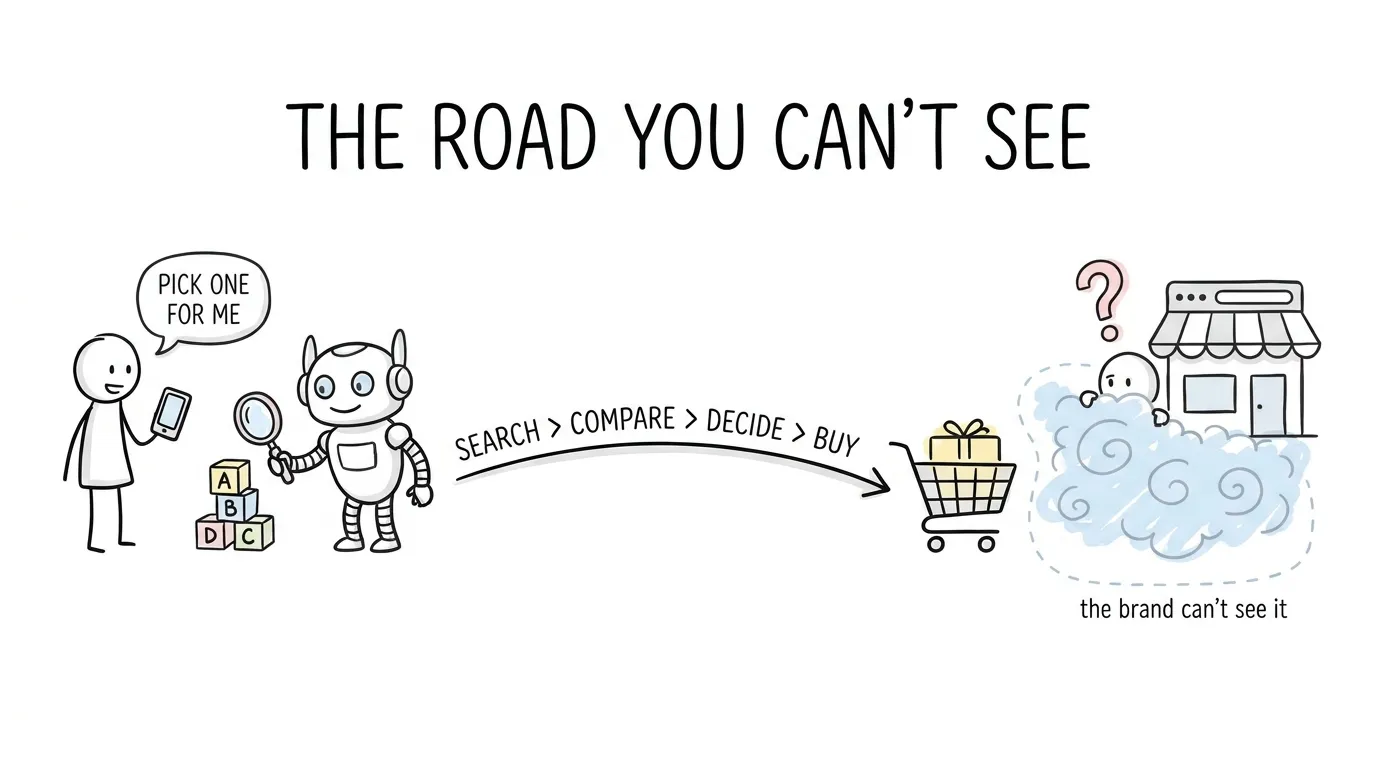
A while back, I upgraded my phone.
Not once in the entire process did I open a single phone brand's website.
So how did I buy it? I asked an AI assistant to help me pick a phone. It compared five models for me and talked through which one suited a daily runner like me. When it finished, I jumped straight to Amazon, placed the order, done.
The phone maker knows I bought a phone. But it doesn't know what I said to the AI, doesn't know what I cared about most, and doesn't know which models I compared.
In other words, the brand has no idea how this deal actually came together.
That has stayed on my mind for a long time.
The question a lot of people worry about is: will customers use AI to buy things? That one already has an answer. Yes. And they've been doing it for a while.
The real trouble is something else: our entire marketing organizations were built around a process of campaigns, scheduling calendars, and customers researching, comparing, and deciding on their own. Now customers have outsourced those three things — search, compare, decide — to AI. The process has changed. The organization hasn't.
Brand visibility is lost long before the sale ever happens.
That's why I keep telling people: in companies going AI-first, everyone is busy fixing the tech and the operations, and marketing is always the last function anyone thinks of. It should be exactly the opposite. Marketing should be the first one pulled to the table.
So where to start? Three shifts.
Shift One: From Fireworks to a Steady Stream
How does traditional marketing work? Set a budget, build a schedule, launch a campaign, let it run its course, hold the review, wait for next quarter.
Like fireworks. Sure, it makes a loud bang — a big one — and then the sky goes dark.
AI-first marketing isn't like that. It runs continuously around the customer's full lifecycle. AI handles around-the-clock orchestration and execution; people set the direction and make the judgment calls.
McKinsey has research on this: human–AI teams that work this way — AI setting the stage, humans making the calls — can lift marketing ROI by as much as 30%.
The key change inside all this is that the way you ask questions has changed.
Before, you asked: what happened last month? Now you have to ask: what's changing right now — and what am I going to do about it?
Insight used to be a report produced for the retrospective meeting. Now, insight has to be put to use in real time.
So how do you measure whether you're doing well? How many emails went out, how many campaigns launched — in the new model, those numbers tell you almost nothing.
You have to watch the real results. But watching results alone isn't enough. Let me run the numbers for you: suppose AI saves a marketer 20% of their time, but nobody decides where that 20% should go. What happens?
Nothing happens. Those savings evaporate on the spot, becoming a more polished performance of looking busy until five o'clock.
So leaders need to do three things: set clear value targets on day one; watch whether the targets are being hit; and proactively invest the time and budget AI frees up into work that actually grows the business.
A dashboard that only counts activity can tell you everything — except whether any of that activity mattered.
Shift Two: Win the AI's Trust Before You Try to Win the Person
Here's the part a lot of executives find hardest to sit with: more and more of the time, the one screening for your customer is AI.
AI assistants filter, summarize, and recommend on people's behalf. Which means your brand has to be understood and trusted by the machine first, and only then does that person get to see you.
Sound familiar?
Right — the logic is exactly the same as SEO back in the day. Except back then, what you studied was Google's ranking rules; now what you study is how large language models and AI assistants understand you, verify you, and recommend you.
Some in the industry call it AEO, some call it GEO. The name doesn't matter; the core is the same: make sure AI can find you, understand you, and feel confident enough to recommend you.
So what do you actually do? Build a knowledge engine for your brand.
What's a knowledge engine? It's a complete set of machine-readable, structured information: detailed technical specs, verified expert content, material AI can digest and validate directly — instead of leaving the AI to guess.
This is the infrastructure for any brand that wants to influence how AI understands and recommends it.
And one more thing most people haven't thought about: this work has to have an owner. You need a clear owner in charge of two things: that the brand is presented accurately in the AI's world; and that the underlying data is structured to the point machines can read it.
If nobody owns it, it doesn't get done.
Shift Three: Rebuild the Team Around New Capabilities
McKinsey gives five pillars: continuous insight, creativity at scale, hyper-personalization, agentic commerce, and always-on orchestration.
Of the five, I want to talk about two in particular.
The first is hyper-personalization. Done solidly — meaning AI decides in real time what to say and what to recommend to this particular customer next — it can bring 5% to 8% revenue growth.
This is not the kind of "personalization" that adds a customer's name in an email. This is building a one-to-one journey for each customer, and that journey adjusts in real time as the customer moves.
The second is creative. Creative has to go from a handcrafted production line to infrastructure. An asset that fits the brand's tone can be generated in minutes, instead of waiting weeks.
But once speed goes up, how does the brand survive? You take the brand's voice and visual standards out of people's heads, write them down as guardrails AI can use, and settle them into the system.
People can leave. The standards stay in the system.
Finally, talent — this is the part executives feel most directly.
The more forward-leaning teams are already building hybrid roles: people who understand marketing and also understand AI and data. Some blend cultural judgment and data capability, deciding how the brand shows up across the customer's fragmented journey; some specialize in managing data models, so that one-to-one experiences can run at scale.
The title doesn't matter. What matters is: don't assume these capabilities already exist on the team. They have to be built.
Do marketers still need intuition, judgment, and creativity? Of course they do. What changes is how they're used: from using them in bursts to using them continuously; from speaking only to people, to also taking care of the AI in the middle.
One Last Thing
One more thing about that phone from the beginning.
This shift had no launch event. No morning where you wake up to a headline saying "starting today, AI is influencing how customers buy."
It just happens quietly, one purchase at a time. Like my phone.
So the question was never "will this affect my business." It's already affecting it.
The question is whether you can answer this: when the last customer bought your product, which road did they take?
If you can't answer that — that's the thing that should actually keep you up at night.
Continue reading
Related articles

What Is GEO? How Your Brand Gets "Mentioned" in the Age of AI Search
An explainer on GEO (Generative Engine Optimization) for e-commerce and DTC brands: how it differs from SEO and AEO, why AI answers shape brand visibility, and eight practices covering question-focused content, consistent brand messaging, structured pages, external evidence, comparisons, and AI mention tracking.

AI Is Already Making Decisions for Your Customers. Are You on the List?
A learn article explains GEO (Generative Engine Optimization): why AI-generated answers now shape which brands customers see, and how SEO fundamentals, entity clarity, citable evidence, and monthly measurement affect visibility in AI answers.

Google Is Stuffing Ads Into AI Search: These Recent Stories Are Really One Story
A news roundup linking recent AI marketing stories—Google adding ads to AI Mode, Amazon's Ads Agent, ChatGPT image updates, a UK startup tracking brand mentions in AI answers, and an AI ransomware warning—arguing that control over ad data and visibility is shifting toward platforms.