
More Data, Farther From Your Customers?
A learn article summarizing a marketing interview with Typeform's global VP of marketing on how zero-click AI answers and AI-generated content are reshaping marketing workflows. It covers her points on acting on customer feedback rather than accumulating more data.
A few days ago, I was listening to a marketing interview show on my way somewhere. The guest was Malinda Sandman, Typeform's Global VP of Marketing.
The host asked: AI tools keep arriving in wave after wave — has marketing finally become easy?
I expected her to go along with it: yeah, the efficiency gains are huge.
Instead she said: quite the opposite. In the short term, it's gotten harder.
I froze. Nearly missed my stop.
What Is "Zero-Click"?
What does zero-click mean?
It means people who want something just ask an AI directly, and the AI serves the answer up to them. They don't click links, don't browse pages, don't compare prices.
It used to be that when you opened a store, customers would at least push the door open and wander around. Now the customer stands at the doorway and asks the doorman, the doorman hands him the answer, and he turns around and leaves.
However beautiful your window display, he never gives it a glance.
Fighting for rankings, fighting for clicks, fighting for conversions — the ground under this whole playbook is being pulled away.
Clicks are disappearing. Marketing that lives on clicks is naturally going to hurt.
97% — And Then What?
She cited a number: 97% of marketers are already using AI.
97%. Practically everyone is armed.
But lead follow-up is still sluggish.
The tools are new. The motions are old.
New gun, same old playbook. Might as well not have swapped it at all.
Garbage In, Garbage Out
On the topic of using AI to mass-produce content, she flagged a pitfall: garbage in, garbage out.
AI is an amplifier. Feed it good grain, it gives you a meal. Feed it chaff, it scatters the chaff all over the place.
What's worse: everyone is using roughly the same tools, writing roughly the same prompts, and the output is looking more and more alike.
But the most valuable thing in marketing is precisely the "different."
Human-centered creativity is the scarce resource. What AI should do is amplify that difference — amplify it, amplify it, amplify it again.
Is It Data Marketers Lack?
So where does the problem actually lie?
Sandman said one thing that, the moment I heard it, I wanted to pin on my wall:
What marketers usually lack isn't data. It's action.
Think about it: how many reports are lying in your backend? How many customer personas?
Read. Nod. Meeting over. And then?
Then nothing. Nothing ever follows.
Data doesn't turn into action on its own. Someone still has to take that step — a person.
The Marketing Industry's Biggest Lie
Near the end of the show, the host asked: what is the biggest lie the marketing industry has ever told itself?
I loved her answer: that more data means you know your customers better.
The line sounds so reasonable that you would never think to question it.
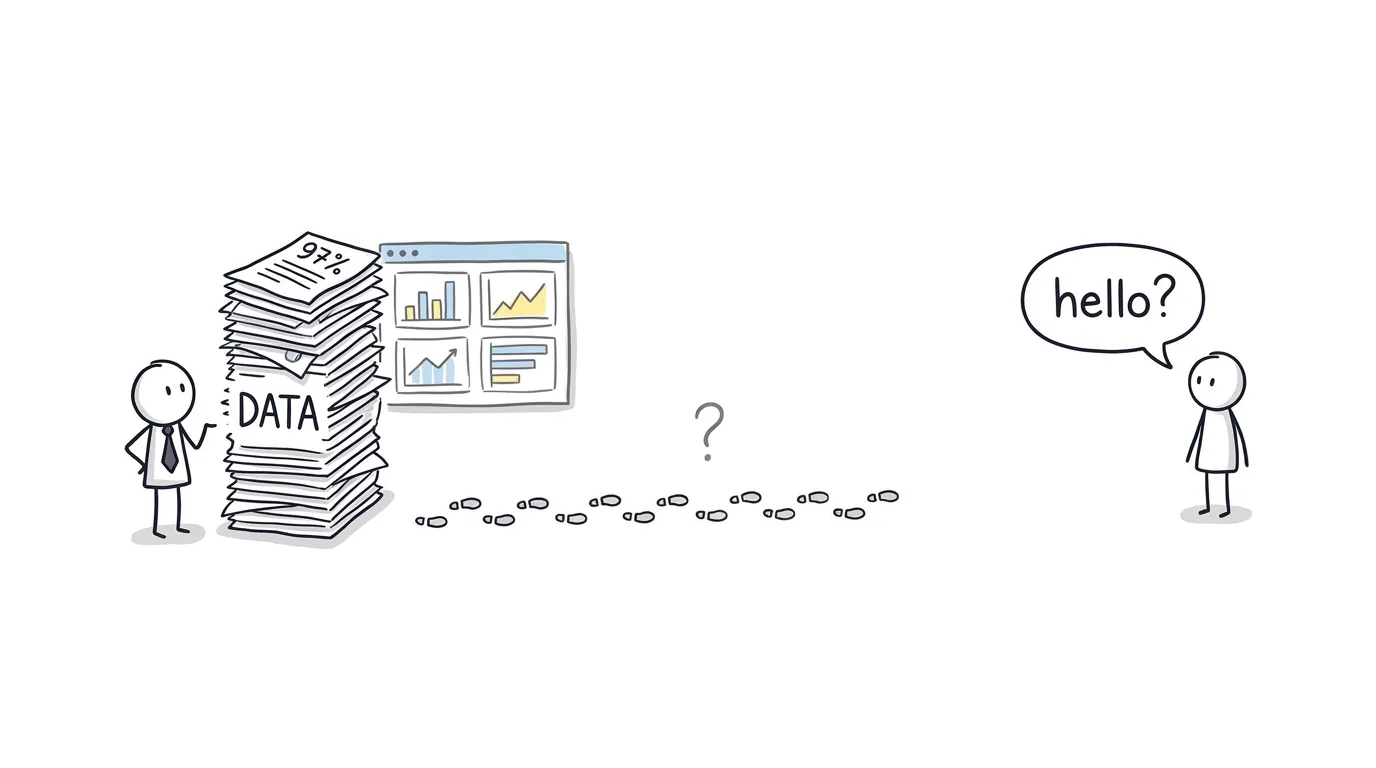
But data is only footprints. What customers really think — you have to go ask, go listen, sit down face to face and talk.
How Does Typeform Do It?
After all that — what does Typeform itself actually do?
They have a practice called Always On research: continuously collecting customer feedback online, with results back within 24 hours.
Not a quarterly survey that nobody fills out, but turning "listening to customers" into an everyday motion.
They also use AI to scale customer interviews. The AI does the asking and the note-taking; the judgment stays with people.
Even cleverer: they use video feedback to bridge the mindset gap between B2B and B2C. The B2B side talks process and logic; the B2C side talks emotion and experience; the two often can't get on the same page. Then you screen a clip of a real user talking, and suddenly everyone speaks the same language.
Sharp.
Finally, Back to You
Data doesn't lie. But data doesn't talk, either.
It just lies there, waiting for you to ask the right questions, waiting for you to act.
97% of people have the new tool. Only a few have adopted the new motions.
The gap in between is your real opportunity.
Here's to getting from "reading the data" to "asking the customers" — sooner rather than later.
Continue reading
Related articles

What Is GEO? How Your Brand Gets "Mentioned" in the Age of AI Search
An explainer on GEO (Generative Engine Optimization) for e-commerce and DTC brands: how it differs from SEO and AEO, why AI answers shape brand visibility, and eight practices covering question-focused content, consistent brand messaging, structured pages, external evidence, comparisons, and AI mention tracking.

AI Is Already Making Decisions for Your Customers. Are You on the List?
A learn article explains GEO (Generative Engine Optimization): why AI-generated answers now shape which brands customers see, and how SEO fundamentals, entity clarity, citable evidence, and monthly measurement affect visibility in AI answers.

Google Is Stuffing Ads Into AI Search: These Recent Stories Are Really One Story
A news roundup linking recent AI marketing stories—Google adding ads to AI Mode, Amazon's Ads Agent, ChatGPT image updates, a UK startup tracking brand mentions in AI answers, and an AI ransomware warning—arguing that control over ad data and visibility is shifting toward platforms.