
92% of Companies Are Chasing AI Personalization — and Most Get Stuck on the Same Misunderstanding
A learn article on AI personalization in e-commerce, covering recommendation engines, shopping assistants, dynamic pages, email timing, and ad audience scoring, plus data requirements, layered controls, privacy limits, and measurement practices.
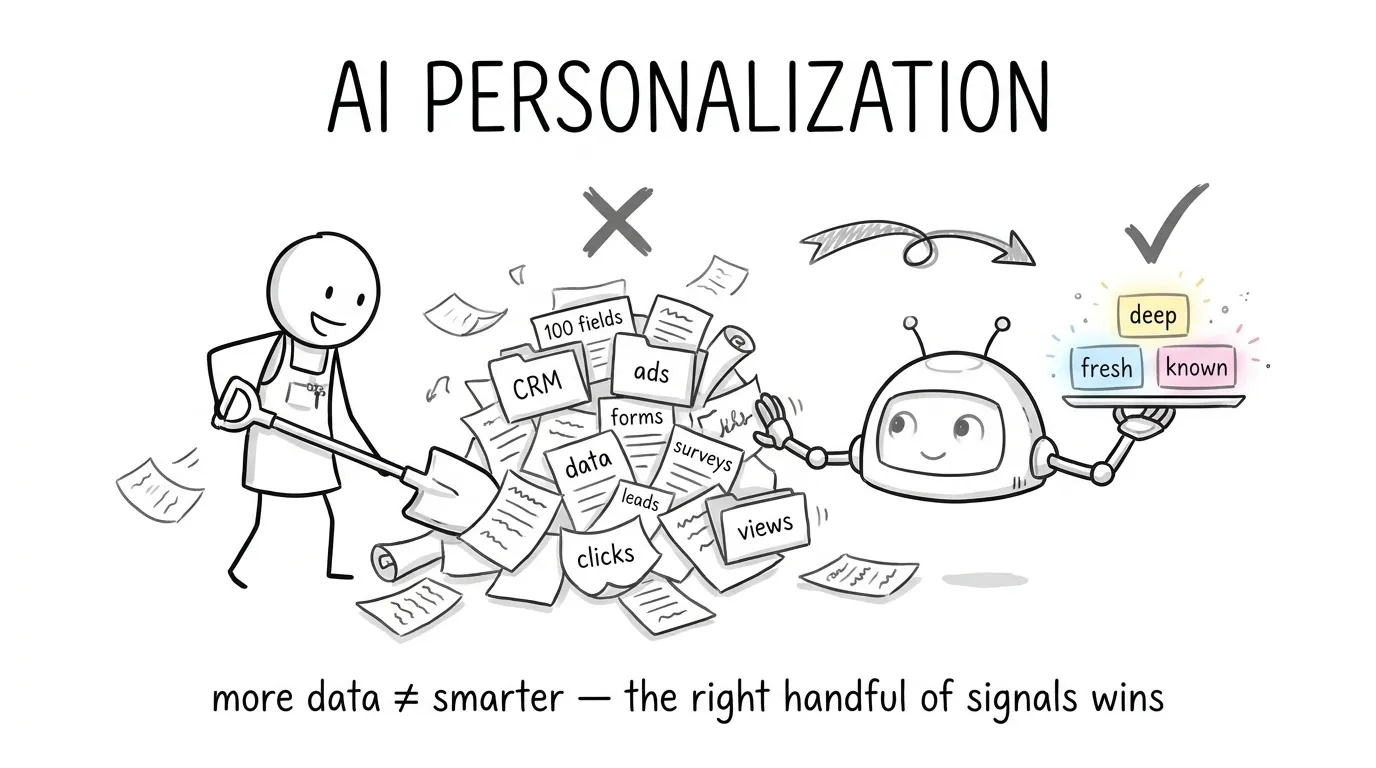
A few days ago, I had dinner with an old friend who runs an e-commerce business. He was looking pretty pleased with himself: "We've hooked our CRM, our warehouse, our customer service, our ad platforms — all of it — into AI. We've got ten times the data we used to."
I asked: how's it working out?
He paused. "Honestly? Worse than the old system we had before."
I asked him three questions: Which fields does your recommendation model actually read? How often is it retrained? When a brand-new visitor who's never shopped with you opens your homepage, what do they see?
He couldn't answer a single one.
If you can't answer those three questions, the money you're spending on AI personalization is basically money burned. That's what this piece is about — getting to the bottom of it.
What Is AI Personalization?
So what is AI personalization?
Put simply: AI watches each customer's behavior — what they've viewed, what they've bought, what they've clicked — predicts what they'll want next, and immediately puts it right in front of them.
The key is predicting the next step, not slapping labels on people. The traditional approach sorts people into buckets by age or region and sends each bucket one version of a message. AI personalization gives every single person their own version.
How big is the gap between those two? 76% of consumers get frustrated when they discover a brand doesn't understand them. That's why more than nine in ten companies are working out how to do this with AI.
Why does everyone want it? Because the returns are striking. Companies that do it well see 5 to 8 times the return on their marketing spend, and conversion rates typically rise 15% to 25%. Another 56% of consumers, once they've experienced personalization, come back and buy again.
And here's the sharper version. What is hyper-personalization?
It means cutting "one version for a group" down even further — to "one version for each individual."
McKinsey research found that fast-growing companies pull in 40% more revenue from hyper-personalization than their slower-growing peers. The reason isn't complicated. They know at which moment, to which person, to hand which thing.
Let Me Tell You 5 Stories
Theory done. Now let me tell you 5 stories. Every one of them has a real name attached and concrete numbers.
Story one: recommendations.
The French beauty brand Yves Rocher swapped its on-site recommendations from "best-selling products" to AI-driven personalized recommendations — and purchase rates jumped 11x.
Think about what 11x means. A best-sellers list can show every customer the same ranked table; AI shows each customer the one item that's theirs.
But there's a trap here that trips up a lot of e-commerce operators: that "customers who bought this also bought" module on the page is not personalization at all. It learns pairing patterns across the entire product catalog and has nothing to do with the customer in front of you. Real personalization feeds in that individual's own browsing, add-to-cart, and purchase history. They look similar. They're worlds apart.
Story two: the shopping assistant.
The South African retail group TFG, on Black Friday — the most crowded, most valuable battleground of the year — put an AI shopping assistant on its website. It didn't just answer questions; at the key moments while a customer was browsing, it spoke up first.
The results: conversion rate up 35.2%, revenue per visit up 39.8%, bounce rate down 28.1%.
On Black Friday, everyone is discounting. What you're really competing on is who catches the customer first. A shopping assistant that never tires, replies in seconds, and remembers what the customer said two lines ago is the most valuable employee on the floor that day.
This kind of assistant has a formal name: Agentic AI. In a 2026 report from G2, AI Decision Intelligence in Marketing, data from Bloomreach and similar platforms showed that 51% to 75% of their customers are already using AI to make decisions automatically. Not dabbling. Actually using it.
Story three: the page itself.
HP Tronic, an appliance retailer in the Czech Republic and Slovakia, used AI to show every new visitor a different homepage — and new-customer conversion rose 136%.
The mechanism behind this is worth a closer look, because it is not the same thing as A/B testing. An A/B test finds the version that works better for most people, and then everyone sees it. What AI does is judge person by person: what device this visitor is on, what city, what time they arrived, what they've bought before — and then picks the version most likely to close the sale with them.
For example: most people respond to a discount, a minority respond to free shipping. An A/B test shows everyone the discount. AI shows the minority the free shipping.
Story four: email.
The UK beauty brand Benefit let AI decide what the next email should say, and when to send it, based on each customer's most recent action. Click-through rate rose 50%, revenue rose 40%.
The trick is in the send time. The system times each email to each person's peak online window: if you tend to read email at 10 p.m., it holds the message until 10 p.m. And it optimizes for clicks, not open rates. Why? Because after the recent privacy changes, open-rate data has been unreliable for a long time.
If you're still grading your email AI on open rates, you're aiming at the wrong target.
Story five: ads.
HMV, the long-established British music and video retailer, used AI to define audiences in real time and serve ads — and revenue driven by those ads rose 14% within a week.
Here's a lever most teams have never pulled: purchase probability. The model scores every recent visitor from 0 to 1, predicting how likely they are to place an order within a given window.
Anyone above 0.9 barely needs ads — they're going to buy anyway. Anyone scoring very low is hard to make profitable no matter what you spend. The segment actually worth more budget is the middle band. Move the money from the two ends to the middle, and that's when your ad spend finally goes where it counts.
The Data Misunderstanding Is the Number-One Killer
Five stories in, you might be thinking: all right, I'll get on board too.
Hold on. Back to my friend at the start — where exactly did his problem lie?
His problem came down to a misunderstanding almost everyone shares: believing that the more data you feed the AI, the smarter it gets.
It's exactly the opposite. Every model reads only a small handful of specific signals. And that handful has to be signals it recognizes, signals that are fresh, signals with enough depth.
What do I mean? A "frequently bought together" recommendation needs roughly 6 months of purchase history. A "you may also like" recommendation needs roughly 2 months of browsing history. Purchase-probability prediction requires that the customer has visited at least once in the last 90 days. Feed it a hundred extra fields — it can't use them. Let one field go stale — it gets led astray by it.
So the first thing to check about your own project is not "is our data complete?" but "for each model, which events and how much history does it need?" Get that list straight from your vendor.
There's a sneakier trap too: AI cannot rescue a bad catalog. If your product descriptions are a few dry specs and nothing else, the AI can't recommend well no matter how hard it tries. A text-based recommendation engine needs descriptions written in language humans can actually read. The fix isn't tuning the model — it's hiring someone who can write copy.
"Real-Time" Is Actually Five Clocks
When a vendor says "real-time," you assume it means one thing. It actually means five, running at completely different speeds.
Event data arrives in milliseconds. Profile updates depend on the cadence of event processing. Recommendation models retrain — usually a full run overnight, which means a product added to the catalog this morning runs on fallback logic during the day, waiting for the next training cycle. Purchase probability is computed fresh on every single call. And then there's the in-session purchase-intent score, refreshed every time the customer clicks — the only clock that's genuinely computing while the customer browses.
Next time a vendor talks about "real-time," ask one question: which clock do you mean?
If they can answer, they know their stuff. If they get vague, stay sharp.
The Real Danger Isn't the Black Box — It's No Layering
A lot of executives are afraid to adopt AI personalization. What they fear is losing control: the model pushing whatever it likes, steamrolling carefully curated merchandising placements.
The fear is legitimate. The answer is layering.
Rules on top, models underneath. The blocked-product list filters first and keeps anything that shouldn't appear out; featured slots are reserved for whatever the ops team has chosen; compliance and inventory set the ceiling. AI only chooses within this fence. Step outside it — not a chance.
To judge whether a vendor is trustworthy, three questions are enough: Which signals, specifically, does this recommendation use? What does a brand-new customer with no history see, and why? Where do we set our team's rules, and how are priorities ordered?
The third question reveals the most. If they can pull up the block list, the featured slots, and the dynamic filters for you on the spot, they've solved the control problem. If the answer is "the AI will handle it" — a straight no.
The Line You Don't Cross
There's one more problem, harder than the technology: judgment.
There have been documented marketing incidents: a system emails a female customer to congratulate her on her pregnancy. When she herself may not have known yet.
A technical success. A reputational catastrophe.
The rule: just because you can get the data doesn't mean you should use it. And there's exactly one test for it: would your customer expect you to know this? Within their expectations, it's thoughtfulness. Beyond them, it's a shock.
And with GDPR tightening all the time, only 51% of consumers trust companies to handle their data well. You close that trust gap with transparency: be clear about what you collect, what you use it for, and that the customer can delete it at any time. And the deletion has to truly reach the model's inputs — not just get the person scratched off a mailing list.
One Last Reminder: Decide How You'll Inspect the Goods First
Before you invest, one more thing — and it's the easiest trap of all to fall into: how will you measure results?
The numbers vendors hand you are mostly "percent lift." A lift only means anything when it's measured against a control group. Lift numbers without a randomized control don't survive the CFO.
A credible test: hold back a random group of customers who never see the experimental experience; before launch, define in writing the metrics and the attribution window — 24, 48, or 72 hours is common; below 98% confidence, treat it as if it never happened; count only customers who were actually exposed.
The math is simple too: revenue per exposed visitor in the test group, minus the same number in the control group, times the number of people in the test group. As for figures like "annualized potential" — those are projections, not results. Know what those numbers really are.
Before You Go
Back to my friend from the start. The first thing he did afterward wasn't swapping systems, and it wasn't piping in more data. It was sitting down with his vendor and walking through, item by item, the list of fields each model needs to read.
By the way — those cases above, Yves Rocher, TFG, HP Tronic, Benefit, HMV: the engines behind most of them come from the same place, the Loomi platform from Bloomreach. Which tells you this playbook isn't theory. It's something already running, and running well, in the real world.
When it comes to AI personalization, the hard part was never the AI. The hard part is whether the data fits, whether the rules sit on top, and whether the judgment stays in your heart.
Here's wishing you the same: that small handful of the right signals, fed to the right models, sooner rather than later.
Continue reading
Related articles

It's 2026: Stop "Buying" AI Tools for Your Marketing Team — Start "Hiring" AI Agents
This learn article explains how AI agents differ from standalone AI tools in marketing, outlines three agent categories — build-your-own platforms, CRM-native agents, and vertical tools — and covers use cases across SEO, social media, advertising, and reporting, plus criteria for choosing one.

Did the Money You Spent on AI Marketing Ever Come Back?
A guide to measuring AI marketing ROI across three layers: ad reports, sales pipeline, and the financial ledger. Covers metrics such as ROAS and CPA, eight dashboard metrics, industry benchmarks, and common measurement mistakes.

How to Pick a Creative Automation Platform: First, Figure Out What These Eleven Actually Do
A learn article sorts eleven creative automation platforms — including Bannerflow, Celtra, Smartly.io, and Storyteq — into four functional groups and proposes five evaluation questions covering publishing reach, automation depth, ease of adoption, team fit, and verifiable evidence.