
AI Marketing Daily · 2026-11-09
This daily digest gathers seven AI marketing reads: an ANA and Northwestern GEO report with a Gartner organic-search forecast, a ChatGPT citation mechanics breakdown, a GEO starter checklist, a seven-step GDPR guide for using customer data with AI, influencer market data, and research on AI and marketing jobs.
AI search is now formally managed as a channel: ANA, joining forces with Northwestern University, published a definitive piece on GEO; Gartner forecast that brands' organic search traffic will be cut in half by 2028; mechanism breakdowns and a starter checklist arrived the same day to complete the picture — a full playbook assembled in one day. On the compliance side, a GDPR-perspective handbook updated just this October turns your obligations before feeding customer data to AI into seven steps. On the data side, the influencer marketing market is set to grow to $193.9 billion within six years, AI-based creator selection has entered the toolkits of more than a third of US buyers, and regulation is tightening in three markets at once. Read these seven items and you'll have everything you need to make today's calls.
🎯 Today's Headline
GEO Enters the Industry Agenda: Gartner Predicts Brands' Organic Search Traffic Will Be Cut in Half by 2028
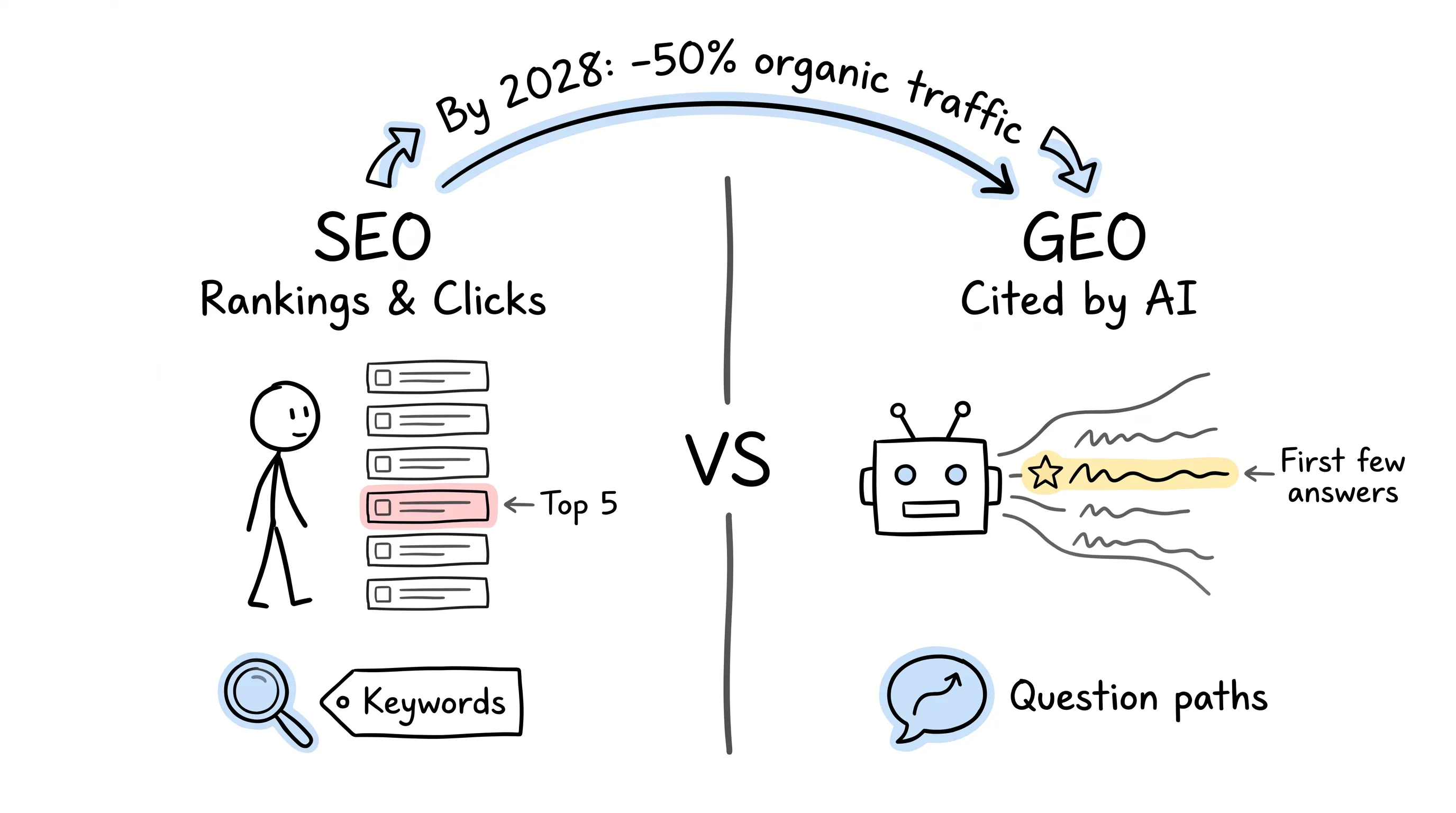
The Association of National Advertisers (ANA), joining forces with Northwestern University's Medill Spiegel Research Center, has published a GEO special report, pushing Generative Engine Optimization (GEO) onto the industry agenda. The goal is clear: get brands into the first few answers that ChatGPT, Gemini, and Claude give. The naming is still contested — some call it AEO, some call it AI visibility, some call it LLM optimization — but it's all the same thing.
The most striking number in the report comes from Gartner: surveying 253 marketing leaders this year, it predicts that by 2028, brands' organic search traffic will drop by 50% or more as consumers shift to generative search. The first to walk this path was SEO agency First Page Sage. The company built roughly 70 custom pages, pairing industry-specific hyper-lists — listicles stamped with "best" and "top," with seemingly scientific judging criteria — to consistently occupy the recommended-answer slots in ChatGPT. Its client list includes U.S. Bank and Rodan + Fields. CEO Evan Bailyn's experience: as long as the judging criteria look scientific, AI platforms trust it. His formula is blunt: rank in Google's top five, appear in two or three lists, and the top position is locked in.
The backdrop is a migration in consumer behavior. More and more people ask a chatbot before they buy, and they search for blue links less often. The LLM has effectively become the consumer's proxy for asking questions — it asks on the user's behalf who a brand is, why it deserves trust, and how it compares to competitors. Having your brand name in the first few answers is the new prime ad placement. That's also why GEO deserves its own name: the position it manages has already split from the position SEO manages.
Here's why this carries weight. ANA is the trade organization of brand owners; its publishing on this means GEO has been upgraded from agency sales talk to advertiser agenda. Gartner's 50% is a prediction, but what it changes is budget logic: the search-traffic pie is being re-divided — brands that get cited take the increment, and brands that don't watch their organic traffic shrink. Forrester principal analyst Nikhil Lai goes a step further in the piece, defining GEO as an opportunity to understand customers more deeply: organize content around the real questions in the three stages of discovery, evaluation, and decision, and stop orbiting keywords.
One more layer worth noting: the special report lays out a whole path. From a machine-readable technical foundation, to reorganizing the content library around question paths, to continuously accumulated industry-insight content — every link has a corresponding action, so marketing teams can execute against the blueprint instead of feeling their way from zero.
On the ground, three job functions change first. SEO teams' scorecards need one more line — AI citations — because reporting rankings and clicks alone is no longer enough. Content teams switch from keyword layouts to question paths, writing direct-answer content for every stage. Technical teams must close the machine-readability gap: schema markup, alt text, and other tasks that used to be optional become must-dos. For paid-media teams there's a hidden impact too: brand recommendations inside AI answers have no ad slots to buy for now — first to publish, first to hold the spot — and this window is worth treasuring. Amsive's Sarah Gray put her finger on the GEO–SEO relationship: the sources appearing in AI answers overlap heavily with Google's front page, so ranking logic still works, but LLMs weight structured signals extra. Everything should be set up to be maximally digestible for crawlers and AI crawlers; answers need to be more direct, and content structure needs a different organizing method. ANA executive vice president Michael Donnelly added a dose of reality: traditional search is still mainstream, but AI search is growing at an absurd pace. GEO is a moving target — brands need distinctive multimodal content, and it has to be findable by machines. LLMs don't care about flashy design; you have to get back to the fundamentals.
Three things you can start this week. First, list the 10 customer questions you most want AI to recommend you for, check your existing content library against them, and fill the gaps with direct-answer content written to match the discovery, evaluation, and decision stages. Second, add schema markup and alt text to your high-value pages — that's readability in the model's eyes. Third, borrow First Page Sage's list-page playbook and build ranked-list pages for your industry with genuinely real judging criteria. Two red lines not to cross: don't abandon traditional SEO — Google rankings and AI-cited sources overlap heavily, so you can't drop either leg; and don't fabricate judging criteria — Northwestern's Kelly Cutler prescribes continuously accumulating a real library of industry thought-leadership content, sending relevance signals to generative engines on an ongoing basis. While you're at it, stand up measurement: give this batch of pages its own citation monitoring, following the server-log approach in the Go Fish Digital item below. Without a baseline, you can't prove the investment was worth it.
My judgment: GEO today looks a lot like SEO around 2008 — the rules are rough, the investment is small, and early movers pocket the dividend. Seventy pages were enough to occupy an industry's recommendation slots, which tells you the bar is still low. Once brands enter collectively, the cost of claiming positions will only go up. My recommendation: formally greenlight GEO as a channel, ring-fence the answer slots for 5 to 10 high-value questions first, measure a citation-rate baseline this quarter, and talk about scale next year. By the time Gartner's 50% actually comes true, you'll already be sitting in the new position.
🔗 Further reading: Read the full article
🏷 AI Search (GEO Special)
Patent and Log Breakdown: How ChatGPT Decides Whom to Cite
SEO agency Go Fish Digital's GEO guide doesn't stop at a strategy checklist — it takes public patents and its own probing evidence and pries the AI retrieval pipeline open. GEO, in essence, is making content retrievable, re-rankable, and citable; miss any one of the three gates and you don't get into the answers. Gate one: ChatGPT runs an internal reranking model, ret-rr-skysight-v3, and the documents it fetches get filtered once more on quality and authority signals before they can be used — so ranking high in search results doesn't mean being cited. Gate two: freshness is an active ranking signal; an outdated in-depth piece can be overtaken by a newer shallow one, so evergreen pages need continuous upkeep. Gate three: query intent detection and lexical-aware retrieval are running — if your content type doesn't match user intent, strong traditional rankings may still get you excluded; content must use industry terminology accurately and consistently, backed with definitions and glossaries.
Three more findings at the mechanics level. Query fan-out (the system splitting one question into multiple sub-queries before retrieving) means content must cover a cluster of semantically adjacent phrasings — betting on a single keyword isn't enough; semantic near-synonyms, related entities, and upstream/downstream questions all need pages to catch them. Paragraph-level optimization is the new battlefield: AI fetches and ranks by paragraph, so FAQs, tables, and subsections get cited independently — every module must stand alone as an answer, with the conclusion in the opening sentence. Grounding (the anchoring mechanism of an answer: the model picks authoritative passages from trusted sources to serve as anchors) means content with clean structure, complete citations, and verifiable facts is far more likely to enter the anchor set. Another thread is source tiering: public web content must pass the strictest reranking filters, while trusted connection sources like Google Drive and Notion are scored more leniently — which makes the parseability of enterprise content libraries important.
The biggest new ground is in the measurement section. The author proposes four GEO-specific metrics, each covering a different stretch of the journey: AIGVR (AI visibility rate) tracks the share of AI answers in which the brand appears; citation rate tracks how often it's called out by name; the content extraction rate (CER) tracks how much of your content gets lifted in large chunks; conversation conversion rate tracks the path from AI conversation to an actual deal. The strategy framework comes fully stocked with six layers: paragraph-level optimization, continuous updates, semantic footprint expansion, intent-first structure, grounding authority signals, and domain vocabulary building. In execution terms: maintain your content library like a database built for AI to read — every module self-contained, cross-linked, and kept fresh. Attribution has to change too: the author advocates replacing GA4 with server logs. The evidence is hard: over the same period, logs captured 490 ChatGPT citations while GA4 recorded just 3 sessions — two orders of magnitude apart. The author predicts enterprises will need to build their own AI-search attribution tech stacks to prove ROI.
💬 Two things you can do this week. Have tech pull ChatGPT-User requests from server logs to get your own AI citation baseline — stop guessing with GA4. Add update timestamps and revision histories to evergreen pages to protect the freshness score. Among the four metrics, watch citation rate first; add the rest as volume grows. This mechanics breakdown also hands GEO a cheap reverse-validation method: change one thing, log one entry, watch the citation movement — more reliable than any expert's opinion.
🔗 Further reading: Read the full article
GEO Starter Checklist: Turn Content from Ranking Assets into Answer Assets
Single Grain's starter guide draws the dividing line bluntly. SEO's goal is ranking on search results pages, serving users who use search engines to find URLs; GEO's goal is being cited and paraphrased by AI, serving models that generate answers directly on the user's behalf. The scorecard accordingly shifts from rankings and click counts to AI citation rate and the accuracy of brand information inside answers.
It offers six moves for execution: semantic content optimization — explain concepts thoroughly, stop piling up keywords; schema structured data — tag FAQs, definitions, and products item by item; entity-based content — give people, organizations, and concepts their own pages to help models build a knowledge graph; authoritative-source backing — content that's been fact-checked and cites credible sources; conversational Q&A structure — anticipate how users would ask an AI assistant and answer directly in Q&A form; and internal/external link strategy — show models how pieces of content relate and where authority sits. Entity-building has a direct payoff: models organize knowledge by entities, and when your products, founders, and terms each have clear definition pages, brand information comes through more accurately when you're cited. And don't write the Q&A as a self-asked, self-answered shell — questions should use users' spoken phrasing, and answers should give the conclusion in the first sentence. The author's judgment: GEO doesn't replace SEO; it's SEO's extension toward AI engines.
The positioning needs to be stated plainly: this is agency lead-gen content with no original data — qualified as a checklist, not enough as intelligence. There's also a side effect of the perspective switch to think through: the better your GEO, the more likely AI finishes the answer and the user never clicks through, and the traffic report looks worse. So switching metrics is a whole-team matter — don't let the content team carry new goals while being scored on old metrics.
💬 Teams with an SEO foundation should use it as an execution sequence: add FAQ schema and Q&A blocks to your top five revenue pages first, then check citation-rate movement two weeks later. Teams starting from zero shouldn't start here — read the headline and the previous item to build judgment first, then come back for the checklist.
🔗 Further reading: Read the full article
🏷 Marketing Tools & Compliance
Before You Feed Customer Data to AI, Run It Through These Seven Steps
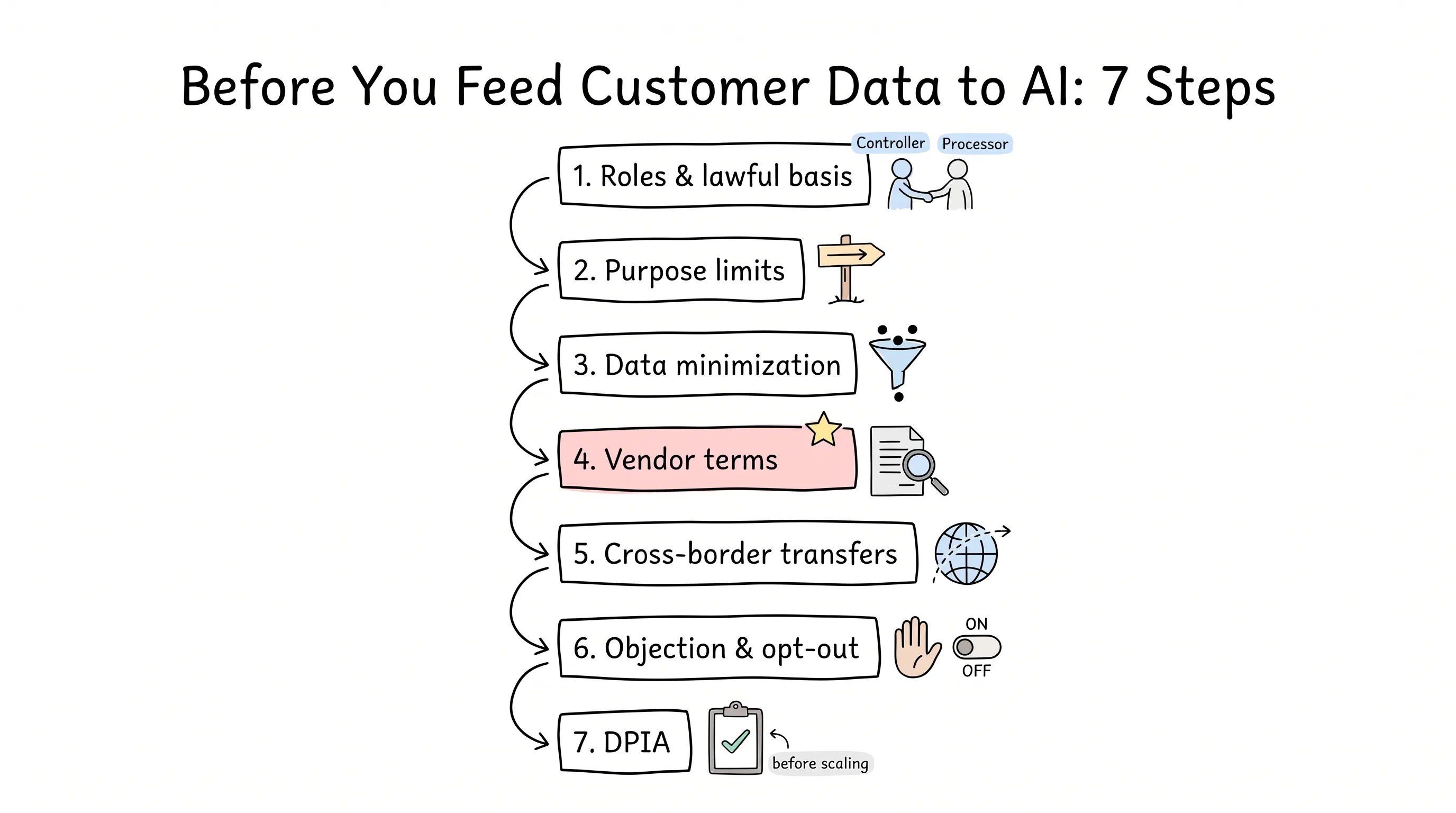
This guide, updated in October in the Rework knowledge base, answers one question: the moment customer data enters an AI tool, what are your obligations. With GDPR as the main line, supplemented by the UK's ICO, France's CNIL, the US FTC, and California's CCPA, the seven steps run: define controller and processor roles and the lawful basis; check purpose limitations before upload; data minimization; treat vendor terms as contracts to review; cross-border transfer mechanisms; right to object and opt-out; and a DPIA (a Data Protection Impact Assessment) before scaling.
The scenarios AI disrupts are concrete. Sharing data with software used to require procurement and review; now a single media buyer can paste a CRM export into a chat window in a single afternoon to look for patterns — new processing purpose, new recipient, opaque retention, all three happening at once. The case-style scenarios in the piece deserve to be pinned above your desk: taking a webinar registration list to train a lookalike model is textbook purpose drift — the justification given at sign-up can't support this new use. The most common gap: the email platform's opt-out list never propagates into AI-built audiences, and the right to object idles in neutral.
Step one's lawful basis is the easiest to take for granted. Consent, contract, and legitimate interests each have boundaries: consent must be free, specific, and explicit — consent given for one purpose can't underwrite another use; contract basis only covers processing necessary to perform the agreement — a user bought something, which doesn't mean you can profile them for repeat-purchase pitching; legitimate interests require a balancing test, and in marketing scenarios user rights tend to prevail. In vendor due diligence, sub-processors must be vetted too — every layer an AI vendor further outsources is a new recipient. Ask about retention as well: for records that entered a training set, deleting the raw data doesn't necessarily erase the impact — a deletion problem unique to the AI era.
Vendor terms must pass three questions: Is your data used to train models? Where are the default switches? Can you get written confirmation? If you can't find the answers, treat them as "no." Regulatory action is accelerating: the EDPB's opinion last December made clear that models trained on unlawfully processed data carry that taint into deployment; the FTC has stated that quietly changing terms after the fact to expand data use may constitute unfair or deceptive practices — notice must come before use. On the scale of penalties: GDPR caps at €20 million or 4% of global annual revenue, whichever is higher.
Step two's purpose limitation can be turned into a table: list required fields per marketing task. Sending an order-confirmation email needs only the order record; building user segments is what needs behavioral data. Exporting the entire CRM and tossing it to a model is the laziest — and most dangerous — move. Step five, cross-border transfers, is the most often overlooked: where are the vendor's servers, does data pass through third countries, are there standard contractual clauses — three questions that decide legality, so don't assume cloud services are compliant by default. Step seven's DPIA sounds like a legal document, but for marketing it's a pre-launch checklist: which fields does this AI use process, who covers the loss when it errs, can it be reversed. Pre-launch checks are cheap; post-incident remediation costs far more. The guide provides a risk matrix and a 10-item checklist across five functions — email, segmentation, paid media, content, ABM — and states it's general information, not legal advice; run it past legal before implementing. The companion advice is pragmatic: turn the seven steps into a one-page flowchart in the team wiki, and anyone who wants to hook up an AI tool goes through it first.
💬 Legal scheduling is always slow — marketing shouldn't wait. Two free things this week: go through the vendor terms of every AI tool in use; anything failing the three questions gets taken offline or replaced; audit the sync path of your opt-out lists and confirm every AI tool actually receives them. Facing a penalty of 4% of global revenue, an afternoon of checking pays for itself many times over.
🔗 Further reading: Read the full article
🏷 Industry Data & Trends
Influencer Marketing Races Toward $193.9 Billion: Money Flows to Nano Influencers and Fraud Detection
Mordor Intelligence's October-updated report delivers a full set of benchmark numbers: the global influencer marketing market at roughly $40.5 billion in 2026, $52.8 billion in 2027, and a projected $193.9 billion by 2032 — about 4.8 times current levels, with a 29.71% CAGR from 2027 to 2032. North America holds 34.1%, the largest share; Asia-Pacific grows fastest at 33.3%.
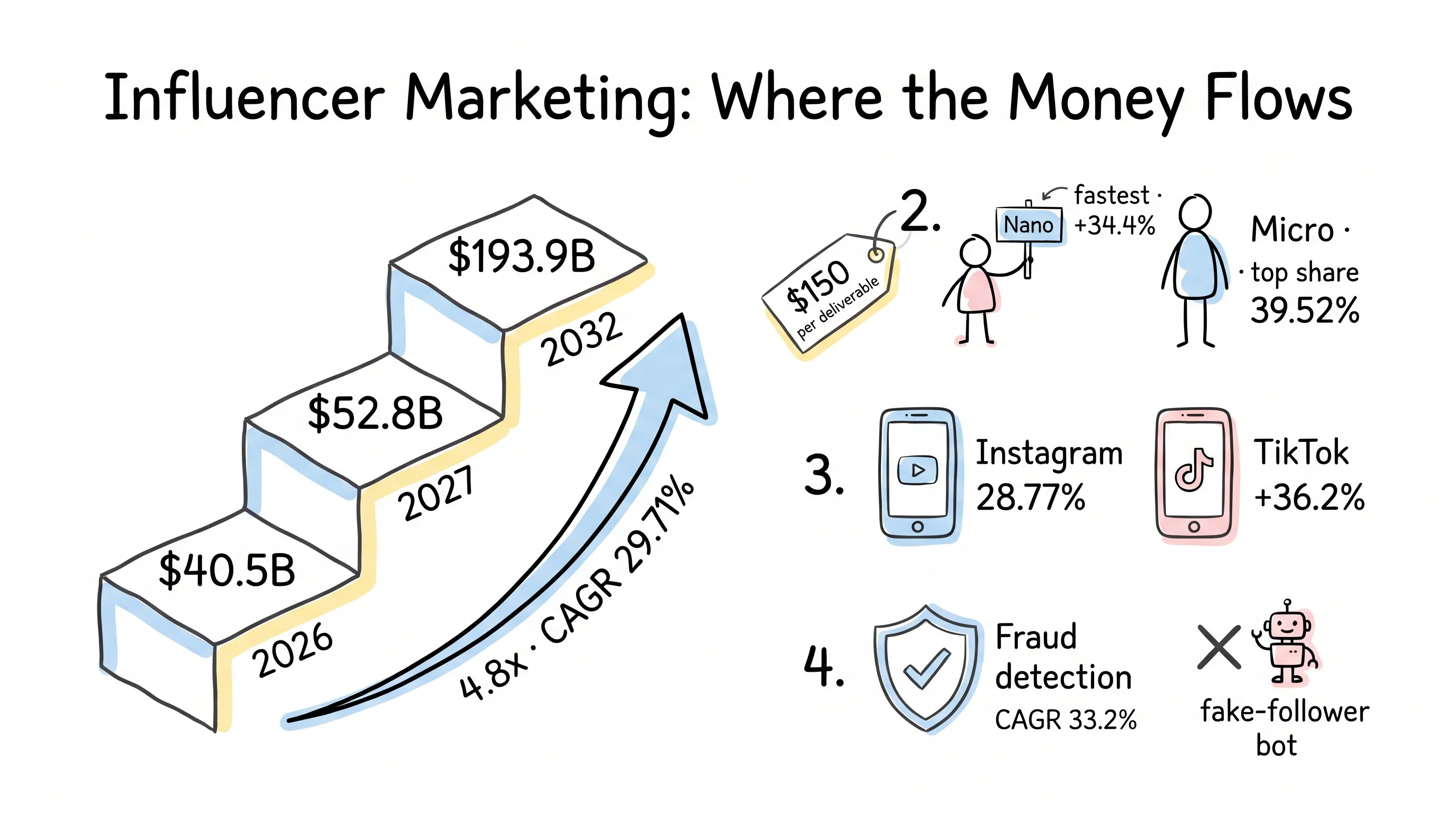
The creator mix is sinking down-market. Micro influencers hold the top share at 39.52%; nano influencers (accounts with a few thousand to ten thousand followers) grow fastest at 34.4% — engagement rates higher than top-tier creators, low rates, suited to spreading volume quickly; brands' median rate for nano is only $150 per deliverable. On channels, Instagram leads with 28.77% share, and TikTok leads growth at 36.2%. By use case, campaign management is the biggest block at 33.82%, while compliance and fraud detection tops the whole table for growth at a 33.2% CAGR — fake followers and bot engagement are eroding ROI, and brands like Dabur have started writing CPE (cost per engagement) and CPV (cost per view) into contract clauses.
AI has entered the creator-selection stage. An IAB survey shows 35% of US brands and agencies use AI to screen influencers; AI matching and dynamic pricing are listed as mid-term growth drivers — the latter implying creator rate cards may get reshuffled. Platform moves are dense: CreatorIQ deployed its enterprise agentic AI system Q in October; Later integrated Mavely and the YouTube creator-partnerships API, validated in the field across more than 300 campaigns — campaign-management vendors are getting first-hand creator data.
Regulation is tightening in step. The US FTC's fake-interaction ban took effect last October — buying fake engagement metrics is a direct violation; China's livestream-selling rules require pre-broadcast review and identity verification from February this year; Brazil's September joint order requires platforms to provide disclosure tools within a set deadline, giving brands 90 days to adapt. With three markets stacking up, influencer campaign contracts and process templates must be forked and maintained by market. The direct impact on brands is a longer process: pre-broadcast review in China, fake-interaction metrics stripped from contracts in the US, disclosure tools in place within 90 days in Brazil. The data comes from the public summary page updated October 23; when using it for budget planning, re-validate against your own historical data on the platforms you actually run on. Methodology caveat: this is a vendor-built model, about 35% off some agencies' 2025 baselines — note that when citing.
💬 You can copy the budget structure directly: seed new markets with nano influencers at $150 per deliverable — seeding 50 accounts costs less than one mid-tier influencer while spreading the risk. Cross-border teams should shift test budgets toward Asia-Pacific; the growth gap is right there. Starting this year, add two clauses to every signing: a minimum genuine-engagement rate, and a data-disclosure obligation.
🔗 Further reading: Read the full article
Harvard Business School's Answer: Job Transformation, Not Replacement
Harvard Business School Online published on October 29 on AI and marketers' livelihoods. Professor Gupta's stance is transformation: tools and speed have changed, but the fundamentals — objectives, audience, value proposition, metrics — haven't. His one-line framing: marketing is a highly dynamic, fast-response industry that always has new trends to chase; the only question is which ones to chase. The piece has plenty of judgment anchors: the Mastercard CMO once asked whether NFTs were genuinely smart or marketing hype — used to remind readers to identify which trends deserve chasing, a method that still applies today.
Strategy before speed is the article's hidden thesis. Robin Cohen, executive vice president of media at Rain the Growth Agency, cautions that the media market is getting more crowded, with all brands fighting for growth in the same channels — how content gets developed and where budget goes must be settled by strategy first; tools can't lead while thinking plays catch-up. Gupta's view of AI lands on two concrete scenarios: the creator economy and ad production, and the way consumers get information.
The article distills five trends. AI personalization: fashion e-commerce player THE YES builds recommendations from every like and skip. Generative content design: GANs produce images dynamically, with human review guarding accuracy and brand voice. Dynamic optimization and predictive analytics: Meta allocates budget in real time through its large-scale experimentation system. Livestream shopping: e.l.f. Beauty's CDO says it removes the do-your-own-homework step — users watch hosts demonstrate, ask questions on the spot, and order in real time, one more layer of human presence and immediacy than a traditional product page. And the privacy-driven return of contextual advertising: as third-party cookies exit, advertising shifts toward content-context matching — one financial services company placed ads on Financial Times pages, with the contextual fit as the reason. Privacy pressure comes from both ends: consumers are pushing back, governments are legislating, and Apple already requires third-party apps to obtain user permission before tracking — making first-party data the new bargaining chip. Four challenges come right behind: over-reliance making content converge, ethics and authenticity, privacy and algorithmic bias, and team skills gaps. And the industry's still-unsolved problem is measurement — MMM and multi-touch attribution have no unified standard.
L'Oréal's chief digital marketing officer's approach is worth writing down: seize what is starting — stay curious, run small pilots, build partnerships, and don't chase every trend. The article closes on people: once AI takes over routine work, what marketers must add is strategic thinking, creative problem-solving, data interpretation, ethical judgment, and relationship building. One reminder: this is course-promotional soft content — the views are consensus summaries with no new data, and all quotes come from course guests.
💬 It works well as a team-training skeleton: score your own business against each of the five trends, run the four challenges as a risk checklist, and a quarterly retro agenda is complete. The genuinely actionable item is L'Oréal's: pick two trends and run a two-week pilot on each — cheaper than the whole team chasing trends. Discount the conclusions by about 30% as you read.
🔗 Further reading: Read the full article
Peer-Reviewed Study: Argument Quality Wins Seller Subscriptions; Endorsements Win the Price Premium
A new study in Emerald's Chinese Management Studies uses the Elaboration Likelihood Model (ELM) to explain why cross-border e-commerce sellers adopt generative AI tools. Survey data from 369 practitioners paired with PLS-SEM (partial least squares structural equation modeling, a regression-based technique for survey data) yields a conclusion that's blunt for pricing strategy: both argument quality and source credibility significantly raise subscription intent and willingness to pay more — but the dominant factor differs. Argument quality governs subscription conversion; source credibility governs the premium. Influencer endorsement and user endorsement are the two levers for building credibility.
There's a theoretical increment too: the study shows ELM's dual routes reinforce each other — strong central-route argumentation dynamically lifts peripheral-route credibility, breaking the old assumption that the two routes run parallel. Methodologically, take note: PLS-SEM works on self-reported survey data, so causal strength is limited — fine for budget assumptions, not enough for scientific claims. Placed in today's seven-item frame, this study supplies demand-side evidence: sellers don't lack tools; they lack a reason to pick which one. Argument quality is verifiable on the spot for sellers — run a demo, pull up the comparison table, and the quality shows immediately; credibility is a slow variable — one KOL scandal can wipe it to zero, and maintenance costs are high, but the premium ultimately accrues to credibility. The sample is mostly Taiwan-based practitioners, so mind that before extrapolating to other markets. This daily-pack item only captured the abstract page — the full text sits behind a paywall, details are written per the abstract, and the original must be verified before citing.
💬 AI SaaS teams selling to sellers should split the budget by these two conclusions: argument-quality assets — product pages, demos, comparison data — drive subscription conversion; KOL reviews and user testimonials drive order value. Pouring all endorsement budget into signup conversion, or expecting argument quality to lift prices by itself, is money spent on the wrong thing.
🔗 Further reading: Read the full article
💡 Today's Big Picture
Read together, today's seven items have a single through-line: AI search is turning from a concept into a formal channel that gets headcount and budget — and the precondition for a channel to stand is that data and trust get re-sorted in sync.
On the reach side, Gartner's 50% forecast, the patent-grade mechanics breakdown, and the starter checklist all arrived within one day. The industry is treating "being cited by AI" as an asset managed alongside rankings. The methodological differences between the three pieces are themselves information: the authoritative institution explains why, the agency explains how, the mechanics camp explains what actually works. Fit together, the three say this track is still early — no unified operating standard, and the first movers are defining the rules. The log data says it plainly: 490 citations versus 3 sessions — existing analytics tools essentially can't see this happening. Whoever builds measurement first grasps the truth first; whoever builds later can only guess.
On the constraint side, the seven-step GDPR handbook and three-market influencer regulation point in the same direction: data use is shifting from freely available to audited at every turn. Model training data must have clean provenance, term changes must be noticed before use, influencer engagement data must be genuinely verifiable. Compliance is turning from post-hoc review into a precondition of marketing action — a line that will be written into more and more brands' workflows.
The positions of people and money are clear too. Harvard says job transformation, not disappearance — judgment and trust stay with humans. Emerald's empirical work says the premium comes from credibility. Mordor's numbers say money is flowing toward nano influencers and fraud detection. Machines take over the execution layer, humans hold the judgment layer, and budgets follow trust.
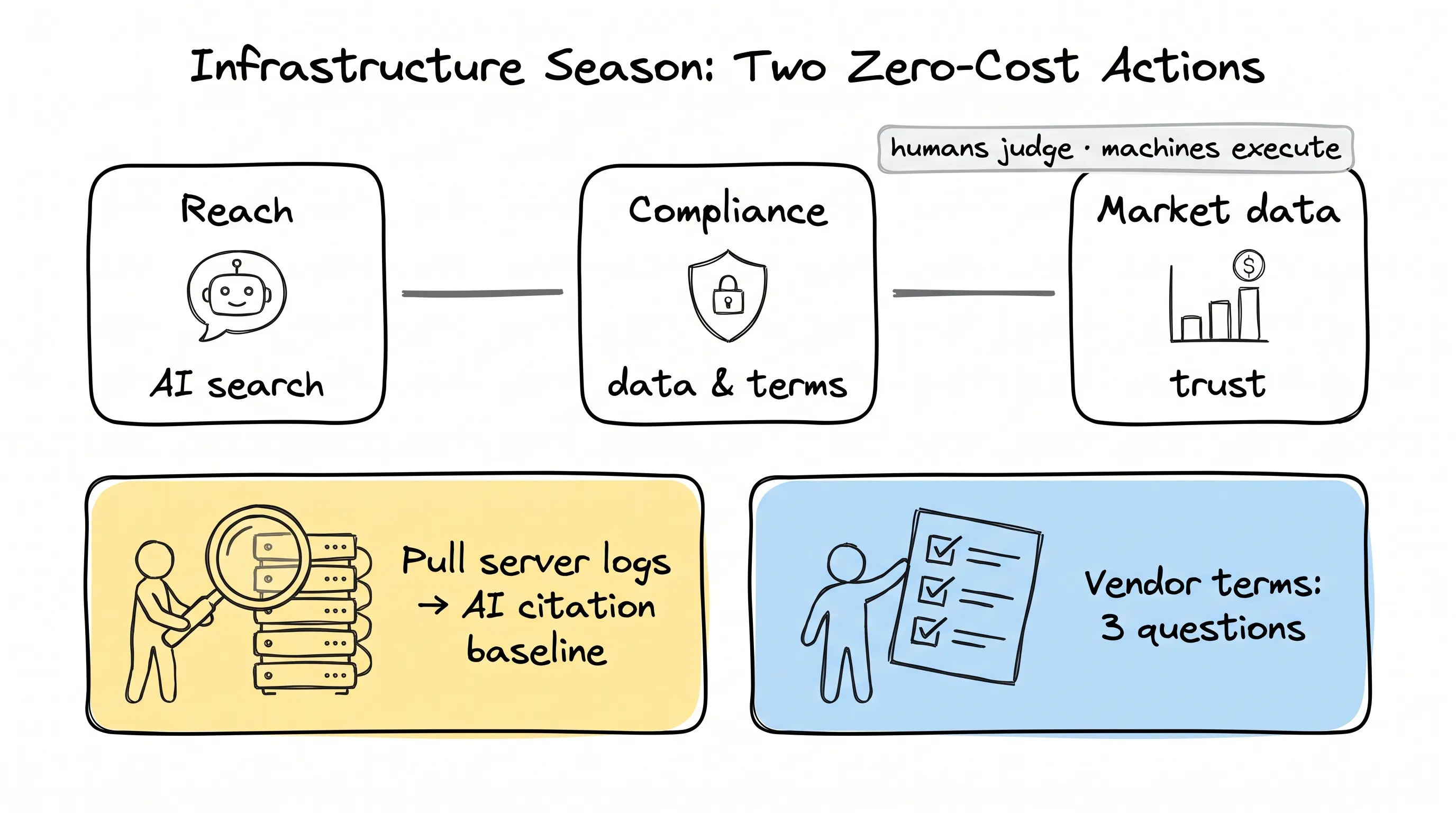
Laid side by side, the seven items share one more thing: not a single one is a breakout product — it's all infrastructure. Channel infrastructure, compliance infrastructure, market-data infrastructure; the industry is pouring foundations. Actions during the foundation phase are cheap. Arrive after the cap goes on, and the price won't be this number.
This week's actions should converge on two, both at zero procurement cost: pull server logs once to get an AI citation baseline; run vendor terms through the three questions. One protects your reach for the next three years; the other keeps you clear of fines.
Continue reading
Related articles
AI Marketing Daily · 2026-11-22
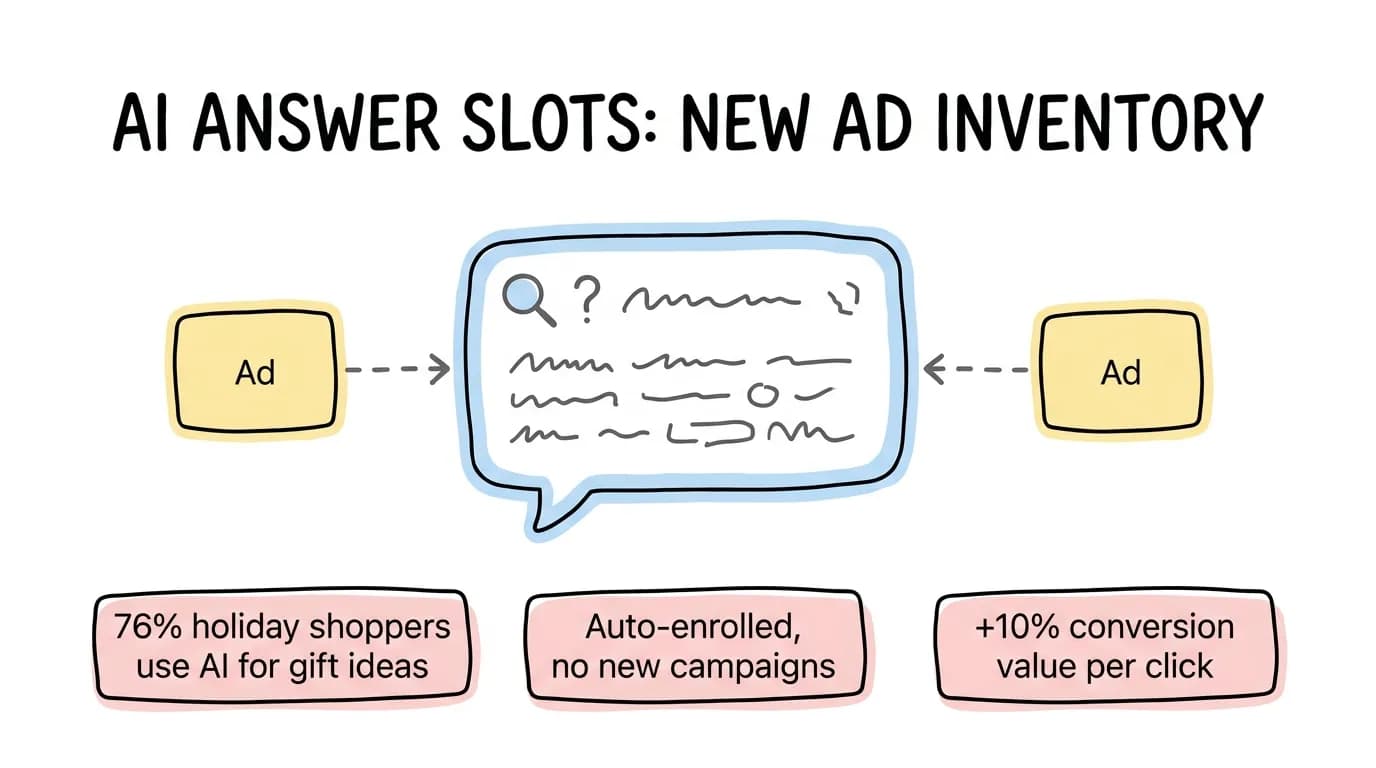
AI Marketing Daily for 2026-11-22 rounds up 20 items led by Microsoft opening Bing AI Overviews to ads and Google expanding AI Mode ads to ten countries, plus GEO guides, ad automation delegation guidance, AI Overviews CTR data, and a legal-risk checklist for AI-generated creative.
AI Marketing Daily · 2026-11-21
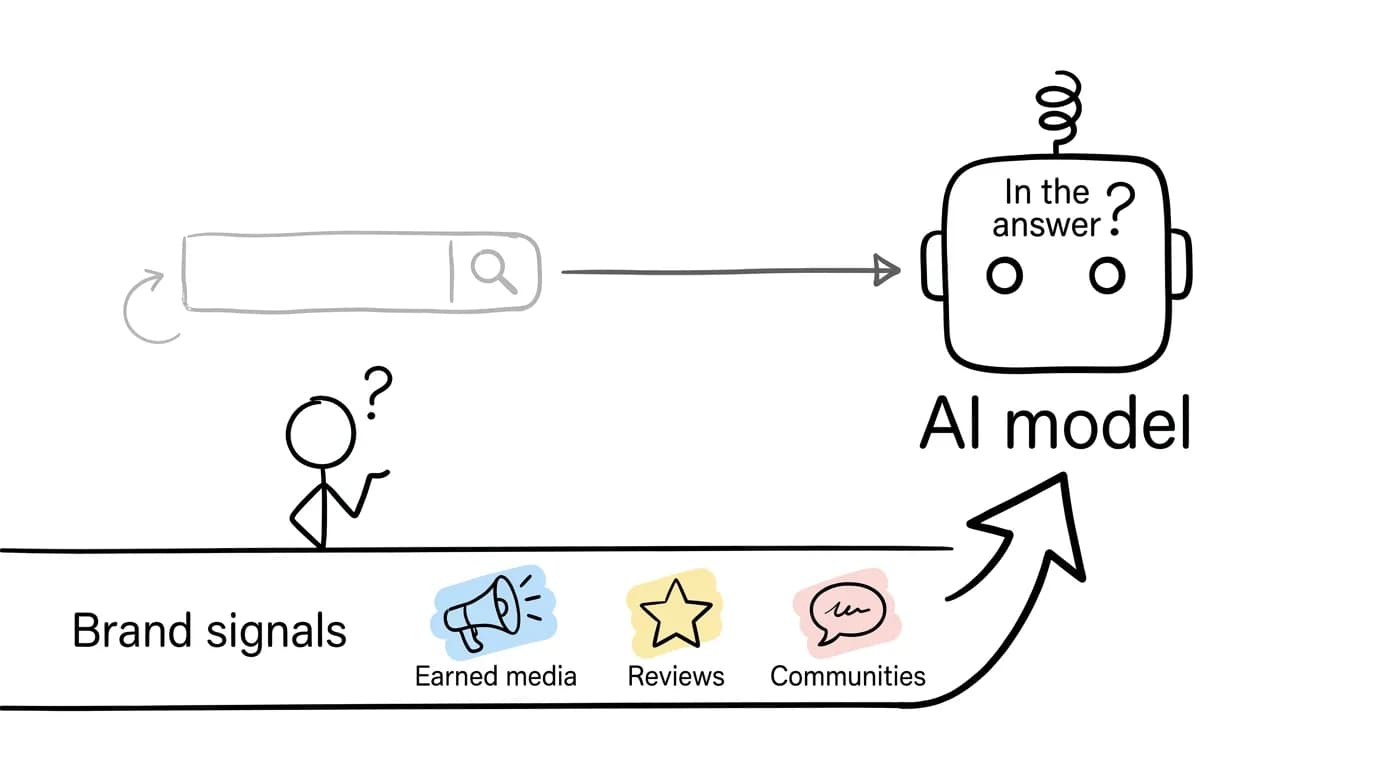
A November 21, 2026 AI-marketing daily covering AI search visibility, GEO methods, Google AI Mode ads expanding to ten countries, Meta's pre-Black Friday changes, agentic shopping, and industry adoption and ROI data.
AI Marketing Daily · 2026-11-20
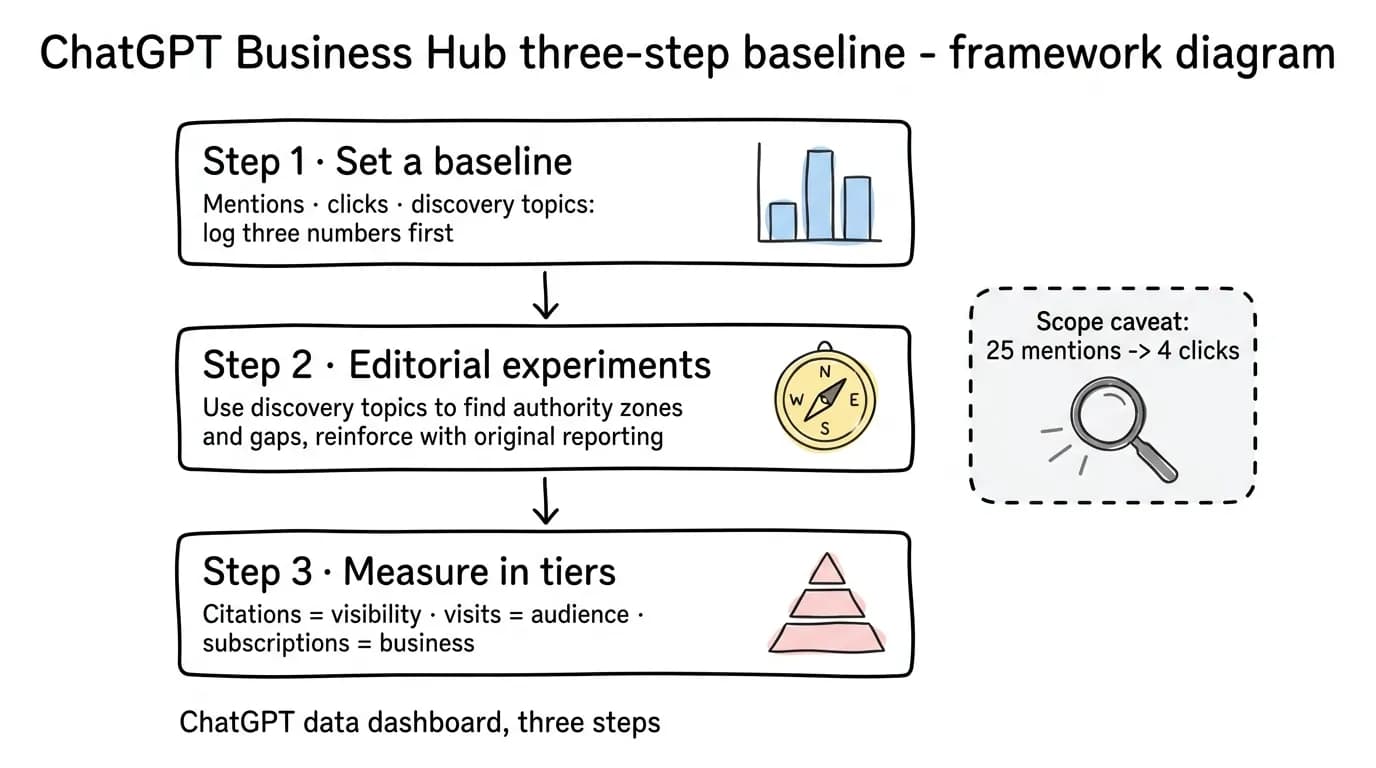
AI Marketing Daily for 2026-11-20 rounds up 19 items centered on measurement: OpenAI's ChatGPT Business Hub dashboard, EU rules for agent-mediated purchasing, Meta pausing four AI terms, and B2B data on shortlists and the dark funnel, each with action advice.