
Buying an AI Tool and Paying More for It Are Two Different Things
A learn article explains a survey of cross-border e-commerce operators on what drives willingness to subscribe to generative AI tools versus pay more for them. Using the Elaboration Likelihood Model, it reports that argument quality drives subscribing while source credibility drives paying more, with takeaways for AI v
A while back, a friend of mine who runs a cross-border e-commerce business invited me out for coffee. His team is small — a dozen or so people — and lately they've been stuck on one question: should they get a generative AI tool for the team? A few thousand yuan a year — is it worth it?
I told him: the final call is yours. But his question happens to be one that a group of researchers studied in earnest.
In 2026, a published survey asked exactly this. The researchers found 369 cross-border e-commerce operators, most of them from Taiwan, and set out to answer two questions: what makes people willing to subscribe to a generative AI tool? And what makes them willing to pay more for it?
Mind you — these are two questions, not one.
The analytical framework they used is a classic model from communication studies, the Elaboration Likelihood Model, or ELM for short.
So what is the Elaboration Likelihood Model?
Put simply, it describes the two routes by which people get persuaded.
One is called the "central route." You study the product itself, carefully: Are the features strong? Is the evidence of results solid? What's at work here is argument quality.
The other is called the "peripheral route." You don't do deep research; you go by feel: Is the person recommending it credible? What have users who've tried it said? What's at work here is source credibility.
In the traditional view, these two routes are parallel. Either you think it through and buy, or you buy when the vibe feels right.
But when the study ran its data (they used a statistical method called PLS-SEM — you don't need the details, just know it can validate relationships between variables), it found something interesting:
Argument quality actually reinforces source credibility.
In other words, if you build a good product and make a solid case for its results, users who were first persuaded by the features gradually come to trust the brand itself.
The two routes don't run side by side. The central route feeds the peripheral route.
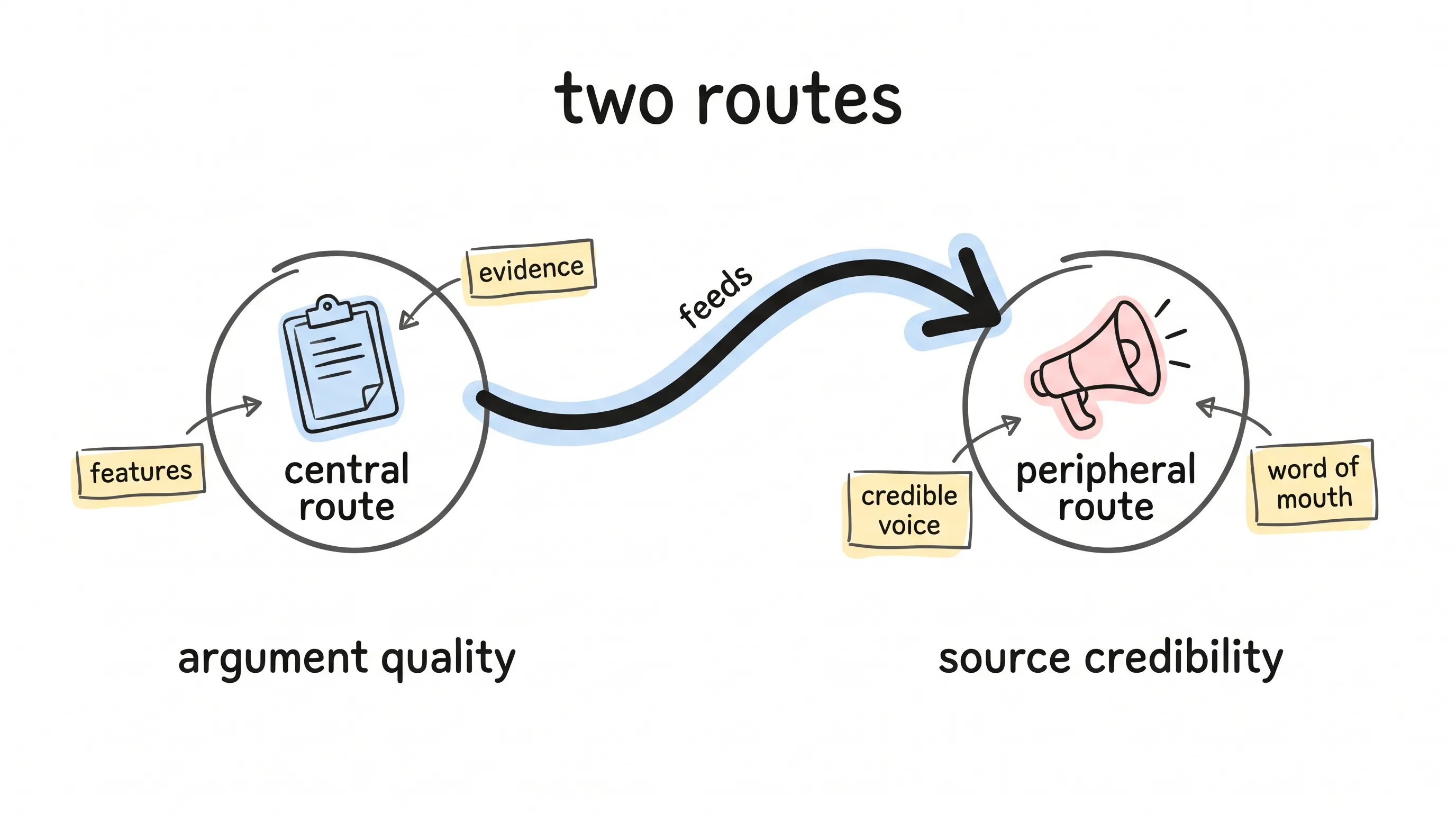
Product strength is the seed of trust.
Now look at the two decisions — subscribing and paying. The answers the study gave were sharper than I expected.
What drives "subscribing" is mainly argument quality. How clearly the results are explained, how real the evidence is — that's what decides whether users hit that trial button.
What drives "paying more" is source credibility.
Arguments get people to buy. Trust gets them to pay more.
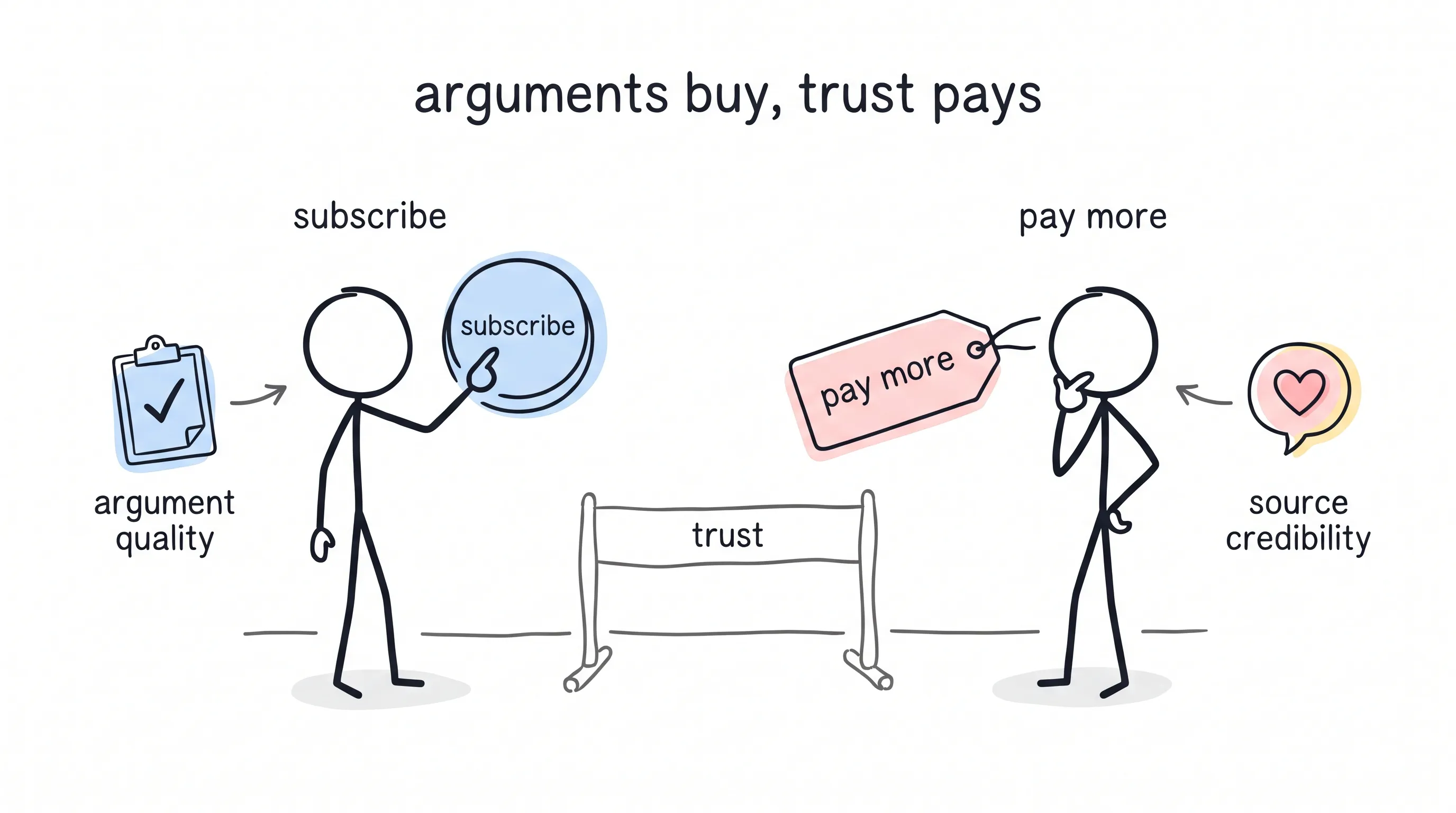
Between being willing to use a tool and being willing to pay extra for it, there's a hurdle called "trust."
The researchers also dug into several layers of antecedents.
Why do users find your arguments persuasive? Start with "outcome quality." They first experience whether the results are good, and only then judge whether what you say makes sense. If the results are bad, no amount of talk will save you.
What does source credibility live on? Two things: influencer endorsements, and word of mouth from ordinary users. Getting influencers to promote it helps; letting longtime users speak up helps too.
As for piling a bunch of ancillary services onto the tool — does that make the core selling point more persuasive? The data says no. Satisfaction with ancillary services has no effect on argument quality. Don't count on stuffing in freebie features to prop up your core argument.
These two findings matter to two camps.
If you're an AI vendor: making the evidence of results solid matters more than piling on features; finding a credible person to speak for you matters more than cutting prices. If you want users to renew, upgrade, and buy pricier plans, put the work into trust.
If you're a cross-border seller: when you evaluate a tool, look at the evidence of results first, then check whether the person recommending it is credible. Before you agree to pay more, ask yourself one question — do I trust this product, or do I only trust the person who recommended it?
Coffee finished, my friend said he'd figured it out: use it for a month first and watch the results. If the results are good, then we'll talk money.
I said, congratulations — you've just lived your way into that study.
May every AI tool you buy be worth the extra money you pay for it.
Continue reading
Related articles

What Is an AI Marketing Agent? From "Using AI" to "Delegating to AI"
A learn article explaining what an AI marketing agent is, how it differs from rule-based automation, and which repetitive tasks such as lead qualification, reporting, and campaign monitoring can be delegated while humans keep key decisions.

Marketing Automation Is Shifting from "You Do It" to "You Say It"
This article explains how marketing automation is shifting from rule-based platforms that merely execute toward AI agents that plan, create, publish, and review campaigns, covering delegable tasks, underlying technologies, tool categories, adoption steps, and risks such as privacy and automating without strategy.

When AI Does the Creative, Mistakes Come in Batches Too
A learn article on the risks of using generative AI for marketing creative across brand, legal, compliance, and operational layers, with case examples and seven practices for review, rights clearance, documentation, and vendor governance.