
Before You Paste Customer Data into AI, Pause
A learn article on data privacy obligations when pasting or uploading customer data into AI marketing tools, covering lawful bases, purpose drift, data minimization, vendor contract checks, cross-border transfers, opt-outs, and impact assessments under GDPR and regulator guidance.
A few days ago, I dropped by the office of a friend who runs an e-commerce business.
Around noon, one of his ops staff came over with her laptop: "Boss, I want to use AI to analyze our customer data and find patterns in repeat purchases."
My friend didn't even look up. "Just paste it in."
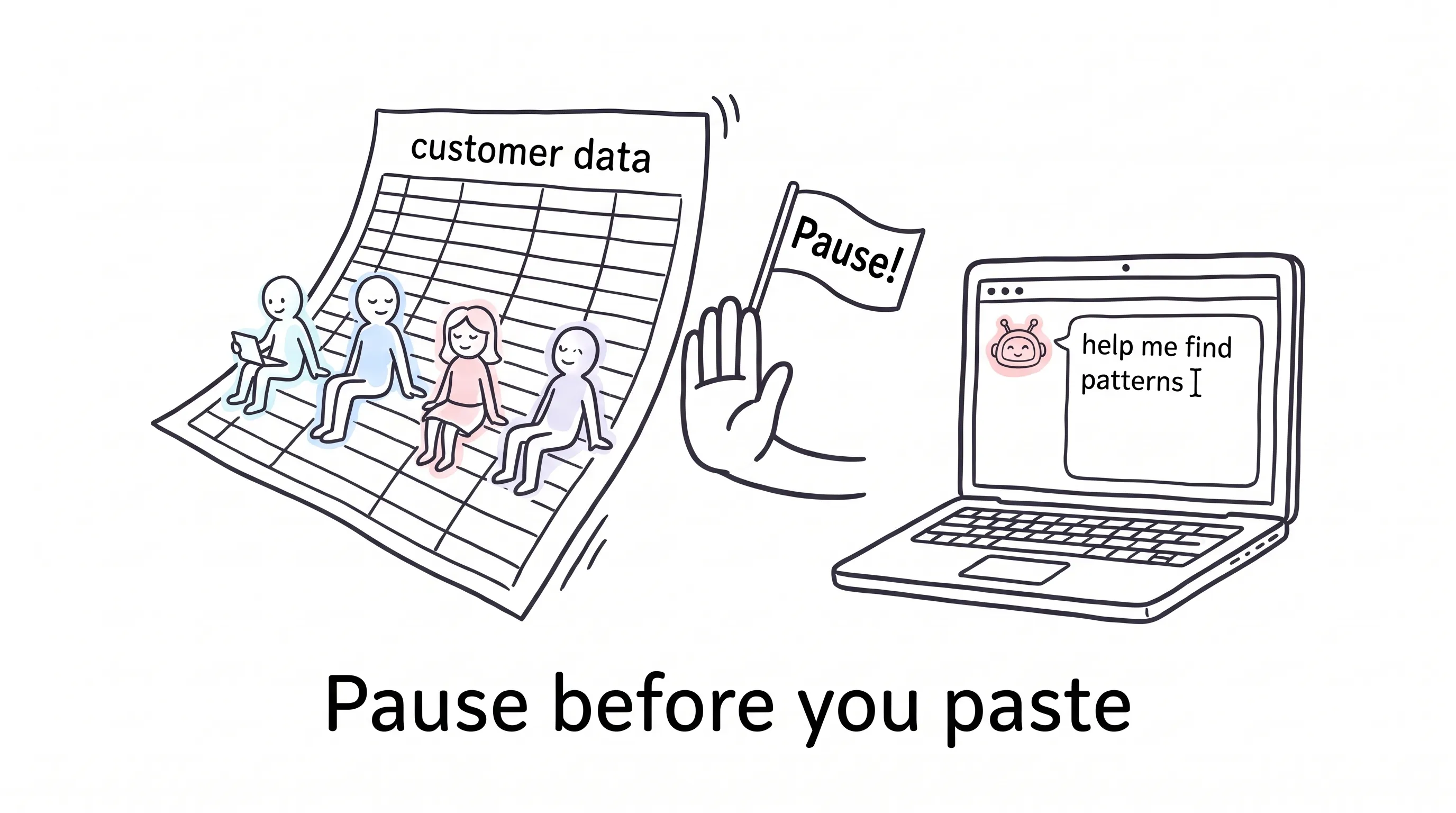
That was a CRM export. Tens of thousands of customers. Names, email addresses, what they'd bought, how often they bought.
I stopped him.
The idea itself wasn't the problem. Using AI to find patterns is perfectly reasonable. The problem was that spreadsheet: the personal information of tens of thousands of people, about to set off on a journey no one had reviewed.
The data had been sitting in the database all along. The risk is born the moment you feed it to AI.
Let me be upfront about one thing: what follows is a common-sense overview, not legal advice. Before you actually implement anything, have your privacy advisor look it over.
What Do We Mean by "Data Privacy in AI Marketing"?
Put simply, it's a set of obligations that kick in from the moment you paste, upload, or sync customer data into an AI tool.
There are four core questions:
First, do you have a legal basis for using this data this way?
Second, have you told your customers?
Third, is the AI vendor processing the data only on your instructions?
Fourth, where on earth does the data physically end up?
None of these four questions is profound. But each one deserves a clear answer. If you can't answer it, don't hit Enter yet.
What's Different Now?
You might think: marketing teams have been handing customer data to software for twenty years. Web analytics, email platforms, ad systems — which of them isn't?
True. What's different is the way this happens in the AI era.
An ops person, afternoon drink still in hand, pastes a CRM export into a chat window: "help me find the patterns." An email tool flips a switch in its back end and an AI feature goes live, quietly reading your entire interaction history along the way. A browser extension, one click, and call recordings get summarized automatically.
Every one of these is a new use of data. Every one adds a new third party. And every one is often just some individual's afternoon decision.
Specifically, AI differs from ordinary software in three critical ways:
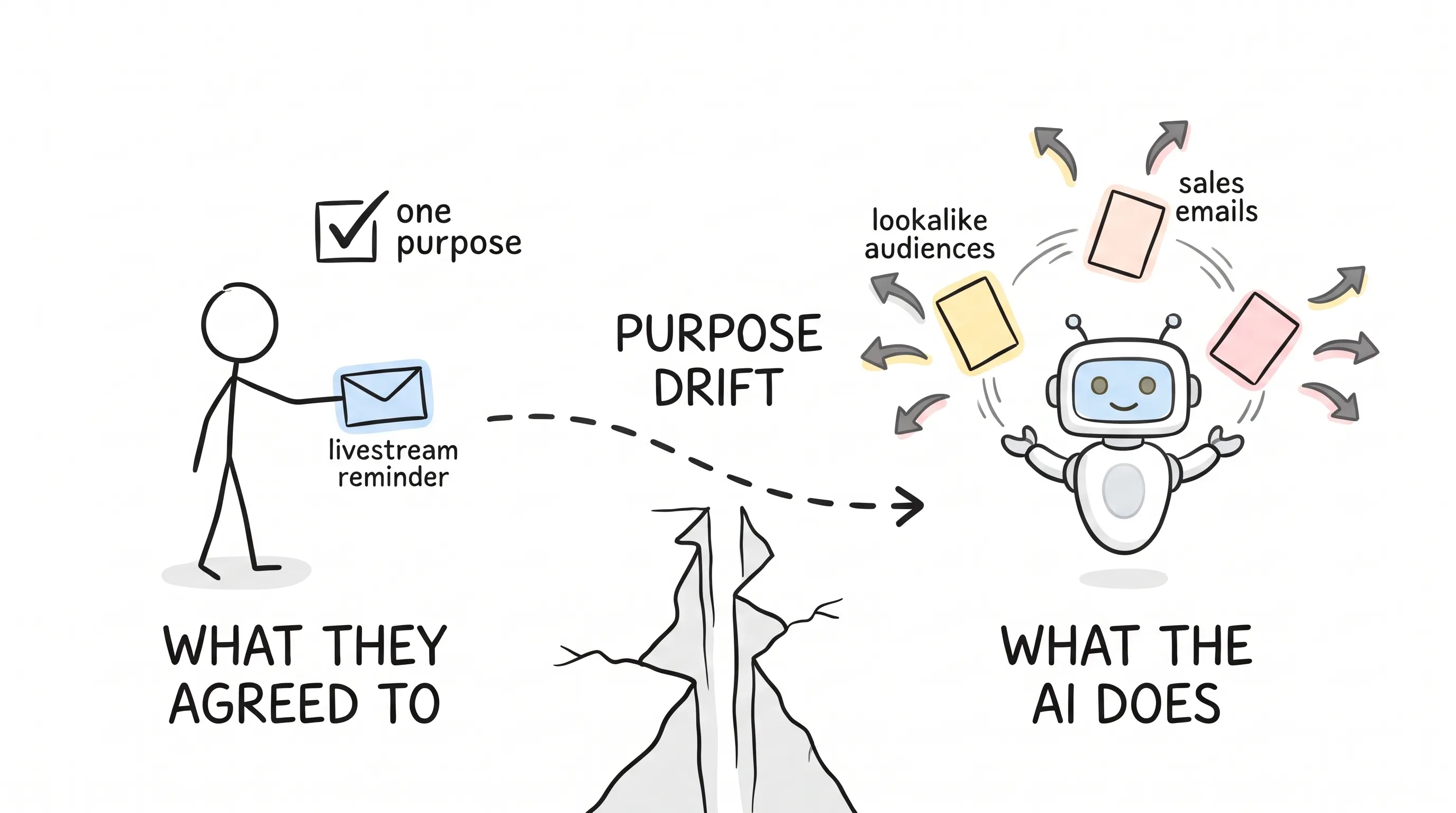
One, purpose drift. Data given for one reason (say, order confirmation) ends up doing another job (say, modeling lookalike audiences).
Two, new recipients. The AI vendor — and possibly the vendor's own downstream — now has its hands on this data.
Three, you can't delete it clean. Once data has been used to train or fine-tune a model, deleting the original records doesn't remove the influence that stays inside the model.
Regulators can see all of this. On December 18, 2024, the European Data Protection Board (EDPB) adopted an opinion on AI models, issued at the request of the Irish regulator, that makes a key point: if a model was trained on unlawfully processed personal data, the lawfulness of its later deployment is affected — unless the model has been fully anonymized.
What does that mean? A model's provenance travels with the model.
By the way, the fines genuinely hurt. Under GDPR, the heaviest penalty is up to €20 million, or 4% of global annual revenue, whichever is higher. Multiply your own revenue by 4%, and you'll know what this lesson is worth.
Know Who You Are Before You Talk About Lawful Bases
GDPR defines two roles, and you need to know where you stand.
The controller decides "why and how" the data is used — usually, that's you. The processor is the one doing the work on your behalf — usually, the AI vendor.
Why does this division matter? Because the primary obligations to your customers rest on the controller. When something goes wrong, you can't say "the vendor did it."
The second question: every use of personal data needs a lawful basis. Article 6(1) of GDPR lists six; in marketing practice, three do most of the work.
Consent. Newsletters, SMS, behavioral advertising — these scenarios basically run on it. But consent must be freely given, specific, explicit, and unambiguous, and consenting to one purpose is not consenting to another.
Contract. Sending order confirmations and shipping notices goes without saying. But "he bought something" can't carry "so I get to profile him for a second sale."
Legitimate interests. Service emails to existing customers, basic analytics, some light personalization. The precondition is a balancing test: your interests can't outweigh the customer's rights and freedoms.
Careful — don't treat legitimate interests as a master key. The three-step test in that EDPB opinion uses customer-service chatbots and cybersecurity AI as its examples, and even those have to satisfy "strict necessity" plus a balancing of interests. If marketing waves it around, claiming "we have legitimate interests" for everything, regulators notice.
My suggestion is a simple split: for cross-site tracking and electronic marketing, use consent. For low-risk uses, write a formal balancing assessment and rely on legitimate interests. And whenever an AI use differs from what you originally told customers, review it again.
The Most Common Trap: Purpose Drift
Let me give you a concrete scenario.
A customer gives you an email address just to get a reminder for one livestream. A few months later, the team exports the whole list, feeds it to an AI tool to build lookalike audiences, then generates personalized sales emails.
Where's the problem? The original notice never said a word about "profiling."
The customer agreed to one thing; the AI is doing another. That gap is called purpose drift.
Article 5 of GDPR says it plainly: personal data must be collected for "specified, explicit and legitimate purposes," and further processing must not be incompatible with those purposes.
So can data never be used for anything else? It's not quite that strict. France's regulator, the CNIL, offered a pragmatic take in its February 2025 AI recommendations: reusing databases — including publicly available ones — is often permissible, as long as the original collection was lawful and the reuse doesn't exceed the scope of the original purpose. The same document notes that data minimization doesn't prevent the use of large training sets, but that they should generally be filtered and cleaned to avoid unnecessary processing.
So there's really only one question that referees all of this: in the beginning, what did you tell customers?
Think about it — before every upload, ask yourself three questions:
- When we collected this data, what did we tell customers?
- Does the AI use we're planning now fit inside that sentence?
- If the customer were watching us do this, would they be surprised?
If the answer to the third question is "yes," stop. Either send an updated notice and collect consent again, or write a formal legitimate-interests assessment, or give up on this data.
The Cheapest Control: Give Less
Data minimization is the cheapest of all privacy controls. Article 5 of GDPR requires data to be "adequate, relevant and limited to what is necessary."
Applied to AI marketing, it comes down to one habit: show the tool the fields it needs, not the whole table.
Subject-line testing needs open rates and click rates by segment. Names, emails, phone numbers — they don't go.
Mining support tickets for content ideas needs the ticket text with names and contact details removed. Customer IDs, order numbers, addresses — they don't go.
Churn or repeat-purchase prediction needs plan type, how long they've been using it, usage volume, plus a pseudonymous ID. Free text in the notes field — it doesn't go.
Building ad audiences should go through the ad platform's own hashed upload channel. Raw lists — don't paste them into a general-purpose chat tool.
For call summaries, scrub the sensitive details before handing over the recording transcript.
One misconception to correct while we're here: pseudonymization is not anonymization. Swapping names for IDs does lower the risk, but the key still exists somewhere, and the data is still personal data. True anonymization is hard to prove — the EDPB's position is that whether a model is anonymous gets assessed case by case by regulators. The word "anonymized" on a vendor's marketing page — don't use it as a safe-conduct pass.
And one category of data needs a hard line of its own: sensitive information like health, religious beliefs, and sexual orientation. Don't let models infer it for targeting, and don't let it show up in everyday prompts.
Vendor Contracts: Four Questions
Most privacy accidents in AI marketing happen at the vendor boundary.
A free tool any employee can sign up for on a whim can still receive your customer data. So before any customer data walks in the door, have your privacy lead confirm four things.
One, is there a processor agreement? Article 28 of GDPR requires processing to be governed by a written contract, stating the subject matter, duration, nature and purpose of the processing, the types of data and categories of data subjects — and the processor may act only on your written instructions.
Two, are sub-processors under control? The same article requires the processor to obtain your prior written authorization before bringing in sub-processors, and if a sub-processor slips up, your direct vendor bears full liability to you. Ask for the current list and how changes will be notified.
Three, will your data be used to train models? This is the most important clause of the AI era. Go through the vendor's current terms and data processing addendum, and check three things: whether inputs, outputs, and uploaded files are used to train or improve models; whether it's on by default; whether it can be turned off. Consumer-account and business-plan terms often differ, and they change. If you can't find a clear answer, treat it as "yes, it trains" until the vendor confirms otherwise in writing.
If you don't know what the AI did with your data, you don't know how exposed you are.
Four, can it be deleted? Article 28 also requires that, at the end of the service, the processor delete or return all personal data at your choice. When you ask, don't just stare at the tables in the database — logs, prompts, vectors, fine-tuned models — ask about all of them.
On the US side, the Federal Trade Commission (FTC) issued a reminder on February 13, 2024: when companies adopt looser data practices but notify consumers only through retroactive changes to terms, that can count as unfair or deceptive. That warning applies to you and to your vendors alike. If you want to use customer data for AI, update your notice publicly before you start — don't quietly add a clause after it's done.
Where Does the Data Land?
For many AI tools, the servers doing the processing sit outside the region where your customers are. Article 44 of GDPR says transfers to third countries — including onward transfers — are allowed only when the conditions of Chapter V are met. In practical terms, that means an approved mechanism, such as an adequacy decision, or the standard contractual clauses in Article 46.
Ask the vendor three questions:
- Where is the data stored and processed? Can support staff access it? Where are the sub-processors?
- Which transfer mechanism is in use? Is it written into the agreement?
- Can I choose regional storage? And is that choice real, or is it just local storage while processing still happens elsewhere?
Then keep a one-pager for every tool: region, mechanism, sub-processors, review date. If your business spans multiple markets, local rules may add their own conditions — don't count on one EU clause to cover the world.
When the Customer Says "No," Do You Hear It?
AI marketing can't avoid profiling: scoring, segmentation, prediction. Two rights here will bite.
The first, the right to object. Article 21 of GDPR: whenever processing is for direct marketing, the customer may object at any time, including to the related profiling, and the processing must stop. Let that sentence sink in. Your opt-out list has to be chased into every AI tool, not stopped at the email platform. A customer clicks unsubscribe, then turns up in an AI-generated lookalike audience — that's the raw material of a complaint letter.
The second, purely automated decisions. Article 22 gives the right: for decisions based solely on automated processing (including profiling) that produce legal or similarly significant effects, the customer has the right to say no. Most everyday marketing doesn't reach that threshold. Credit decisions, pricing that excludes people from basic services, eligibility review — those do. Before you automate, run it past legal first.
Transparency strings all of this together. In your privacy notice, say it in plain words: we use customer data for AI-assisted personalization and analysis — and spell out the purposes. California has a matching requirement, which the state attorney general has summarized: businesses must disclose at the time of collection which categories of personal information they gather and what they use them for, and must treat a user's Global Privacy Control (GPC) signal as a valid opt-out request. California residents can also request correction and deletion of their data, and limits on the use of sensitive information. On top of that, the California privacy agency's regulations now cover automated decision-making technology, risk assessments, and cybersecurity audits. If you do business with California customers, have your advisor check the current requirements.
Before You Launch, Run the Risk Math Once
Article 35 of GDPR requires a data protection impact assessment (DPIA) when a type of processing is likely to result in a high risk to individuals. The article names new technologies as a factor, and specifically calls out the case of "a systematic and extensive evaluation of personal aspects based on automated processing, including profiling, on which decisions are based that produce legal effects or similarly significantly affect the individual."
Most purely marketing scenarios don't reach that trigger. But large-scale profiling, or touching sensitive data, can get you there.
The UK regulator, the ICO, has dedicated guidance on AI and data protection, covering lawfulness, security, minimization, and accountability — including what an assessment should contain. It carries its own note: because of the Data (Use and Access) Act, the guidance is under review and may change. Treat it as a compass, not as statute.
The assessment doesn't need to be a dissertation. For each new AI use, spend an hour and record seven things: purpose, data fields, lawful basis, vendor and region, retention period, who can see the output, and what to do when a customer objects.
One Page of Unglamorous Legwork
The list is short, and it's all unglamorous legwork:
- Inventory your AI tools. Including the AI features switched on inside platforms you already have, and the ones employees are using on the sly.
- For each tool, draw a data map. Which fields go in, from which system, for what purpose.
- For each purpose, name the lawful basis. Consent, or the reasoning for legitimate interests.
- Strip before you upload. Remove identifiers and unnecessary fields.
- Go through vendor contracts. Processor clauses, sub-processors, training use, retention, deletion, region.
- For cross-border flows, record the mechanism.
- Wire up opt-outs. Let the "no" reach every tool.
- Update your notice. Before you start, not after.
- Write a one-page employee policy. Which tools are allowed, what data may go where, who to ask when something breaks.
- Review quarterly. Terms change, sub-processors change, laws change too.
Back to that noon at my friend's office. I stopped him and walked him through those four questions. When he'd heard them out, he pulled the CRM export back out of the chat window, and that afternoon he exported only a table with names removed, carrying just the purchase sequences.
Later he told me: nothing got delayed, as far as he could tell.
Sometimes the distance between a careless afternoon and €20 million is one sentence: "Just paste it in."
Here's wishing your AI runs fast and steady — and your customers sleep soundly.
Continue reading
Related articles

What Is an AI Marketing Agent? From "Using AI" to "Delegating to AI"
A learn article explaining what an AI marketing agent is, how it differs from rule-based automation, and which repetitive tasks such as lead qualification, reporting, and campaign monitoring can be delegated while humans keep key decisions.

Marketing Automation Is Shifting from "You Do It" to "You Say It"
This article explains how marketing automation is shifting from rule-based platforms that merely execute toward AI agents that plan, create, publish, and review campaigns, covering delegable tasks, underlying technologies, tool categories, adoption steps, and risks such as privacy and automating without strategy.

When AI Does the Creative, Mistakes Come in Batches Too
A learn article on the risks of using generative AI for marketing creative across brand, legal, compliance, and operational layers, with case examples and seven practices for review, rights clearance, documentation, and vendor governance.