
What Is GEO? Getting AI to Speak for You in Its Answers
An explainer on GEO (Generative Engine Optimization): how AI answer engines retrieve, rerank, and cite content, how GEO differs from SEO, and why server logs rather than GA4 are needed to measure AI citations.
A few days ago, a friend of mine who runs a cross-border e-commerce business called me, sounding anxious.
He had a product page that had steadily ranked top-three on Google for years. Over the past six months, its organic traffic dropped by 30 percent. His first reaction: the algorithm must have penalized us.
I told him, don't rush off to hunt for a penalty. Go ask ChatGPT how to choose products in your category, and see who it recommends.
He tried it and came back deflated: the AI recommended three of his competitors and never mentioned him once.
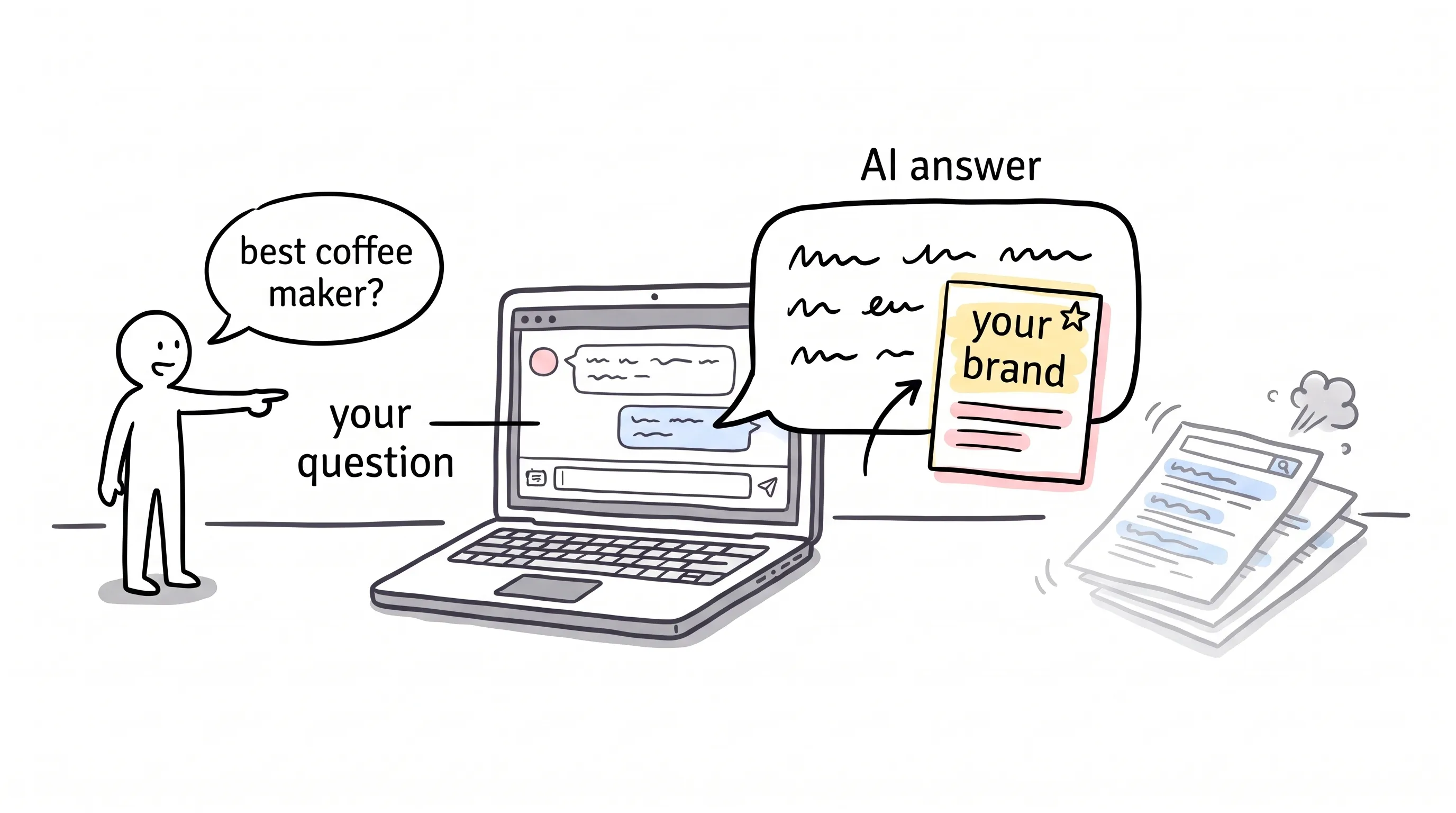
Now the problem was clear. His website hadn't gotten worse — his customers had simply changed where they ask questions. They used to bring keywords to Google; now they bring a whole paragraph of plain talk to ChatGPT. The AI delivers the whole answer itself — and the user never clicks anything.
The traffic didn't disappear. It got replaced by citations.
What Is GEO?
GEO stands for Generative Engine Optimization — the practice of optimizing for AI answer engines.
Put simply: in the past, you optimized content to rank high on a search results page. Now what you optimize for is getting AI systems like ChatGPT, Google's AI Overviews, and AI Mode to cite you and mention you in the answers they generate.
You used to compete for rankings. Now you compete for citations.
One word of difference, and the entire game has changed.
How Does AI Pick Its Content?
You'd think ChatGPT receives a question, sweeps the whole web, and hands you the most relevant results.
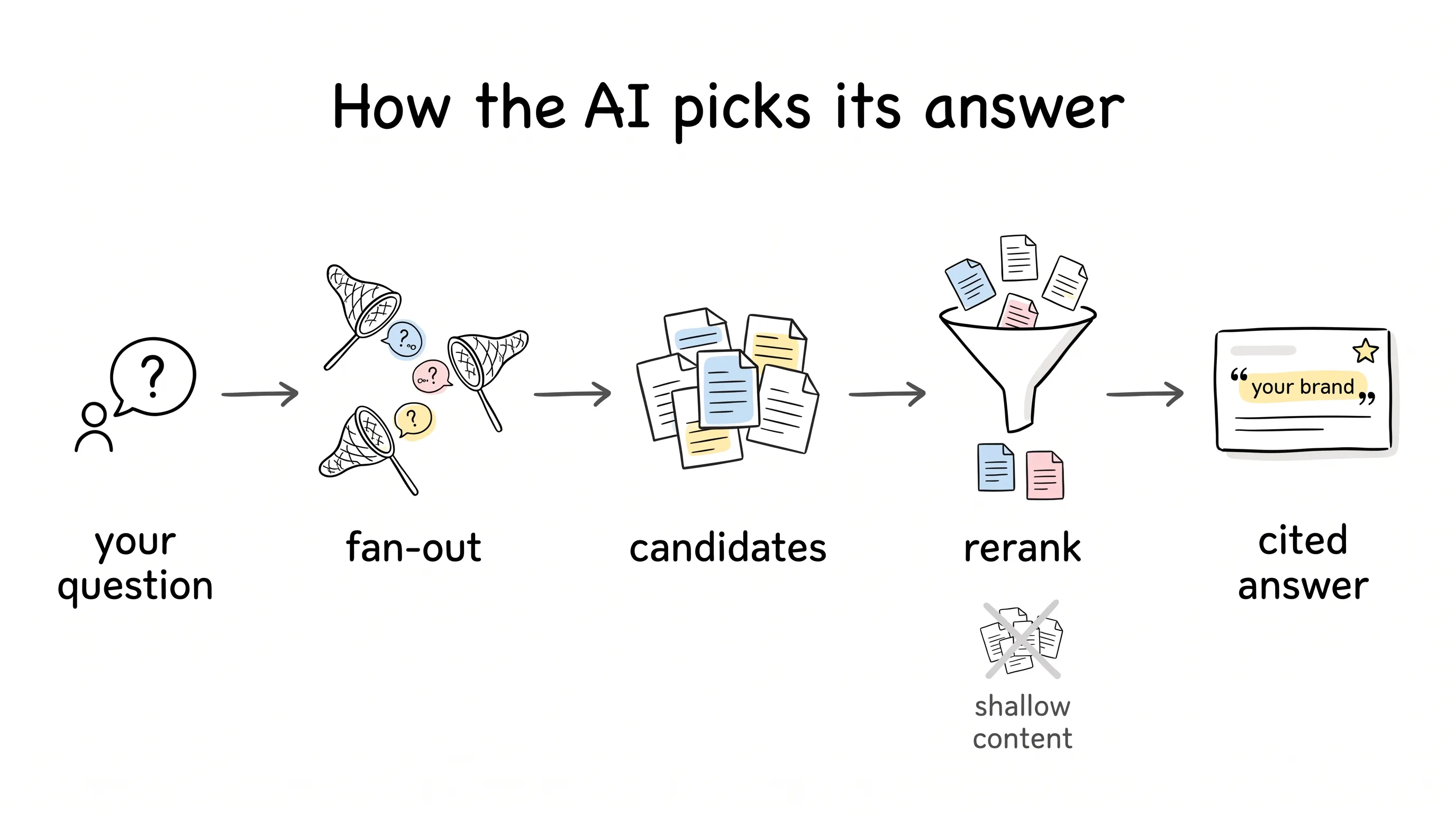
It doesn't. Inside, it's a multi-stage pipeline.
Step one: pull in a large pile of candidate documents. Step two: a reranking model re-orders those documents by quality and credibility — only after that does it start writing the answer. People have dug up a reranking model called ret-rr-skysight-v3 inside ChatGPT's system; that's exactly the job it does.
This means getting retrieved only buys you an entry ticket. Whether you survive to the end depends on whether your content is comprehensive and credible enough. Shallow writing with vague facts won't make it past the second round.
So how do you get the AI to trust you? Read on — each of the following has been repeatedly validated by research.
Content Has a Shelf Life Too
People have dug into AI retrieval systems and found a freshness mechanism: freshness itself is a scoring factor.
A meticulously written article that hasn't been updated in three years will lose to a freshly updated one that's less comprehensive. Sounds unfair — but think about yourself: you'd rather read a guide from last week than one from five years ago.
So old articles can't be left sitting. Core pages need regular refreshes with new data and new cases, and the update date and revision history should be displayed plainly on the page, so the AI can tell at a glance: this is new.
AI Also Reads Intent and Speaks the Jargon
People have found two interesting configuration options inside ChatGPT: one called enable_query_intent, one called vocabulary_search_enabled.
What do they mean?
First, the AI tries to figure out what you're actually trying to do. Looking up a definition, following a tutorial, or comparing prices — different intents call for different things. If your page's intent doesn't match, even strong traditional rankings can still get the page thrown out. Definition questions get definition pages; how-to questions get tutorials; comparison questions get comparison tables.
Second, the AI favors insider language. Write "that software that makes photos look better," and it can't recognize it; write "image enhancement algorithm," and it recognizes it at a glance. Terms must be written precisely, and paired with definitions, glossaries, and structured markup that help the AI slot those words into the right knowledge framework.
Google's MUM model was designed along exactly these lines: understanding subtle nuances of wording across domains and languages.
The Biggest Change: The AI Casts a Wide Net
This may be the single most important thing in all of GEO.
What is query fan-out?
When a user asks the AI a question, the AI doesn't search with just that one sentence. It breaks the question apart into several related sub-questions, casts its nets from different angles at once, and weaves whatever it catches into one answer. Google's patent on neural-network retrieval, US11769017B1, describes exactly this kind of retrieval expansion.
Here's an example. A user asks, "With a budget of 20,000 yuan, how do I renovate a 60-square-meter old apartment?" The sub-questions the AI breaks out might be: the typical price range for old-home renovation, the pitfalls of plumbing and electrical work, the reputation of local renovation crews. If your article only hits the single phrase "renovation quotes," the other two nets miss you entirely.
Before writing its answer, the AI performs one more step: grounding — literally, dropping anchor. From the content it retrieved, it picks the few most credible items as anchors, and the answer is anchored on them. Patent WO2024064249A1 describes this as well, including setting that anchor with the user's history taken into account.
Only content that is clearly structured, and carries data and sources, has a chance of being chosen as one of those anchors.
GEO vs. SEO: What Exactly Is the Difference?
Four sentences, and it's clear.
The unit of optimization changed. In the SEO era you worked in pages — titles, descriptions, keywords. In the GEO era you work in paragraphs. The AI often lifts a single table or one FAQ entry from your article to use, so every paragraph must stand on its own, citable in isolation.
The evaluation signals changed. In the past it was backlinks — whoever got more votes was stronger. Now it's citations, data, brand mentions, factual consistency.
The freshness requirement changed. Evergreen content you could write once and forget was the darling of the game's last version. In this version, if you don't update, you fall behind.
The definition of success changed. It used to be rankings and clicks; now it's being cited, being extracted, being carried into the conversation.
The technical foundation is still the same: crawlability, speed, structured data. What's new is one more layer of requirements — the machine must not only reach you, it must also be able to read you.
How Do You Measure It? This Is Where Most People Get Lost
Some will say: can't I just check GA4?
No. There's a huge blind spot here.
Analytics tools like GA4 record visits through JavaScript events in the browser. But when the AI cites you, the user never clicks into your site at all — they finish the AI's answer and leave, often without even knowing your name appeared in it. Every one of those citations registers as zero in the analytics tool.
I've seen a set of comparison data: over the same period, server logs caught 490 visits from ChatGPT citations, while GA4 recorded only 3 sessions.
A gap of more than a hundredfold.
Where do you see the real numbers? The logs. Your server logs are the most reliable record of AI usage. Inside there's a user agent called ChatGPT-User, which means a real user's question triggered ChatGPT to come fetch your content. Pull these visits out on their own, and you'll know which pages are actually being cited in conversations, and which topics deserve more investment.
With measurement solved, the next step is doing the math. The new scorecard looks roughly like this: AI Visibility Rate (AIGVR) — how often your content appears in AI answers; citation rate — how many times you're cited directly; Content Extraction Rate (CER) — which passages get lifted for reuse; and most critically, conversation conversion rate — match AI citations against closed deals in your CRM, and see how much business these invisible citations ultimately bring in.
Invisible citations can't be exchanged for visible business. Make citations visible first — then talk about optimization.
Big companies with traffic at scale will all, eventually, have to build an AI search measurement system for themselves, the way they once built BI systems. Whoever builds it first is the first to see the whole table.
A Few Common Questions
Persuade the machines first, or the humans first?
The machines first. GPT-4, Gemini, Llama — these large models decide whom to cite. Machines are the gatekeepers; humans make the final call. If you can't get through the gate, nothing beyond it matters.
You could already see the first sprouts of today's large models back in the BERT generation: grammar and semantics, parsed in fine detail. Today's generative models don't just classify — they also write answers, and what they rely on when writing is well-structured, fact-dense content. So half of what GEO does is for the machines to read.
Has content returned to center stage?
Content never left the stage; only the weights changed. From 2012 to 2018, backlinks and technical signals called the shots. Now it's semantic density, factual density, and degree of structure. Lists, guides, FAQs, in-depth long-form pieces — these formats carry the densest semantics and the clearest modules, and are the easiest to lift section by section.
Didn't Google itself drop any hints?
It did, and very bluntly. The Helpful Content system, launched in 2022, shifted the entire center of evaluation away from external signals like backlinks and toward the content itself: is it deep enough, does it read smoothly, was it genuinely written for the reader? That direction, and the logic of how the AI picks content, are one and the same.
The way users ask has changed — what now?
It has indeed changed, from a few keywords to a whole paragraph of plain speech. And that's actually good news for people who take content seriously: cover a topic's neighboring questions thoroughly, lay out the relationships between entities clearly, and when the nets are cast, every net will catch you.
Back to That Friend
My friend later did a few things: he broke his product pages into self-contained modules, paired every section with data and sources, set a fixed monthly update routine, and had someone start watching the server logs.
Last month he told me: when ChatGPT answers questions in their category now, it has started mentioning them.
The citations came back. And business is coming back with them.
In the age of AI, business starts with being cited.
Here's to you being cited too.
Continue reading
Related articles

It's 2026: Stop "Buying" AI Tools for Your Marketing Team — Start "Hiring" AI Agents
This learn article explains how AI agents differ from standalone AI tools in marketing, outlines three agent categories — build-your-own platforms, CRM-native agents, and vertical tools — and covers use cases across SEO, social media, advertising, and reporting, plus criteria for choosing one.

What Is GEO? How Your Brand Gets "Mentioned" in the Age of AI Search
An explainer on GEO (Generative Engine Optimization) for e-commerce and DTC brands: how it differs from SEO and AEO, why AI answers shape brand visibility, and eight practices covering question-focused content, consistent brand messaging, structured pages, external evidence, comparisons, and AI mention tracking.

AI Is Already Making Decisions for Your Customers. Are You on the List?
A learn article explains GEO (Generative Engine Optimization): why AI-generated answers now shape which brands customers see, and how SEO fundamentals, entity clarity, citable evidence, and monthly measurement affect visibility in AI answers.