
Customers stopped searching. Now they ask AI. Is your brand in the answers?
A learn article on GEO (Generative Engine Optimization): how brands get cited in AI answers, how GEO overlaps with and diverges from SEO, and tactics like schema markup and question-based content planning.
A few days ago, I asked ChatGPT a question: which is the best SEO company in the cybersecurity industry?
It answered with full confidence — conclusion first, reasons after. It recommended First Page Sage, saying the firm "regularly ranks No. 1 in various listings of cybersecurity SEO agencies."
I followed the source it cited, wanting to see who had actually awarded that No. 1 spot.
I froze. The source was a page on First Page Sage's own website — a page that, with a perfectly straight face, analyzed why the firm was stronger than its competitors.
The company has built nearly 70 pages like this. Aviation, electrical contracting, executive headhunting — one page per industry, each one written to "persuade" AI: in this industry, I am the best.
Its CEO, Evan Bailyn, put it even more bluntly: as long as the evaluation criteria you feed AI look scientific and credible, AI will actually believe them. Pair that with two things, and the top spot is welded shut — ranking in Google's top five search results, plus showing up on two or three industry lists, especially the ones labeled "top" or "best."
Their client roster includes Rodan + Fields and U.S. Bank.
Wow. Isn't this literally sharpening a dedicated salesperson for AI?
So What Exactly Is GEO?
This new discipline goes by the trade name GEO — Generative Engine Optimization.
What is a generative engine? Large language models like ChatGPT, Claude, and Gemini. You ask a question, and it generates an answer on the spot.
GEO has exactly one job: get your brand into the first few lines of an AI answer.
Some call it AEO — Answer Engine Optimization. Others call it AI visibility. The name doesn't matter. What matters is that it is carving out territory from traditional SEO, and fast.
How fast? Let's run the numbers.
In 2025, Gartner surveyed 253 marketing leaders. The conclusion: by 2028, brands' organic search traffic will drop by more than 50%.
Why the drop? Because before making a purchase decision, consumers have shifted from "searching for it" to "asking AI about it."
Customers used to type in keywords. Now they talk like humans.
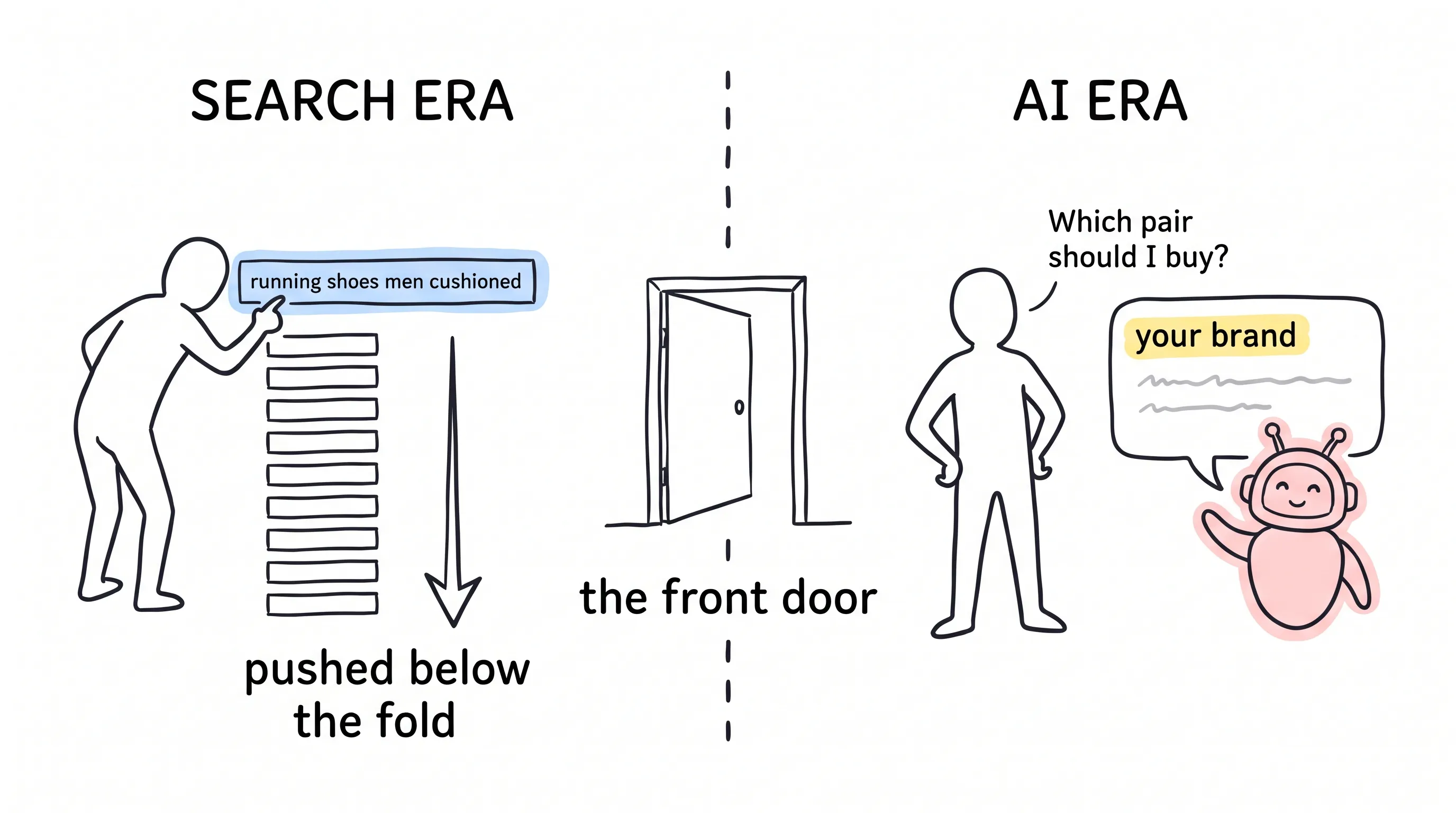
The front door has changed. The playbook must change with it.
GEO and SEO Are Relatives, Not Twins
Some business owners may be asking: was all that SEO kung fu I learned wasted?
Not wasted. Quite the opposite.
Sarah Gray, SVP at the marketing agency Amsive, said something right on target: the content that appears in AI answers overlaps heavily with what appears on page one of Google.
If you rank well on Google, AI will most likely cite you too.
But relatives are not twins. Here are two places where they part ways.
First: how machines read you. Search engines look at how web pages link to one another. Large language models sweep the web for language machines can understand. That demands a crystal-clear content structure — add schema markup, the code that helps machines understand context, and give every image alt text so words tell the machine what the picture shows.
AI doesn't care how flashy your page design is. It is "blind" — it only reads structure.
Second: how customers ask you. In the search-engine era, customers typed "running shoes men cushioned." In the AI era, they say: "I run three times a week, my knees aren't great, my budget is around 500 yuan — which pair should I buy?"
And that's the rest of Gray's point: what you need to do is become the answer itself. Ten blue links will only get pushed below the fold.
Treat the LLM as an Errand-Running Assistant for Your Customers
Nikhil Lai, an analyst at Forrester, offered a perspective I find especially illuminating.
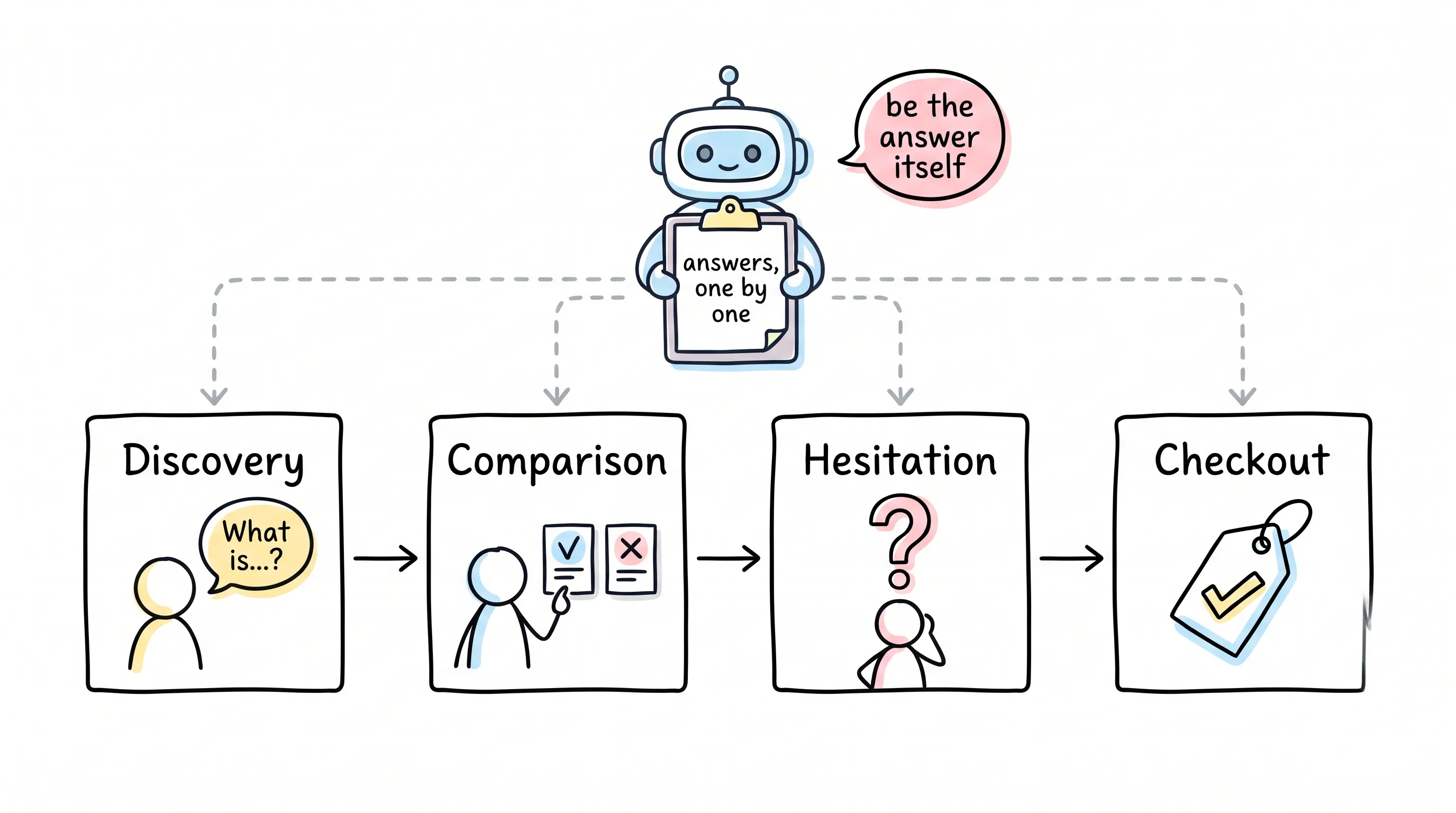
Picture the large language model as an assistant who runs errands for your customer, asking on the customer's behalf whatever the customer cares about.
The content you need to prepare, then, is not a pile of keywords. It is answers to a chain of questions. From discovery, to comparison, to hesitation, to checkout, customers ask different questions at every stage. List out the questions for each stage, then answer them one by one, directly.
Put plainly, this takes the old SEO craft — studying user intent — and takes it further: harder, more thorough.
And those ~70 First Page Sage pages? Same logic. Anticipate what AI will be asked, lay out the "model answers" in advance, and wait for AI to copy.
Oh, and one more point that is especially easy to overlook. Kelly Cutler, who teaches digital marketing at Northwestern, reminds us: don't throw away traditional SEO principles. Steadily building a content library with genuine substance is a continuous signal to generative engines: for these questions, go with my content.
Back to Where We Started
I asked ChatGPT which SEO company is best, and it recommended First Page Sage.
Do you see it now? That "best" is half genuine skill — and half somebody planning ahead, planting "I'm the best" in language AI can read, all across the internet.
Before, if you wanted to be seen by customers, you fought for the search front door. Now, if you want to be seen by customers, you have to be seen by AI first.
Traffic hasn't disappeared. It just found a new voice.
Is your brand in AI's answers?
Continue reading
Related articles

It's 2026: Stop "Buying" AI Tools for Your Marketing Team — Start "Hiring" AI Agents
This learn article explains how AI agents differ from standalone AI tools in marketing, outlines three agent categories — build-your-own platforms, CRM-native agents, and vertical tools — and covers use cases across SEO, social media, advertising, and reporting, plus criteria for choosing one.

What Is GEO? How Your Brand Gets "Mentioned" in the Age of AI Search
An explainer on GEO (Generative Engine Optimization) for e-commerce and DTC brands: how it differs from SEO and AEO, why AI answers shape brand visibility, and eight practices covering question-focused content, consistent brand messaging, structured pages, external evidence, comparisons, and AI mention tracking.

AI Is Already Making Decisions for Your Customers. Are You on the List?
A learn article explains GEO (Generative Engine Optimization): why AI-generated answers now shape which brands customers see, and how SEO fundamentals, entity clarity, citable evidence, and monthly measurement affect visibility in AI answers.