
Nobody Clicks Links Anymore—So How Does Your Content Get Seen?
An explainer on GEO (Generative Engine Optimization) and how it differs from SEO, plus a six-item beginner checklist for getting content cited in AI answers: clear writing, Schema markup, entity building, verifiable claims, Q&A formatting, and link structure.
Recently I noticed a habit of mine, and it's a little alarming.
Whenever I run into a problem, I ask AI first. Get the answer, close the tab. In that entire process, I never click a single link.
Then one day I stopped and thought about it: when was the last time I scrolled search results to page two?
I couldn't remember.
And I'm not the only one. We used to find answers by searching: type in a keyword, skim ten blue links, pick, compare, and piece the conclusion together ourselves. Now we find answers by asking: throw a whole sentence at ChatGPT, and it hands you the answer directly.
When user behavior changes, the flow of traffic changes with it.
So here's the question: if AI never cites your content, does it simply not exist in this new game?
The word for this is GEO.
What Is GEO?
GEO stands for Generative Engine Optimization.
What are generative engines? Things like ChatGPT, Perplexity, and Google's AI Overviews. Instead of handing you a list of links, they read the web themselves and generate an answer for you.
And what does the "optimization" part mean? Making sure that when these AIs write their answers, they know you, trust you, and want to cite you.
Put simply:
SEO is about "people searching for information." GEO is about "AI choosing on people's behalf."
They sound similar, but they are two entirely different games.
One Storefront to Explain GEO vs. SEO
What is SEO like? It's like renting the best storefront on a busy pedestrian street. Beautiful decor, a striking sign, a hundred thousand people walking past every day. You perfect the shop, then wait for customers to stroll by, walk in, and buy.
And GEO? Customers have stopped strolling that street. When they head out the door, they go straight to a trusted advisor: "I want to buy X—which one should I pick?" Without a moment's hesitation, the advisor names three options.
Your shop is still there, still the best-decorated on the whole street. But the customers never come.
So tell me: do you keep optimizing the storefront, or do you make the advisor remember you?
The two routes don't even share the same metrics.
What does SEO measure? Keywords, backlinks, click-through rate, traffic. Where you rank on the results page, and how many people clicked through.
What does GEO measure? When AI writes its answer, did it cite you, mention you, get the facts right? The user may never touch your webpage from start to finish—yet AI has already spoken your name to them.
So does that mean SEO can be thrown out?
No.
GEO is not here to take SEO's job. It's the other half of the battlefield, the half that was missing.
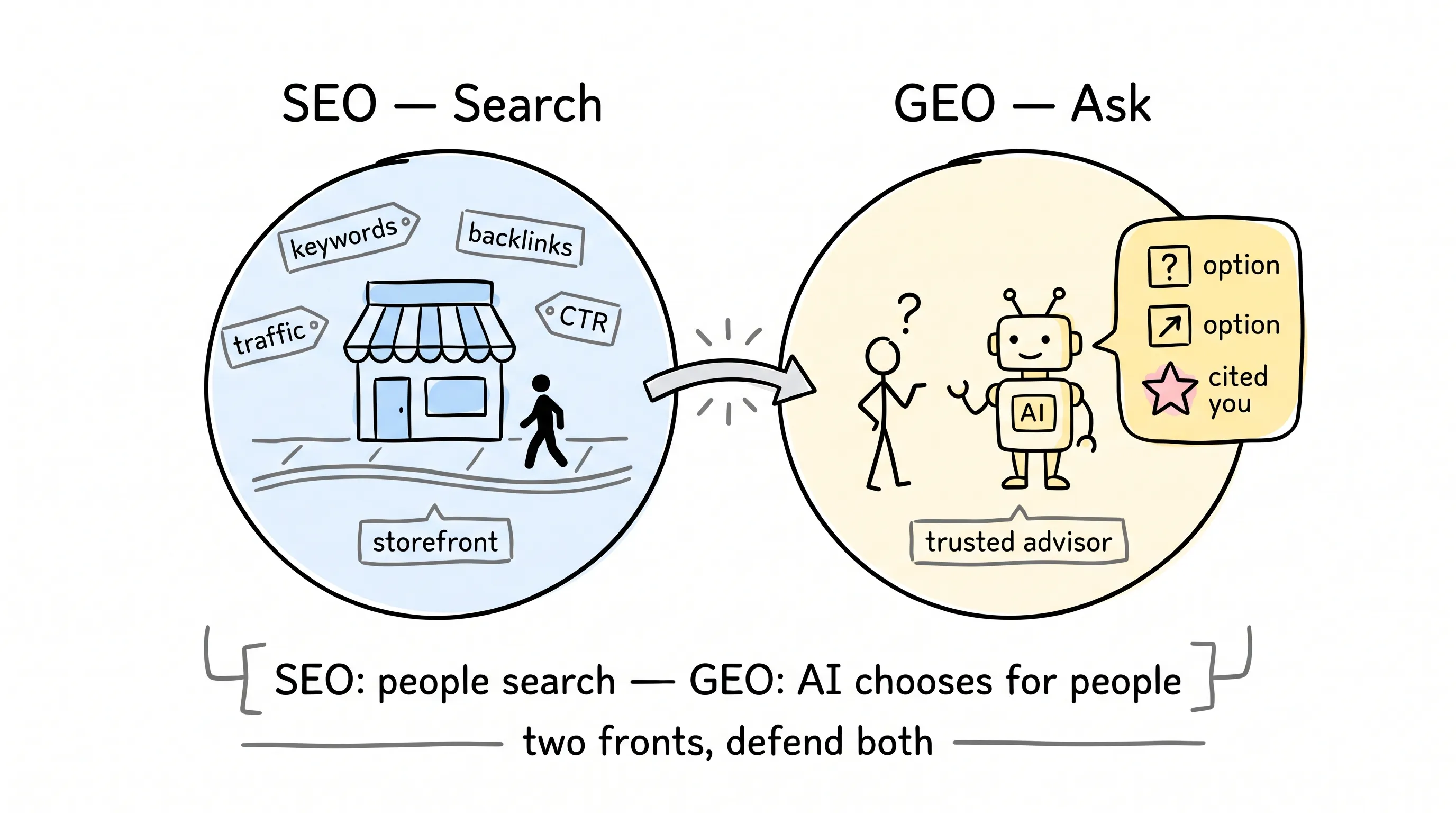
Search is still here, so SEO still needs doing. But with every point AI's share climbs, you carry more risk if Google is the only front you defend. A complete strategy mans both lines.
Getting Cited by AI: Six Things to Do
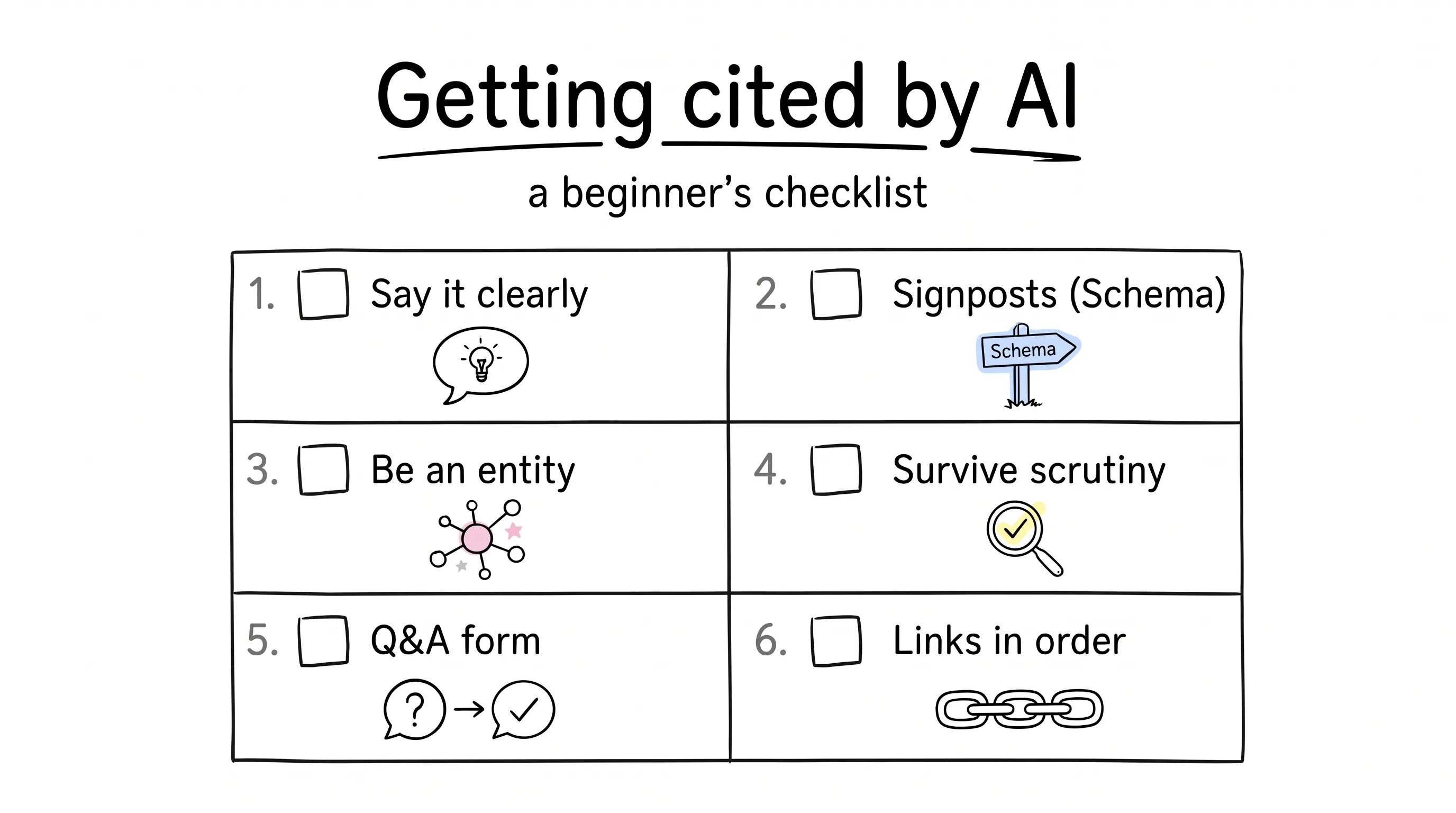
Where do you start? I've gathered the approaches I've come across lately into a beginner's checklist. Six items, nothing mystical—take them one at a time.
One: say things clearly, in plain language.
AI doesn't count keywords; it reads meaning. If an article is vague and drowning in jargon, AI can't parse it, so it won't risk citing it. Flip it around, and content that takes every concept apart, explains it thoroughly and plainly, is exactly what it loves to use. Before you write, ask yourself one question: could an outsider understand this paragraph?
Two: put up "signposts" in your content.
There's a thing called Schema markup, also known as structured data. Put simply, it tags what's on the page: this is an FAQ, this is a term definition, these are product specs. AI processes massive volumes of information every day; the clearer your labels, the less effort it spends extracting, and the higher the odds your content gets cited accurately.
Three: turn yourself into an "entity."
AI understands the world through a network of entities: people, companies, products, concepts, and who is connected to whom. If you want your brand woven into that web, you have to state plainly who you are, what you do, and whom you're connected to. Concept pages, definition pages, a small industry glossary—all solid entry points.
Four: make your content survive scrutiny.
When AI writes an answer, its biggest fear is saying something wrong and tarnishing its own reputation. So it picks its sources carefully, favoring ones with solid facts, clear provenance, and claims that hold up under checking. Cite your data, back your opinions. These are entry qualifications, not bonus points.
Five: write in question-and-answer form.
The questions users ask AI are all plain speech: Which is better? How do I choose? Is it worth it? Your content should have those exact questions and answers embedded in it. Write to match the way questions actually get asked. And once you finish a piece, ask which single question a user would ask AI that it answers.
Six: get your links in order.
Internal links string your content system together; outbound links point to credible sources. Do this for your readers, and do it for AI too. It follows your links to judge whether your knowledge is complete and your provenance is clean.
Three Questions Everyone Asks
First: GEO is here—so is SEO dying?
No. Search is still around, so SEO still needs doing. GEO is a new front that opened up alongside it: one side catches "search" traffic, the other catches "ask" traffic—and you can't afford to lose either.
Second: do small companies stand a chance?
I'd argue this is actually good news. Ranking battles used to be wars of money and time, with big sites hogging the front rows. In AI's answers, only the content itself counts: whoever explains it clearly and proves more trustworthy gets cited. For small and mid-sized players who take content seriously, that's a rare new window.
Third: where do I begin?
From today's checklist, pick one item. Add Schema markup to your FAQ page, say, or rewrite your most important introduction around "how would a user actually ask this." Start moving, then iterate. How AI works will keep changing, but the core—make your content clear and trustworthy—won't.
A Note to Close
Writing this, I think again of my own habit: ask AI, take the answer, close the tab, never click a link.
Behind that habit stands a habit that hundreds of millions of people are forming together.
Your users are in there too.
So next time you open an AI, try asking yourself one question first:
If AI were asked about your industry right now, would it mention you?
Here's to becoming the name that gets mentioned—sooner rather than later.
Continue reading
Related articles

It's 2026: Stop "Buying" AI Tools for Your Marketing Team — Start "Hiring" AI Agents
This learn article explains how AI agents differ from standalone AI tools in marketing, outlines three agent categories — build-your-own platforms, CRM-native agents, and vertical tools — and covers use cases across SEO, social media, advertising, and reporting, plus criteria for choosing one.

What Is GEO? How Your Brand Gets "Mentioned" in the Age of AI Search
An explainer on GEO (Generative Engine Optimization) for e-commerce and DTC brands: how it differs from SEO and AEO, why AI answers shape brand visibility, and eight practices covering question-focused content, consistent brand messaging, structured pages, external evidence, comparisons, and AI mention tracking.

AI Is Already Making Decisions for Your Customers. Are You on the List?
A learn article explains GEO (Generative Engine Optimization): why AI-generated answers now shape which brands customers see, and how SEO fundamentals, entity clarity, citable evidence, and monthly measurement affect visibility in AI answers.