
AI Can Write Ads Now. What's Left for Marketers?
A learn article on what AI changes for marketers: AI takes tasks, not judgment. Covers generative content, personalization, dynamic optimization, livestream shopping, and contextual ads, plus risks like over-reliance, authenticity, data bias, and skills gaps.
A couple of days ago, an old friend who has spent ten years in marketing invited me to dinner.
Before we had even sat down, his first words were: "Run, tell me honestly — do you think AI will one day wipe out our entire department?"
I told him not to panic yet, and asked him a question first: what exactly is AI taking away?
A lot of people confuse "tasks" with "professions."
What AI can do is handle specific tasks, one by one: writing copy, creating images, running tests, monitoring the data. Losing those tasks does sting. But the profession of "marketer" was never built by stacking up tasks — it was built by stacking up judgment.
Judgment about what? Where to strike and where not to. Which trend is a real opportunity and which is just noise. Whether the brand's money should be spent on today's conversions or on tomorrow's mindshare.
Today's AI still cannot take any of that away.
AI takes away tasks. It cannot take away judgment.
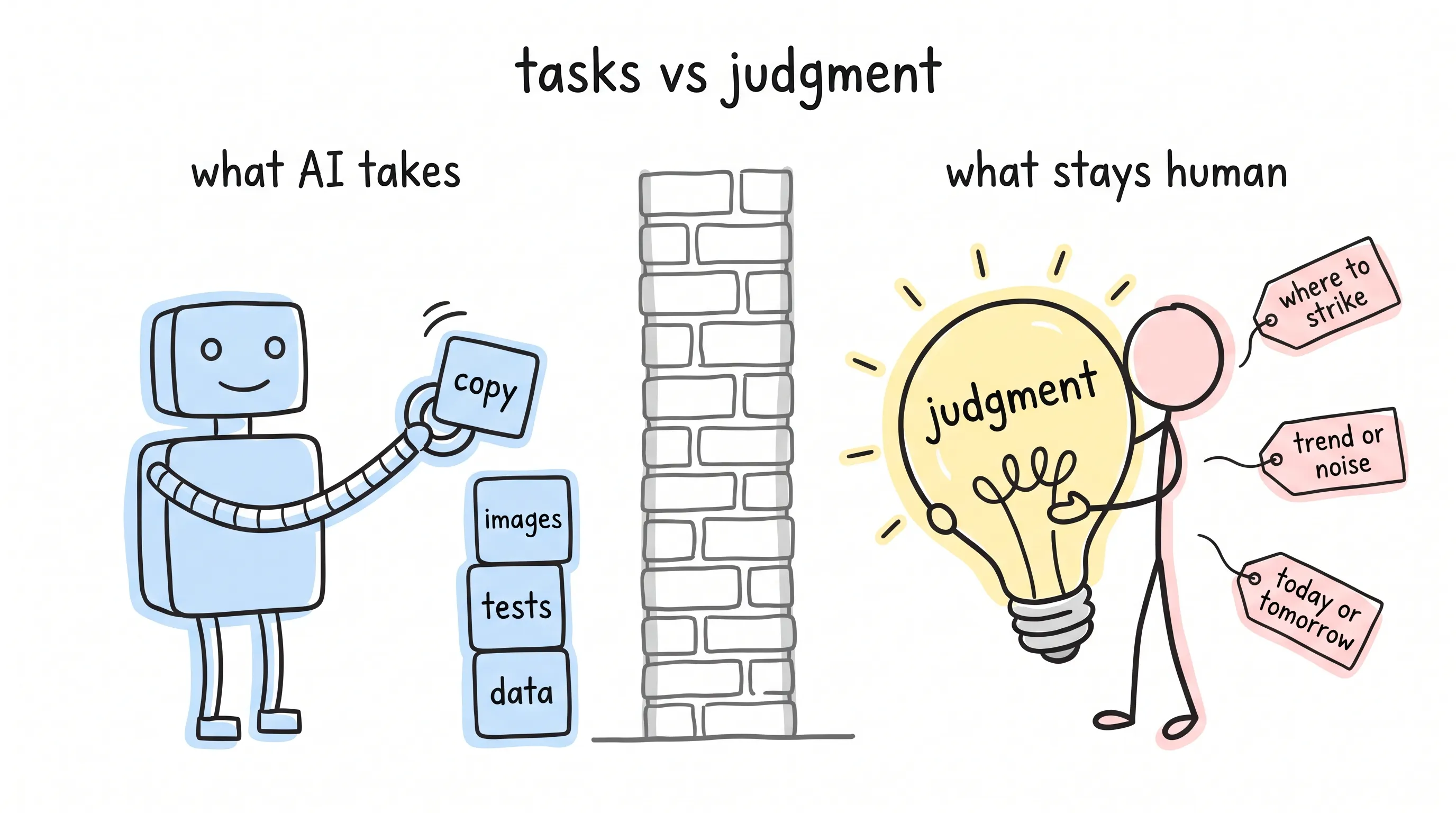
So my answer is: AI will not wipe out marketers as a whole. But it will reshuffle the deck: people who know how to use it move up; people who don't stay trapped in the tasks.
I didn't pull this out of thin air. It's what a group of people on the front lines have verified with real money on the line. How they see it and what they're doing — I've pulled it all together for you.
1. The Tools Keep Changing. The Fundamentals Don't.
Sunil Gupta, a professor at Harvard Business School who studies digital marketing and AI, once said something I particularly love: marketing is a highly dynamic, fast-response industry — new trends keep popping up, and you have to keep chasing them.
Chase what, exactly?
Steve Gallo, president of the footwear brand OOFOS, sees it clearly: the tools have changed, the speed has changed, but the fundamentals of digital marketing haven't changed one bit.
What are the fundamentals? Clear objectives, a clear audience, a value proposition that holds up, metrics set precisely. And before you spend the money, you have to genuinely understand the customer journey: which dollar is bet on today's conversion, and which dollar is bet on tomorrow's brand.
AI can crunch these questions faster. But you still have to sign off on the answers.
2. The Real Pros Know: Strategy Beats Speed
Robin Cohen, executive vice president of media planning at Rain the Growth Agency, has a sobering observation: the media market is getting more and more crowded, with more and more brands squeezed into the same few channels, fighting for attention.
What does "crowded" mean?
It means being faster is useless. Everyone is fast.
What counts now is how you answer two questions: how to make the content, and where to put the money.
AI can help here: analyzing customer preferences, doing personalization, testing different versions of creative, optimizing budgets — even sniffing out the next trend early from online discussions and search queries.
But choosing which platform, betting on which play, abandoning which opportunity that looks beautiful. That's human work.
Asmita Dubey, chief digital and marketing officer at L'Oréal, has a creed I'd love to frame and hang on my wall: seize what is starting.
With new technology, don't rush to judge it. Stay curious first, get your hands on it first. Pilot it, experiment, find new partners. But note: she isn't telling you to chase every hot topic — only chase the innovations that both serve customers and strengthen the brand.
Curiosity gets you a seat at the table, agility keeps you in the game, strategy wins it.
3. Five Changes Happening at the Table
So what exactly is changing? I've grouped the changes I've seen into 5 categories.
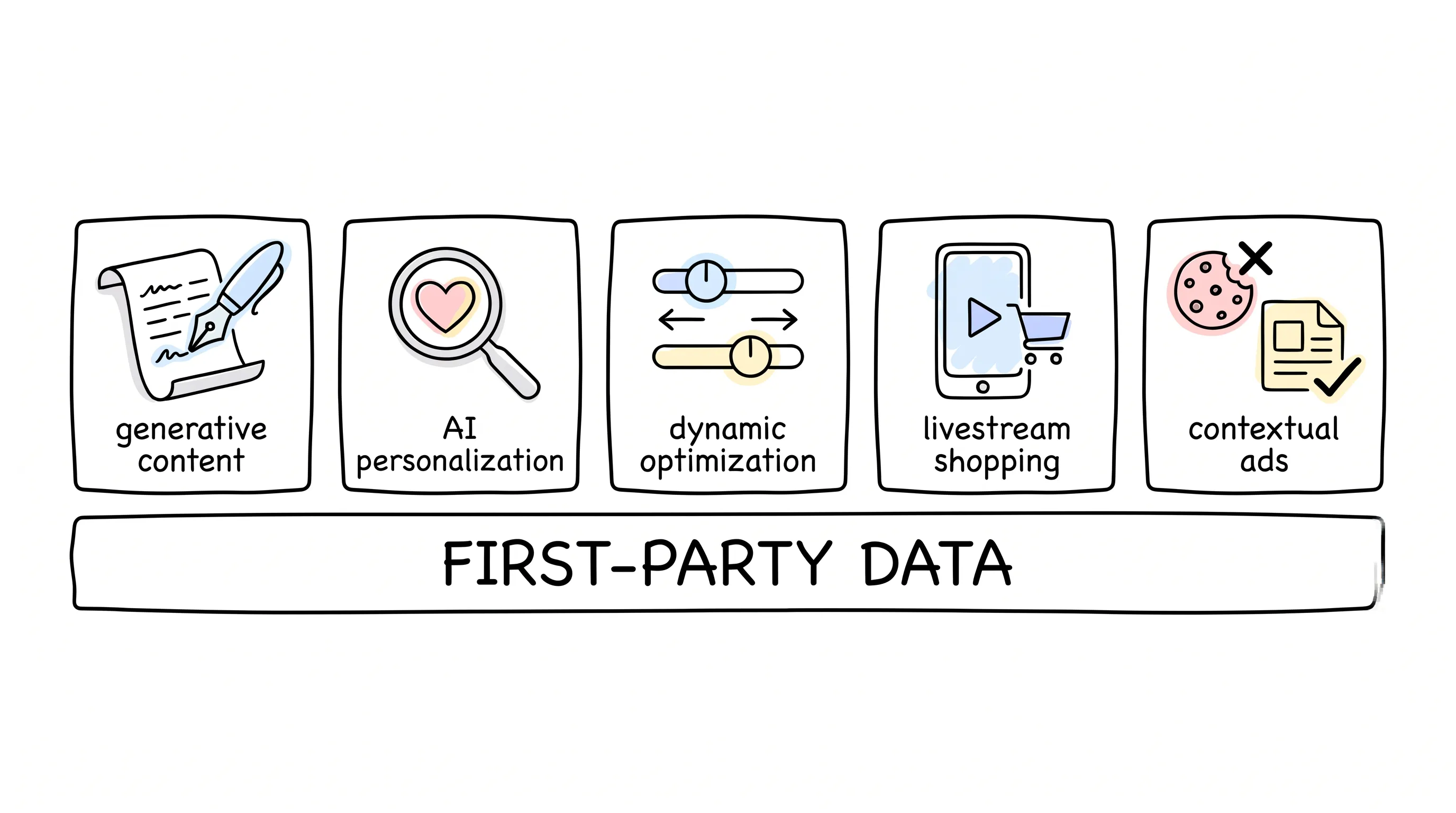
1) Generative content. Ad copy, blog posts, social media posts, images, videos, campaign ideas — AI can lend a hand with all of it. Think about it: a round of A/B testing used to take a week of waiting for creative; now AI can give you dozens of versions in one night, and humans are only responsible for picking and judging. Gupta also mentioned that technologies like generative adversarial networks (GANs) can already directly generate images and designs for marketing use. But remember one rule: AI drafts, humans gatekeep. Accuracy, originality, inclusivity, brand tone of voice — every single gate needs a human pass.
2) AI personalization. There's a fashion e-commerce company called THE YES, and its play is clever: every "want it" and "don't want it" from customers, every browse, every saved item — all of it feeds its recommendation engine. The result is that recommendations get more and more accurate, the understanding of each person's taste gets deeper and deeper, and in the crowded field of fashion e-commerce it has carved out an advantage that others simply cannot offer.
3) Dynamic optimization. Meta has poured enormous resources into its AI advertising systems, running experiments at scale and automatically allocating budgets in real time. The capability is real. But Cohen offers a dose of blunt honesty: measurement, to this day, remains the whole industry's unsolved problem. Marketing mix models, multi-touch attribution — nearly every industry headline is talking about how to measure. Yet "reaching consensus on common measurement standards" — nobody has managed to do that so far. So for every recommendation AI gives you, you still have to check it against your company's bigger goals.
4) Interactive and livestream shopping. Ekta Chopra, chief digital officer at e.l.f. Beauty, has explained why livestream shopping works: it saves customers the step of "figuring it out themselves." Someone is there on the spot telling you how the product is used and what's inside; once you've watched, you can buy it on the spot. Content, community, transaction — all in one go.
5) Privacy and contextual advertising. This shift was forced on the industry. Consumers are tired of the whole cookie-tracking apparatus, and governments have moved too: multiple countries have legislated restrictions, and Apple simply requires third-party apps to obtain user permission before tracking. As cookies become less and less reliable, many marketers have turned back to "contextual advertising": forget your browsing history — the ad only cares whether the content context matches. A financial services company, for example, places its ads on the Financial Times website, because the people reading that page naturally overlap with its customer base.
Behind these five trends sits a single theme: first-party data, and honest customer relationships, are worth more than ever before.
Cohen puts it plainly: you need a rock-solid understanding of your own customers' first-party data, so you can lean less on third parties.
4. But There's Always a Flip Side
AI is not a free lunch.
The first trap: over-reliance. AI has no intuition, no creativity, no strategic nose. Unreviewed AI content all ends up looking the same: mediocre, interchangeable, separated from the reader by a pane of glass.
The second trap: authenticity. As AI-generated content multiplies, customers will start asking: is this true? Is the information trustworthy? Brands have to set their own rules — when AI was used, whether to disclose it, and how.
The third trap: data and bias. AI feeds on data, and data can leak; algorithms carry bias, and the results will be unfair. Who keeps watch? Still people.
The fourth trap: the skills gap. Not every team knows how to use AI. Being able to evaluate AI's output, use data responsibly, and stack human insight on top of machine recommendations — this itself is a whole new discipline the industry still has to learn.
Back when NFTs were flooding everyone's feeds, Raja Rajamannar, chief marketing and communications officer at Mastercard, asked a particularly good question: is this actually smart, or just a burst of noise manufactured for attention?
Later, we all learned the answer.
Now, facing every new AI play, I suggest you ask the same question.
5. So Will You Actually Lose Your Job?
Back to that dinner at the start.
My answer has two layers.
First layer: in the short term, AI is more likely to change marketing jobs than to eliminate them. The upfront investment is real, but stretched out over time, AI will thin out the cost of content production and optimization bit by bit, especially with large-scale campaigns. Where do the saved money and people go? To more valuable work: understanding customers, building relationships, making genuinely creative judgments.
Second layer: in the long run, what decides your fate is not AI — it is the speed at which you stop learning.
Cohen's advice to newcomers is especially practical: read more industry coverage, keep a constant eye on how the industry shifts; and dare to take risks and try new things — don't just guard the same old proven playbook.
Bianca Reed, formerly vice president of client services and inclusive marketing at Rain the Growth Agency, put it even more bluntly: stay hungry to learn, always. She added one more line: "content is queen." Audiences increasingly expect personalization and cultural relevance; your content has to speak to both the platform and the person.
And data alone isn't enough. Mastercard has spent recent years stepping beyond traditional advertising, co-creating stories directly with customers, turning marketing into a platform that even partner banks and merchants benefit from. How? By always looking at what lies beyond the data: customers' needs, motivations, behaviors.
Data tells you what happened. Only people can tell you why.
Finally, Back to That Dinner
When the meal was nearly finished, I asked my friend: is what you're afraid of really AI — or your own standing still?
He paused for a beat. Then he smiled.
By this point, the answer is already obvious:
AI will take away tasks, will thin out costs, will redistribute a marketer's time. But it cannot take away curiosity, cannot take away judgment, cannot take away that genuine understanding between you and your customers.
What gets eliminated has never been a profession — it's the people who stop updating.
Professor Gupta said something at the end of his course. I pass this line on to that friend of mine, and to you:
This line of work never goes out of date. And every one of us must keep learning, keep updating ourselves.
Here's to becoming the person who never stops updating.
Continue reading
Related articles

It's 2026: Stop "Buying" AI Tools for Your Marketing Team — Start "Hiring" AI Agents
This learn article explains how AI agents differ from standalone AI tools in marketing, outlines three agent categories — build-your-own platforms, CRM-native agents, and vertical tools — and covers use cases across SEO, social media, advertising, and reporting, plus criteria for choosing one.

Did the Money You Spent on AI Marketing Ever Come Back?
A guide to measuring AI marketing ROI across three layers: ad reports, sales pipeline, and the financial ledger. Covers metrics such as ROAS and CPA, eight dashboard metrics, industry benchmarks, and common measurement mistakes.

How to Pick a Creative Automation Platform: First, Figure Out What These Eleven Actually Do
A learn article sorts eleven creative automation platforms — including Bannerflow, Celtra, Smartly.io, and Storyteq — into four functional groups and proposes five evaluation questions covering publishing reach, automation depth, ease of adoption, team fit, and verifiable evidence.