
AI Marketing Daily · 2026-11-07
AI marketing daily for 2026-11-07 covering a working paper on ChatGPT ad traffic revenue versus Google paid search, a Scrunch vs Ahrefs AEO tool comparison, automation self-checks, prompt requirement practices, Meta creator budget signals, 2026 benchmarks, and AI ad privacy compliance.
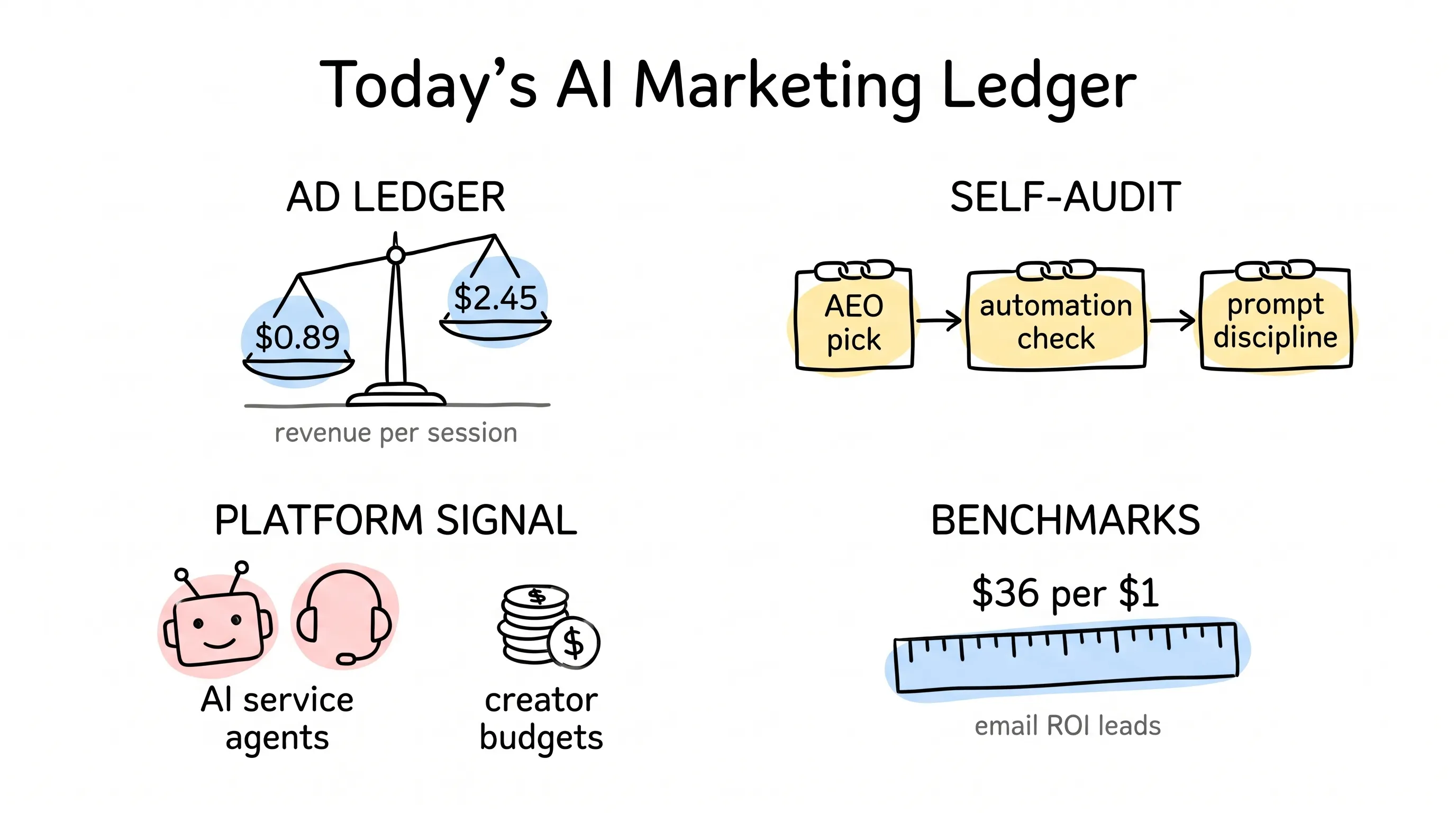
Today's throughline is running the real numbers on AI traffic and AI automation. A working paper from the Frankfurt School of Finance & Management and the Vienna University of Economics and Business takes nearly 10 billion visits of real transaction data and dissects ChatGPT advertising — and its conclusions land directly on ad budgets. On the tools front, an AEO (Answer Engine Optimization) monitoring comparison, a diagnosis of why automation fails, and a case for requirement discipline before prompting: three practical pieces that together amount to a self-audit workflow. Meta's CMO has said it himself that 2026 bets go on AI customer-service agents and creator budgets; the privacy-compliance side offers an executable three-part checklist; and the industry-data side has a 2026 benchmark reference frame. Read all eight items and you'll come away with a cooler-headed ledger for "where AI money should go, how much, and how to verify it." The one thing worth doing today is simple: pull the per-dollar output of each of your own channels and line it up against these benchmarks.
🎯 Today's Headline
Tested on 1,898 E-commerce Sites: ChatGPT Ad Traffic Earns Only 36% of Google's Revenue per Session
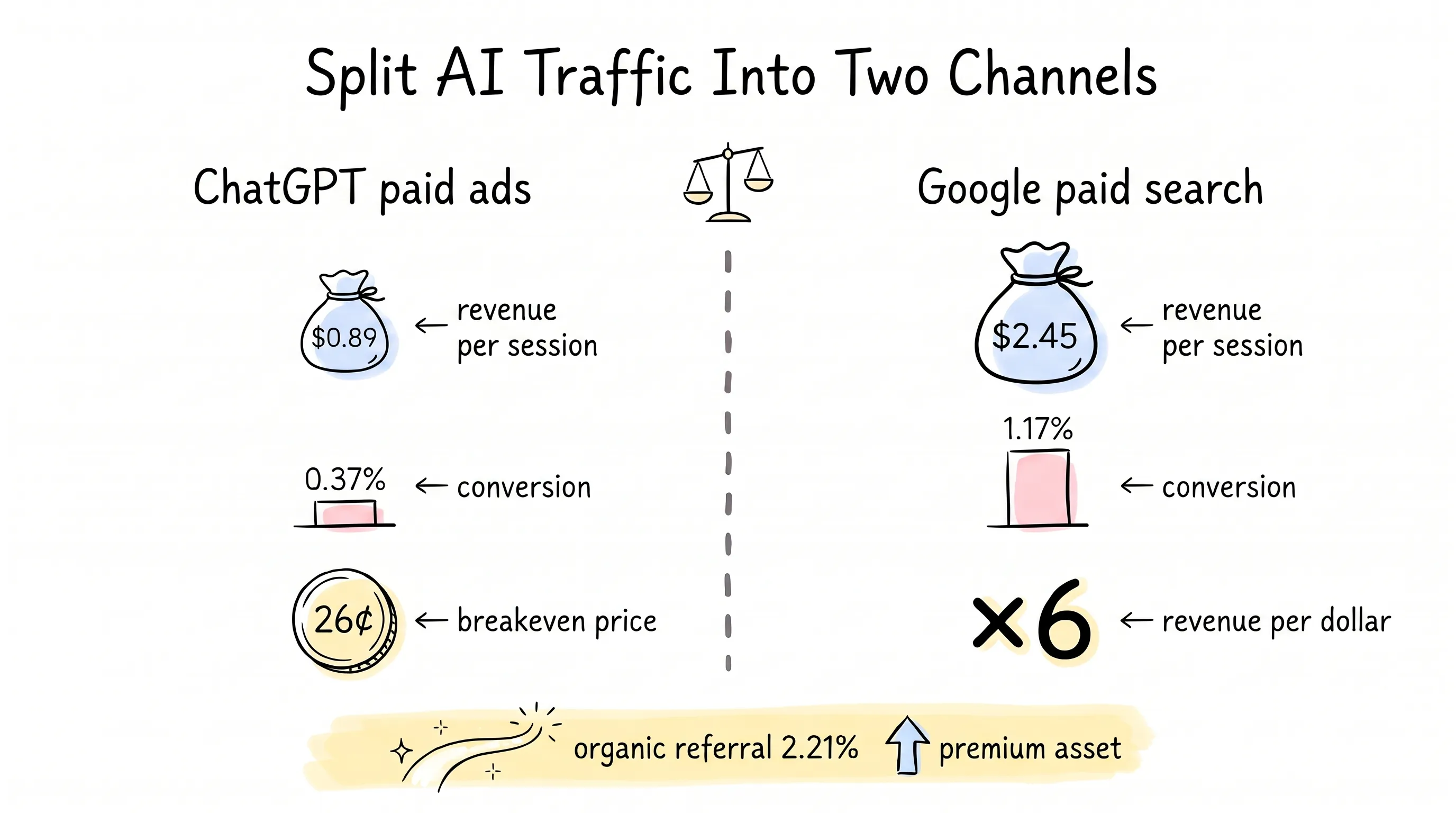
Researchers at the Frankfurt School of Finance & Management and the Vienna University of Economics and Business have published a working paper that uses 60 weeks of data (June 2025 through August 2026) to track 1,898 e-commerce sites, $16 billion in annual sales, and nearly 10 billion visits. The data shows ChatGPT paid ad traffic bringing $0.89 of revenue per session, against $2.45 for Google paid search; conversion rates of 0.37% on one side and 1.17% on the other. At public list prices, every dollar of ad spend on Google produces more than six times the revenue of a dollar spent on ChatGPT. Of 102 advertisers, 82 recorded not a single purchase on ChatGPT ads. Back-solving the numbers, the researchers find ChatGPT's click cost would have to fall to around 26 cents to break even with paid search — while the largest known actual price paid in their data was $1.72 per click.
Methodologically, the paper has a rarely seen design: ChatGPT launched ads in the US first and then expanded to eight other countries, while the EU never opened ads at all — so the entire EU became a natural control group. The paper is still under review and its conclusions should be read as early evidence, but the sample and design are of rare caliber among studies of this kind.
Why this matters. OpenAI's own claim is that ChatGPT Ads reached a $1 billion annualized revenue run rate within 200 days of launch. The paper's authors flag two things: first, that figure is an annualized run rate, not advertising revenue actually booked; second, OpenAI is a private company, and outsiders cannot verify it against public financials. The researchers' own estimate is that, at the current state, the ads business contributes only about $1 per free user per year, while serving a free user costs roughly $5. Set against OpenAI's 2030 target of $102 billion in ad revenue (roughly $40 per free user), that gap cannot be closed by signing more advertisers. The pace of advertiser inflow is startling, though: Adthena tracked brands advertising across the US, UK, Australia, and Europe rising from 1,082 in June to 6,333 in August, and New Street Research estimates advertisers had reached about 60,000 by early October, versus 20,000 at the end of August. Adoption is sprinting; return validation is standing still.
The more notable finding inside the paper is divergence. Within the same ChatGPT, paid placements convert at 0.37%, while organic referrals before the ads launched converted at 2.21% — a six-fold gap. Paid-placement visitors performed worse than Google Ads traffic, Google organic search, direct visits, and even ChatGPT's own free referrals. On the other side, Adobe Analytics data echoes this directionally: across US retail sites in September, organic traffic referred by AI earned 83% more revenue per visit than non-AI traffic, converted 90% better, kept visitors 73% longer, and drove 25% more pages viewed. The two datasets measure different things — one counts only paid ChatGPT visits, the other looks at AI referrals broadly — but they point to the same conclusion: the term "AI traffic" has to be split into two channels. Organic referral is a premium asset; paid placement is, for now, a weak channel.
Side effects are surfacing too. After the ads launched, ChatGPT's organic referrals to these e-commerce sites fell 6% to 8%. The initial estimate was a 5.9% decline over the first 13 weeks, not statistically significant; after the researchers adjusted for North American ChatGPT usage growing faster than Europe's, the decline range became 7.2% to 8.4%, statistically significant under those assumptions. Interestingly, ChatGPT's current ad design already keeps the sponsored slot outside the answer itself: free users see a card marked Sponsored below the shopping recommendations, not an ad inserted into the recommendation copy. The researchers believe OpenAI faces a dilemma — more precise targeting, or pushing ads into the answer itself, would make the inventory more valuable, but either would squeeze the product experience that generates organic referrals.
The impact on marketers lands on three roles. If you run media buying and your budget model already reserves a slot for ChatGPT Ads, recompute its revenue per dollar with attribution data now — don't take vendor adoption numbers as proof of return. If you run SEO and content: organic AI referral is your high-converting new channel, converting several times better than paid placement, and it deserves its own content and its own reporting as a separate channel. If you run data and attribution: in Digiday's coverage, Accuracast Group CEO Farhad Divecha says plainly that the platforms' attribution definitions don't line up — partly teething friction from new systems being wired in, and partly attribution itself being a mess — so pin down the definitions before any cross-channel comparison.
How to use it, in three steps. Step one: if you're already spending on ChatGPT Ads, pull a revenue report broken down by channel this week, compute your own revenue per session and conversion rate, and read them next to the paper's $0.89 and 0.37% — above benchmark, add budget; below, pull back. Step two: teams that haven't invested yet shouldn't rush in; use the researchers' 26-cent figure as a negotiation anchor, and if quotes come in near or above it, wait for inventory prices to fall. Step three: shift the energy to organic referrals — check how your product pages get described inside ChatGPT when purchase questions come up, and fill in your structured data and review content. That channel converts at 2.21% right now, and it's free.
My judgment: the paper is still under review and the numbers will get revised, but the direction is clear enough. OpenAI's commercial story currently has adoption speed running ahead of return validation — the same shape as the early days of every new ad channel in history. For advertisers, the right posture now is small positions, verified against your own transaction data, while nurturing free organic referrals as a real asset. Waiting for the day prices fall to parity before talking scale is nothing to be ashamed of.
🔗 Further reading: Read the full article
🏷 Marketing Tools
Scrunch vs. Ahrefs: How to Pick an AEO Monitoring Tool, Broken Down Across Seven Dimensions
HubSpot updated this AEO tool comparison on November 6. The underlying question is: buy a dedicated tool, or add AI monitoring to the SEO suite you already run? Scrunch is Sitecore's Agent Experience Platform, and its differentiation is the ability to identify AI crawlers — ChatGPT, Claude, Perplexity, and others — at the edge, then serve them a structured version of the page with leaner tokens while human visitors see the site as usual; the vendor claims page tokens shrink by about 26%. On pricing, the Core tier runs $250 a month and includes 125 tracked prompts and 4 large models; Enterprise expands to 9. Ahrefs Brand Radar takes the other road, bolting AI brand monitoring and citation tracking onto its existing SEO suite, resting on a database of more than 406 million monthly prompts from real user searches; every paid tier covers the seven major platforms, from Google AI Overviews and AI Mode to ChatGPT, Perplexity, Copilot, Gemini, and Grok, plus YouTube, Reddit, and TikTok (beta) tracking. Bundled, it starts at $129 a month; standalone, $398 a month. The background data comes from Pew: in March 2025, 18% of Google searches produced an AI summary, and when one appeared, users clicked fewer links and ended their sessions earlier. The article breaks the field down item by item across seven dimensions — engine coverage, prompt methodology, citation reporting, actionability, integrations, pricing, and team fit — and honestly discloses that HubSpot itself sells AEO products.
On prompt methodology, the two take different approaches. Ahrefs' prompt library comes from real user search behavior, so prompts can be tied to real search demand for prioritization, and custom brand-specific prompts are supported. Scrunch uses AI Search Trends to estimate prompt volume and surface emerging topics and content gaps, plus a Query Fan-out analysis showing which related searches an engine expands a single raw query into. The article cautions that any tool is only sampling a slice of your buyers' questions, and AI answers fluctuate by session, geography, and phrasing — so read the numbers as trends; what matters is the direction of movement for the same set of prompts tracked over time. Citation-quality verification gets called out separately: for each tracked prompt, record which domains and pages the engine cited and whether your own pages showed up, and require the vendor to show citation detail down to URL level — a tool that only reports "you were cited" without the pages is an order of magnitude less actionable. On the execution side, the division of labor is: Scrunch works the bot end, with Agent Traffic analysis separating human visits from AI bot visits and Site Maps doing page-level audits; Ahrefs works the SEO-workflow end, with Site Audit, Bot Analytics, IndexNow instant re-crawling, and AI Content Helper all plugging into existing habits. The article also offers a signal for when to pull PR into the game: if the citation data repeatedly shows engines citing review sites, trade media, and community posts, no amount of blogging on your own domain plugs that gap — go cultivate those third-party sources instead.
💬 How to use: If your team already lives in Ahrefs, turn on Brand Radar first. During Scrunch's seven-day trial, use 15 to 25 real buyer questions as your test set, covering the awareness, comparison, and purchase stages; run each one manually across the engines and check whether the brand mentions and citation sources the tool reports actually match — talk payment only once they do. Scrunch has a seven-day free trial and Ahrefs doesn't, so when you discuss a pilot, have sales put a proposal on the table. E-commerce teams should look hardest at Scrunch's product-level AI shopping visibility; content-driven teams at Ahrefs' YouTube and Reddit tracking. In monthly reviews, sort visibility gaps into three buckets — new pages, updating old pages, off-site opportunities — and hand them to the same people who own SEO briefs today. Before you act, pull the citation URLs for your five highest-value prompts and confirm two or three of them are third-party sources; only then decide between content and PR. That step is what gets a limited quarterly budget spent in the right place.
🔗 Further reading: Read the full article
When Marketing Automation Fails, the Root Cause Isn't the Tool: A Seven-Barrier Self-Check List
A diagnostic guide updated by HubSpot on November 6, citing the company's own 2026 State of Marketing report: 86.4% of marketing teams have already applied AI somewhere in their workflow, yet 33% still rank measuring ROI as their biggest challenge. The article's argument is that automation failures are rarely tool problems — the roots are unclear strategy, dirty data, sales-and-marketing misalignment, and tool silos, and the automation platform merely executes those pre-existing problems faster and at larger scale. The symptom list is concrete: every contact, regardless of lifecycle stage, flows into the same nurture stream; workflows have accumulated for years and nobody remembers why they exist or whether they should be switched off; campaign counts keep climbing while conversion rates don't move. The fix framework asks four questions. Why — which business metric is this automation supposed to move? Who — is the segmentation clearly aligned (93.2% of marketers believe personalized segmentation brings more leads and purchases)? How — are entry, exit, and suppression conditions complete? Most automation runaway incidents are exactly missing exit conditions. Owner — every automation needs a named person accountable for its performance and maintenance. The new item for 2026 is drawing lines in advance: specify which decisions AI agents may make autonomously and which must stay with humans. The article stresses one shift: traditional rule-based workflows only execute preset steps, while today's AI agents can research, draft, and decide the next action on their own — reading context such as buyer behavior, personas, and funnel stage to pick the optimal move — and machines with that much authority need a real strategy underneath them. Among the typical incident patterns the article lists, the most common one: automation runaway is almost always a missing exit condition — the user stopped qualifying long ago but stays in the flow, getting touched again and again.
💬 How to use: Treat this piece as an audit checklist. This very week, sample five workflows that have run for six months with nobody touching them: either add exit conditions or take them offline — that move alone usually cuts wasted touches the same day. Assign an owner to every active automation and write it into the docs; review once a quarter. Split nurture streams by lifecycle stage into at least two tracks — new leads and existing customers should not hear the same script, and this one change usually lifts a stalled conversion rate. Before you switch on AI agents, hold a meeting and put in writing which decisions machines can make on their own and which require human sign-off; after the meeting, send that list to the whole team.
🔗 Further reading: Read the full article
Bad at Writing Prompts? The Problem Usually Sits Before the Prompt
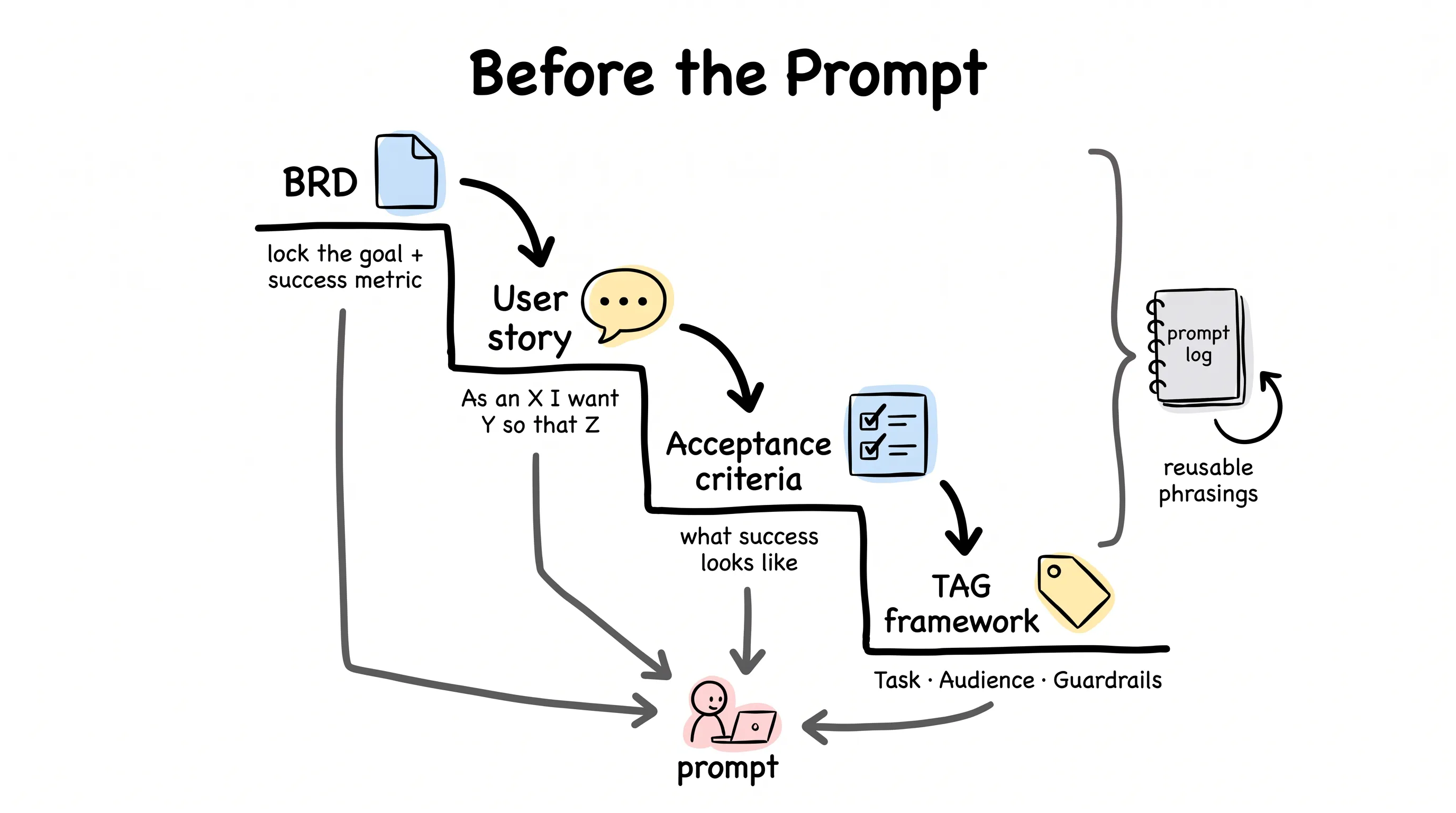
MarTech published this on November 6; the author is Steve Petersen, a marketing technology specialist at Wyndham Hotels & Resorts. The thesis fits in one sentence: AI lets marketers build software in minutes, and vibe coding generates fast — but fast generation is not the same as meeting business requirements, and endless prompt iteration burns time and AI credits. The article ports mature development practice into marketing contexts, tiered by task size. Big initiatives get a BRD (business requirements document) that locks in the overall goal and the metric that defines success, so downstream executors — programmers, designers, or vibe-coding marketers — have an alignment baseline when unforeseen detail questions come up. Day-to-day tasks get broken down into user stories, in the format "As an X I want Y so that Z" — for example: as a customer, I want the address field to auto-fill, so I don't have to type the full address every time. User stories then pair with acceptance criteria that pin down what success looks like; examples include auto-filling street, city, state, and ZIP when the field is selected, allowing free entry of unit numbers on address line two, and offering an option for addresses outside the US that don't auto-fill. At the instruction level, structure prompts with a prompt framework — the article cites TAG: Task, Audience, Guardrails. Finally, keep a prompt log that captures which phrasings produced good results and which to avoid; IT's security and reliability engineers can pre-write safety-related phrases for vibe coders to reuse. The author specifically warns that generating an entire site from a single prompt cannot guarantee the requirements are covered — break the work into small tasks and verify each one. The BRD's value also shows up at the splitting stage: when you cut a big initiative into task packages for different teams, without a vision document each team's slice drifts off on its own. User stories are the lightweight tool — changing the order of form fields doesn't need a BRD; one story plus acceptance criteria is enough. There's also an often-overlooked use for the prompt log: deposit the phrasings that safe, performant, sustainable code requires, pre-written by IT's security and reliability engineers, so vibe coders drop them straight into their prompts — professional judgment packaged as a reusable asset.
💬 How to use: One move you can make today: write acceptance criteria directly into your prompt template, and three fields suffice — who the user is, what they want, and what success looks like. On the team side, build a shared prompt log and archive effective phrasings by project; a month from now you'll have saved a large amount of repeat trial-and-error time, and AI credits too. Don't improvise safety-related phrasings yourself — pull in an IT colleague for half an hour to write a standard set into the log for the whole team to reuse. Don't generate big projects in one gulp: split into user stories first and verify each one, checking every task's output separately, so that when something breaks you can trace it to the specific requirement that never got covered.
🔗 Further reading: Read the full article
AI Customer Journey Mapping: Fill the Dark Social and Cross-Device Blind Spots First
The Smarketers' long read is about AI customer journey mapping. It first argues where traditional journey mapping is blind: third-party review sites (G2, Capterra, TrustPilot), dark social (shares inside WhatsApp and private messages), cross-device behavior, and voice assistants — touchpoints that standard analytics either record as direct traffic or miss entirely, and that UTM parameters can't catch. AI brings three layers of capability: recognizing behavior patterns invisible to the human eye, processing every touchpoint in real time, and predicting what a customer will do next. The implementation section proceeds step by step: a checklist of data sources to connect first — four silos of marketing automation, CRM, customer service, and product analytics that need to be wired together; tool selection by company size, with different viable routes for small and large enterprises; where the boundaries of data collection sit under privacy compliance; and realistic expectations for integration challenges and time to launch. The piece closes in the voice of counterintuitive findings, offering optimization directions: budget reallocation — move money away from over-credited channels toward the touchpoints actually carrying conversions; publish-timing optimization — adjust the schedule to the high-activity windows the AI model identifies; and attribution precision — fish dark-social and review-site contributions out of direct traffic and book them to the right account. Worth noting: this piece carries a lead-gen CTA, the title is exaggerated, some of the performance numbers have no cited source, and there is no publication date anywhere.
💬 How to use: Start with the part that costs nothing. Go through the last three months of customer-service records and sales notes, copy down customers' own accounts of "where I saw you," and reconcile them against your attribution reports — the gap is basically dark social and review sites. That exercise takes an afternoon; decide whether to buy tools afterward. If you do buy, first inventory your own data silos — which of CRM, customer service, and product analytics isn't connected — and fix the data before choosing a tool, otherwise the tool only sees a mutilated journey. Treat the article's unsourced performance numbers as directional reference; do not write them into the expectations you present upward.
🔗 Further reading: Read the full article
🏷 LLM Updates
Meta's CMO Sets the Tone Himself: 2026 Goes All-In on AI Service Agents, with Budgets Shifting Toward Creators
An 18-minute YouTube interview of Meta CMO Alex Schultz by Meta ads educator Ben Heath, whose team has deployed more than $300 million in ad spend; uploaded July 20, currently at 13.5K views. In the interview, Schultz gives two clear signals. First, his personal top priority for 2026 is Meta business agents — scaling up AI customer-service and sales agents; in his words, these AI investments have to become real things. Second, the creator strategy centers on getting existing advertisers to shift budget toward authentic creator content plus paid amplification, because he judges that structure's ROI to be better — adding that Google is seeing the same trend. Using creators as the hook for acquiring new advertisers, by contrast, is not his current focus. He wants teams to use Instagram Meta Marketplace to match advertisers with creators, and the selection criterion is genuine fit, not follower count: grabbing the biggest creator and then forcing their voice to fit the brand works far worse; picking creators whose content naturally matches the target audience and then buying amplification is what holds up. On acquisition logic he laid out the KX funnel, named after its co-designer Konstin Jin, who has since left the company; the path, designed in 2007, hasn't changed: first get a person using the product, then have them spontaneously use the product to run a business, and only then will they buy ads. Schultz said an advertiser who has never used the product is almost impossible to turn into a successful advertiser, so the path to new advertisers remains converting existing users into people who run a business on the product. Asked about timeless principles, he reached for Tesco's club-card database marketing: other loyalty cards discounted on the spot at the register, while Tesco's innovation was mailing discount coupons — which forced the company to obtain each customer's accurate, current address. So when a competitor opened in the same area and store traffic dipped, Tesco could fire coupons precisely at the customers who had just been poached, rather than spraying everywhere. The principle was true in 1990 and still holds in the 2020s: data accuracy determines targeting efficiency. As for the scale of Meta's own investment on the creator side, he gave one number: a thousand creators in deep partnership, including the eyewear product line and Instagram growth.
💬 How to use: Two executable signals. On the media-buying side, in your next test cycle put 20% of your budget into creator-native content with paid amplification behind it; choose well-matched small and mid-tier creators over top-tier ones, let them keep their authentic voice, and buy only the amplification placements. Validate with your own ROAS data, and scale up gradually if the numbers are good — Ben Heath's observation is that the best-performing ad in your account is quite possibly already creator content. On the product side, watch the rollout pace of Meta business agents; if your business lives on customer service and lead-conversion, it could change how you receive traffic, so think ahead about the handoff process from AI agent to human once a lead comes in. One caveat: this is a July interview — apply a 20% timeliness discount, but the directional signal is still worth it.
🔗 Further reading: Read the full article
🏷 Industry Data
2026 Digital Marketing Benchmarks: Email's $36 Return Leads the Field; 85% Can Be Automated but Only 6% Truly Deployed
BizIQ's 2026 compilation of digital marketing statistics, with a source cited on every item. The big-picture numbers: the global advertising market stands at $1.25 trillion, with digital at 69%; the digital marketing market is $786.2 billion, growing at a 15.4% compound annual rate to $1.16 trillion by 2030; US digital advertising in 2025 was $298 billion, the largest single market. In the channel ROI rankings, email marketing returns $36 for every $1 invested — first among all channels; 49% of marketers consider organic search the best-ROI channel; 27% of B2B marketers rank website and SEO first; the Google Ads benchmark is $8 returned per $1 spent; and 70% of B2B marketers believe SEO beats PPC over the long run. The omnichannel premium is obvious: multichannel brands retain 89% of customers, single-channel only 33% — a 2.7x gap. The AI execution gap is the most eye-catching set in the whole piece: 85% of digital marketing operations tasks can already be automated with AI, yet only 6% of marketers have AI fully embedded in their workflows. On budget structure, social takes 11.3%, content 10.2%, and paid search 9.8% — three nearly equal slices; mobile advertising is $400 billion, or 54% of digital advertising. Social platforms count 5.79 billion active users, and social ad spending will exceed $230 billion in 2026. On budget direction, 44% of companies are increasing digital ad budgets in 2026, and more than three-quarters of marketers intend to maintain or raise search and display spending; local small businesses typically put 5% to 10% of revenue into digital marketing, with large enterprises up to 14%; B2B organizations route 60% to 80% of budget into digital channels, B2C 40% to 60%. Another 40% of marketers rank proving campaign ROI as their number-one challenge — a figure that corroborates HubSpot's 33%. North America holds about 38.7% of the global digital marketing market.
💬 How to use: When you build next year's budget or report upward, this document is a ready-made benchmark reference — and when you cite it, carry the source along with the number; for instance, the 36x email return is Litmus's figure, so don't retell an aggregated number as if it were first-hand research. The 85%-versus-6% gap works as an urgency yardstick inside your team: how far is your team from full embedding — list the specific blockers. The 2.7x retention gap is the right piece of ammunition when you're arguing for omnichannel investment.
🔗 Further reading: Read the full article
🏷 Policy & Funding
The AI Ad Privacy Compliance Triple: Assessment, Transparency, Human Spot-Checks
Captain Compliance's guide to AI advertising privacy governance. It opens by setting the tone with the IAPP AI Governance Report 2025: 69% of marketers have already brought AI into operations, nearly 20% of enterprises are putting more than 40% of their budget into AI-driven campaigns, and 16% of enterprises use AI for personalization. The article splits AI advertising's privacy risks into three links along the data lifecycle: training data (the material fed to the models may itself contain personal information), real-time user interaction (the data chatbots and recommendation systems collect during sessions), and feedback loops (model outputs flowing back to influence subsequent collection). The countermeasures come in three groups. Data governance: run a privacy impact assessment (PIA) before launch, train on anonymized and aggregated data, stick to data minimization, and designate a privacy owner. Transparency and consent: disclose clearly that the user is interacting with AI, obtain informed consent, and provide an opt-out option. Human oversight: routinely audit model outputs with tools like TensorFlow Fairness Indicators and IBM AI Fairness 360, guard against hallucination and bias, and restrict high-risk use cases per the EU AI Act. The regulatory map covers GDPR, privacy laws in about 20 US states (Massachusetts and New York in progress), the Utah AI Policy Act, and the EU AI Act. The article's stance is to front-load compliance costs: a pre-launch PIA and anonymization work cost less than post-incident remediation. This is vendor educational content; the strategy section leans generic, and no publication date is given.
💬 How to use: Before you scale up AI-personalized targeting, have legal or your privacy lead run through a PIA covering three items: training-data sources, session-collected fields, and opt-out mechanisms. That exercise usually takes a few days and is far cheaper than a complaint after the fact. Keep a human spot-check over AI-generated targeting and creative: audit outputs monthly with fairness tooling, watching above all for systematic skew in what different demographic groups get targeted with. Wherever the front end touches an AI chat or an AI recommendation, complete the disclosure copy and the opt-out entry — of the three countermeasures this is the smallest change with the fastest payoff. For US operations, have legal clear the multi-state compliance list in one pass; don't wait for state laws to take effect one by one and patch them one by one.
🔗 Further reading: Read the full article
💡 Today's Big Picture
Put today's eight items side by side and the same crack keeps reappearing across different domains: an enormous time lag between adoption and verification. ChatGPT ads grew from 20,000 advertisers to 60,000 in two months, yet 82% of advertisers recorded zero purchases; 86.4% of teams have applied AI somewhere in their workflow, while 33% can't compute the ROI; 85% of operations tasks are automatable in theory, but only 6% are truly fully embedded. Three sets of numbers from three independent sources, all saying the same thing: this industry's AI adoption is running fast on the dashboard and hasn't yet balanced on the ledger.
The other recurring theme is splitting. AI traffic has to be split into organic referral and paid placement — the former converts at 2.21% but is getting more expensive, with referral volume down 6% to 8%; the latter converts at 0.37% and only pays off once prices fall to 26 cents. AEO monitoring has to be split into two different actions — rewriting what AI crawlers see, and monitoring whether your brand gets cited — the former is Scrunch's job, the latter Ahrefs'; settle which one you need before you pick a tool. Prompt capability has to be split into instruction technique and the requirement definition that comes before the prompt — the latter decides whether the former means anything at all. Whoever treats a big word as a single unit will get this year's books wrong.
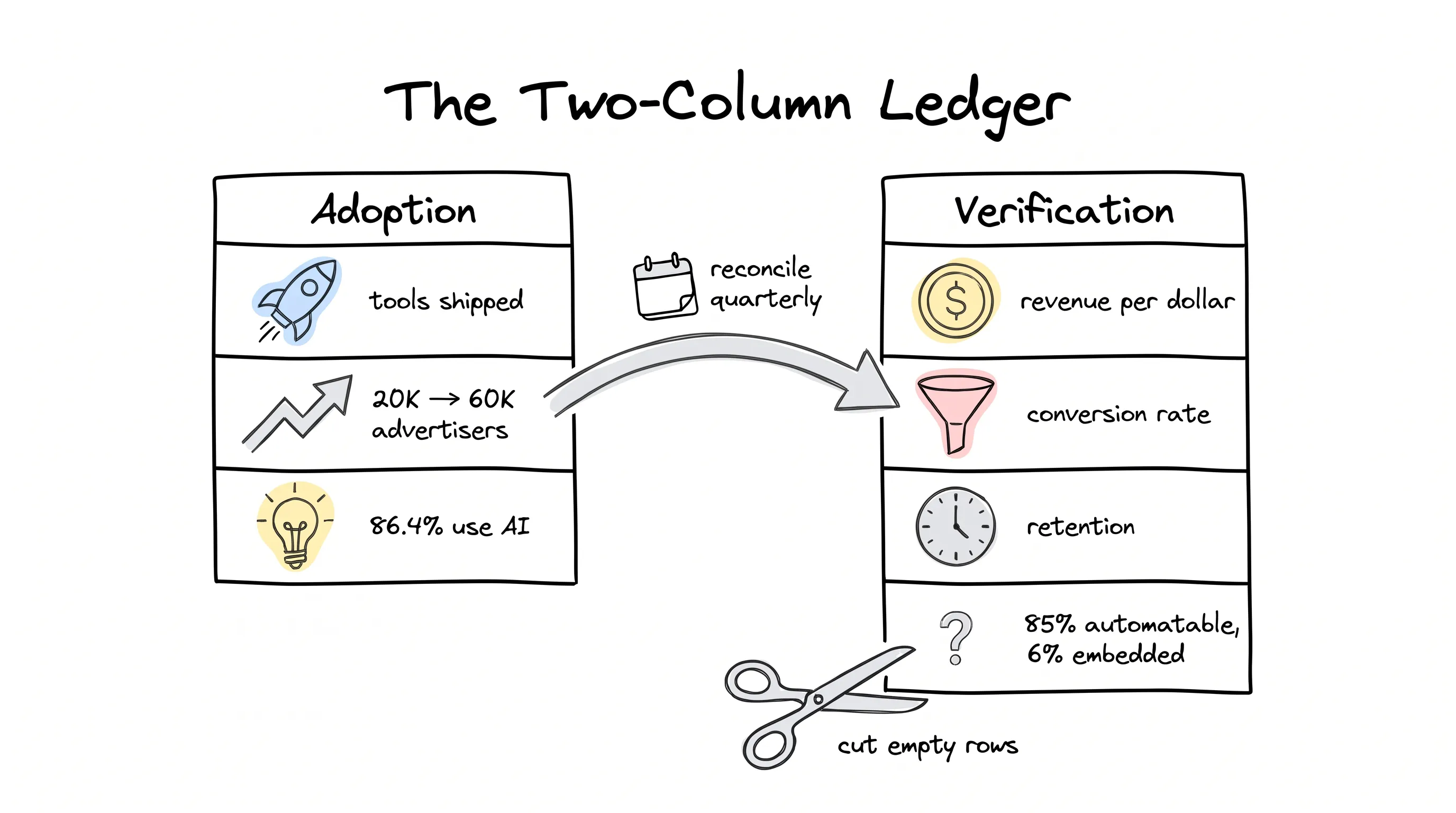
One reminder to close: among today's sources, HubSpot, Captain Compliance, The Smarketers, and BizIQ all have products of their own to sell, and Meta's signal comes from inside the platform itself. That doesn't make them unusable — it just means wringing them out first. The hardest piece of material today is in fact the academic working paper, the source with the least stake in the game. Operationally, the suggestion is that every team keep a two-column ledger: adoption metrics on the left (which tools went in, which channels got funded), verification metrics on the right (revenue per dollar, conversion rate, retention). Reconcile the two columns once a quarter, and any row whose right-hand column stays empty for long gets its budget cut back. In an era of verification gaps, the list of source motives belongs right next to the report.
Continue reading
Related articles
AI Marketing Daily · 2026-11-22
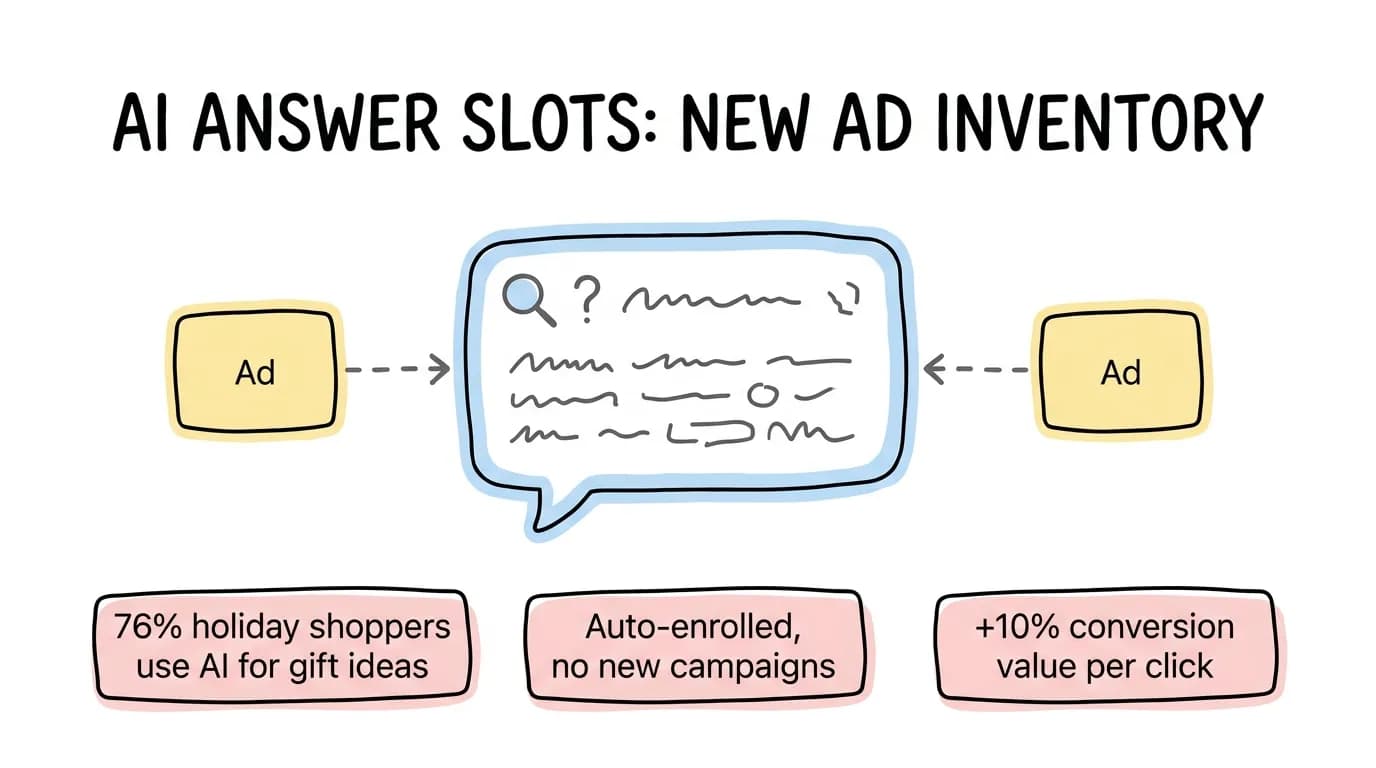
AI Marketing Daily for 2026-11-22 rounds up 20 items led by Microsoft opening Bing AI Overviews to ads and Google expanding AI Mode ads to ten countries, plus GEO guides, ad automation delegation guidance, AI Overviews CTR data, and a legal-risk checklist for AI-generated creative.
AI Marketing Daily · 2026-11-21
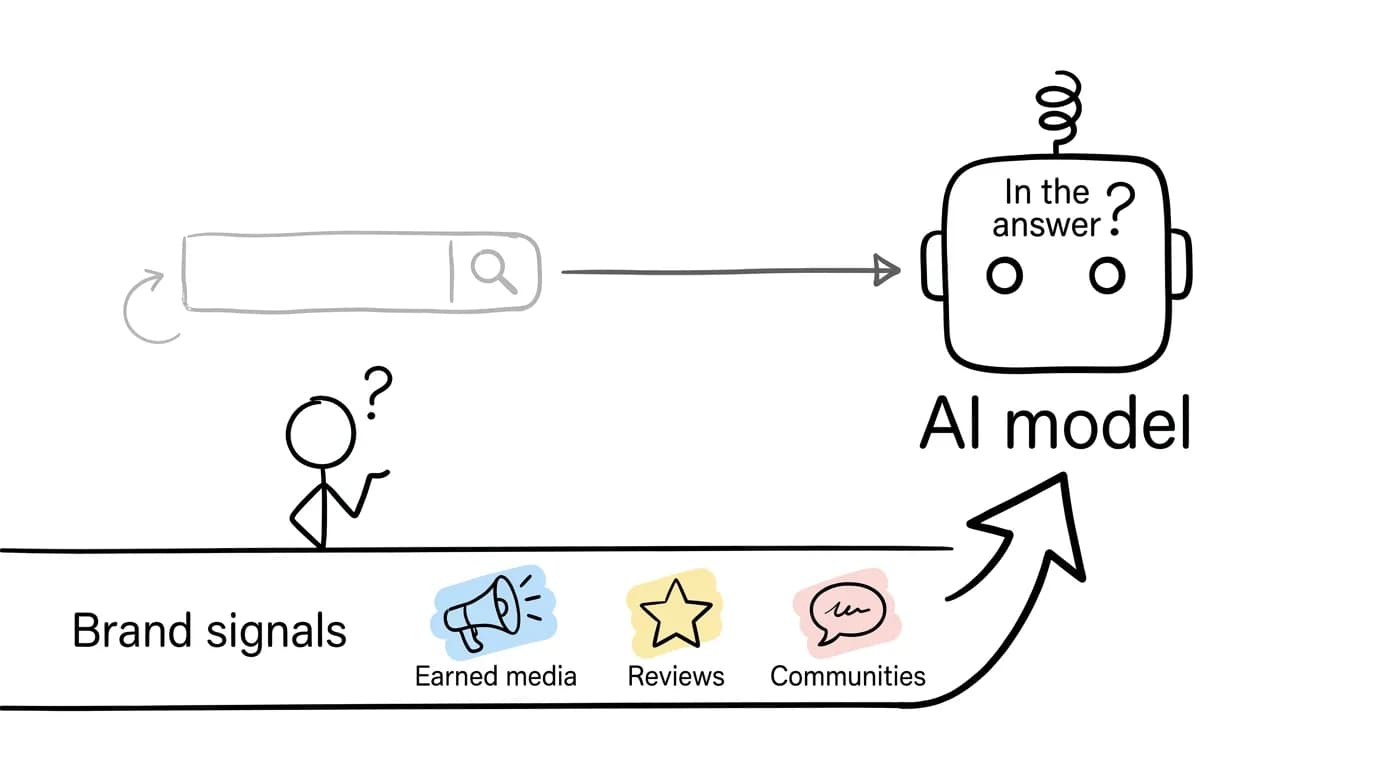
A November 21, 2026 AI-marketing daily covering AI search visibility, GEO methods, Google AI Mode ads expanding to ten countries, Meta's pre-Black Friday changes, agentic shopping, and industry adoption and ROI data.
AI Marketing Daily · 2026-11-20
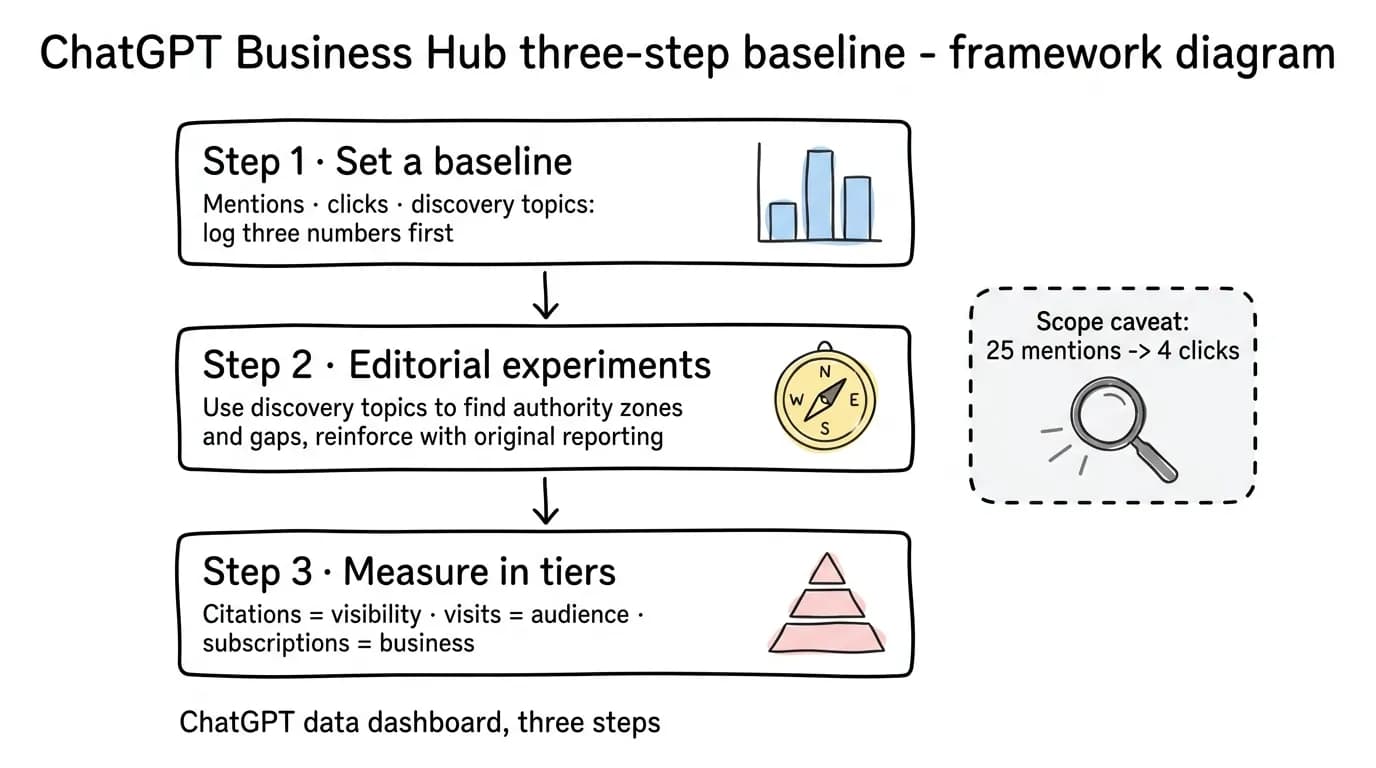
AI Marketing Daily for 2026-11-20 rounds up 19 items centered on measurement: OpenAI's ChatGPT Business Hub dashboard, EU rules for agent-mediated purchasing, Meta pausing four AI terms, and B2B data on shortlists and the dark funnel, each with action advice.