
Why ChatGPT's Paid Traffic Is Worth Far Less Than Google's
An analysis of a study comparing ChatGPT paid ads with Google search ads, covering revenue per visit, conversion rates, and the gap between paid AI traffic and organic AI recommendations.
I recently came across a study that upended a few of my assumptions.
The narrative we've heard most this past year goes like this: AI is rewriting the entry points to the internet, and whoever owns the AI entry point takes Google's business. The moment ChatGPT opened ad slots, advertisers flocked in. OpenAI even announced that less than 200 days after its ad business launched, it had hit a $1 billion annualized run rate.
Sounded like the gold rush was on.
Then someone ran the numbers. I stared at them for a long while.
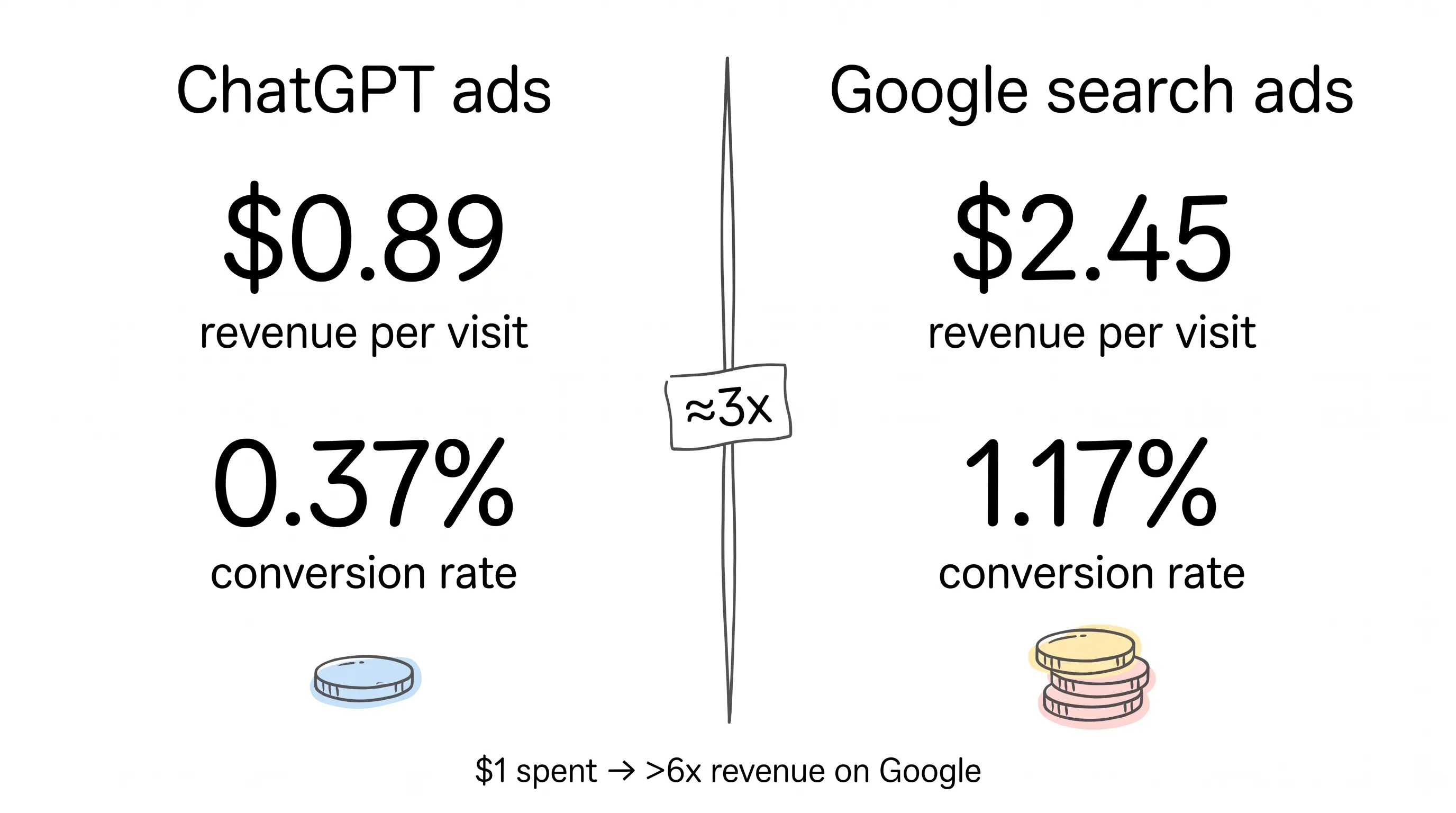
Here's the headline: traffic bought on ChatGPT generates an average of just $0.89 in revenue per visit; on Google search ads, the same figure is $2.45.
Nearly a threefold gap.
And it doesn't stop there. On conversion: 0.37% of visitors from ChatGPT ads end up buying; for Google search ads, it's 1.17%. Do the math, and a dollar of ad spend on Google brings back more than six times the revenue it does on ChatGPT.
What does it look like when traffic isn't worth paying for? This.
The study comes from researchers at Frankfurt School of Finance & Management and the Vienna University of Economics and Business. The paper is still under peer review, so treat it as early evidence, not a final verdict. But the sample is substantial: 1,898 e-commerce sites, $16 billion in annual sales, nearly 10 billion visits, observed continuously from June 2025 through August 2026 — sixty full weeks. ChatGPT rolled out ads in the US and eight other countries while the EU never got them, which made the EU a ready-made control group.
The most brutal number: of the 102 advertisers in the study, 82% hadn't closed a single order from their ChatGPT ads.
Why Such a Huge Gap?
Think about it. One person opens Google and types "best running shoes price comparison" — they're one step from pulling out their wallet. Another asks ChatGPT "I want to start running, any advice?" — they're still doing homework.
Two clicks that look the same: one is the final shot on goal, the other is the opening kickoff.
The researchers' math backs this up: a ChatGPT click would have to fall to around 26 cents for the return to break even with Google search. And the largest known account in their data was paying $1.72 per click.
At public list prices, every dollar of Google search ad spend returns more than six times the revenue of a dollar spent on ChatGPT.
The More Interesting Story: ChatGPT's Own "Organic Recommendations"
In this study, one and the same ChatGPT split into two entirely different channels.
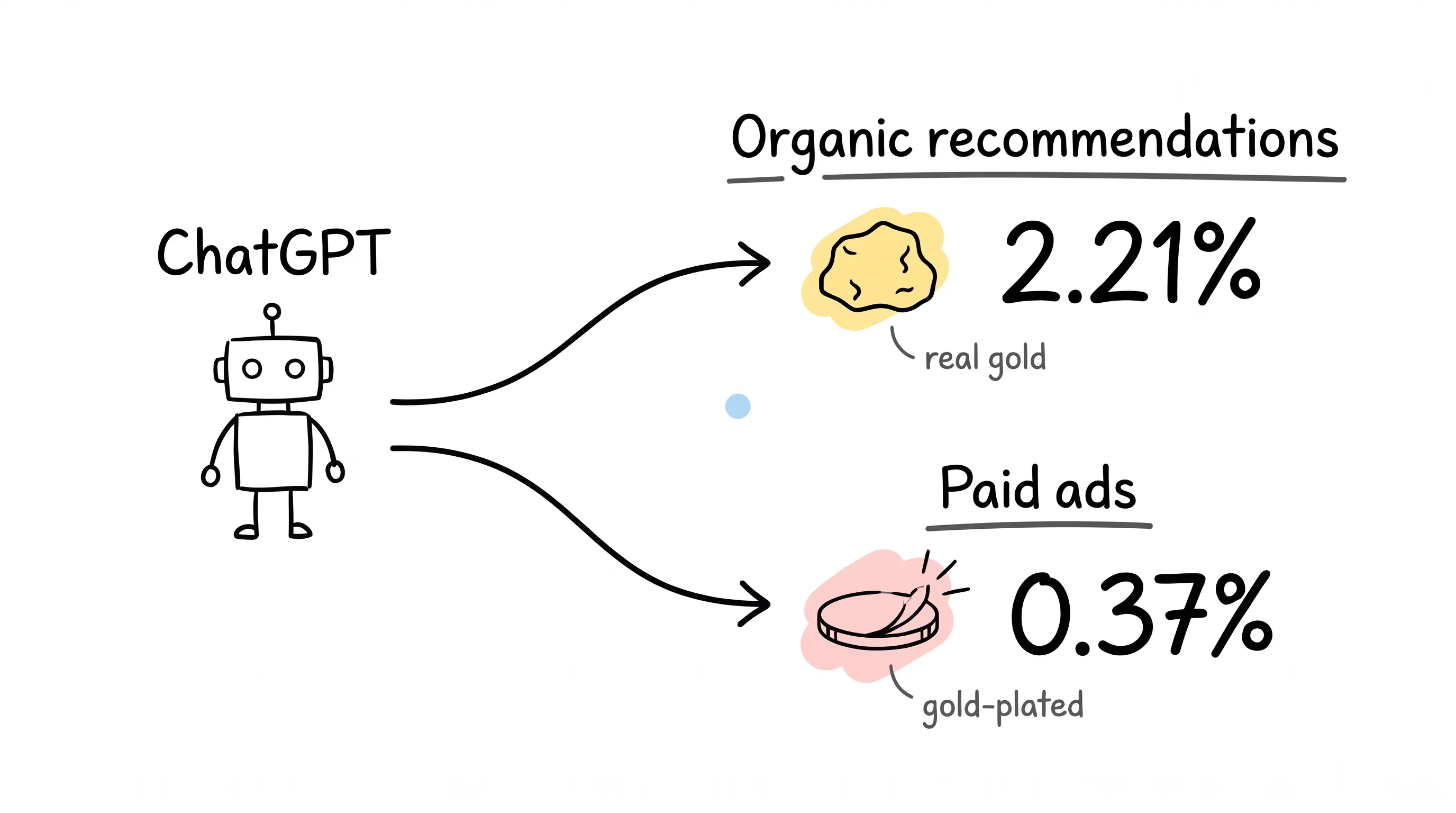
Visitors who arrived through ChatGPT's organic recommendations — no ads involved — converted at 2.21%. That's far above ChatGPT's own paid traffic, and even higher than Google ads.
Adobe's data twisted the knife: on US retail sites, visitors referred by AI generate 83% more revenue per visit than other traffic, stay 73% longer, and view 25% more pages.
So the question was never "AI traffic doesn't work." The AI traffic you pay for and the recommendations AI gives freely are two different animals. Merge them into one channel and you can't see anything clearly.
But the Real Trouble Is Here
After the ads launched, the organic visitors ChatGPT sent to these e-commerce sites dropped by 6% to 8%. And the conversion rate of those organic visitors barely moved.
Keep in mind that ChatGPT's current ads are actually fairly restrained: a card labeled "Sponsored," placed below the shopping suggestions, not inserted into the answer itself.
Even with that, the organic recommendations were the first thing to take a hit.
The researchers also found that the initial estimate of the decline was 5.9%, not statistically significant; after correcting for the fact that ChatGPT usage grew faster in North America than in Europe, the decline landed between 7.2% and 8.4% — and became significant.
Let's Run OpenAI's Numbers
Right now, its ads bring in about $1 per free user per year. But serving that free user costs roughly $5 a year.
More advertisers, more clicks — none of it fills that hole. Unless every click becomes worth more.
How do you make a click worth more? Sharper targeting, or pushing ads deeper into the answer itself.
But that would crush the very experience that's producing the organic recommendations. The more valuable the ads, the more the product suffers; the more the product suffers, the less organic traffic; and the less organic traffic, what exactly are the ads worth then?
Is this a knot that can't be untied? I don't know. But no one has an answer yet.
Before You Trust the Big Numbers, Add a Question Mark
OpenAI says the "search-like" queries ChatGPT handles are roughly 20% of Google's. Sounds like a lot. But it hasn't published the underlying volume or explained how it's counted, so there's no clean comparison against Google. Third-party estimates are far more conservative: the SEO tool vendor SEOClarity puts it at around 7.5%, which works out to about 375 billion queries a year.
And that $1 billion? Careful — it's an "annualized run rate," meaning "if today's pace held for a full year," not $1 billion in cash already collected. OpenAI is a private company with no public financials, so the number can't be independently verified.
Looking further ahead, OpenAI's working assumption is that ad revenue reaches $102 billion by 2030. Spread evenly, that means every free user would need to contribute $40 a year.
Today, it's $1.
From 1 to 40 — on the back of what? On every click being worth far more than it is today. And clicks are precisely the weakest link right now.
Advertisers Are Pouring In; the Evidence Hasn't Caught Up
Advertisers really are flooding in. Ad intelligence firm Adthena counted 1,082 brands running ChatGPT ads across the US, UK, Australia, and the EU in June 2026, rising to 3,741 in July and 6,333 in August. By early October, research firm New Street Research estimated around 60,000 advertisers — up from just 20,000 at the end of August.
The categories are spreading too. Sensor Tower data shows retail's share of US ChatGPT ad spend fell from 38% in April to 20% in September; software rose from 13% to 18%, financial services from 2% to 13%, and travel from 5% to 9%.
But headcount is headcount, and returns are returns. These numbers prove people are entering the arena — not that anyone is making money.
Attribution is another murky ledger. The head of the ad agency Accuracast has pointed out that ChatGPT's conversion data never quite reconciles with advertisers' own systems — partly teething troubles from integration, and partly because attribution itself has been scrambled.
Finally, Back to the Opening Question
Is AI traffic a gold mine?
Yes. But it's two kinds of mine: AI's organic recommendations, converting at 2.21%, are real gold; ChatGPT's paid placements, converting at 0.37%, are still gold-plated.
OpenAI holds a massive, nearly free gateway in its hands — but every path to turning that gateway into money walks over the product experience. This may be one of the most tangled business dilemmas of the moment.
The day I finished reading the study, one line surfaced in my head:
Every gift of traffic came with a price tag hidden in the fine print.
Here's hoping OpenAI soon finds the answer that doesn't dirty the answer. And here's hoping every dollar of your ad spend is money spent with your eyes open.
Continue reading
Related articles

What Is GEO? How Your Brand Gets "Mentioned" in the Age of AI Search
An explainer on GEO (Generative Engine Optimization) for e-commerce and DTC brands: how it differs from SEO and AEO, why AI answers shape brand visibility, and eight practices covering question-focused content, consistent brand messaging, structured pages, external evidence, comparisons, and AI mention tracking.

AI Is Already Making Decisions for Your Customers. Are You on the List?
A learn article explains GEO (Generative Engine Optimization): why AI-generated answers now shape which brands customers see, and how SEO fundamentals, entity clarity, citable evidence, and monthly measurement affect visibility in AI answers.

Google Is Stuffing Ads Into AI Search: These Recent Stories Are Really One Story
A news roundup linking recent AI marketing stories—Google adding ads to AI Mode, Amazon's Ads Agent, ChatGPT image updates, a UK startup tracking brand mentions in AI answers, and an AI ransomware warning—arguing that control over ad data and visibility is shifting toward platforms.