
Marketing Automation Stalling Out? The Root Cause Usually Isn't the Machine
A learn article argues that most marketing automation failures stem from strategy, data quality, team alignment, and measurement gaps rather than the tools themselves, and outlines seven common traps with fixes.
A while back, an old friend of mine in B2B texted me in the middle of the night.
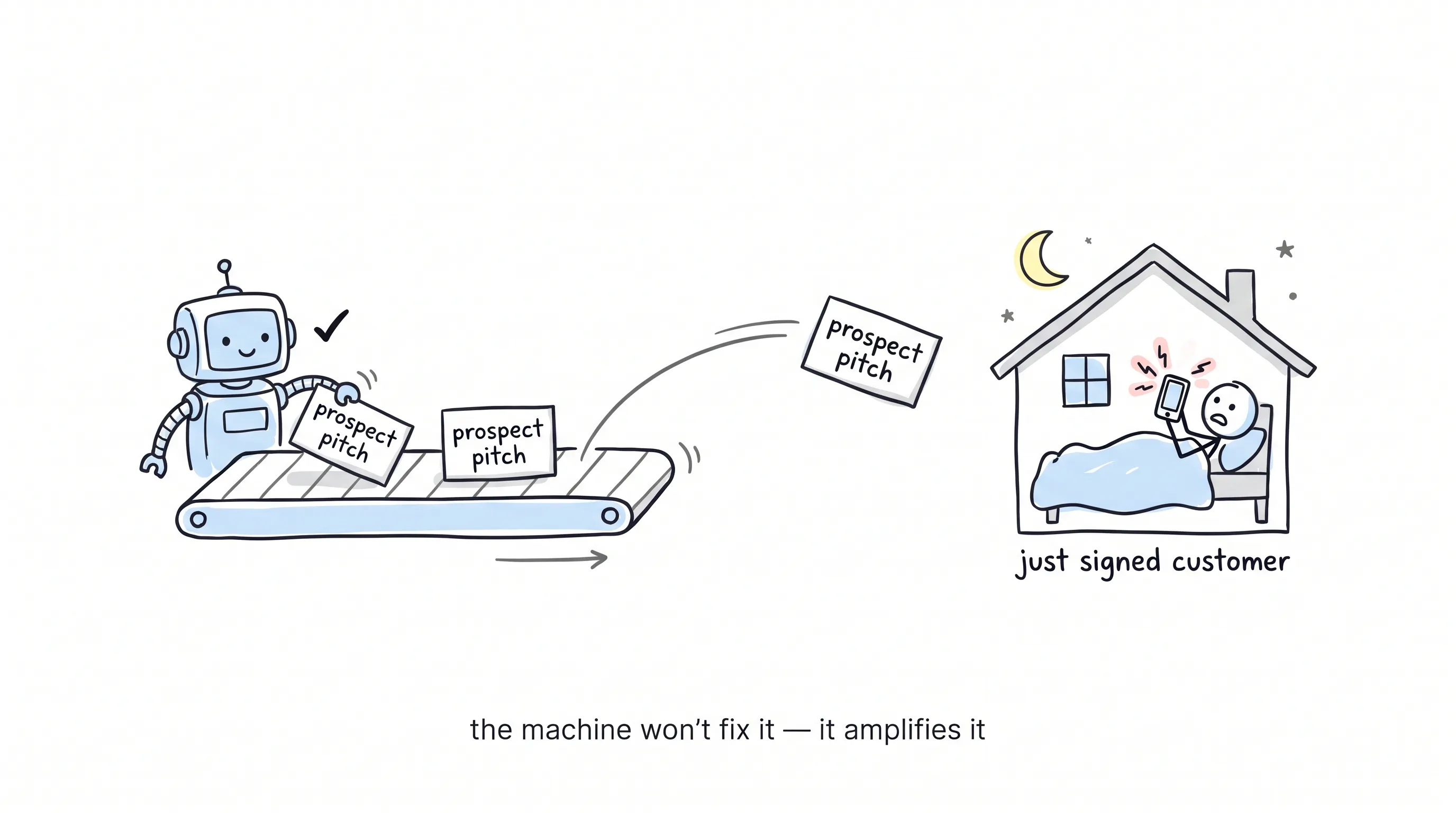
His marketing automation system had sent a promotional email to a major customer they had just signed. The money was already paid, and his system was still running the "prospect" playbook, nurturing them like a stranger.
He asked me: did I buy the wrong tool? Should I swap it out for another one?
I got into their backend the next day — and had to laugh.
The tool was fine. The people were the problem.
This one is painfully typical. HubSpot's State of Marketing 2026 report has a number on it: 86.4% of marketing teams are already using AI in their workflows. Yet the challenge at the top of their list is still "we can't measure ROI," picked by 33% of marketers.
Look at that: more machines, murkier math.
Why?
Because the vast majority of marketing automation problems aren't automation problems at all. They're problems of fuzzy strategy, dirty data, fragmented tools, and teams out of sync. The automation platform just executes those old diseases faster, and at scale.
The machine won't correct your mistakes. It will amplify them tenfold.
I've grouped the traps I've watched teams fall into over the years into seven. One at a time.
Trap No. 1: Hitting "Automate" Before Thinking It Through
What does automation without strategy look like?
It looks like nobody ever answered four questions: why are we doing this, who is it for, when does it stop, and who's accountable when something goes wrong.
The symptoms are easy to spot.
Every contact, whatever their stage, whatever their fit, gets funneled into the same nurture track. Workflows pile up year after year; nobody remembers why they were built, and nobody dares to switch them off. Activity volume keeps climbing while conversion rates don't budge.
These aren't technical glitches. They're strategic diseases.
And the disease has mutated. Workflows used to be rule engines: you wrote the steps, it followed them. Today's AI agents are different — they can research, draft, and make decisions on their own. A machine that makes its own decisions, with no strategy behind it, isn't efficiency. It's streaking.
So before you touch anything, write down four things.
Why you're doing it: every automation should map to a business metric — revenue, efficiency, whatever. While you're at it, decide what you're deliberately not automating.
Who it's for: 93.2% of marketers say personalized, segmented experiences generate more leads and deals. But personalization only works on top of clearly defined segments.
When it stops: who enters, under what conditions they exit, and who must never be swept in. In every "automation gone rogue" incident I've seen, nine times out of ten there were no exit criteria.
Who owns it: every automation needs a named human being accountable for it.
Trap No. 2: The Fuel Is Dirty
An automation platform is like a nice car. CRM data is the fuel.
Put water in the fuel, and the better the car, the faster it breaks down.
Duplicate contacts trigger duplicate email sequences. Stale job titles route leads to the wrong salesperson. A missing lifecycle field turns loyal customers into "new prospects" to be nurtured all over again. Every one of these is a high-severity incident.
HubSpot's report has another number: only 65% of marketers believe they have high-quality data on their target audience. That figure barely moved over the past year — while AI adoption kept climbing.
The foundation never moved; the tower just kept getting taller.
And these days, "clean" isn't enough — the data has to be "complete." A B2B database that can actually carry revenue needs at least five kinds of signals: demographic attributes, firmographics, technographics, event signals like funding rounds, acquisitions, and executive changes, and intent signals.
The typical team's failure mode: collecting everything, merging nothing. Signals sit scattered across five tools, and what sales ends up with still can't be stitched back into one whole person. Layer on natural decay — people change jobs, companies get acquired — and the automation starts snapping, link by link.
AI raises the stakes again. Scoring models, routing logic, agent research — all of it reads CRM data as fact. Feed it wrong data, and the machine will be wrong a thousand times, at scale.
So what do you do? Clean first, automate second. I usually recommend three steps.
Step one: audit. How many duplicates, how many missing key fields, how many stale records — quantify it first, and define what "clean" means for this database.
Step two: clean along five dimensions. Accurate (the data reflects today, not last quarter). Fresh (refreshed on a schedule). Complete (fill in the fields your automations actually read — and don't assume fields no workflow reads don't matter; agents read them). Consistent (one industry dropdown, one job-title format, one definition of lifecycle stage). Deduplicated (decide once which record survives, then let the tools merge automatically).
Step three: continuous governance. Data keeps aging; someone has to keep watching quality. Let AI agents do the heavy lifting, with humans approving at the end.
I worked with a B2B tech company whose approach I loved: they built governance directly into the automation. Layered filters, compliance exclusions, and suppression rules formed a "not allowed to automate" gate. Records that didn't meet the data bar never even got into the engine.
And an even easier move: gate the front door. Required form fields, validation on list uploads — keep the dirty data out in the first place.
Don't build one automation whose only job is cleaning up after another.
Trap No. 3: Two Teams, Two Languages
When marketing and sales aren't in sync, money leaks out through the seam of every handoff.
HubSpot's data says 27.6% of marketers rank "cross-team misalignment" as their top challenge. A DemandGen report puts it more starkly: 67% of B2B buyers say inconsistent messaging from a vendor directly kills their interest.
The misalignment is usually planted two steps before the handoff.
First spot: how you define the target. Marketing builds segments around personas and industries; sales works off a named-account list. So automation lovingly nurtures the very accounts sales will never touch. Meanwhile the buying committee sales actually needs — a whole group deciding together, not one person — never gets mapped by anyone.
Second spot: what each team is measured on. Marketing carries lead volume; sales carries pipeline. Two teams automating toward numbers the other side doesn't count.
The fix? Sign an SLA, and turn the handoff into a written commitment.
What counts as a marketing-qualified lead (MQL), what counts as sales-accepted (SQL), how rejection reasons flow back; who claims which leads; how fast a response is required; and the recycling loop — leads sales says "not right now" on go back into nurture with a reason attached, instead of getting thrown away.
An example. I helped a supply-chain tech startup rebuild its demand engine: the system watched customer signals — website visits, intent spikes, executive changes, funding events — and pushed an alert to sales the moment anything moved. But every alert had to carry four things: who owns it, how fast to respond (one hour for VIP accounts, four for everyone else), what criteria to qualify against, and what to do next.
Who, why, what, by when.
Add a shared real-time view on top, and nobody can claim they didn't see it.
Trap No. 4: Tools That Don't Talk to Each Other
Email lives on one platform, intent data on another, the CRM on a third.
Every one of those seams is a place where the customer record starts to drift.
The result is absurd: marketing sees an engaged, red-hot lead; sales opens the system and sees a blank record.
Many teams' first reaction is to buy another tool to patch the hole. My observation is the opposite — that usually digs the hole deeper. More glue, more export-import cycles, more latency, more human error.
The real question to ask: is every layer plugged into the same customer spine, or just sitting alongside it?
Two tests, and you have to pass both.
The speed test: from signal captured, to CRM, to routing triggered — that should be measured in minutes, not hours.
The orchestration test: cross-channel pacing and suppression logic should behave like a conductor, not like every channel firing its own cannon.
One customer, one record. Every tool reads and writes to it — nobody keeps their own copy.
Trap No. 5: Automation With No Sense of Propriety
When does automation start hurting the customer experience? When its timing, its tone, and its choice of channel make the person on the other end feel like they're talking to a machine.
It looks like this: emails firing at the wrong lifecycle moment; personalization tokens flying everywhere without a single line that's actually about you; the same message carpet-bombing three channels in one day; a customer says "not right now" and the sequence keeps selling.
The root cause is a division of labor done wrong. Automation is built for high-frequency, repetitive, low-judgment work — data cleaning, routing, reporting, reminders. It is not built to make the judgment calls that shape how customers feel.
The teams that get this right don't pick between humans and AI. They draw a clean line.
Always-on work goes to AI: scoring, customer research, signal-watching, routine follow-ups.
Trust-critical moments get a human checkpoint: the first outbound call, pricing, deals mid-negotiation — all of it passes through human eyes.
AI drafts need real context: a draft written from actual signals, CRM history, and customer research reads like it knows you. A draft made from a template and token-swapping reads like a mass blast.
Relevance beats personalization.
Someone made this point in Marketing in the Age of Answer Engines: as buyers increasingly encounter a brand through AI summaries and answer engines, a real human voice becomes precisely the source of trust.
That supply-chain company did it the same way. Signals and AI handled the always-on work, but no outbound message left the building without a named salesperson's sign-off.
The result? The AI did the work of two or three junior SDRs. And every message a customer saw carried human judgment.
Machines do the grunt work; people make the calls. That's the right ratio.
Trap No. 6: Automation Never Asks Twice
Automation's defining trait is that it executes at scale and never asks permission.
So compliance can't rely on people remembering. It has to be welded into the workflow.
Suppression lists as a workflow step: subscription status, do-not-send flags, internal exclusion lists — checked once at form submission, checked again before every send, all consolidated in one master list.
Consent records with source and timestamp, stored on the contact record, readable by every tool.
AI too. The agents doing research and data enrichment must follow the same suppression and consent rules as email. Don't let a research agent cross a line the sending system wouldn't dare cross.
Deletions must propagate. A GDPR deletion request executed in the CRM has to travel with the data into the warehouse.
And finally, this needs a named owner. Usually marketing ops or RevOps holds the line, legal and privacy teams set the policy, and everyone reviews it quarterly.
Compliance with no owner is compliance you don't have.
Trap No. 7: Not Keeping Score
33% of marketers rank "can't measure ROI" as their top challenge. It's first on the whole challenge list, and it's the most ironic one — automation works on precisely the quantifiable things, yet can't do the math on itself.
The problem is keeping only one ledger. You need two.
The first is the outcomes ledger: did automation actually move revenue? Stage-by-stage conversion rates, one by one; pipeline influenced and generated by automation journeys; and cost per result — plenty of AI features are billed by credits now, and that bill is getting harder to dodge.
The second is the system-health ledger: is the machinery itself running well? How long from trigger to first action; which signal types have the highest response and meeting rates, and deserve more investment; how the downstream pipeline quality of automation-sourced leads compares to other sources; and the workflows' own error rates, missed suppressions, and freshly minted duplicate records.
Hold on to this: operational metrics are leading indicators — the moment the system gets better, they move first.
The prerequisite: automation data and revenue data have to live in the same place. Only when every workflow action lands on the same record can the two ledgers be merged into one report.
In a recent project of mine, we launched an AI reception agent and cut average response time from 3.4 days to under 4 hours. The same measurement layer also tracks response rates by signal type, so the team always knows where to point the outbound firepower next.
Finally
These seven traps don't fail alone. They chain-react.
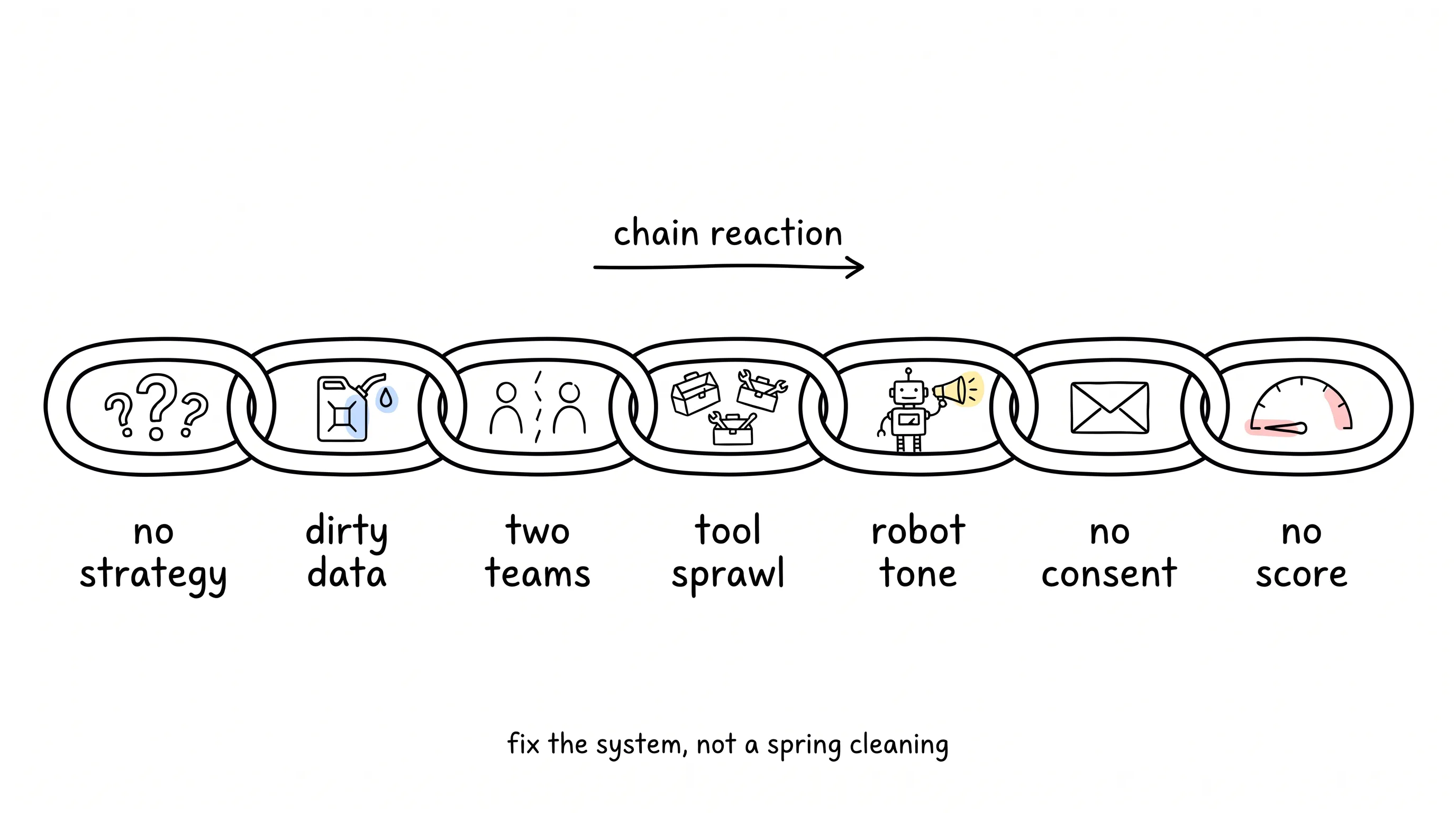
Fuzzy strategy breeds a tangle of workflows. Dirty data poisons segmentation, personalization, and routing. Two teams out of sync break every handoff. Fragmented tools shred the customer record. And when you're not keeping score, all of the above happens quietly, and nobody knows.
The fix is a system, not a spring cleaning: one shared data foundation, a clear human–AI division of labor, two ledgers everyone can see. That's also the architecture behind HubSpot's whole ecosystem — Smart CRM as the shared customer record, marketing automation carrying the repetitive load, and journey orchestration stringing cross-channel paths into one coherent conversation.
My advice is concrete: this quarter, pick one trap from the list and run a diagnosis on your own workflows. Fix the system first; talk about scale later.
Do it in the wrong order, and what you scale isn't growth. It's failure.
Here's wishing your automation only ever brings you good news during business hours — and never wakes you at midnight with a crisis.
Continue reading
Related articles

What Is an AI Marketing Agent? From "Using AI" to "Delegating to AI"
A learn article explaining what an AI marketing agent is, how it differs from rule-based automation, and which repetitive tasks such as lead qualification, reporting, and campaign monitoring can be delegated while humans keep key decisions.

Marketing Automation Is Shifting from "You Do It" to "You Say It"
This article explains how marketing automation is shifting from rule-based platforms that merely execute toward AI agents that plan, create, publish, and review campaigns, covering delegable tasks, underlying technologies, tool categories, adoption steps, and risks such as privacy and automating without strategy.

When AI Does the Creative, Mistakes Come in Batches Too
A learn article on the risks of using generative AI for marketing creative across brand, legal, compliance, and operational layers, with case examples and seven practices for review, rights clearance, documentation, and vendor governance.