
Before You Let AI Run Your Ads, Think This Through First
The article examines privacy risks in AI-driven advertising across training data, real-time interactions, and feedback loops, and outlines five practices: data minimization, transparent disclosure, human oversight, staff training, and technical safeguards such as differential privacy and federated learning.
A while back, I spent an afternoon at the office of a friend who runs an e-commerce business.
They were running their ads with AI. The creatives were AI-generated, the audiences were AI-picked, and even the middle-of-the-night bid adjustments were made by AI itself. My friend was pretty pleased with himself: a media-buying team that used to need seven or eight people now needed two.
I said, congratulations. But have you ever asked yourself one question:
What has your AI been raised on?
Data. Your customer data, user behavior data, and the feedback data the model spits back out while it runs your ads.
There's no free lunch. The manpower AI saves you is paid for in data. That's a bill you'd better do the math on.
How Big Is This?
First, a few numbers.
In 2025, the International Association of Privacy Professionals (IAPP) put out an AI governance report, and three figures in it stuck with me:
16% of companies were already using AI to personalize the user experience. 69% of marketers had put AI to work in their daily jobs. And nearly 20% of companies were throwing more than 40% of their budgets at AI-driven marketing campaigns.
My God. Nearly half the money, handed to AI to spend.
But where the money goes, the risk follows.
So What Is the Privacy Risk in AI Advertising?
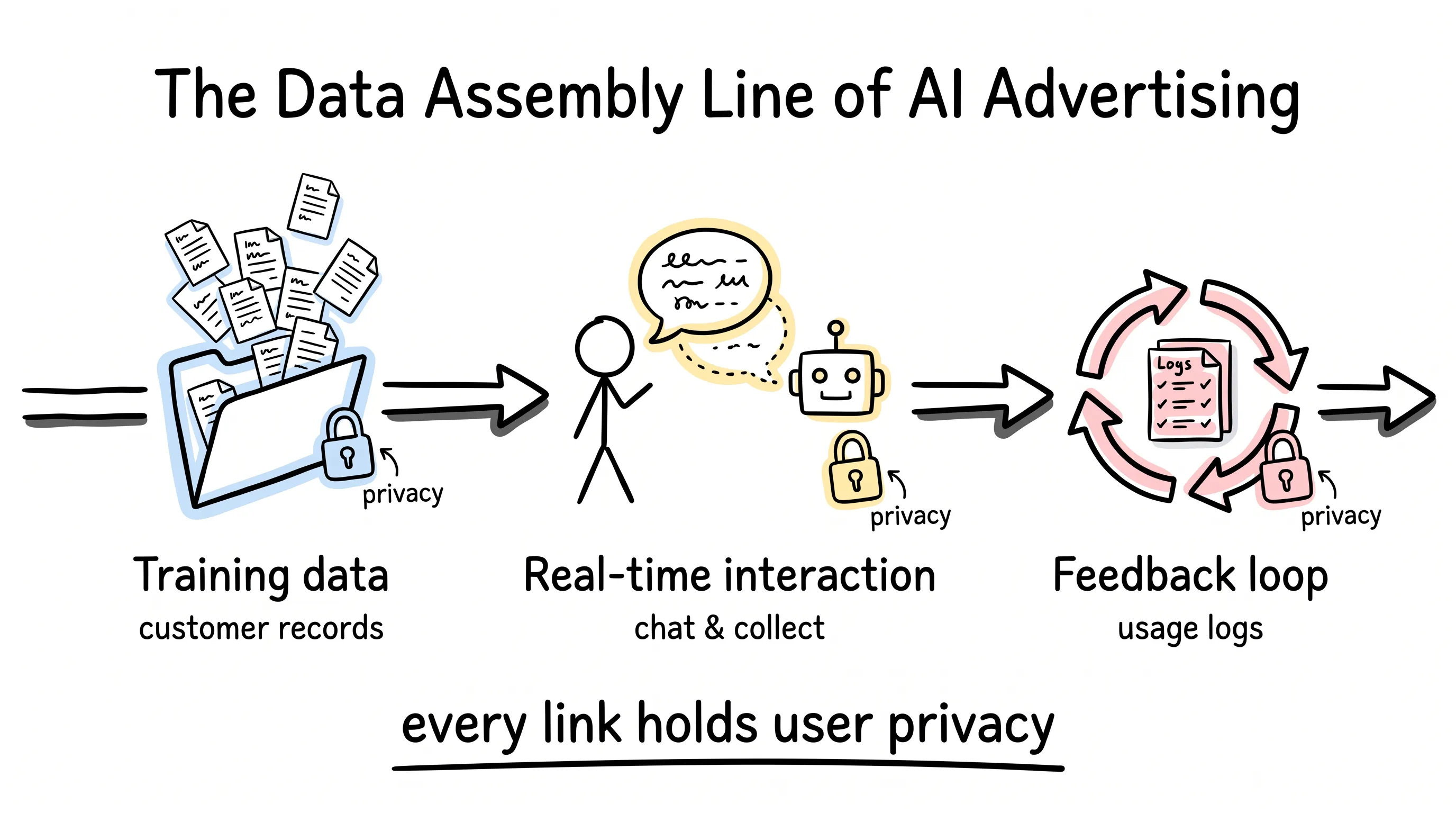
To put it bluntly: on this data assembly line, every link can go wrong.
Link one: training data. You use customer records and third-party datasets to train the model, and mixed in may be names, home addresses, behavior trails. Feed this stuff in, and it doesn't come out again.
Link two: real-time interaction. Chatbots and recommendation systems chat with you while collecting at the same time. What you've searched, what you've bought, the questions you've asked late at night. You think you're making small talk with a machine; you're actually laying all your cards on the table.
Link three: the feedback loop. After the model goes live, the system keeps "feeding" it usage logs to optimize it. Logs look anonymous, but if they aren't handled properly, they can be reverse-traced back to a specific person.
Impressive stuff — AI really is impressive. But look: from intake, to processing, to recycling, every link holds a fistful of user privacy. If any one of them leaks, what you lose isn't just data — it's trust, and possibly a fine.
Some people say: I'll deal with it when something goes wrong.
Too late.
The EU's GDPR is already sitting there. In the US, some twenty states have established their own privacy laws, and Massachusetts and New York are still debating whether to follow. States like Utah even have dedicated rules for AI itself. And with third-party cookies exiting the stage, the old playbook of living off user tracking is having its foundations torn up.
Regulation will only get tighter, never looser.
When it comes to privacy, there is no skipping class for AI-powered advertising.
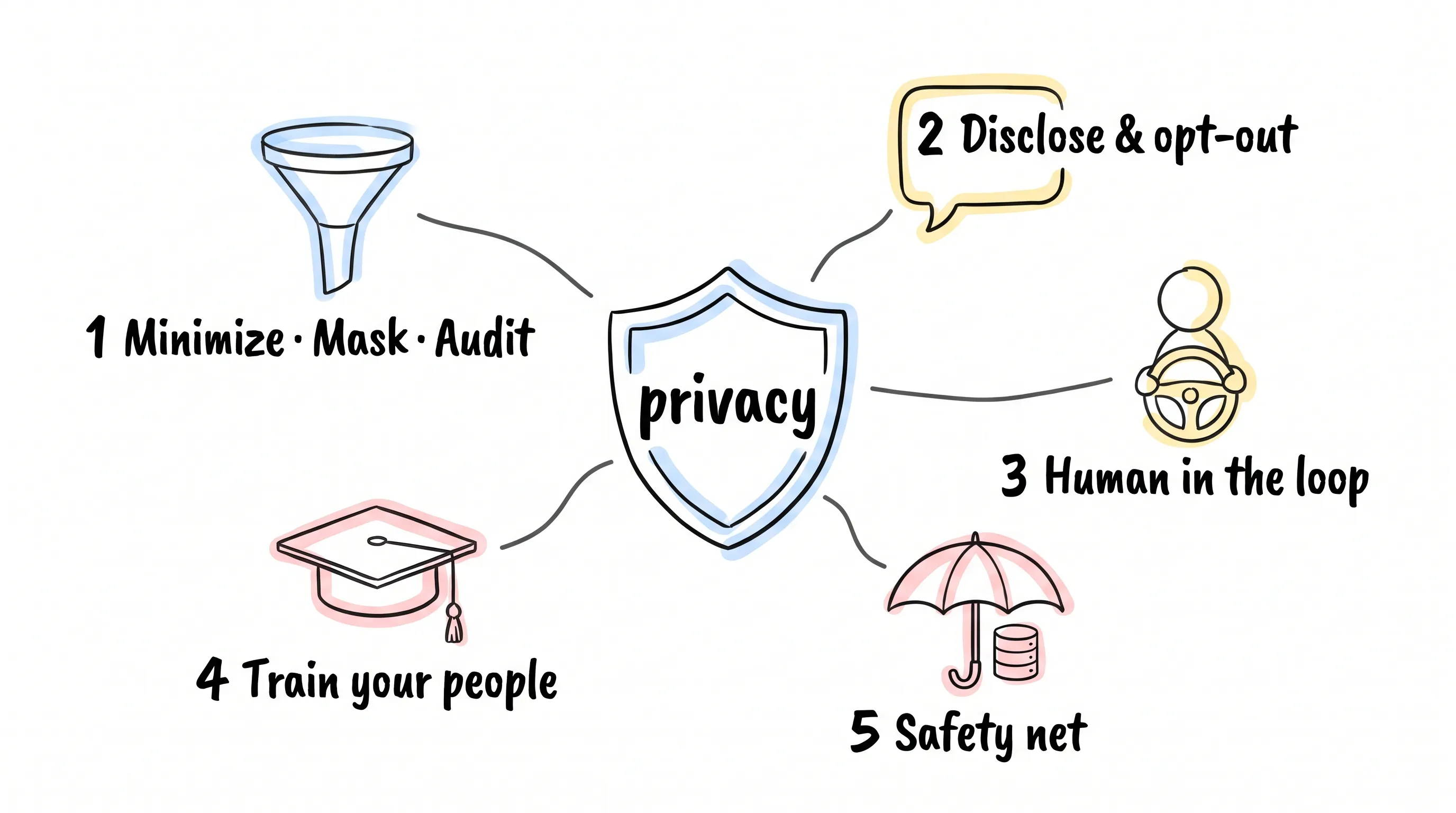
What To Do? Five Moves
One: Control the Data First
How do you control it, concretely? Three words: Minimize. Mask. Audit.
Minimize means data minimization. You're placing an ad and what you want is audience trends, so there's no need to collect every person's detailed profile. Whatever you can avoid collecting, refuse to collect.
Mask means when anonymized, aggregated data can do the job, don't touch identifiable data. Can't find anything ready-made? Google's Dataset Search has a batch of public, vetted datasets you can use to train models.
Audit means doing a privacy impact assessment on a regular schedule. What is a privacy impact assessment? Before data goes anywhere near the model, walk it through once: is there sensitive information in here? Which step might leak? Say you discover the training set has users' home addresses mixed in — anonymize first, then load it into the database.
Oh, and this whole pile of work is best left to a dedicated owner. If you can afford it, set up a Chief Privacy Officer; if you can't, at least assign one team member to own this and nothing else.
Two: Say It Plainly
If you use AI to deal with your users, let them know they're dealing with AI.
One pop-up, a few lines: "This chatbot collects your questions to improve its answers, and does not store your personal information." That's all it takes.
At the same time, give users a way to say "no." If they don't want AI-personalized recommendations, let them opt out.
These principles are spelled out, black on white, in the Association of National Advertisers' (ANA) marketing ethics code: say clearly what data you collect and what you use it for.
Trust is a strange thing. Hide things and it runs; come clean, and it sticks around.
Three: Keep Human Hands on the Wheel
AI makes mistakes. And it makes them with remarkable imagination.
Over the past couple of years, Google's Gemini, OpenAI, and Grok have all had their public meltdowns — those absurd outputs are probably still fresh in everyone's memory.
So auditing AI output on a regular basis is a must. Ready-made tools exist — TensorFlow's Fairness Indicators, IBM's AI Fairness 360 — that can help you detect bias. Let the machine review it once, then let a human review it again. For hallucinations and hidden bias, the human eye is still the sharper weapon.
Even more important: draw the no-go zones.
The EU AI Act's attitude is very clear: decisions like hiring and credit, which can substantially change a person's life, cannot be handed entirely to machines. Unilever moved even earlier, with an explicit internal rule: any decision with "significant life impact" is forbidden from full automation. Someone must make the final call.
I especially like what Salesforce does; they call it "mindful friction." The idea is to deliberately build a few pause points into the AI workflow: when it reaches a critical node, stop, wait for a person to nod, then continue.
Doesn't that sound a bit inefficient?
Yes. On purpose.
Concede a step on efficiency so you never concede one on risk.
Four: Train Your People
However good the tool, it's still people who wield it.
PwC's advice comes down to two things: first, training — teach employees to recognize when AI goes wrong; bias, privacy leaks, whatever it is, they can spot it and flag it. Second, set the rule that AI-generated content gets verified by a human before anything goes out.
Bottom line: AI is the new intern. It can do the work, but it can't go without someone showing it the ropes.
Five: Add a Technical Safety Net
Differential privacy adds a pinch of "noise" to the data. No single individual can be made out, the overall patterns survive, and the model trains as usual.
Federated learning goes one step further: the data never leaves the user's device at all. The model travels to where the data lives, learns, and leaves.
Plus full encryption for storage and transmission.
You won't need every one of these tools, but the direction is clear: keep data "usable" while making it as "invisible" as possible.
Is All This Worth It?
Run the numbers.
Surveys by the Pew Research Center show that consumers trust companies more when they're transparent about how they use AI. Trust means repeat purchases; it means word of mouth.
Compliance means staying clear of fines and lawsuits.
Once third-party cookies exit the stage, AI solutions built on anonymized data are exactly the replacement for the old playbook. Get it right one step early; be one step late and all that's left is catching up.
Salesforce drew boundaries around what its AI output may say, allowing it to speak only within a fenced-in scope, and paired that with privacy impact assessments and "mindful friction" to press down the risk of its customer-facing AI tools.
Unilever wrote "major decisions require a human call" into policy.
Google opened up its vetted public datasets, so other companies can train models "cleanly" too.
See the pattern? These three companies didn't treat compliance as a cost; they treated it as a competitive edge.
Back to That Afternoon
As I was leaving that day, I asked my friend one question: all that customer data of yours — did you clean it before feeding it to the model?
He froze for a moment.
He did end up assigning one person to own the data, and laid down three ground rules: nothing AI generates goes live without passing human eyes; decisions like loans and hiring are never left to the machine to make alone.
Business keeps running, ads keep running, the AI keeps humming along all day long. Only this time, the steering wheel is held in human hands.
Here's hoping you can do the same: let AI lead the charge, let privacy bring up the rear, and let trust grow right along with your orders.
Continue reading
Related articles

It's 2026: Stop "Buying" AI Tools for Your Marketing Team — Start "Hiring" AI Agents
This learn article explains how AI agents differ from standalone AI tools in marketing, outlines three agent categories — build-your-own platforms, CRM-native agents, and vertical tools — and covers use cases across SEO, social media, advertising, and reporting, plus criteria for choosing one.

Did the Money You Spent on AI Marketing Ever Come Back?
A guide to measuring AI marketing ROI across three layers: ad reports, sales pipeline, and the financial ledger. Covers metrics such as ROAS and CPA, eight dashboard metrics, industry benchmarks, and common measurement mistakes.

How to Pick a Creative Automation Platform: First, Figure Out What These Eleven Actually Do
A learn article sorts eleven creative automation platforms — including Bannerflow, Celtra, Smartly.io, and Storyteq — into four functional groups and proposes five evaluation questions covering publishing reach, automation depth, ease of adoption, team fit, and verifiable evidence.