
Put In $1, Get $36 Back: Let's Talk About the Digital Marketing Math
A learn article on digital marketing budget math, contrasting channels that build compounding assets, such as email lists and search rankings, with pay-per-result channels like ads and social media, plus notes on mobile optimization and embedding AI into marketing workflows.
A while back, an old friend of mine who runs a chain of pet stores invited me out for tea. The first thing out of his mouth when we sat down was: this year's budget — where exactly should I throw it?
He told me a competitor down the street had burned hundreds of thousands on feed ads last year. It looked lively enough, but when the books were tallied at year-end, they'd lost money. Other people were telling him to do SEO — a long-term play, they said — but he couldn't afford to wait.
I said, hold on. Before you ask "where to invest," answer a more basic question: is every dollar you spend buying an asset, or paying rent?
He paused for a beat.
Come on, then. Let's run the numbers from the top.
First, How Big Is the Pie?
So how big is this digital marketing pie, really?
Statista's numbers go like this: in 2026, the global advertising market will total about $1.25 trillion, with digital channels taking roughly 69% of it. Traditional media is left with 31%.
And the digital marketing market itself? Around $786.2 billion in 2026. Research firms project it will climb to $1.16 trillion by 2030 — a compound annual growth rate of 15.4%.
What does 15.4% mean? It roughly doubles every four and a half years.
Take the US alone: in 2025, $298 billion went into digital advertising — the largest single market in the world.
And how are the people inside this pie thinking? 44% of businesses say they'll keep raising their digital ad budgets in 2026. An ordinary local business typically puts 5% to 10% of revenue into digital marketing; bigger companies dare to go as high as 14%.
The market is growing, the budgets are climbing. Opportunity everywhere, it would seem.
But here's the interesting part: 40% of marketers admit their biggest headache is proving that the money they spend actually works.
More money going out, and the books get murkier. Why?
Because most people have never sorted out the difference between "renting" and "building."
Two Kinds of Channels: Ones That Build Assets, and Ones That Pay Rent
First, some data.
In HubSpot's annual survey covering more than 1,500 marketers worldwide, 49% of marketers said organic search delivers the best ROI of any channel. 27% of B2B marketers put their website, blog, and SEO in first place. And 70% of B2B marketers believe that stretched over several years, SEO brings in more sales than paid clicks.
What about paid ads, then?
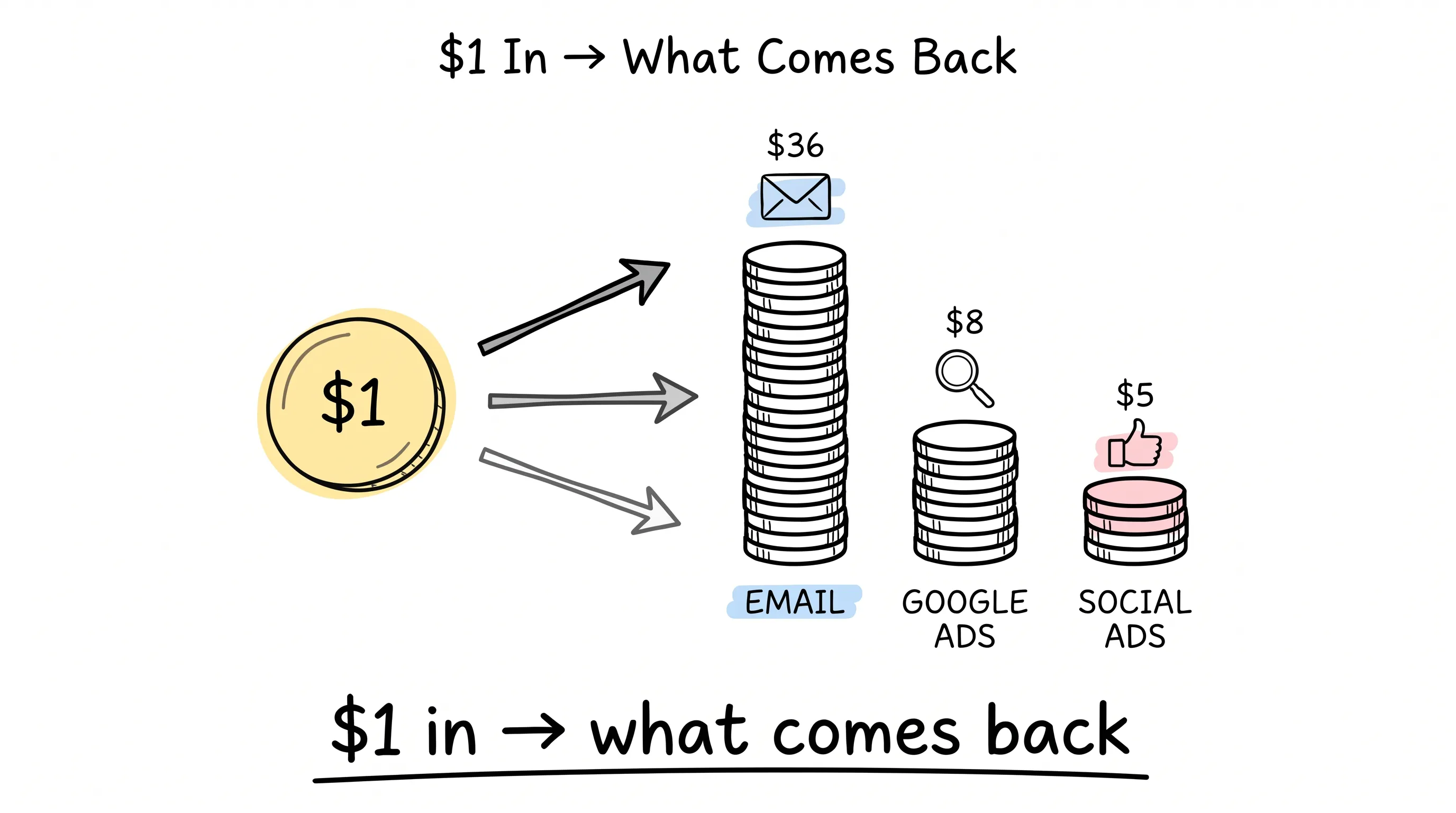
Google's own commissioned economic impact study has put a number on it: for every $1 spent on Google Ads, the average return is $8. For social media ads, the industry's common estimate is around $5 back per $1.
Eight times, five times — doesn't sound bad either. So why did nearly half the crowd cast their vote for the "slow, plodding" search rankings?
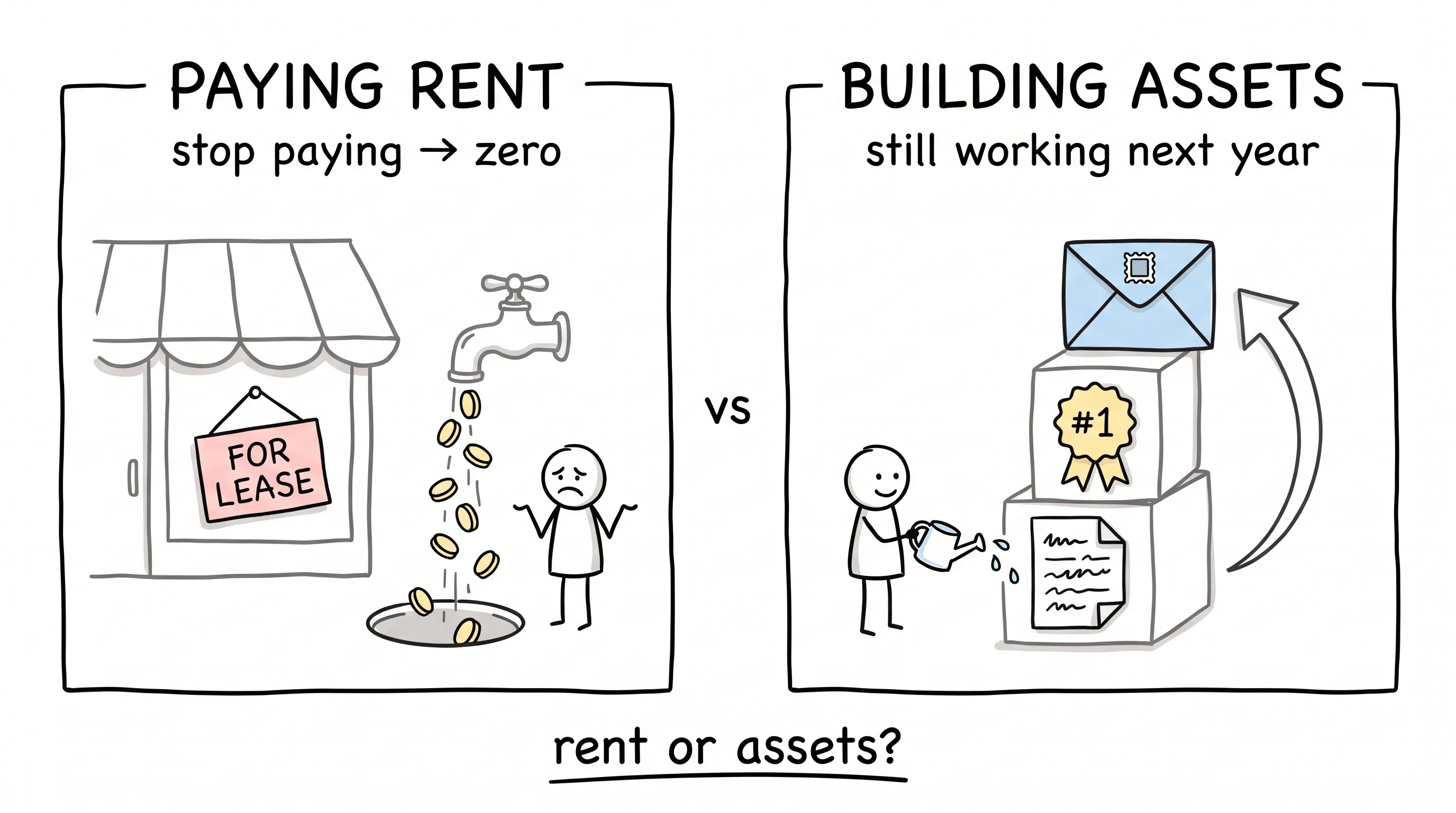
Because paid advertising buys traffic, while search rankings and email lists build assets.
What counts as an asset?
The article you write today, the ranking you've earned, the subscribers you've accumulated — they'll still be working for you next year, and the year after that. They compound.
Ads? Stop paying today, and it's zero tomorrow. Every unit of return is rent settled on the spot. Lease a storefront for ten years and it still never becomes yours.
Some will sneer: Email? What decade are we living in, and we're still talking about email?
Email is, as it happens, the single highest-return channel in all of digital marketing: for every $1 invested, the average return is $36. That's not one agency's self-serving claim — the email marketing platform Litmus has long measured it, multiple independent studies have cross-verified it, and they all point to the same number.
Thirty-six times your money. No paid channel comes anywhere close.
Why email, of all things?
Think about it: a user willing to leave you their email address is someone who raised their own hand and said "I'm willing to hear you out." That's a different breed altogether from the traffic you scoop up with a wide net. Email's average conversion rate can reach 10.1%, and its reach is staggering: there are about 4.73 billion email users in the world today, and 82% of digital marketers are doing email.
Wait a moment — if 82% are doing it, why don't most of them get 36x?
Because adopting it and mastering it are two different things. The companies that actually pocket that 3,600% return hold three things in hand: a working automation workflow, a tiered sending strategy, and relentless list hygiene. Everyone has the tools; the craft lives in the process.
Worth jotting down a quick, immediately usable tip: adding a call-to-action button inside an email lifts the click rate by 37%. It's that simple.
The Truth About Social Media: Built for Getting Discovered, Not for Waiting for the Sale
Should you do social media? Lay all the cards on the table first.
5.79 billion people worldwide use social media — close to 64% of the planet. In 2026, social media ad spending will exceed $230 billion, the second-largest digital ad category after search. 58% of consumers say they discover new businesses through social media. And users who have interacted with a brand on social media spend 35% to 40% more when they buy.
Looks like all good news, right?
But one number stings.
Organic reach for Facebook business pages is now down to 2% to 3%. What does that mean? You have 1,000 followers; you publish a post; without paying to promote it, roughly 20 to 30 people will see it.
So all that work building a following, and for nothing?
Can't quite say that either. Followers are still worth something; only the usage has changed. Here's how social media really works now: it's the place where you get discovered — 58% of consumers meet you there first; it's the staging ground for paid amplification — retargeting ads at people who've visited your website can lift conversion rates by 70%; and it's one link in an omnichannel chain — the data is right there: brands running omnichannel operations keep 89% of their customers, single-channel ones only 33%, a 2.7x gap.
And each platform has its own temperament. Facebook still has the broadest coverage — 76% to 83% of small and medium businesses use it, with an average cost per click of just $0.83 and a click-through rate of 1.51%. Instagram follows close behind at 60% to 63%. LinkedIn has 43%, and for B2B service companies its conversion rate is 2.7 times that of other social platforms. TikTok's adoption among SMBs has risen to 34%, with an average engagement rate of 3.70% — the highest of all platforms.
So stop pinning hopes on "post and the customers will come." The payoff on social media hides in paid amplification and retargeting, not in free posting.
Mobile Isn't a Bonus Feature. It's the Foundation.
Let's tally another ledger.
In 2026, global mobile ad spending will reach about $400 billion, 54% of total digital ad budgets. Of all advertising spend, 69% is generated by smartphones. 57% of online purchases happen on a phone. Mobile search ads convert at a rate 35% higher than desktop.
Americans spend an average of 4.5 hours a day staring at their phones.
What does this mean? It means if your website opens one second slower on a phone, or the button is one size too small, or the call button can't be tapped — every dollar you spent on every channel upstream is leaking away in the final inch. 61% of consumers say they'd rather contact a business whose website is mobile-optimized.
Mobile optimization isn't a nice-to-have add-on. It's the foundation that decides whether all your other investments go to waste.
The AI Paradox: Everyone Is Using It, Only 6% Are Really Using It
Finally, AI.
By 2026, generative AI tools will have reached 2.42 billion monthly active users — nearly doubled within one year.
What about marketing? Research shows that 85% of digital marketing operations tasks can now be handed to AI: writing content, tuning ads, segmenting audiences, building reports, researching keywords. Businesses that use AI see advertising revenue rise by an average of 30%, and productivity by 32%.
Sounds like AI has already conquered marketing?
Quite the opposite. Only 6% of marketers have embedded AI fully into their own workflows.
85% can be automated, 6% truly embedded. The gulf between these two numbers is the biggest opportunity gap of the moment.
Most teams use AI in piecemeal, scattered bursts: write a couple lines of copy, tweak a headline. That's dabbling, not embedding. The ones who actually capture that 30% revenue growth are the people who have woven AI into the entire pipeline — from content to ad delivery to the post-mortem.
Before tools, everyone is equal. Only process separates the winners.
Back to That Cup of Tea
As the tea was going cold, I gave my friend a few straight words.
Email lists and search rankings — this unremarkable land. Buy it first, while everyone else scrambles for traffic, and it will compound. Keep spending on ads and social media, sure, but know in your heart it's rent — what it buys is today's water, not next year's well. If your website is one second slow on a phone, all the money upstream is leaking; pour the foundation solid first. As for AI, don't treat it as a toy; treat it as an assembly line, and weave it into your process, one strand at a time.
He asked: so this year, where does the first cut of the budget go?
I said: cut the piece you're most likely to overlook. When everyone crowds into the noisy places, the quiet places are the cheap ones.
Here's to spending your next budget where it compounds.
Continue reading
Related articles

It's 2026: Stop "Buying" AI Tools for Your Marketing Team — Start "Hiring" AI Agents
This learn article explains how AI agents differ from standalone AI tools in marketing, outlines three agent categories — build-your-own platforms, CRM-native agents, and vertical tools — and covers use cases across SEO, social media, advertising, and reporting, plus criteria for choosing one.

What Is GEO? How Your Brand Gets "Mentioned" in the Age of AI Search
An explainer on GEO (Generative Engine Optimization) for e-commerce and DTC brands: how it differs from SEO and AEO, why AI answers shape brand visibility, and eight practices covering question-focused content, consistent brand messaging, structured pages, external evidence, comparisons, and AI mention tracking.

AI Is Already Making Decisions for Your Customers. Are You on the List?
A learn article explains GEO (Generative Engine Optimization): why AI-generated answers now shape which brands customers see, and how SEO fundamentals, entity clarity, citable evidence, and monthly measurement affect visibility in AI answers.