
Meta Ads Keep Getting More Expensive. Who Should Actually Be Worried?
A learn article arguing that rising Meta CPMs reflect growing ad supply and better AI-driven matching, so advertisers should track ROAS and customer acquisition cost instead. It also covers creator fit over follower counts, compliance workflows, and how AI agents may change ad delivery.
A few days ago, a friend of mine who runs a cross-border e-commerce business came to me to vent.
He said, Bro, Meta's CPMs are climbing again. The cost per thousand impressions goes up year after year — the money I pour in just vanishes into a black hole.
I told him, don't panic yet. I'd recently turned over in my head, again and again, the views Meta's CMO has shared about advertising, and I noticed something genuinely interesting:
Most advertisers are probably watching the wrong number.
The Supply Has Actually Been Growing
What's CPM? It's what you pay every time your ad is shown a thousand times.
Here's the mental math most people do: there are only so many people scrolling Meta, only so many ad slots, and ever more advertisers chasing them — so of course the price keeps climbing. The pie is only so big; the more people splitting it, the smaller each slice.
Sound airtight, right?
But this CMO offered a counterexample. When TikTok burst onto the scene, everyone assumed user attention was a fixed stock, something being stolen out of Meta's hands. Yet think about it: all those hours people spend watching short videos — where did they come from?
Mostly from television.
In other words, the attention pie wasn't stolen and shrunk. It got baked bigger.
Zoom out further. Advertising's share of the global economy had been stuck at around 1% for who knows how many years. And now? Roughly 1.3%, 1.4%.
The pie is growing. There are more places to run ads, and more inventory to run them in.
So why is your CPM still rising?
The Number You Should Actually Watch
Let's run a thought experiment.
Suppose a platform could use AI to push "the right ad, at the right moment, to the right person" to its absolute limit: creative generated by AI in unlimited volume, with humans staying in the creative director's seat to decide the direction, and matching precise down to each individual. What happens?
The value a single ad slot can create would multiply, over and over.
The slot is worth more — so of course CPM rises.
But CPM rising does not mean your cost of acquiring a customer is rising.
Let's do the math. Say CPM doubles, but because the matching is sharper and the creative is better, your conversion rate climbs too — and when you crunch the numbers, your cost per sale is actually lower. Did you win or lose?
You won.
That's why I completely agree with something this CMO said: the only legitimate reason for CPM to rise is that ROAS (return on ad spend) is rising too.
What you should be watching is ROAS — your customer acquisition cost. CPM? That's just an intermediate variable.
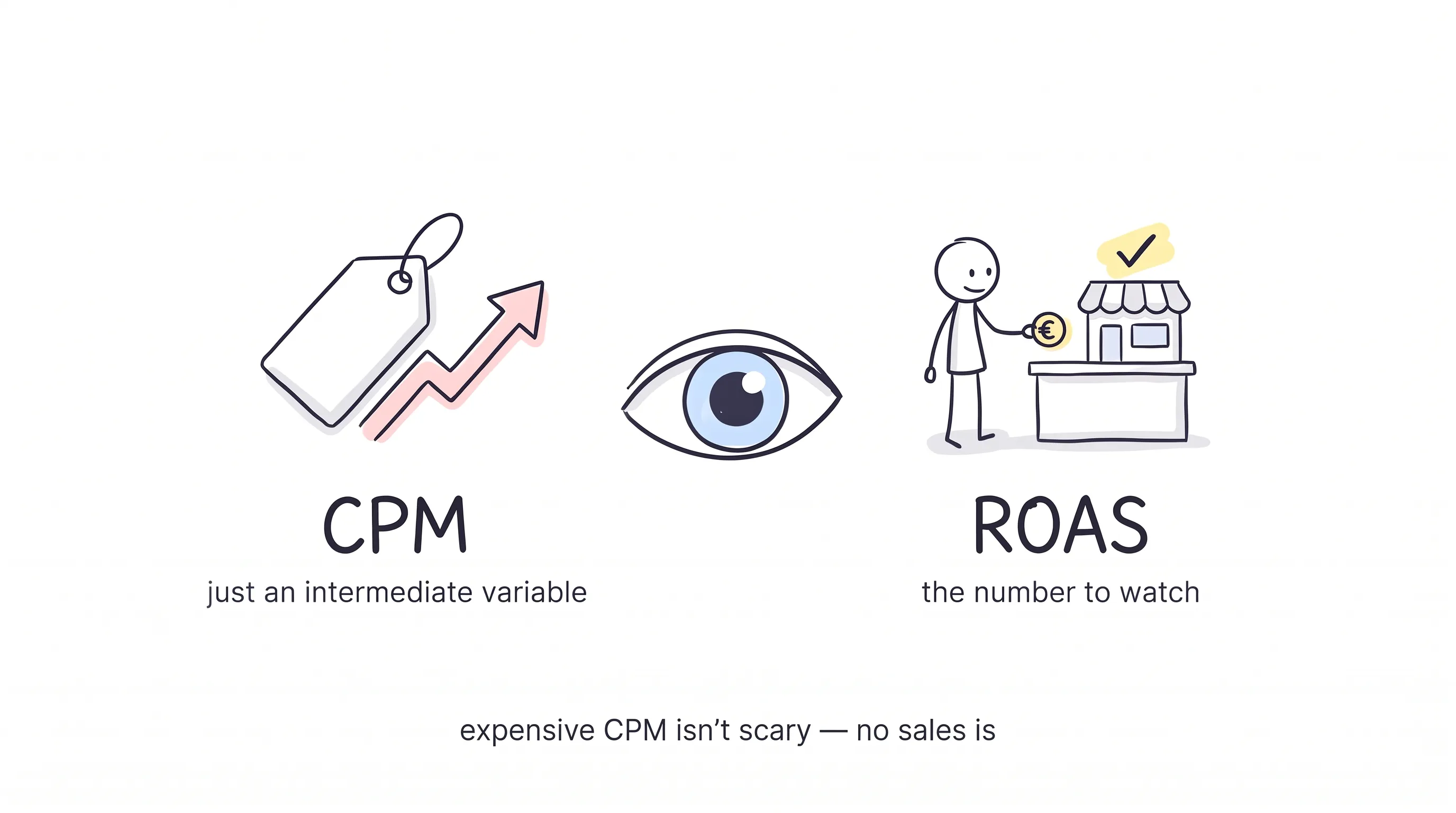
Expensive CPM isn't scary. Paying more and still closing no sales — that's scary.
AI Isn't a New Story. It's an Old One.
At this point you might say: fine, I get the logic — but the AI wave, that's something brand new, isn't it?
Quite the opposite.
Let me tell you a story from the 1990s.
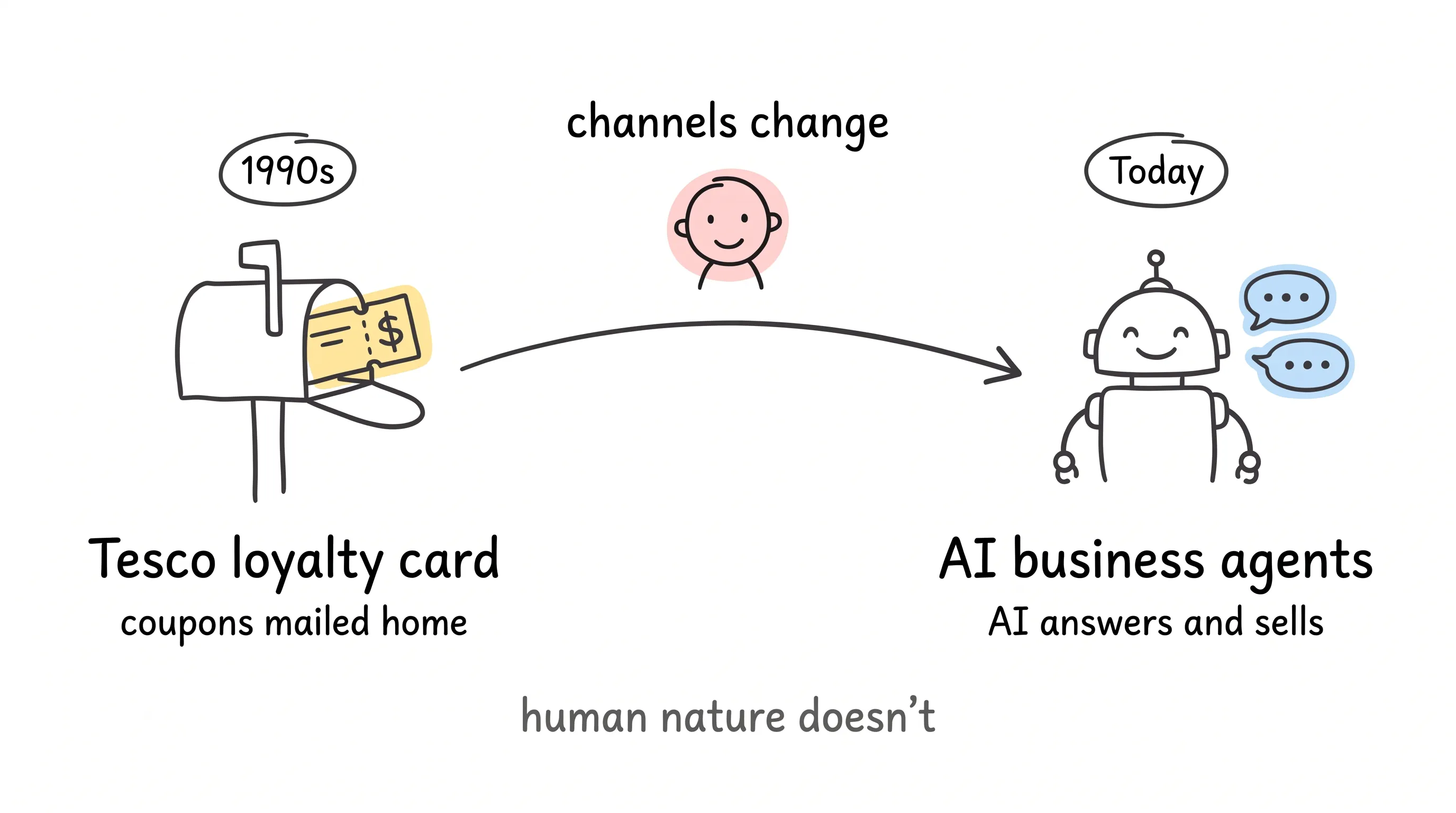
Tesco, the British supermarket giant, ran a loyalty card program. At other supermarkets, a loyalty card meant you swiped it at the register and got an instant discount. Tesco did something different: it mailed the coupons to your home.
Why the extra trouble? Because it wanted your address.
With your address, the database now contained "you" as a person: where you lived, which store you shopped at. And then something remarkable happened. Say a competitor opened a new store right across from a Tesco location, and that location's foot traffic dropped. Any other supermarket could only carpet-bomb the whole city with coupons. Tesco could precisely mail coupons to exactly the people who had actually gone over to the competitor.
The same money, spent only on the people it should reach.
That playbook worked in the 1990s. What about today?
It works even better.
The AI business agents Meta is pushing hard right now — the things that answer your customers and sell for you. Sounds new, right? The underlying logic is exactly the same as Tesco's loyalty card: you have to hold the information about a person before you can say the right thing to them. The only difference is that those first few conversations are now handled by an AI instead of a salesperson — an AI that never sleeps and always has the answer.
The channels change; human nature doesn't. The bedrock of marketing hasn't budged in thirty years.
Next: Ads Will Be Served to AI Agents
Push this topic one step further and you arrive somewhere far more disruptive.
In the future, a portion of ads will be served to AI agents.
What do I mean? Think about it: a few years from now, you'll have an AI agent buy things for you. Where does it go to choose? Most likely, it queries a database. And in that database, alongside the free listings, will there be sponsored placements?
There absolutely will.
Just like today's search engines: organic results, plus ad slots. The world of AI agents will grow the same structure.
But here's a wonderful twist.
This CMO used himself as the example: he had an AI agent buy toothpaste for him — he wanted Colgate whitening. Why Colgate? He couldn't quite say himself. Probably a lifetime of Colgate ads had slowly "marinated" him.
See what's happening? The AI agent decides for you, but it has to know your preferences. Where do your preferences come from?
From every ad you've watched in your life.
So ads aimed at people won't disappear. Ads must reach the machine — and, even more, the memory of the human behind it.
Don't Look at Follower Counts. Look at Fit.
One more thing everyone who runs ads should care about: creators.
In many advertisers' accounts, the single best-performing ad is often a creator ad. This isn't an outlier case; it's the pattern.
So when you partner with creators, how do you pick?
Most people's first instinct: find whoever has the most followers.
Wrong.
What you're paying for is "the creator's own authentic expression," which you then amplify as an ad. If the creator genuinely fits your product, and there's real trust between them and their followers, the ad works. Flip it around — you sign a top-tier mega creator, then frantically rewrite how he talks and force him to read a script that doesn't suit him — and the results will be far worse.
Fit first, reach second. Never the reverse.
Meta itself does exactly this. They're working with 1,000 creators to push smart glasses and drive Instagram's growth. What's the most valuable thing on Instagram? Creators.
Heavily Regulated Industries Actually Have a Way Out
Someone will ask: AI-generated creative is this good, but my industry has strict compliance rules — the moment AI touches a line of copy or swaps an image, legal hits the roof. What then?
This CMO gave a two-layer answer, and I think both layers are smart.
The first layer is for compliance-heavy industries. Meta's answer is to build "AI lawyers": AI pre-screens the creative for compliance, with human lawyers behind them setting the rules and serving as the backstop. Sound far-fetched? Think of radiology. Hinton, the godfather of AI, once predicted that radiologists would soon be replaced by AI. What happened? Today there are more radiologists than at any point in history — they've just all started using AI.
AI didn't eliminate the professionals. AI amplified them. Once legal's capacity is amplified, compliance review can finally keep pace with creative generation. Meta's own content moderation and privacy compliance already run this way — and they take the statistics to the regulators to show for it.
The second layer is for brands that shouldn't use AI in the first place. Take a laundry detergent brand: what it needs to show you is a shirt stained with chocolate, then actually washed clean. If that image is AI-drawn, it "isn't real" — and the entire selling point collapses.
So don't treat every brand the same. Some industries need AI to scale up their compliance capacity; some brands need to protect "authenticity" as the selling point itself.
The Most Surprising Lesson
The last story is the one I find most counterintuitive.
This CMO runs the most data-driven ad-targeting machine on Earth — which creative to run, to whom, and when, all of it quantified. Now guess what he calls the most effective campaign he's ever run?
The 2025 Super Bowl. They brought in a big Hollywood star and produced an ad as traditional as traditional gets — a big-budget production, through and through.
By his own math, that placement is absurdly expensive. By all rights, it shouldn't pay off.
And the result? Astonishingly good.
The king of data will still, in the most expensive spot, place the least data-driven bet. Why? Because sometimes, the most expensive spot is itself the signal.
Back to That Friend
I later walked the friend from the beginning of this article through this whole logic again.
CPM rising is a byproduct of the pie getting bigger, the price of matching getting sharper. Anxiety over CPM is like anxiety over the number on your bathroom scale. What actually decides whether you gain or lose weight is what you eat.
Watch ROAS. Find the creators who genuinely fit you. And trust this: the tools change generation after generation, but the craft of "the right person, the right moment, the right words" — from Tesco's loyalty card to today's AI agents — has never changed.
Tools become obsolete.
Businesses that understand people don't.
Here's to your next ad, landing truer than the last.
Continue reading
Related articles

It's 2026: Stop "Buying" AI Tools for Your Marketing Team — Start "Hiring" AI Agents
This learn article explains how AI agents differ from standalone AI tools in marketing, outlines three agent categories — build-your-own platforms, CRM-native agents, and vertical tools — and covers use cases across SEO, social media, advertising, and reporting, plus criteria for choosing one.

Did the Money You Spent on AI Marketing Ever Come Back?
A guide to measuring AI marketing ROI across three layers: ad reports, sales pipeline, and the financial ledger. Covers metrics such as ROAS and CPA, eight dashboard metrics, industry benchmarks, and common measurement mistakes.

How to Pick a Creative Automation Platform: First, Figure Out What These Eleven Actually Do
A learn article sorts eleven creative automation platforms — including Bannerflow, Celtra, Smartly.io, and Storyteq — into four functional groups and proposes five evaluation questions covering publishing reach, automation depth, ease of adoption, team fit, and verifiable evidence.