
Scrunch or Ahrefs? First, Do the AI Visibility Math
A learn article comparing Scrunch and Ahrefs Brand Radar for tracking brand visibility in AI answers, covering engine coverage, prompt sampling, pricing units, and a 30-day validation plan. It also briefly mentions HubSpot AEO and open-source alternatives.
A few days ago, a friend who works in B2B marketing asked me: he wants to track how his brand shows up in AI answers on ChatGPT and the like. He has shortlisted two tools — Scrunch and Ahrefs — and wants to know which one to buy.
I didn't answer right away.
Because underneath that question sits a bigger one: when it comes to AI search, are you planning to bring in a dedicated "specialist doctor" — or have the SEO platform you already own do the checkup while it's at it?
Once you've thought that through, the answer surfaces on its own.
Why You Can't Dodge This
What is AEO? AEO stands for Answer Engine Optimization. Put simply: in the past, users searched, then still had to click a link. Now users ask the AI directly, the answer arrives, and the job is done.
The user never reaches your website, so your brand never gets a chance to show up.
How serious is this? Pew Research Center's March 2025 data: 18% of Google searches now surface an AI summary. And the longer the search and the more it reads like a question, the higher that share climbs.
The harsher number is another one. Among users who see an AI summary, only 8% click a traditional search result; among those who don't see one, it's 15%.
Cut roughly in half.
Think about what that means. AI isn't just siphoning traffic — it's fighting over who makes the shortlist. People ask AI before they make a decision, and whoever the AI recommends has the higher win rate. If you can't see what AI says about you, all you can do is watch from the sidelines.
So tracking AI visibility isn't chasing a fad. It's a must.
Meet the Two Contenders
These two tools have completely different temperaments. Let me offer an analogy.
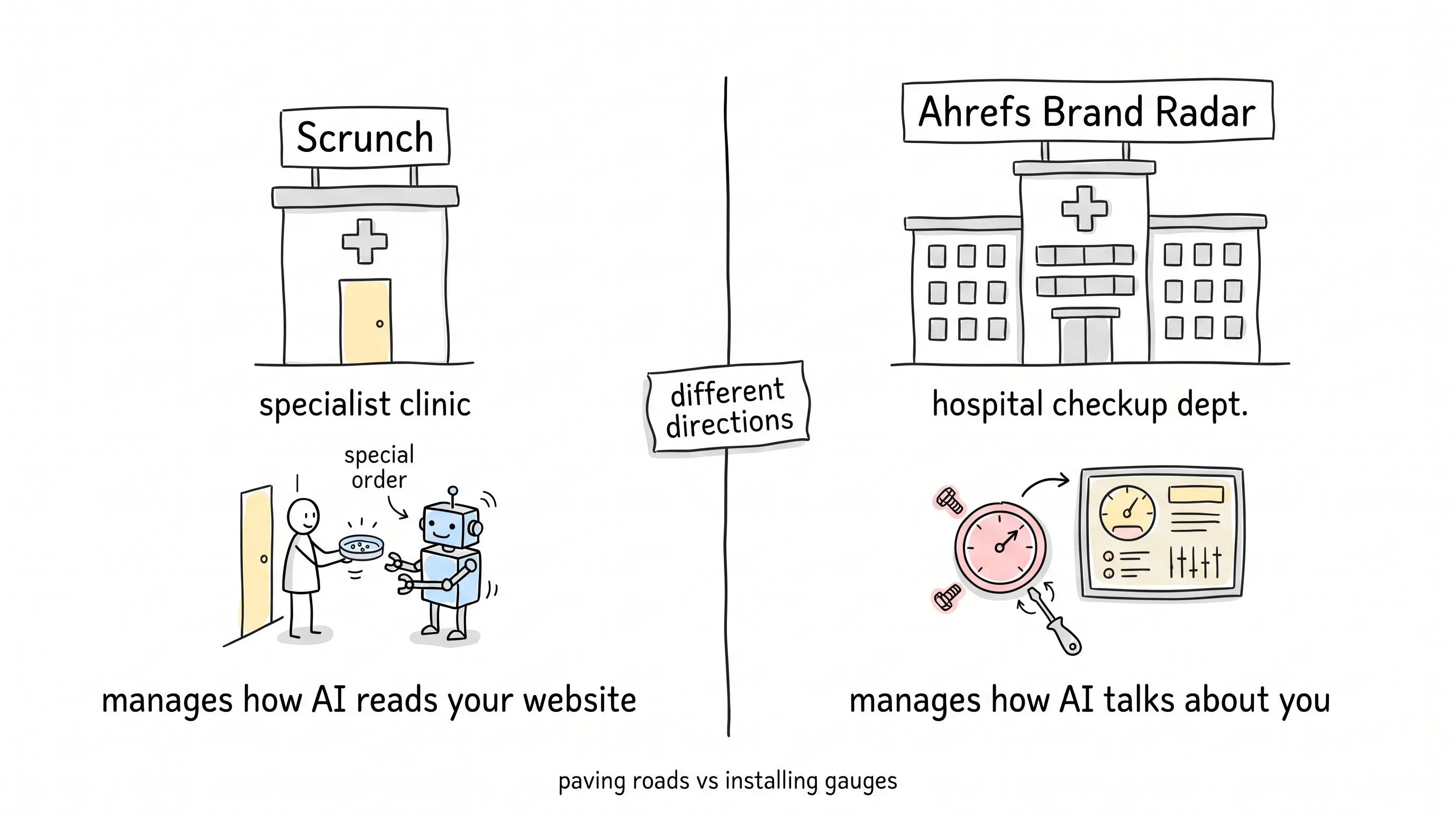
Scrunch is like a specialist clinic. Ahrefs Brand Radar is like the newly opened checkup department in a general hospital.
What is Scrunch? It is a platform under Sitecore, officially called an Agent Experience Platform, or AXP for short. What it does is identify, at your website's front door, which visits come from AI crawlers like ChatGPT, Claude, and Perplexity, then specially serve them a streamlined version of the page. Humans still see the original site; AI gets a special order prepared for machines.
What it manages is how AI reads your website.
And what is Ahrefs Brand Radar? You may already be using Ahrefs — keywords, backlinks, site audits, the veteran all-in-one SEO suite. Brand Radar is an AI monitoring module added into that suite: how many times your brand appears across various AI answers, and whose content gets cited.
What it manages is how AI talks about you. And the data sits right in the SEO dashboard you're already familiar with.
One is paving roads toward AI; the other is installing gauges on an old platform. The directions are different, and all the differences that follow spring from this.
The First Dividing Line: Who Gets Covered
When buying a monitoring tool, the first thing is to see clearly: which AIs does it watch, and where.
Two words to distinguish here. Engines are the AI products that generate answers, such as ChatGPT and Perplexity. Surfaces are the places where answers appear, such as Google's AI Overviews, a YouTube video, or a Reddit post.
Ahrefs Brand Radar is generous on this point: all paid tiers uniformly cover 7 platforms — Google AI Overviews, Google AI Mode, ChatGPT, Perplexity, Copilot, Gemini, Grok. And it doesn't only watch large language models; it also searches for you in YouTube titles and captions, on Reddit, TikTok (still in testing), and Google Business Profiles.
What about Scrunch? The entry-level Core tier has only 4 engines: ChatGPT, Perplexity, Google AI Overviews, Copilot. If you want Claude, Gemini, Meta AI, Google AI Mode, and Grok, you have to go up to Enterprise — 9 engines, and that is a custom contract.
But Scrunch has a signature move: product-level AI shopping monitoring. If you run e-commerce, it can track whether one specific product of yours shows up in AI shopping scenarios — down to the individual product.
How to choose? Don't count the engines; count your buyers. Where do your buyers usually ask their questions? Go look at your website's referral traffic, go through sales records, go ask customers. Google should almost always be on the first watchlist — it's the biggest pond. E-commerce teams should look at Scrunch's shopping module first; if your content is scattered across videos and communities, prioritize Ahrefs' YouTube and Reddit coverage.
The Second Dividing Line: How the Numbers Are Counted
This section, I believe, is the most easily overlooked — and the most lethal.
What is monitoring? The essence of monitoring is sampling. No tool whatsoever can watch every question buyers ask AI. What it watches is a selected batch of prompts.
So where this batch of prompts comes from determines what the numbers you see actually represent.
Ahrefs' trump card is a monthly prompt database of more than 400 million (406M+). Note that these prompts are not machine-made; they are derived from real users' search behavior. The benefit is very practical: behind every AI question hangs a real search demand, making it easy to prioritize. Of course, you can also add custom prompts.
Scrunch takes another road. It uses AI Search Trends to estimate how active prompts are under a given topic, helping you discover newly emerging topics and content gaps; it also has a Query Fan-out analysis, which shows how AI takes a user's one question and fans it out into a string of related questions.
Neither road is absolutely right or wrong, but you have to keep one thing straight: any AI visibility number is a trend line, not a ledger. AI's answers can differ by session, by region, by phrasing. Don't expect precise values; watch the direction.
There's another trap, called aggregation. What is aggregation? For example: within a certain topic cluster, your brand appeared in 60% of the answers — sounds pretty good. But in the three questions closest to the moment of purchase, you never appeared once. Aggregate numbers smear over exactly this kind of gap. So high-value prompts must be reviewed one by one.
Citations work the same way. Don't just count "how many times you were cited"; see where the citations went: your own pages, or review sites, industry media, community posts? Documentation can't settle this; you have to verify it in person during a trial: have the vendor take your own prompts and show citation-level data — exportable, ideally. A tool that can only tell you "you were cited" but gives no specific pages leaves you with essentially nothing to act on.
The Third Dividing Line: What You Can Do Monday Morning
A report only has value when it becomes the team's Monday-morning actions. These two tools pull in opposite directions.
Scrunch's actions happen on the bot side. Agent Traffic can separate human visits from AI crawler visits; Site Maps runs page-level audits, telling you which pages bots came to and where technical obstacles sit. The boldest part: AXP will directly modify the page handed over to AI — by Scrunch's own account, pages slim down 26%, saving tens of thousands of tokens.
Note: 26% is the vendor's figure. Run it on your own pages before you believe it.
Ahrefs' actions grow inside the SEO workflow. Site Audit and Bot Analytics watch how often AI crawlers come by; IndexNow lets search engines recrawl immediately after you change content; AI Content Helper helps you optimize articles toward "being cited"; plus round-the-clock technical SEO advice. If your team is already steeped in Ahrefs, all of these build on muscle you already have.
Integrations follow the same split. Scrunch's Looker Studio connector, API, and MCP are only available from Agency Core and above; all Ahrefs paid tiers come with an MCP server, so you can query Ahrefs' real-time data directly inside Claude or ChatGPT.
Time to Do the Math
On pricing, the two differ not only in numbers but even in units. Below is what the vendors published as of October 2026 — it can change at any time. Let me break it down.
On the Scrunch side: the Core tier is $250 per month — 125 prompts, 4 engines, 1 brand, 5 site audits per month, 5 seats. Agency Core is $500 per month — 250 prompts, 3 brand workspaces plus 3 pitch workspaces, unlimited seats. For 9 engines and the full AXP, it's enterprise custom pricing.
On the Ahrefs side, Brand Radar comes in two ways to buy.
Standalone: Select Platforms at $398 per month — you pick which engines to watch; All Platforms at $699 per month — 2,500 checks, the full database.
Or buy it bundled — the most convoluted and also the most cost-effective part: Lite at $129 per month (drops to $108 with annual billing) — the whole SEO suite plus Brand Radar, but it only lets you watch 5 prompts, with 150 checks per month; Standard at $249 ($208 annually), 10 prompts; Advanced at $449 ($374 annually), 20; Enterprise at $1,499 — 2,500+ checks, uncapped API. If that's not enough, there are add-ons: $50 buys 2,500 checks, $100 buys 7,000, $250 buys 25,000.
See the problem?
Scrunch counts prompts; Ahrefs counts checks. One check is one run of a prompt. Lite's 150 checks spread over 5 prompts means each prompt runs 30 times per month. So "125" in one system and "150" in the other aren't remotely comparable — do the conversion before you buy.
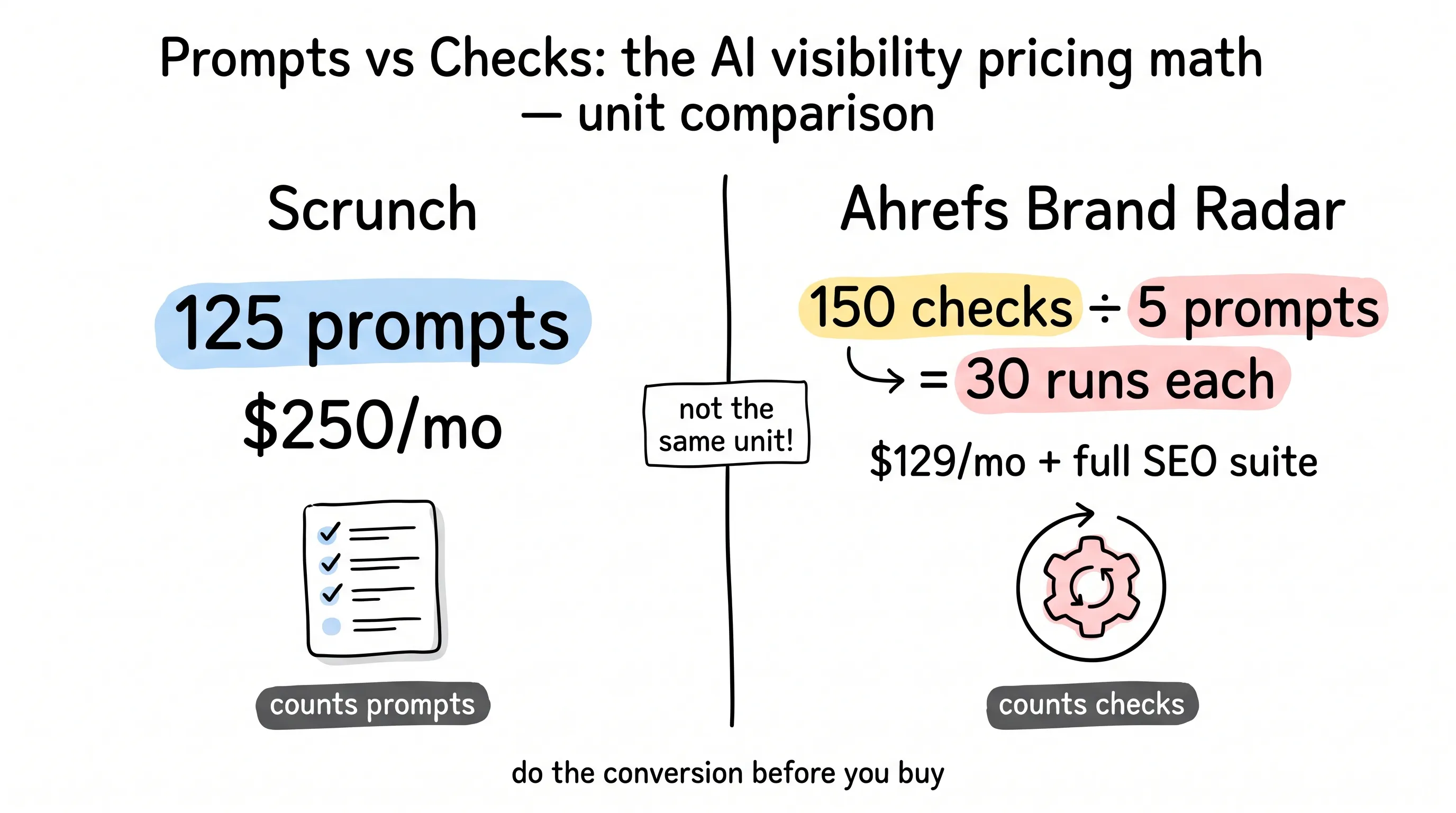
One more subtlety: Ahrefs' bundled price includes the entire SEO suite. So Brand Radar's real cost depends on whether you were already willing to pay for Ahrefs. If yes, it's essentially free; if not, that $129 is paying for something you won't use.
How do you estimate how many prompts you need? Here's a back-of-the-envelope method: the number of products you need to cover, times the number of buyer stages, times the question variants per stage. Say 5 products, 3 stages, 5 ways of asking each — that's 75 prompts gone, before competitors and regions are even counted. And experience says most teams expand their prompt set after the first quarter. So ask about caps and add-on paths before you buy.
For agencies, three more things must be confirmed in person: workspace caps, seats, and whether white-labeling is possible. Scrunch's Agency line is designed around brand and pitch workspaces, naturally suited to multiple clients; Ahrefs scales through prompt add-on packs. One more question to ask: if a client leaves, can you take the historical data with you?
There Are Actually More Than Two Options
Beyond the two heavyweights, a few other roads are worth a quick mention.
The third road is where you already live. If your content, forms, and reports already run inside HubSpot, adding another new tool means one more login, one more data silo, one more handoff. HubSpot has its own AEO: standalone at $50 per month ($45 annually), 25 prompts, watching three engines — ChatGPT, Gemini, and Perplexity — with brand visibility scores, sentiment analysis, competitor share of voice, and citation analysis, and it doesn't require you to build your site on HubSpot; if you're already a Marketing Hub Professional or Enterprise user, it's included outright, and it can use your CRM data to suggest prompts and generate on-brand drafts from a one-line brief.
The weaknesses, stated plainly: only 3 engines, no bot-side delivery, and the product page still carries a beta label. Its strength comes down to one word: seamless. Data, content, reports — all in one place.
Further out, there's the geek route. An open-source project called Elmo — MIT licensed, self-hosted — tracks ChatGPT, Claude, Perplexity, Gemini, and Google AI Overviews, with a REST API and your own API keys. It suits technical teams who want to roll their own; the price is maintaining the machine yourself. Meanwhile, SEO suites like Semrush and SE Ranking are all bolting AI monitoring into their own platforms — the same playbook as Ahrefs. Whichever one you're already in, look at that one's new features first, then decide whether to bring in someone new.
My Verdict
That brings us to the verdicts. I'm not going to hedge.
If you're building a dedicated AEO team, choose Scrunch. What you want isn't just visibility; what you want to change is your website in AI's eyes: bot traffic analysis, page-level audits, streamlined delivery for AI, product-level shopping visibility. An SEO suite was never built to handle these things.
If your team already lives inside Ahrefs, choose Brand Radar. A 28.7-billion keyword database, a 35-trillion backlink index, with AI data sitting right next to the data you already use. You skip one new vendor and one new reporting setup — that's a tangible saving.
If your marketing lives entirely in HubSpot, try HubSpot AEO first. Fifty dollars a month — establish a baseline first, then decide whether to add more. For early-stage teams on tight budgets, this is one of the lowest barriers to entry.
One premise applies to all three cases: if the AI monitoring that comes with your SEO suite already covers the engines and citation depth you care about, one tool is enough. Don't pay for a feature checklist; pay for gaps.
Whatever You Buy, Spend the First 7 Days Counting Yourself
Finally, here's a 30-day hands-on plan. The core idea is one sentence: count it yourself first, then let the tools count.
Days 1–7: run the baseline by hand. Write 20 to 30 prompts a real buyer would ask, run them yourself in the few engines that matter most, and archive the answers: which brands appeared, which sources were cited.
Days 8–14: validate the tools. Feed the same prompts to the tools you like, and reconcile: is the engine coverage right, are the citations reported in full? Where things don't line up, ask the vendor directly.
Days 15–24: get to work. Pick the one or two biggest gaps, decide whether each calls for a new page, an update to an old page, a technical fix, or an off-site play — then get it done.
Days 25–30: retest. Watch the direction; don't draw causal conclusions — AI's answers change every time, and a single result proves nothing. Then move to the next batch of gaps and loop.
Oh, and one signal to watch for along the way. If the citation data shows that AI, in your category, keeps citing review sites, industry media, and community posts while rarely citing brands' own pages, then no matter how much you write on your own blog, it won't help. The play here is PR: take the citation lists from your 5 highest-value prompts to media outlets and communities — and first confirm that at least two or three of them are third parties. That's your internal ammunition.
Finally, Coming Back Around
That question from my friend — my answer, in the end: first think clearly about where your team lives, then think clearly about where your gaps are. The tool comes third.
And one mental adjustment to make no matter which tool you buy: most of AI's influence on purchase decisions never produces a click. Reread those Pew numbers — 8% versus 15%. Which means a portion of AI's influence will never enter your click-based attribution reports. No tool, including the most expensive one, can fully convert zero-click influence into revenue.
What a tool can give you is a sense of direction.
In the AI era, the biggest risk to brand visibility is not being seen at all. Once you can see — even if all you see is the trend — you've already outrun the majority of competitors still watching from the sidelines.
Here's to seeing, sooner rather than later, what your brand looks like in AI's eyes.
Continue reading
Related articles

It's 2026: Stop "Buying" AI Tools for Your Marketing Team — Start "Hiring" AI Agents
This learn article explains how AI agents differ from standalone AI tools in marketing, outlines three agent categories — build-your-own platforms, CRM-native agents, and vertical tools — and covers use cases across SEO, social media, advertising, and reporting, plus criteria for choosing one.

What Is GEO? How Your Brand Gets "Mentioned" in the Age of AI Search
An explainer on GEO (Generative Engine Optimization) for e-commerce and DTC brands: how it differs from SEO and AEO, why AI answers shape brand visibility, and eight practices covering question-focused content, consistent brand messaging, structured pages, external evidence, comparisons, and AI mention tracking.

AI Is Already Making Decisions for Your Customers. Are You on the List?
A learn article explains GEO (Generative Engine Optimization): why AI-generated answers now shape which brands customers see, and how SEO fundamentals, entity clarity, citable evidence, and monthly measurement affect visibility in AI answers.