
Adobe has held the "Leader" position in the Gartner Magic Quadrant for 15 years running. More interesting than the record is how marketing's playbook is shifting gears.
The article reports Adobe's 15th consecutive
The other night, I was scrolling through industry news when one item stopped me. I stared at it for a good while.
Gartner has released its 2026 Magic Quadrant for B2B marketing automation platforms, and Adobe is a "Leader" once again.
The 15th consecutive year.
Fifteen years — what does that mean? Count back 15 years: smartphones had only just learned to unlock with a fingerprint, and the term "short video" hadn't been invented yet. A company's product, in a market where everyone is shouting about disruption, placed in the top tier by the same analyst firm for 15 years in a row.
Not easy.
But honestly, that record isn't what kept me staring.
It was a few shifts this report reveals. I think everyone doing B2B marketing should take a look.
What changed?
Let me walk you through it.
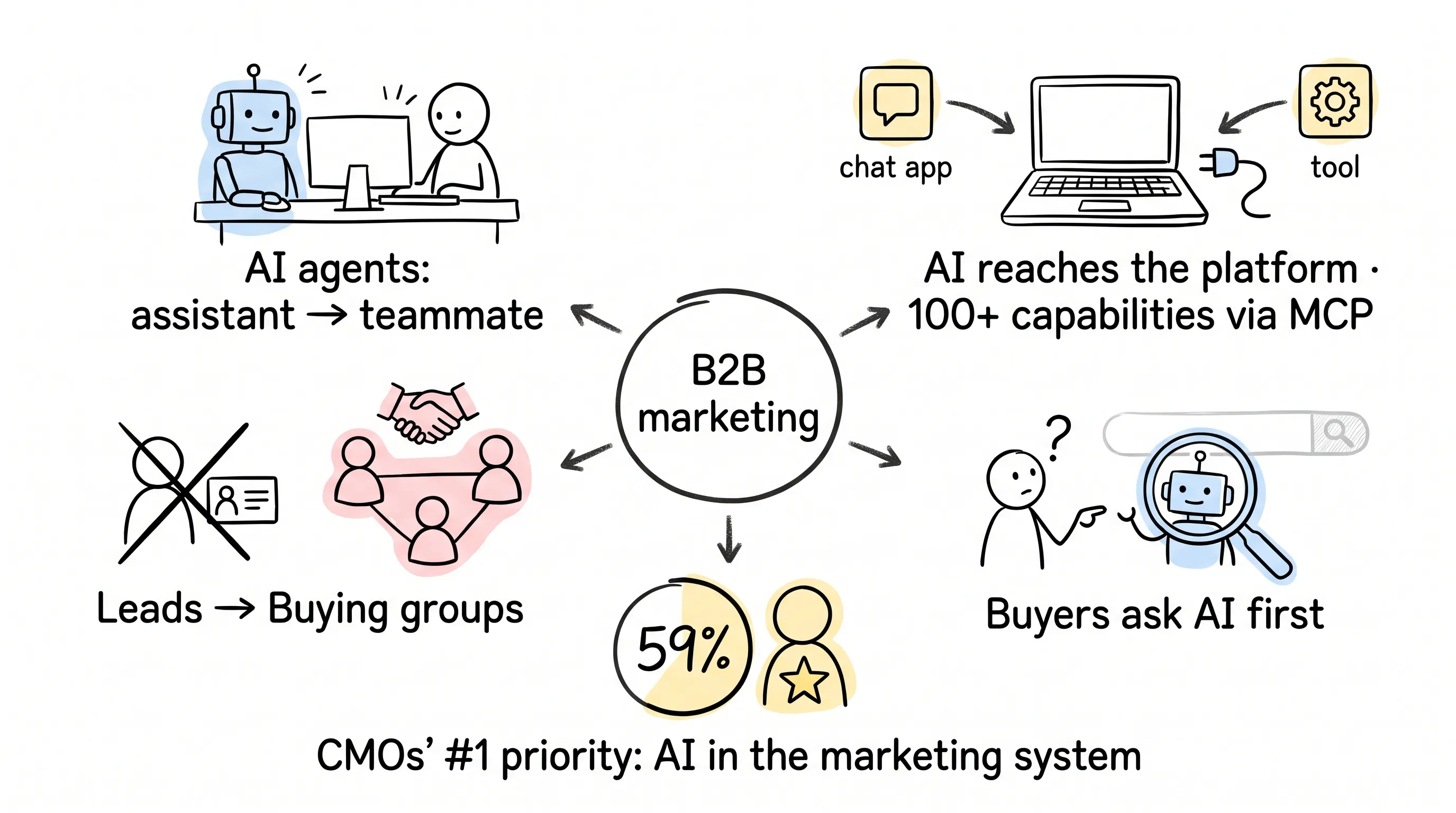
The first shift: AI agents are turning from "assistants" into "teammates."
You used to use AI to draft an email, tighten up a line of copy. Now? It starts planning audiences, building journeys, and tuning campaigns on its own, and your job is to oversee and make the final call.
The role has changed. It used to be a tool; now it's a colleague.
The second shift: your marketing platform has to be within reach of your AI.
What does that mean? Teams can't work these days without ChatGPT, Claude, or Copilot, and they want to run marketing systems right from those AI entry points. So Adobe built an MCP (Model Context Protocol) server for Marketo Engage, opening up more than 100 platform capabilities — external AI tools can plug in and use them, with the original permissions and governance all intact.
You sit in the AI you already like — and put your marketing platform to work.
The third shift: the focus has moved from "leads" to "buying groups."
What is a buying group? The group of people who actually take part in the purchase decision. In B2B, a deal is rarely approved by a single person. What you have to win over is a web of relationships, not a business card.
The fourth shift: buyers have started using AI to find vendors.
Buyer research used to begin with a search box. Now, more and more, it begins with "asking an AI." If your brand doesn't show up in AI's answers, you might not even get a shot at playing.
The fifth shift, and the one I find most striking: AI is now on every CMO's agenda. In Gartner's 2026 survey of B2B CMOs, 59% said their number-one strategic priority is weaving AI into the marketing system.
59%. More than half.
This is no longer a prediction. It's a reality already unfolding.
A judgment I particularly like
Beyond the report, Adobe offered one more idea: marketing needs to move from "automation" to "orchestration."
What is orchestration?
Think about it. When does a buyer come to you? Usually it's after they've finished the research with AI, formed their views, and pulled their buying-committee colleagues into a group chat — only then do they raise a hand to the brand.
The signal they hand you at that moment is not the starting gun.
By the time you step onto the pitch, the match is already 70 minutes in.
In a window that short, standing still is burning money. So the system can't dumbly react to signals one at a time; it has to put everything about this person, this company, and the whole buying group together, weigh it, decide for itself what the next step should be — and then go do it.
That is orchestration.
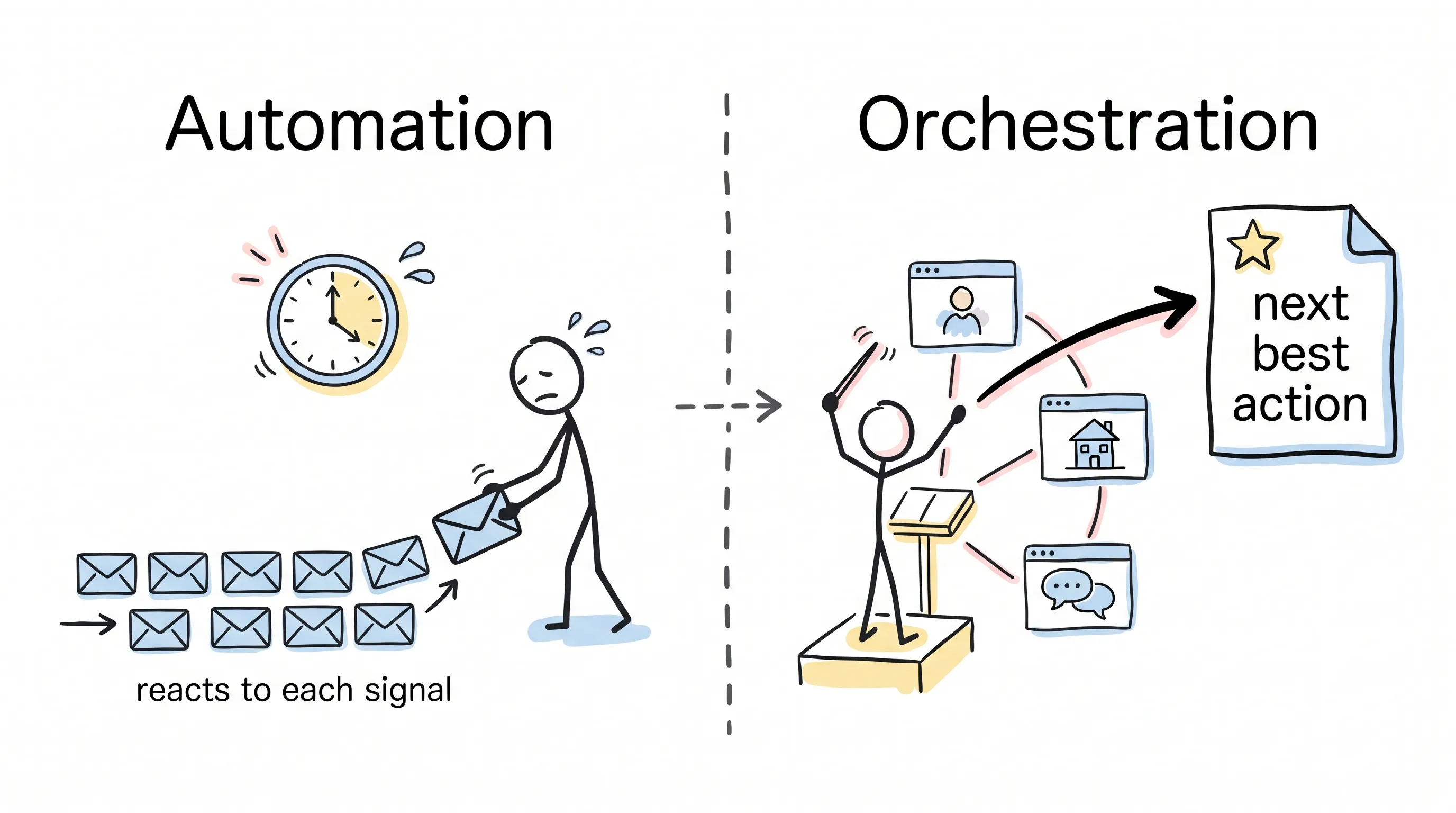
Adobe's approach is to add a layer of "contextual intelligence" on top of Marketo Engage's data foundation. This layer organizes customer data and every kind of signal into continuously updated "semantic stories." Reading these stories, the system can decide on its own: what is the next best action? Which journey to take? Which channel to act through?
How does this land in practice? Adobe offers two paths.
The first is for teams already using Marketo Engage. The newly added Marketo Optimizer and Marketo Qualifier run directly on the existing data foundation — no separate customer data platform to buy, no data to migrate. Optimizer uses AI reasoning to weave the journeys of leads, accounts, and buying groups into a single thread, laying the "next best action" across marketing, paid media, and BDR (business development rep) channels. Qualifier combines inbound lead qualification and outbound proactive outreach into one agentic workflow, built to fill the "last mile" between demand generation and pipeline.
The second is for large enterprises with more complex data. Journey Optimizer B2B paired with Real-Time CDP B2B delivers deeper data unification and identity resolution, and supports multiple instances and multiple CRMs.
Two paths, one goal: no matter where you stand today, there is a walkable path to the mature state of marketing AI.
What you can use right now
None of the above is vaporware. A whole set of these capabilities is already on the shelf.
Take that thing called CX Enterprise Coworker. It lives inside Marketo Engage. You tell it in plain language, "help me set up this workflow" or "check what's wrong with this batch of data," and it goes and does it.
Take the MCP server mentioned earlier. More than 100 capabilities opened to outside AI tools, while permissions and governance stay firmly in your own hands.
And data governance. Agents triggered by webhooks will clean the data, fill in missing fields, and filter out bot visitors before a lead enters the nurturing flow. There are also dedicated workflow agents and data agents: one handles campaign orchestration, the other program quality and data standards.
Over on Journey Optimizer B2B, there's an Account Insights dashboard that uses first-party intent data to tell you: which accounts are heating up, whether contact coverage is enough, and what's stirring inside the buying groups. Emails can carry conditional content, customized by person, by account, by interest. Sales folks can see these insights right in the CRM, and send pre-approved emails directly.
Oh, and one detail I especially like: the AI assistant can generate email copy, images, and subject lines in batches, but Adobe promises in black and white that it will not use your customer data to train its underlying models.
Honestly, a promise like that is more reassuring than the features themselves.
And there's still a whole list left: a brand-new email designer with Adobe Express built in (crop images, cut out backgrounds, change formats — and call up Firefly and the stock library as you go), dynamic conversations that score live chats in real time by temperature (warm, hot, scorching), webinars that automatically produce chapters and summaries and can be turned into blog posts, plus a dashboard for monitoring Salesforce sync, and ad hoc reporting that is 5x faster on large datasets.
So many I can barely count them.
Finally, about those 15 years
A 15-year reign at the top — what does it prove?
My read: on the marketing automation track, Adobe hasn't just called the next step right once. It has seen the next step clearly for 15 years running. And this pivot from automation to orchestration is the next one.
The market never rewards yesterday's leaders. It only rewards those who keep seeing the next step clearly.
If you lead a B2B marketing team — whether you're just starting to touch AI or already running agentic workflows — this Magic Quadrant is worth half an hour of your time. If you already have Marketo Engage in hand, go try Coworker and the two new products first.
May you, too, always be the one who sees the next step clearly.
Continue reading
Related articles

What Is GEO? How Your Brand Gets "Mentioned" in the Age of AI Search
An explainer on GEO (Generative Engine Optimization) for e-commerce and DTC brands: how it differs from SEO and AEO, why AI answers shape brand visibility, and eight practices covering question-focused content, consistent brand messaging, structured pages, external evidence, comparisons, and AI mention tracking.

AI Is Already Making Decisions for Your Customers. Are You on the List?
A learn article explains GEO (Generative Engine Optimization): why AI-generated answers now shape which brands customers see, and how SEO fundamentals, entity clarity, citable evidence, and monthly measurement affect visibility in AI answers.

Google Is Stuffing Ads Into AI Search: These Recent Stories Are Really One Story
A news roundup linking recent AI marketing stories—Google adding ads to AI Mode, Amazon's Ads Agent, ChatGPT image updates, a UK startup tracking brand mentions in AI answers, and an AI ransomware warning—arguing that control over ad data and visibility is shifting toward platforms.