
Before You Run AI Marketing, Price Out These Fines
A learning guide to the legal lines of using AI in marketing, covering GDPR, CAN-SPAM, and the EU AI Act, the ethics questions of bias, inclusion, and transparency, and four practical steps for consent, data handling, human review, and regular regulation checks.
Say you're the head of marketing at a consumer goods company.
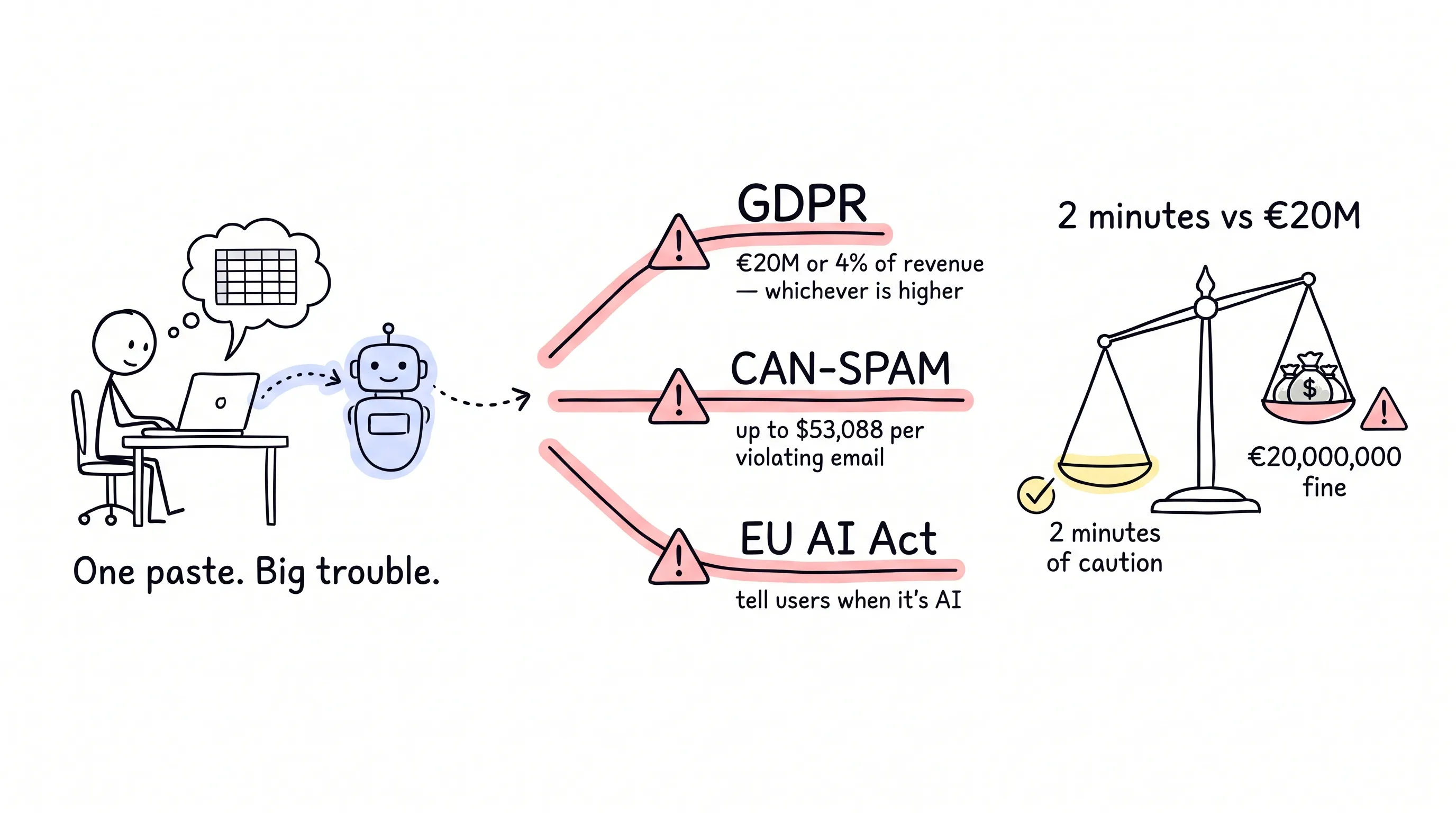
It's Friday night, 10 p.m., and you're racing to finish a weekly report. Thirty thousand customers' purchase records are sitting in a spreadsheet. You select all, copy, and paste them into a free AI chatbot: "Analyze my repeat-purchase trends."
Three seconds later, the analysis is done. Pretty handy.
You close your laptop and sleep well.
What you don't know is that one paste silently accepted a data-sharing agreement you never read. From that moment on, thirty thousand customers' phone numbers, addresses, and shopping habits became fuel for that AI company's model training. A few months later, an operations person at another company asks the same tool a question — and the AI's answer includes a customer profile that closely matches your customer base.
Now you're in serious trouble. In the eyes of consumer privacy law, this is a genuine violation.
How heavy is a GDPR fine? Up to €20 million, or 4% of your global revenue — whichever is higher.
Let's walk through this from the top: exactly which lines AI crosses, where those lines are drawn, and how to stay on the right side of them.
AI Is a Brilliant Intern Who Knows Nothing About the Law
AI's role in marketing is a lot like a brilliant intern who has never cracked a law book.
Writing ad copy? Sure. Blog posts? Sure. Pulling data, building customer profiles, automating the entire pipeline from lead acquisition to closed deals — all fine. It works a hundred times faster than your team.
But you know how interns fail: the moment nobody's watching, that's when they send things that should never leave the building to places they should never go.
AI is the same. Feeding customers' sensitive data into a public large language model without consent is a violation. Using AI to process user data without ever telling your users is also a violation. Either one, once exposed, is no small matter: fines, lawsuits, and a reputational collapse tend to arrive together.
The more capable your AI, the faster you hit the line.
So first, get clear on the hard lines.
Line One: GDPR, a Law That Reaches Across the Planet
What is GDPR? The General Data Protection Regulation, written by the European Union to protect people in the EU and European Economic Area — and their data.
Notice its jurisdictional logic: if your business touches Europeans or their data, it applies to you — even if your company is on the other side of the planet.
For AI-powered marketing specifically, it demands two things. First, if you're going to touch customer data with AI, you must be transparent: why you're using it, how, and with which tools. Second, users can demand you delete their data from your records at any time, and you have to comply.
The cost, as mentioned: €20 million or 4% of revenue — pick one, and the higher figure applies.
Over in the US, California has a law with a very similar logic: CCPA, the California Consumer Privacy Act. If you're selling to the US market, you have to take it seriously too.
Line Two: CAN-SPAM, the Rules of the Email World
If you send marketing email, you need to know CAN-SPAM. The name is an acronym — Controlling the Assault of Non-Solicited Pornography And Marketing.
That tells you exactly how fed up lawmakers were with spam.
It governs a few things: subject lines, body copy, and sender information must all be truthful; the unsubscribe link has to be easy to find and takes effect with one click; and no emailing people without their consent.
So where does AI trip you up? Litmus ran an email-trends survey: 34% of marketers are already using generative AI to write email copy. Chasing open rates, AI loves to write subject lines that are exaggerated and borderline misleading — one slip, and it slides into deception. And CAN-SPAM fines are charged per email: up to $53,088 per violating message.
Send ten thousand emails and do the math yourself.
Line Three: EU AI Act, the New Rules Built for AI
The first two laws are old rules applied to new tools. The EU AI Act, passed in 2024, is aimed directly at AI.
For marketers, the single most important clause: when a user is interacting with AI, you must tell them.
What counts as "interacting with AI"? A few examples. The customer-service agent is an AI. The ad image is AI-generated. The voice in the video is a cloned synthetic voice. Even that virtual influencer posting every day — the person doesn't exist. All of this is synthetic content. If it shows up in your marketing, you must label it clearly.
As for the penalties, look to GDPR and CAN-SPAM for scale — they will not be polite.
Above the Law, Three Questions of Conscience
Regulation is the floor. Above the floor sits ethics. Don't confuse the two: regulation decides whether you get fined; ethics decides whether users trust you.
The first question: bias.
AI's bias comes from three places. Biased data: if the training data itself is incomplete or unbalanced, the output comes out skewed. Biased algorithms: during training, the model unintentionally tilts toward certain outcomes. Feed it data where male customers overwhelmingly dominate, and every targeting plan it generates afterward will only speak to men. And biased people: Grok, the chatbot from Musk's xAI, was reported to lean toward Musk's personal views in its answers.
The cost of bias isn't just skewed content. When things blow up online, it happens fast: one ad with discriminatory undertones, and out comes the PR crisis, the collapsed trust — sometimes a fine on top. The fix: audit your training data regularly, and set neutral, explicit rules for data labeling and prompt design. If a tool can't be fixed no matter how you tune it, swap it out. Don't get sentimental.
The second question: inclusion. Internet corpora already carry discriminatory patterns around gender, race, and physical ability, and AI learns them and repeats them. So make "block non-inclusive content" a hard rule written into your tool configuration — don't count on the model to behave on its own.
The third question: transparency. If you use AI, say so openly: why, what data it processed, how long you keep it. If the content is mostly AI-generated, label it. Same for ad targeting — why did this user see this ad? Because they browsed your website last week. Tell them, and they'll actually think you're honest.
What transparency buys you is users who dare to hand you their data.
Four Moves to Pin the Risk Down
Enough theory. Here are four moves you can put to work immediately.
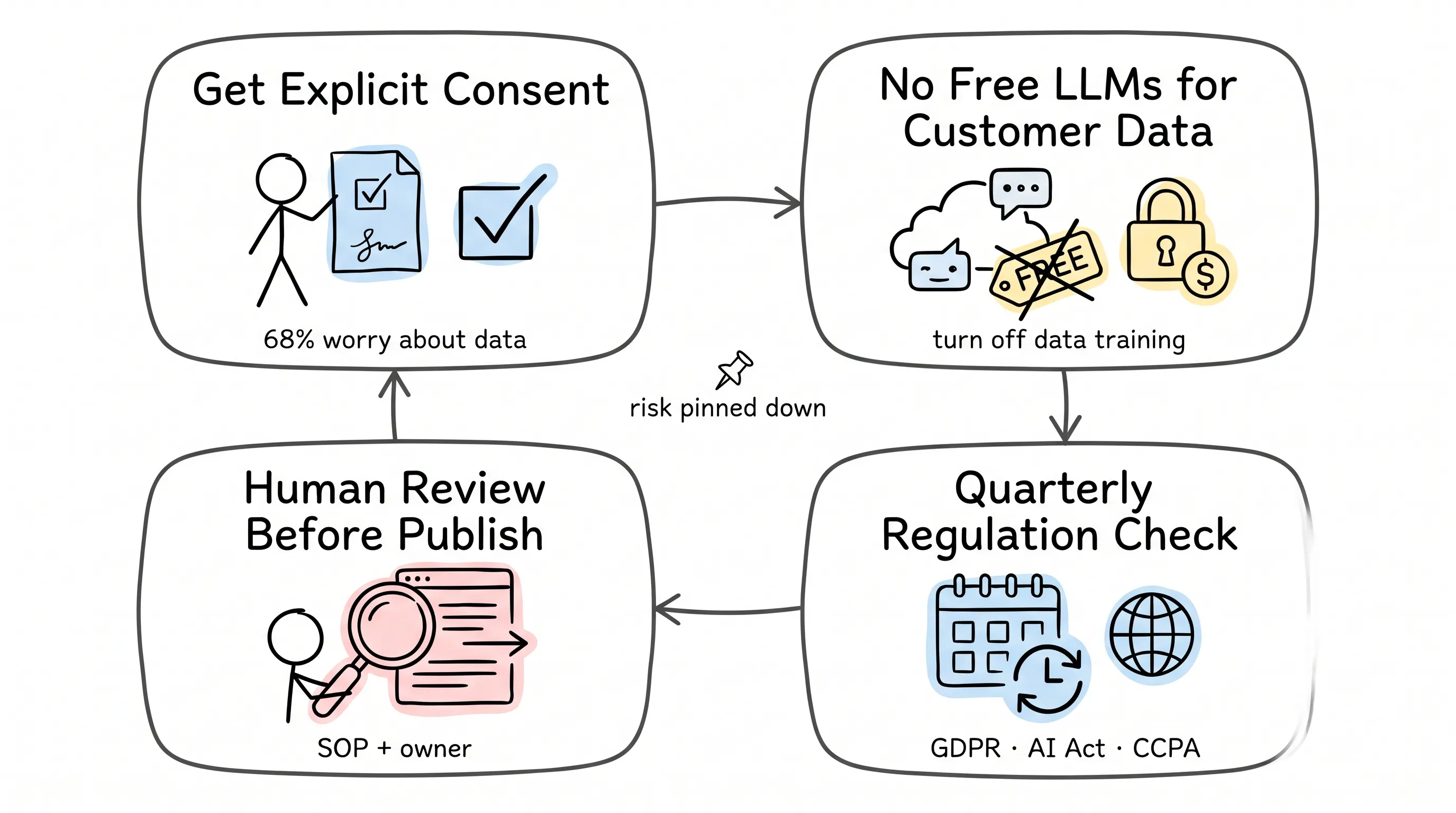
First, get explicit consent. IAPP published a privacy and consumer trust report in 2023: 68% of consumers worry about their online data, and 57% consider AI a significant threat to data privacy. Trust is fragile to begin with — stop pressing on it. In practice: spell out how AI is used in your privacy policy; get authorization before collecting data; confirm again before any high-stakes use; and periodically circle back to ask whether users still consent. Make the data-deletion entry point easy to find, too.
Second, don't touch customer data with free large models. Free versions of public tools — ChatGPT, Perplexity, Gemini — have "agree to data being used for training" pre-checked for you. Your data goes in, and it may come back out in someone else's answers. Either upgrade to a paid version and turn off data sharing in settings, or process your marketing data inside a private analytics platform like Snowflake. And vet AI vendors the way you'd vet any vendor: read the security white paper, read the privacy policy, look at the reputation they've built over the years. Free large language models tend to be the most expensive.
Third, everything AI produces passes through human hands before it goes live. AI will confidently make things up, and no amount of beautiful prompt-writing will stop it. So assign an owner: every piece of AI-involved content gets a human pass before publishing. Give the team an SOP (standard operating procedure): which words may never appear, what tone to hold, which brand voice to align with. For what's already out there, review it regularly. And run legal review before adopting any new tool. Trading a few points of efficiency for the risk of fines and lawsuits — that math doesn't work.
Fourth, put regulation-checking on the calendar. Data and AI regulations update all the time, like phone operating systems. Each quarter, walk through the rules of your market: doing business in Europe, GDPR and the EU AI Act are mandatory checks; in the US, every state has its own set — California's CCPA is just one of them, so watch your own state's rules too.
One Last Thing
Back to that Friday night.
All the marketing lead actually needed was two more minutes: delete the phone-number column, or switch to the paid version, or send legal a message asking whether this paste was okay.
Two minutes, or twenty million euros — which will you pick?
AI has grown into the core of marketing, and that trend isn't reversing. The more you depend on it, the more customer data it touches; the more it touches, the higher the odds something goes wrong.
Compliance doesn't lock down your AI. It locks down your company.
Here's hoping you never have to pay that €20 million fine.
Continue reading
Related articles

It's 2026: Stop "Buying" AI Tools for Your Marketing Team — Start "Hiring" AI Agents
This learn article explains how AI agents differ from standalone AI tools in marketing, outlines three agent categories — build-your-own platforms, CRM-native agents, and vertical tools — and covers use cases across SEO, social media, advertising, and reporting, plus criteria for choosing one.

Did the Money You Spent on AI Marketing Ever Come Back?
A guide to measuring AI marketing ROI across three layers: ad reports, sales pipeline, and the financial ledger. Covers metrics such as ROAS and CPA, eight dashboard metrics, industry benchmarks, and common measurement mistakes.

How to Pick a Creative Automation Platform: First, Figure Out What These Eleven Actually Do
A learn article sorts eleven creative automation platforms — including Bannerflow, Celtra, Smartly.io, and Storyteq — into four functional groups and proposes five evaluation questions covering publishing reach, automation depth, ease of adoption, team fit, and verifiable evidence.