
88% of Marketers Use AI Every Day. Only 1% Have Recouped Their Investment.
This learn piece examines the gap between AI marketing adoption and returns: 88% of marketers use AI daily, but only 1% of companies investing in generative AI have recouped their investment, which the author links to missing training and internal playbooks.
A few days ago I had dinner with an old friend who runs an e-commerce business. He complained to me that his company now uses AI across the entire chain, from copywriting to image creation, and the work flies along at incredible speed.
I asked: and the results? Has the money come back?
He paused for a moment, then said: honestly, I've never done the math.
That pause is interesting. Because a while back I came across a set of data about AI marketing — the contrast was so stark I read it three times back and forth before I dared to believe I hadn't misread it.
Let's start with the biggest number.
The money is coming in — real money.
The AI marketing market was $12.05 billion in 2020. By 2025, it grew to $47.32 billion. What does that mean? Nearly quadrupled in five years. And it's not done: by 2028, the number is projected to exceed $107.5 billion, a compound annual growth rate of 36.6%.
What does 36.6% mean? Think about it: you put $100 into a pool yielding 36.6% a year, compounding, and in a little over four years it becomes $340. When an entire industry expands at that pace, it means demand downstream is genuinely exploding.
And there's a bigger pot behind it: generative AI was worth $62.75 billion in 2025, projected to hit $356 billion by 2030.
The market is growing. What about the people using it?
Practically everyone.
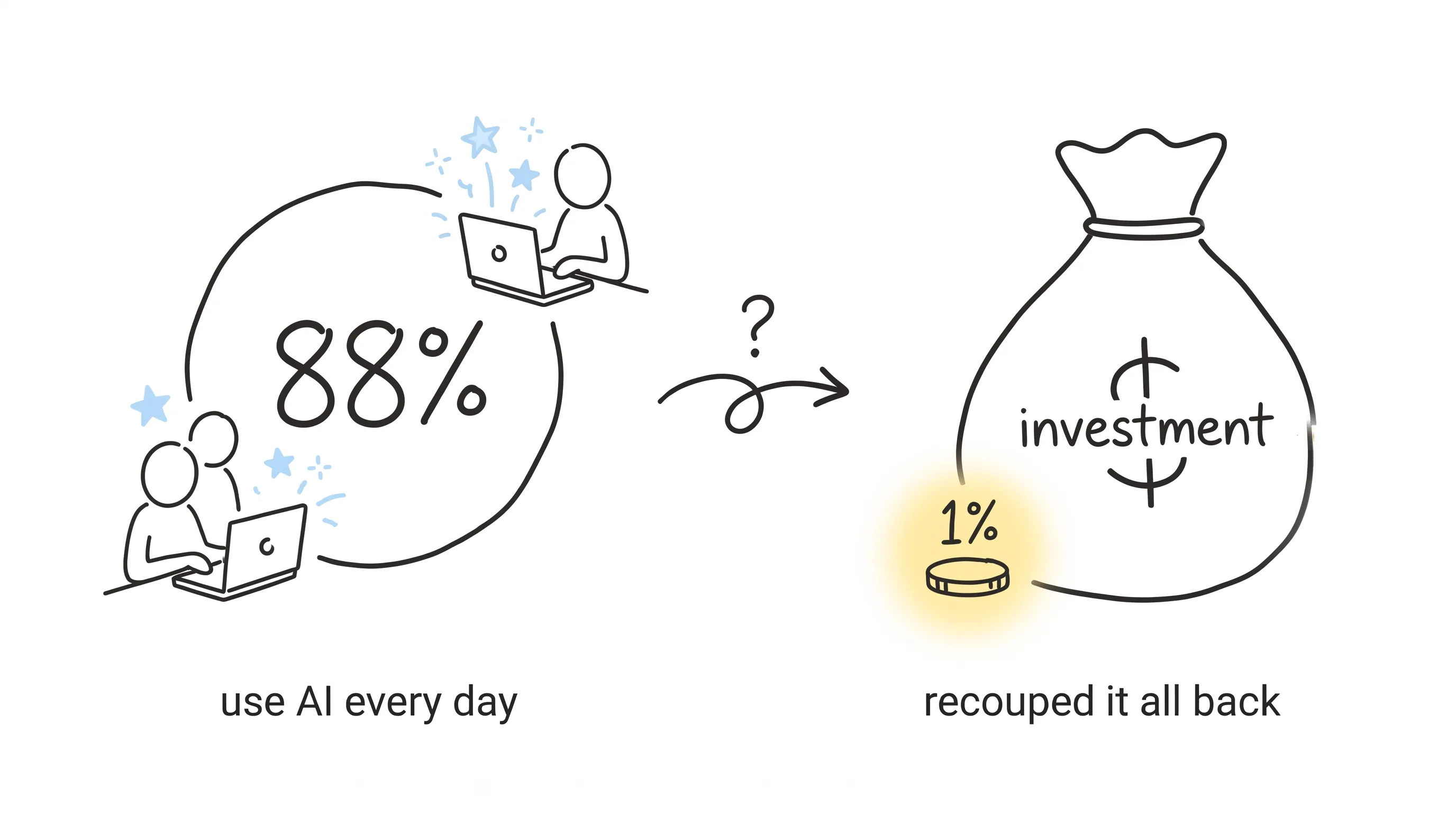
88% of digital marketers use AI in their daily work. 92% of enterprises plan to invest in generative AI tools within the next three years. The top companies go without saying — in the tier that includes Google, Pfizer, CVS Health, and General Motors, 91.5% have already invested in AI. And 69% of marketers say they're excited about the changes AI is bringing.
Looks like one big celebration, right?
But here comes the needle that stung me most in this entire dataset:
Among companies that invested in generative AI, only 1% have recouped their full investment.
1%. Not 10%. One percent.
Why? With this many people using it and this much money poured in, why has almost nobody broken even?
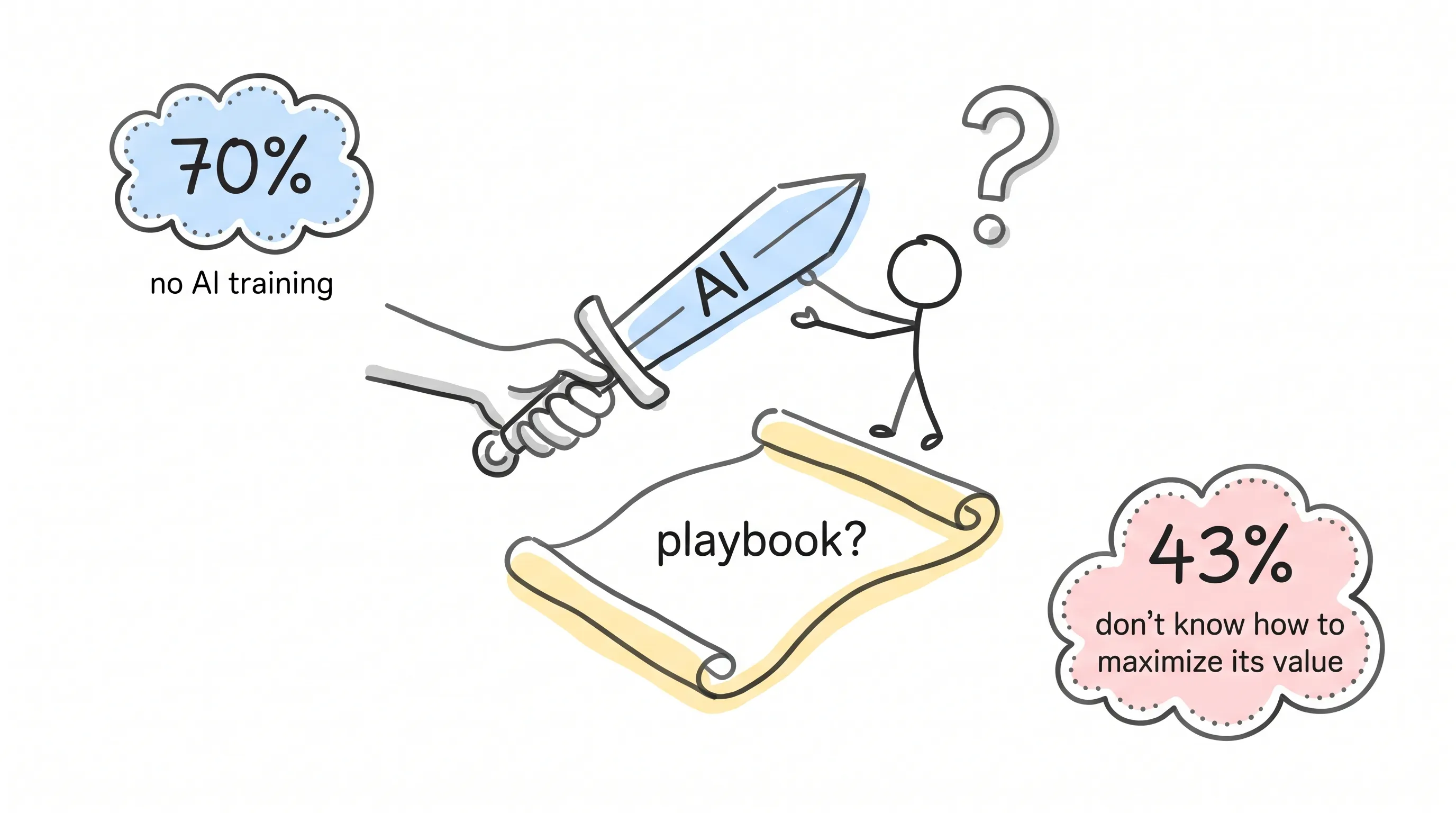
The answer hides in these numbers: 70% of marketers say their companies provide no generative AI training at all; 43% admit they don't know how to maximize AI's value; 39% don't know how to use it safely.
Put plainly: they handed out the sword. Nobody taught the swordsmanship.
Here's the interesting part: this sword works better in frontline hands than in management's. Frontline employees use generative AI on the job at three times the rate their managers do. While the boss is still watching and waiting, the intern has already used AI to finish the weekly reports, the creative assets, and the competitive analysis.
So for the people using it right, what does the math look like?
Just as blunt: 93% of marketers say AI lets them produce content faster; 90% say decisions come faster; 83% say AI lifted them out of repetitive work, freeing them up for strategy and creativity — the things that are actually valuable; 81% say brand awareness and sales went up because of it. In the US, 75% of marketers say AI saved their organization money, and 74% say they're more motivated — and they exceeded their goals.
Notice the relationship between this set of numbers and the last one. Same sword: some people cut their fingers, some cooked a feast. The difference isn't the sword. It's whether the person holding it was ever taught, and whether they've thought through what it's for.
This leads to the most important ledger in this whole shift: the division of labor.
AI takes over production. Humans move back to strategy.
Some forecasts say companies that fully adopt AI in marketing operations will shift 75% of their employees' work from "production" to "strategy." What does moving from production to strategy mean? It means the work that used to eat your whole day — laying out pages, tweaking images, writing the tenth draft of copy — is now the machine's job. Your job is deciding who to talk to, what to say, and why.
The marketer's job itself is being redefined. And this isn't a prophecy; it's an accomplished fact: in 2025, 30% of outbound marketing messages at large organizations were already written by AI.
Of course, every coin has a flip side.
49.5% of companies worry about data privacy and ethics; 43% have been put off by AI content's inaccuracies and biases; 35% worry about cost. In Europe and the Americas, 30% of marketing and advertising professionals believe generative AI threatens brand safety and manufactures disinformation. The U.S. Equal Employment Opportunity Commission has also weighed in: over-reliance on AI for hiring screening could produce discrimination — and legal and reputational trouble with it.
These concerns are all legitimate. But none of them is a reason "not to use AI." They're only a reason "not to use AI with no guardrails."
Finally, let's pull the camera back and look at the big picture.
Nearly 90% of Fortune 1000 companies are increasing their AI investment. McKinsey ran the numbers: by 2030, 30% of work hours could be automated by AI; between now and then, there will be 12 million career transitions, and low-wage jobs will take a hit 14 times harder than the highest-paid ones. Looking further ahead: by 2027, 42% of business processes will be automated; by 2028, 44% of workers' skills will be disrupted. And 85% of executives believe AI can help them build and hold a competitive advantage.
As for whether people will be replaced, my view is simple: in the short run, AI won't replace people. But people who use AI will replace people who don't. The 99% who can't recoup their investment and the 83% who freed up time for strategy are, in the data, telling the same story.
Dinner was nearly over when I asked my friend what he planned to do when he got back.
He said: first, round up the few people on the team who use it best, have them write down their methods, and circulate them company-wide.
I said: yes, that's exactly right.
The tools were never scarce. What's scarce is the playbook that turns tools into profit.
Here's to being the one who runs the numbers first.
Continue reading
Related articles

It's 2026: Stop "Buying" AI Tools for Your Marketing Team — Start "Hiring" AI Agents
This learn article explains how AI agents differ from standalone AI tools in marketing, outlines three agent categories — build-your-own platforms, CRM-native agents, and vertical tools — and covers use cases across SEO, social media, advertising, and reporting, plus criteria for choosing one.

Did the Money You Spent on AI Marketing Ever Come Back?
A guide to measuring AI marketing ROI across three layers: ad reports, sales pipeline, and the financial ledger. Covers metrics such as ROAS and CPA, eight dashboard metrics, industry benchmarks, and common measurement mistakes.

How to Pick a Creative Automation Platform: First, Figure Out What These Eleven Actually Do
A learn article sorts eleven creative automation platforms — including Bannerflow, Celtra, Smartly.io, and Storyteq — into four functional groups and proposes five evaluation questions covering publishing reach, automation depth, ease of adoption, team fit, and verifiable evidence.