
HubSpot Asked 1,000+ Marketers: On the AI Test, Which Question Are You On?
A walkthrough of HubSpot's survey of 1,000+ marketing and advertising professionals: near-universal AI adoption, hurdles like data privacy and overlapping tools, why most treat AI as an assistive tool, top tools and channels such as email and blogs, reported ROI, and outlooks toward 2030.
A few nights ago I had dinner with two friends who work in marketing.
One said their team basically can't get anything done without AI anymore. The other was anxious: what if this thing automates me out of a job someday?
Neither could convince the other.
On the way home, I remembered something: HubSpot ran a survey asking more than 1,000 marketing and advertising professionals around the world how AI is actually being used in marketing. The survey was first conducted in 2025, with an updated version released in 2026.
Real answers from over a thousand practitioners beat two friends trading heated arguments over dinner.
I finished going through the whole thing. Here it is, for you.
What Does "AI Is Already the Norm" Mean?
Plenty of companies say "we're embracing AI." What that looks like in practice, you have to check the data.
Three numbers from that survey — remember these:
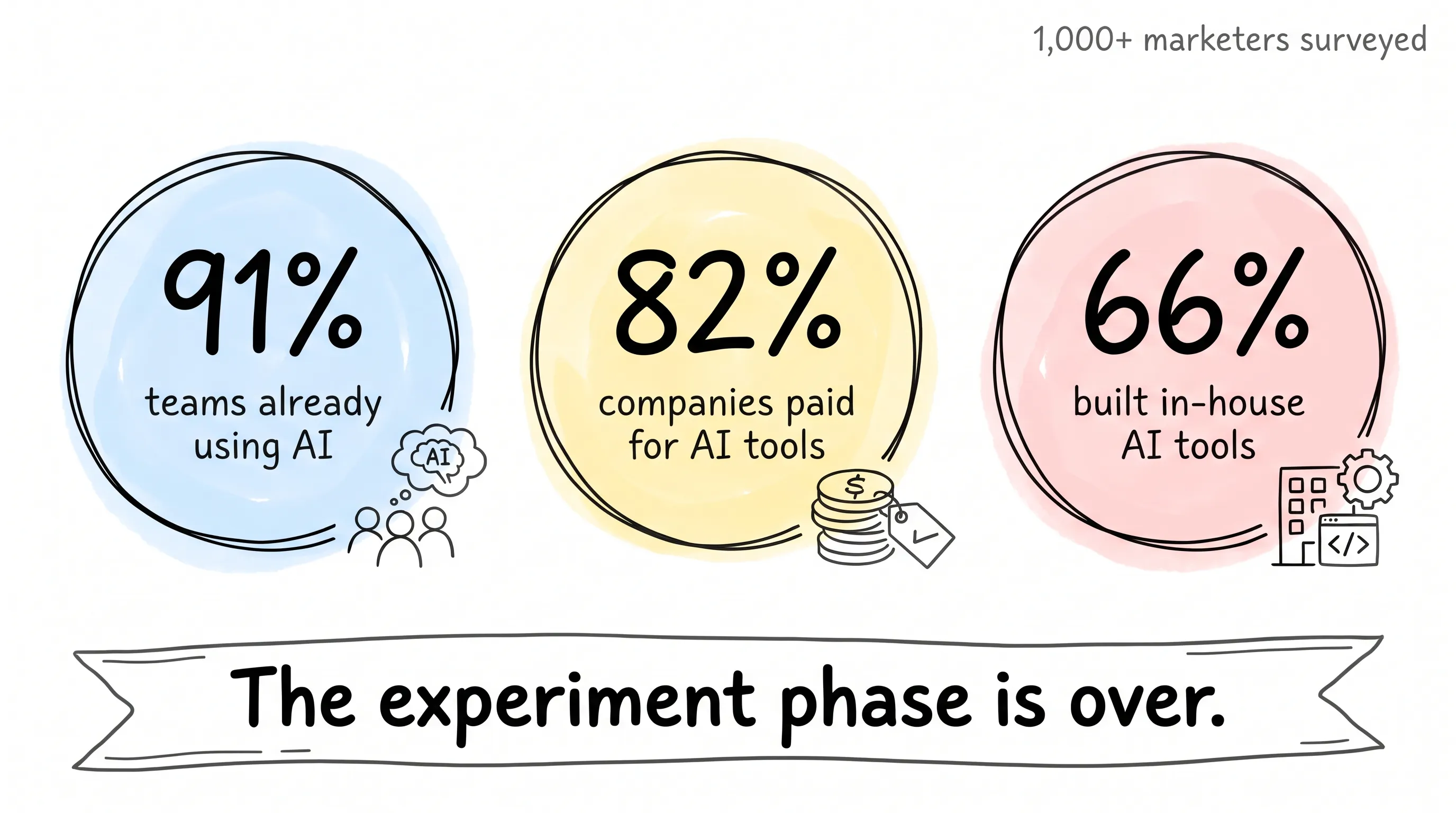
91% of marketing leaders say people on their teams are already using AI to help get work done.
82% of marketers say they or their companies have already paid for automation tools for employees to use.
66% of organizations have built in-house AI tools specifically for their marketing teams.
Think about what that means.
It means the question "should we use AI?" is settled. What everyone is discussing now is "how."
Not long ago, talking about AI still sounded like "you could give it a try." Now AI sits on the workbench next to spreadsheets and documents — standard equipment.
The experiment phase is over.
If you're still hesitating, your peers most likely aren't.
But There's Always Another Side
Universal adoption doesn't mean smooth sailing.
In the survey, three hurdles are stopping marketers from moving forward:
Hurdle one: data privacy. 42% of marketers say their teams held off on new tools this past year purely over data security concerns.
Hurdle two: the investment in training and time. 39% feel that learning a new tool takes too much effort, and the time cost is too high.
Hurdle three: too many tools, and they all look alike. 35% complain: the market is flooded with AI tools with overlapping features that don't talk to each other. You just got the hang of one and another pops up; three tools doing the same job, with data getting shuttled back and forth between them.
That third hurdle is painfully real. It's like owning three remotes for one TV — the devices aren't bad, they just don't know each other.
The last mile of adoption is never blocked by technology. It's blocked by trust and habit.
So, Will AI Take Your Job?
I'd guess that's the question you care about most. It's also what my friend asked me over dinner.
The survey's answer is remarkably consistent: 65% of marketers believe AI should be treated as an assistive tool, and they remind people around them not to over-rely on it.
Why only "assistive"?
Because AI isn't yet at the point where you can fully trust it. It will state falsehoods with total confidence, it carries biases, its output quality swings. An email going to a major client — would you hand it over entirely?
Here's how people are actually letting AI into content work:
52% of marketers use generative AI for written content — blogs, ebooks, marketing emails. But note: only 4% let AI write the whole piece start to finish.
What about the other 96%? They use it for ideas, outlines, a couple of draft paragraphs — then a human takes over.
One more number that stings: 46% of marketers have only modest confidence in their own ability to spot when AI gets something wrong.
In other words, most people understand: AI handles the speed. You handle the accuracy.
The person who makes the final call before the buzzer? Still you.
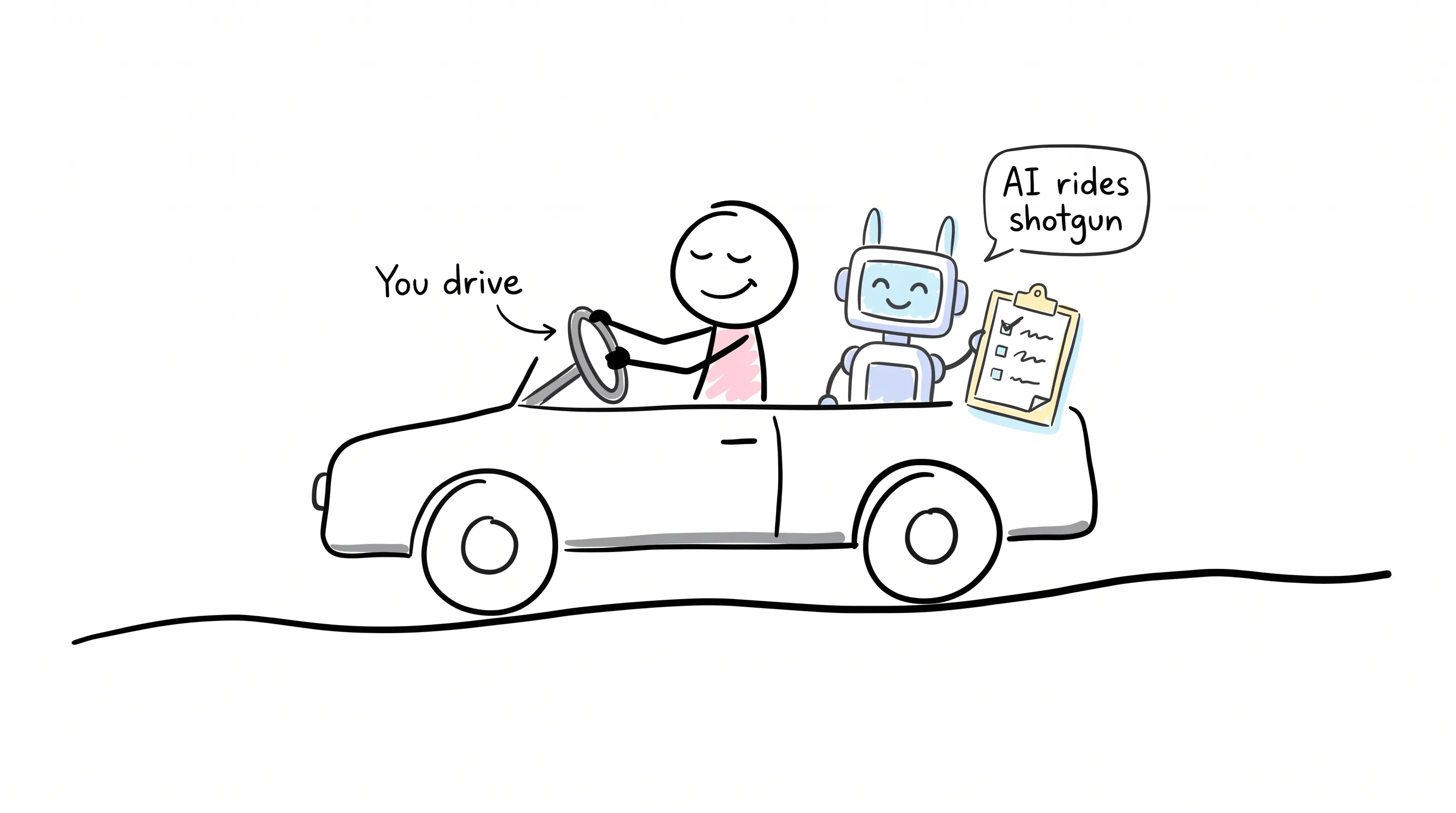
So you can breathe easy. At least for today, AI rides shotgun — the steering wheel is still in your hands.
Where the Law Is Silent, Consumers Aren't
Some will say: if everyone's using it this way, can't we just use it however we like?
Not quite. Multinationals understand this math best.
The United States still has no comprehensive federal AI law. But the EU has the AI Act, which comes down hard on transparency, bias, and high-risk applications; China requires companies to register their AI models with the government.
The same AI marketing playbook that runs fine in the US may be a violation in Europe — locking you out of an entire major market.
So if I'm not selling overseas, I'm safe, right?
No. Where the law hasn't arrived, consumer sentiment gets there first.
Here's an example. Right before Christmas 2024, Coca-Cola used AI to make a Christmas ad. The internet tore it apart, calling it "a terrifying dystopian nightmare." Viewers found the visuals crude — but the deeper grievance was: why would a company this big bypass artists and animators and let a machine do the work?
Add the standing worry that people's data is being fed into AI training — and what happens if it leaks?
You see the pattern: the law is your floor; consumer sentiment is your ceiling.
So what do you do? One word: transparency.
Content creation, data collection, customer communication — whenever AI is involved, tell consumers openly. Many media outlets now note at the top or bottom of an article: AI was involved in producing this piece.
Hide it, and the moment you're caught, trust is gone. Disclose it proactively, and you're usually fine.
So Is the Math Actually Worth It?
After all is said and done, what is AI for?
For individuals: time and energy. From the survey:
79% of marketers agree that AI and automation tools help them do less mechanical work; 73% say they can spend time on the most important part of their job; 66% say they have more time for creative work.
In plain English: less grunt work, more real work.
If you want to try it yourself, you could start with HubSpot's own Breeze Assistant, which combines generative AI with the data in your CRM to get the work done for you.
For organizations: the return. 50% of marketing leaders say their company supports employees using AI to at least some degree; 30% discourage it; and 20% have no policy at all.
But the ROI picture is the interesting part: among companies that have already invested in AI, 75% of leaders say ROI is positive, and only 4% say the investment lost money.
On one side, 75% seeing positive returns. On the other, 20% of companies that don't even have a policy.
The gap between those two numbers? That's the opportunity.
What Is Everyone Using, and Where?
Now for the practical part. How 1,000+ people actually use this stuff is worth stealing from.
Tools first. At the top: image and design generation tools (think DALL-E, Synthesia), used by 40%. Second: chatbots (ChatGPT, Gemini, Copilot and the like), 39%. Third: AI audio and video editing — auto-cutting, noise reduction, color grading, that sort of thing.
Then channels — that is, where AI does the work for you:
Email and newsletters, about 51%, in first place. Text-based social media, 50%. Blogs and long-form articles, 47%.
As someone who makes a living writing articles, seeing "email first, blogs third" stings a little.
The key point: the returns on these channels are all solid — 63% of people see at least somewhat positive ROI on email, 67% on social, 68% on blogs and long-form.
In other words, this isn't feel-good theater. It genuinely saves money and time.
How much? The survey's average: one to two hours a day.
Over a year, that's several hundred hours. Imagine putting those hours into analyzing data, thinking about strategy, sitting with clients. What's that worth?
Looking Three, Five Years Out
Finally, the future. We don't have a crystal ball, but the judgment of 1,000+ practitioners is worth listening to.
In the survey, 65% of marketing leaders say they plan to increase investment in AI and automation tools going forward. By 2030, 65% of marketing directors expect the vast majority of software to come with AI built in; 67% of marketers believe that by then most people will have a generative AI assistant at their side at work — as ordinary as using search is today.
In fact, back in 2025, 67% of marketers already believed AI would significantly change how they work. Looking back now, that prediction is coming true.
The direction is no longer in question. The only question left: will you be in the early cohort, or the late one?
Finally, Back to That Dinner
At the end of the meal, I asked my anxious friend: suppose tomorrow AI finished all your reports, first drafts, and asset sorting for you — two extra hours a day. What would you do with them?
He thought for a moment and said: go see clients. Brainstorm new campaigns.
I said, well, there's your answer. What machines take away was never your job — it's the grunt work you never wanted to do anyway.
However smart the tools get, deciding which story to tell which client, which line will move a human heart — that still takes a person.
Give the drudgery to AI. Keep the brains for yourself.
May your hours go to the things that matter.
Continue reading
Related articles

What Is an AI Marketing Agent? From "Using AI" to "Delegating to AI"
A learn article explaining what an AI marketing agent is, how it differs from rule-based automation, and which repetitive tasks such as lead qualification, reporting, and campaign monitoring can be delegated while humans keep key decisions.

Marketing Automation Is Shifting from "You Do It" to "You Say It"
This article explains how marketing automation is shifting from rule-based platforms that merely execute toward AI agents that plan, create, publish, and review campaigns, covering delegable tasks, underlying technologies, tool categories, adoption steps, and risks such as privacy and automating without strategy.

When AI Does the Creative, Mistakes Come in Batches Too
A learn article on the risks of using generative AI for marketing creative across brand, legal, compliance, and operational layers, with case examples and seven practices for review, rights clearance, documentation, and vendor governance.