
14,000 Marketing Tools, Half of Them Gathering Dust
A bilingual learn article argues that most of the 14,000+ martech tools go unused, and that teams should diagnose their marketing bottleneck first before buying AI tools. It covers content, intent-data, sales-coaching, and automation tools, budget considerations, GEO (generative engine optimization), and platform-cons
A few days ago I had dinner with an old friend who works in B2B. Halfway through the meal, he pulled out his phone to show me: a bookmarks folder, crammed full, with links to dozens of AI tools.
He said, "Take a look — which of these should I actually buy?"
I said, don't start with which one to buy. Answer this first: of the ones you've already bought, how many are you still using?
He froze.
You can't blame him. This is an industry-wide oddity. There are now more than 14,000 martech tools on the market, growing 27.8% a year. Yet actual usage has dropped to 49%.
What does that mean? Half the tools you're paying for are gathering dust in a corner.
You keep buying more medicine, but the illness isn't getting better. Why?
Because most people's approach to picking tools is backwards from the start. Their logic goes: AI is hot, so I need to stockpile a pile of AI tools. So they shop the way people wander through a supermarket: everything looks worth grabbing, and the cart keeps getting fuller.
But there is only one right way to pick tools: start from your bottleneck and reason backwards.
What does starting from the bottleneck mean?
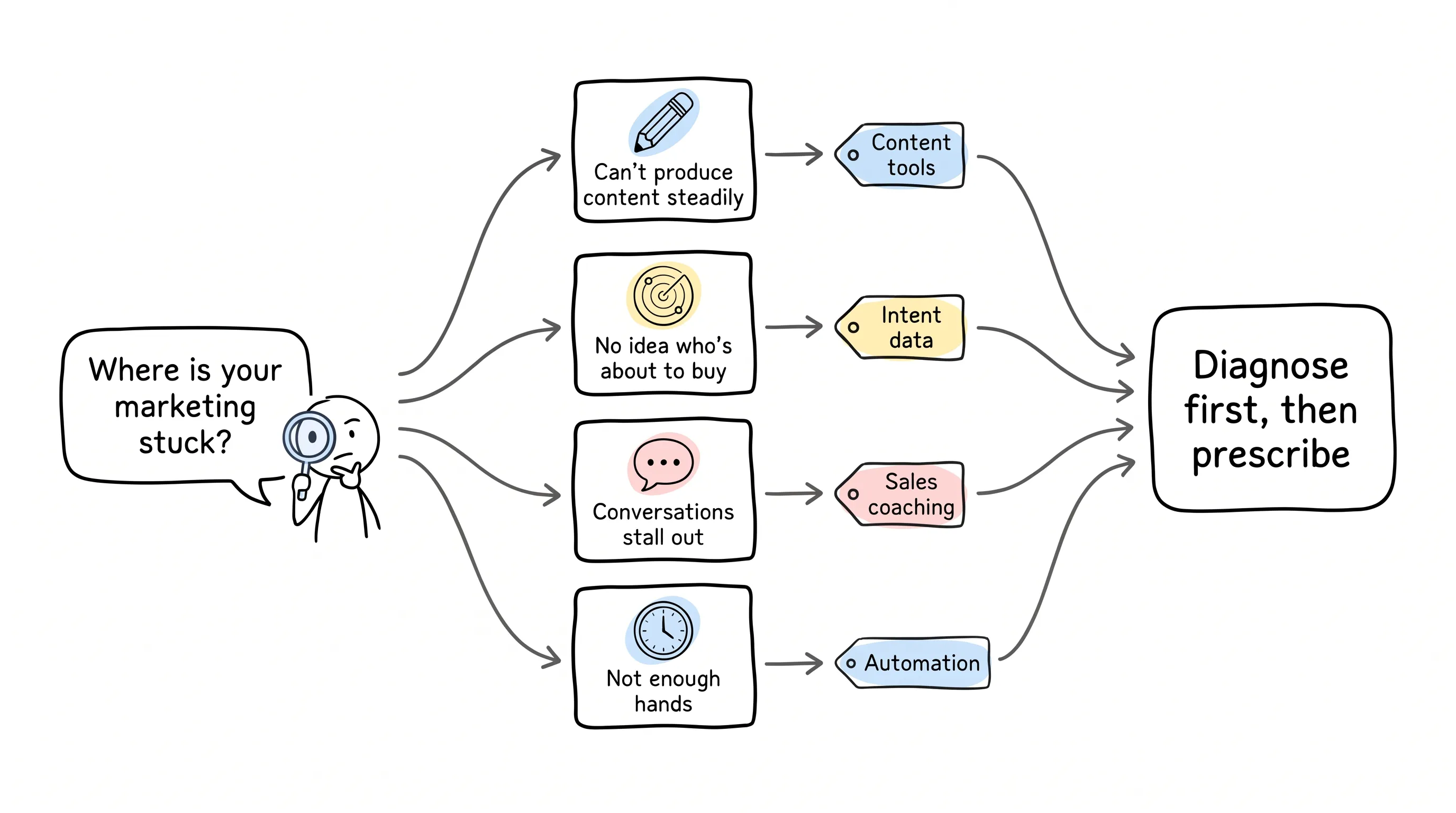
It's simple. Ask yourself one question: where is my marketing stuck right now?
For example, if you can't even produce content steadily — if you can't squeeze out three decent pieces in a week — then you should be looking at content tools. Something like Jasper, which keeps your brand voice flowing steadily; or Copy.ai, which chains your content and lead-generation workflows together.
Or say content isn't your problem — what you're missing is knowing who's about to buy. You've written plenty of articles, but you have no idea which companies are out in the market looking for solutions right now. Then what you need is intent data. 6sense processes more than 500 billion intent signals a month — that's exactly what it does. And Clay can plug into over 100 data sources and stitch scattered customer information into one complete picture. There are even specialized tools for figuring out exactly who's quietly browsing your website — Warmly, for instance.
Or say you have the leads, but sales conversations stall out after a couple of exchanges. Then traffic isn't the problem; conversion is. You should look at sales-coaching tools — like Lavender, which watches your reps write emails and coaches them line by line.
And if every step is more or less fine, but you simply don't have the manpower to get it all done? That's a job for automation. Zapier plugs AI actions into the workflows you already have, and Gumloop lets you hook LLMs up to all your other tools without writing code.
See? Same job — picking tools — but the order is completely different. Diagnose first, then prescribe. Not stockpile prescriptions, then go hunting for a disease.
Get the order right, and the tools are worth what you pay. Get it wrong, and the more expensive the tools, the bigger the waste.
Someone will say: I get the logic, but how much does all this cost?
Let me run the numbers. An AI marketing stack that actually runs — one content tool, one intent tool, one automation tool — can be put together for under $500 a month. For most B2B teams, that math works. Here's a figure I came across: marketing teams using AI have cut customer acquisition costs by 42% on average.
But don't get excited just yet.
And yet, in the same world, another number: 74% of companies have spent the money on AI and still haven't seen any real value.
The money isn't wrong, and the tools aren't wrong. What's wrong is treating tools as the answer. A tool is only a lever, and a lever needs a fulcrum. That fulcrum is your judgment of your own bottleneck. Get the judgment wrong, and the longer the lever, the less good it does you.
One more thing — a shift that's happening right now.
Marketing used to be about figuring out how to rank near the top of search results. Now, more and more people ask an AI before they buy: recommend three tools for account-based marketing (ABM). The AI answers on the spot. Whoever it names, that's who gets the business.
So a new play has sprung up lately, called GEO — Generative Engine Optimization. Put plainly: finding ways to make AI want to cite you when it answers. Some tools are already hedging their bets — fighting for rankings in traditional search while also competing for AI citations.
It's still early. But early is exactly where the opportunity is.
Finally, one more lesson — this one from a real user's own reflection. I think it's worth more than any tool list.
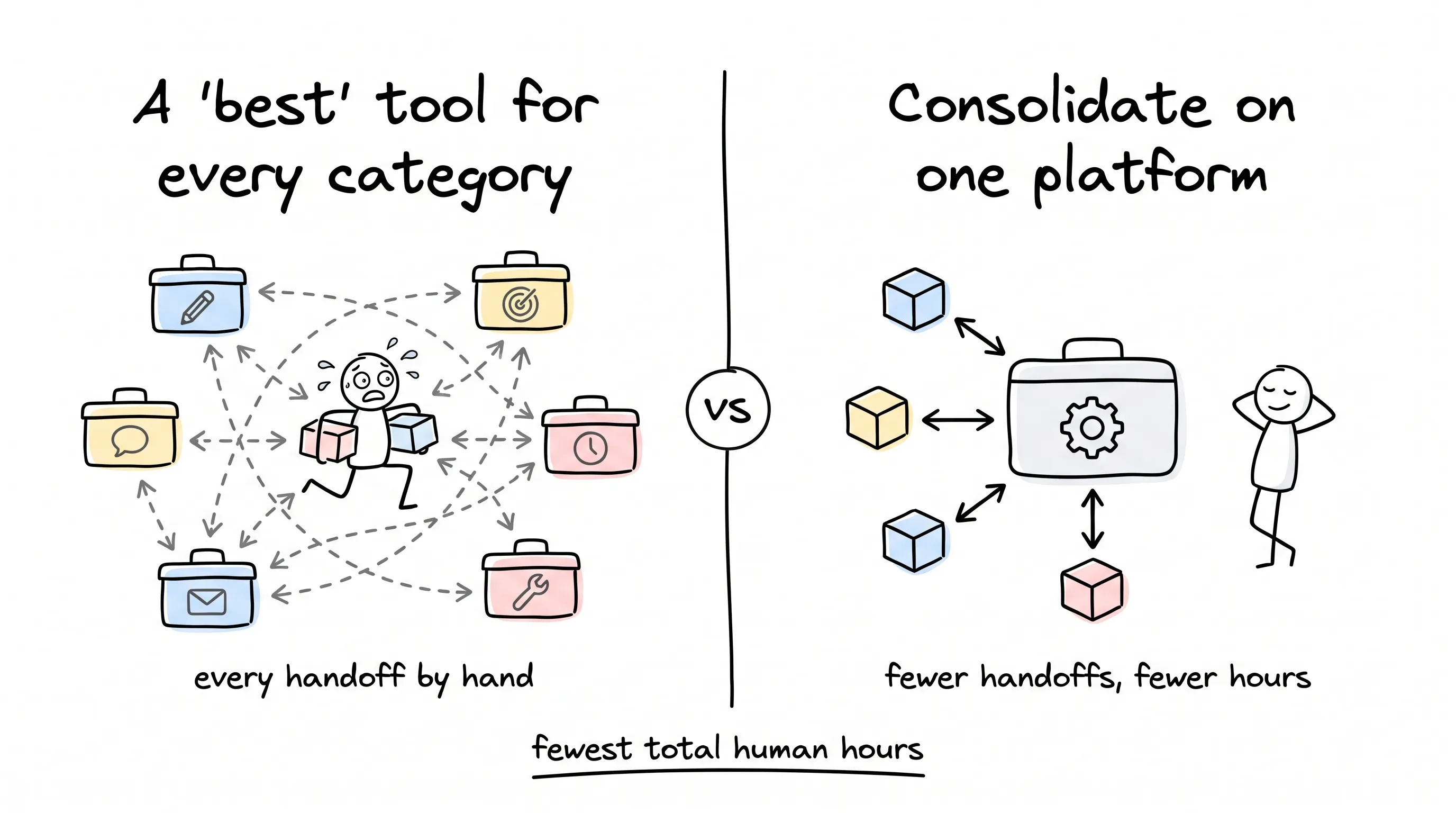
He said the mistake small teams make most easily is picking the "best" tool in every category. Content from A, intelligence from B, outreach from C. Sounds perfect. In practice, six or seven tools each do their own thing, and every handoff in between happens by hand. Every one of them a great tool — and the human gets worked to death.
For a small team, the real bottleneck usually isn't that the tools aren't good enough. It's that nobody ties them together. So his approach is exactly the reverse: consolidate around one execution platform, and accept losing a bit of "optimal" at each stage to save all that human glue work.
Are you optimizing for "doing every single thing at its best," or for "spending the fewest total human hours"? Those two questions lead to two completely different shopping lists.
Back to my friend.
After that dinner, he never asked "which one should I buy" again. The first thing he did when he got back: list out the tools he already had, mark the real usage rate of each one, then hold that list against his funnel and find the biggest sticking point.
Tool lists are never in short supply. There are 14,000 on the market today; next year it might be 20,000.
What's always in short supply is the person who knows where they're stuck.
Here's to you becoming that person.
Continue reading
Related articles

What Is GEO? How Your Brand Gets "Mentioned" in the Age of AI Search
An explainer on GEO (Generative Engine Optimization) for e-commerce and DTC brands: how it differs from SEO and AEO, why AI answers shape brand visibility, and eight practices covering question-focused content, consistent brand messaging, structured pages, external evidence, comparisons, and AI mention tracking.

AI Is Already Making Decisions for Your Customers. Are You on the List?
A learn article explains GEO (Generative Engine Optimization): why AI-generated answers now shape which brands customers see, and how SEO fundamentals, entity clarity, citable evidence, and monthly measurement affect visibility in AI answers.

Google Is Stuffing Ads Into AI Search: These Recent Stories Are Really One Story
A news roundup linking recent AI marketing stories—Google adding ads to AI Mode, Amazon's Ads Agent, ChatGPT image updates, a UK startup tracking brand mentions in AI answers, and an AI ransomware warning—arguing that control over ad data and visibility is shifting toward platforms.