
AI Marketing Daily · 2026-10-27
Daily AI-marketing briefing: Marketo veterans back AI-native automation platforms challenging rule-based workflows; MOps shifts to governing agents; a GEO guide tracks AI Overviews' reach and falling top-result CTR; executives share AI orchestration, personas, and attention metrics; RAND maps AI privacy risks.
All seven stories today press on the same theme: AI has started replacing the old chassis of marketing systems. A new generation of marketing automation platforms (MAPs) is openly calling for Marketo's replacement, MOps teams are shifting from building workflows to managing agents, the contest in AI search has moved from grabbing exposure to grabbing cognitive bandwidth, and even the units of measurement are changing — seat licenses give way to task completion time, viewability gives way to attention. On the brand side, executives at Mastercard and Uber have turned in their AI homework. Read this one briefing and you'll be holding every AI-marketing shift of the past 24 hours. Start with the headline.
🎯 Today's Headline: Marketo Veterans Reunite for the Assault — AI-Native Marketing Automation Platforms Close In
What happened
MarTech columnist Moni Oloyede published a first-hand observation: four next-generation marketing automation platforms (MAPs) — Paminga, Inflection.io, Conversion.ai, and Phave — are gunning for Marketo. They'll happily poach customers from HubSpot, Pardot, and Eloqua along the way, but the name that keeps coming up in every conversation is Marketo.
The challengers aren't hiding it. Inflection's tagline reads, "Finally, you can replace Marketo." Paminga went further and built a Marketo migration translator that moves customers' legacy automation logic onto its own platform. Phave carries the biggest pedigree: co-founder Jon Miller co-founded Marketo itself, and former product executive Nick Bonfiglio has joined the new company as well. Inflection's two co-founders, Aaron Bird and Dave Rigotti, also came out of Marketo. The people who built this category twenty years ago are now back, building its replacement.
Why it matters
The traditional MAP stands on the 2000s-era "leads, nurturing, handoff to sales" waterfall, formalized by SiriusDecisions in 2006. Back then, B2B marketing had to prove its contribution to revenue; CRM made the sales pipeline visible, and the MAP scaled the process. The problem: B2B buying today is a multi-person, multi-threaded, cross-touchpoint behavior, yet the old model still props up the entire product architecture.
Jon Miller sums up the shift as a paradigm change: from rules to reasoning. Old-school MAPs required MOps practitioners to anticipate every scenario in advance and translate it into workflow logic inside the platform; the more complex the customer journey, the taller the pile of rules, exceptions, and dependencies. The new generation instead interprets customer context against goals and constraints, and decides the next action itself. Rules won't disappear — they'll retreat into domains that must stay predictable, like consent management and compliance. What's really being challenged is the human labor that marketing automation consumes.
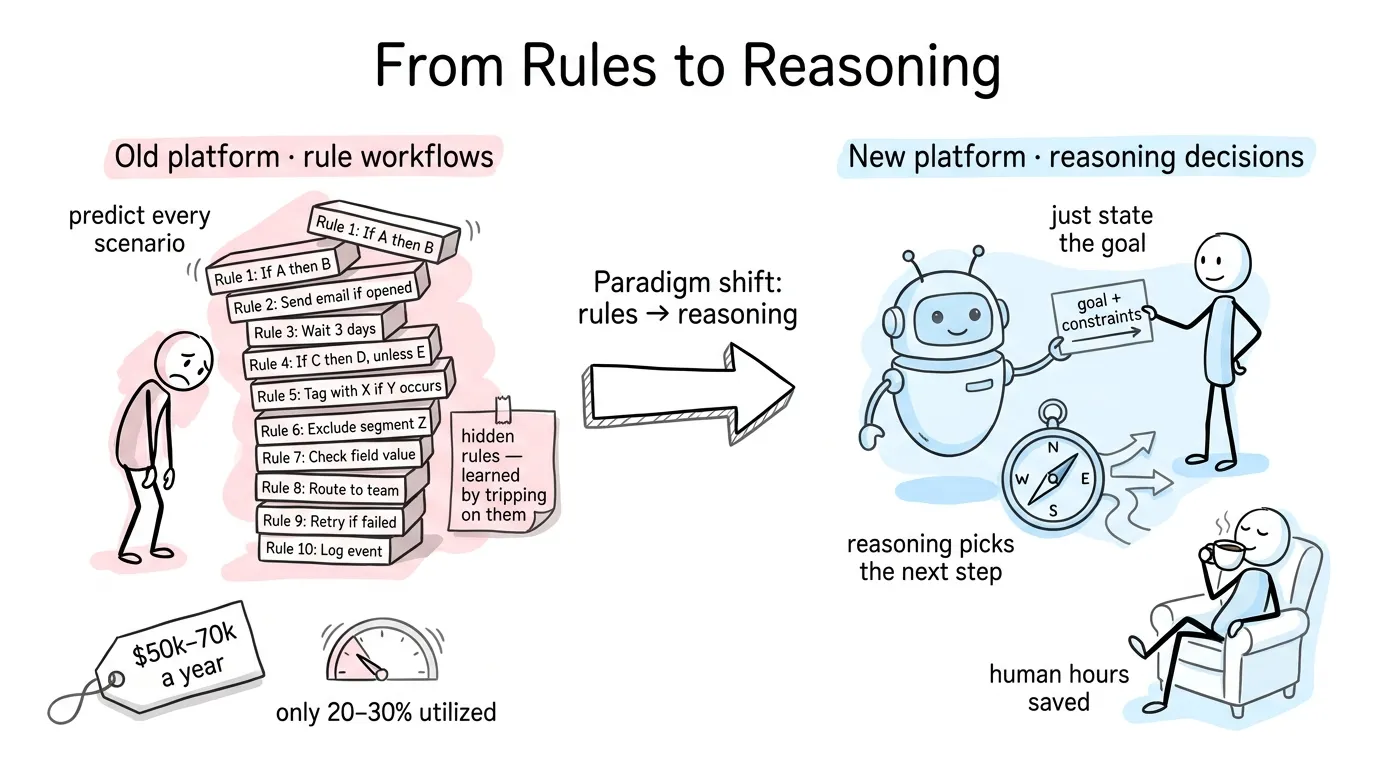
Where Marketo's trouble lies
The author spent years inside Marketo, and her go-to example is a classic: she changed one wait step from 3 days to 5 days, and by any sane expectation, the people already in that step should move to the new timeline. Marketo's actual behavior: anyone already inside the wait keeps the original 3 days, and only contacts entering after the change get the new 5-day wait. Rules like these you learn only by stepping on them — and once you've learned them, your expertise is worth money, which is how enterprises get locked into expensive dedicated administrators.
The price is just as stiff. Adobe doesn't publish Marketo's standard pricing, but from the author's years in the field, enterprises spend $50,000 to $70,000-plus a year — often for little more than email, lead scoring, nurturing, website tracking, and Salesforce sync. The interface drags things down too: the Sky UI, launched before the 2018 Adobe acquisition, never managed to replace Classic; users couldn't leave the old features that lived in Classic, the dual-track coexistence made switching painful, and Sky hung on until it was retired in 2022. The 2026 refresh changed icons and layout, but left the underlying architecture untouched. This is exactly where the challengers get their edge: they can design from scratch around today's usability standards, data access, and AI habits, with no legacy baggage to carry.
A side note: this old architecture isn't Marketo's alone. Eloqua has its own complexity, Pardot grew out of the same lead-prospecting era, and HubSpot's automation footprint keeps expanding. Expect this battlefield to spill over, sooner or later.
Why Marketo specifically
From a competitive standpoint, Marketo is the ideal target. Its customer base happens to be the B2B organizations with the deepest budgets — mature MOps teams, massive databases, complex integrations — precisely the group that benefits most from lower operational complexity and is best able to pay the switching cost. The Marketo name is nearly synonymous with "powerful but complicated" marketing automation, which means the challengers don't have to explain their pitch: you already know how much pain you're in. Add the veterans' insider knowledge — the Phave and Inflection founding teams know why customers love it, what makes it hard to replace, and where its weaknesses are.
What it means for marketers
If your team is running a MAP selection or a renewal evaluation, this lands directly on your budget line. First, put the platform's actual utilization next to its annual fee: many organizations use 20–30% of what Marketo can do, while paying full price plus a dedicated administrator's salary. Second, when evaluating new platforms, look past the demo theatrics and interrogate migration: how do the existing nurture flows, lead scoring models, and Salesforce syncs move over? Paminga's translator is a signal — migration cost is now being marketed as a selling point. Third, sort your rules into categories: compliance and consent rules shouldn't go to a reasoning engine anytime soon; judgment-type rules are the stock AI can actually take over.
Look at the whole moat, too. Marketo's Salesforce integration is mature, Adobe's enterprise ecosystem stands behind it, and its track record of bearing complex operational demands is something the new players will need years to prove they can match. The harder line of defense is people. The Bleed Purple community is fiercely loyal: some practitioners spent ten, fifteen years turning Marketo into a craft and built their careers around it. These people curse Marketo all day — and the moment you seriously propose replacing it, they'll block you. Adobe isn't sitting still either; it has already rolled out Marketo AI skills and an MCP (Model Context Protocol) server to fight back. The switching friction is real; the only true variable is time. The author's own words carry a wink and a dose of seriousness: Marketo, you're in trouble — they're coming for your throat.
My take
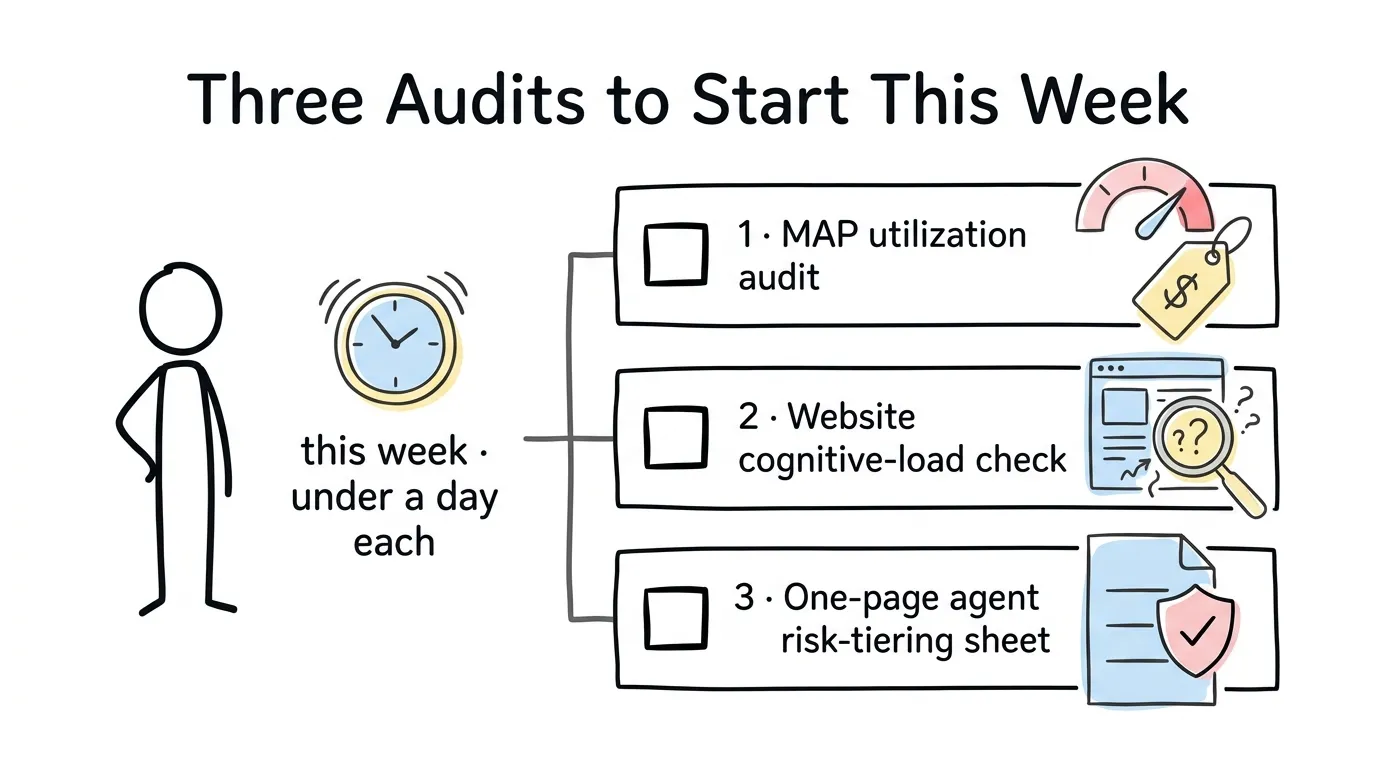
This siege won't move the overall market in the short term; Marketo's installed base isn't migrating en masse this year. But the signal is clear: the axis of competition in marketing automation is shifting from "whose rules engine is stronger" to "whose platform saves customers more human labor." For mid-sized B2B teams, a utilization audit before renewal is something you can do this week — the data will tell you whether to buy the new story these old Marketo hands are selling.
🔗 Further reading: Read the full article
🏷 AI Search & Content Visibility
Winning AI Search Isn't Winning the Buyer: Cognitive Load Is the New Conversion Gate
MarTech columnist and Carbon Design founder Scott Gillum offers a framework: winning visibility in Google, ChatGPT, or Perplexity only gets you a ticket to the game — your website still has to convert that visibility into understanding, trust, and action. His evidence is hard. 6sense research shows buyers complete roughly 70% of the purchase process before ever contacting sales, and 81% already have a preferred vendor at first contact. Meanwhile, Databox pegs the median session on a B2B website at just 78 seconds, and Contentsquare reports that figure down 7% year over year. Buyers are making more of the decisions themselves — with less time to evaluate each site.
Gillum recommends a cognitive load test as the checkup: it measures how much mental effort a buyer must spend to understand your site, trust it, and act. Four dimensions: comprehension (can visitors quickly say what you do and who you serve), orientation (does the information hierarchy carry people to the right content), credibility (does every claim sit next to traceable evidence, method, and dates), and action (do visitors at different stages of readiness have an appropriate next step, instead of every road funneling to "contact sales"). The backdrop: only 35.7% of B2B buyers rate their vendor-website experience positively — most sites are making buyers pay effort they shouldn't owe.
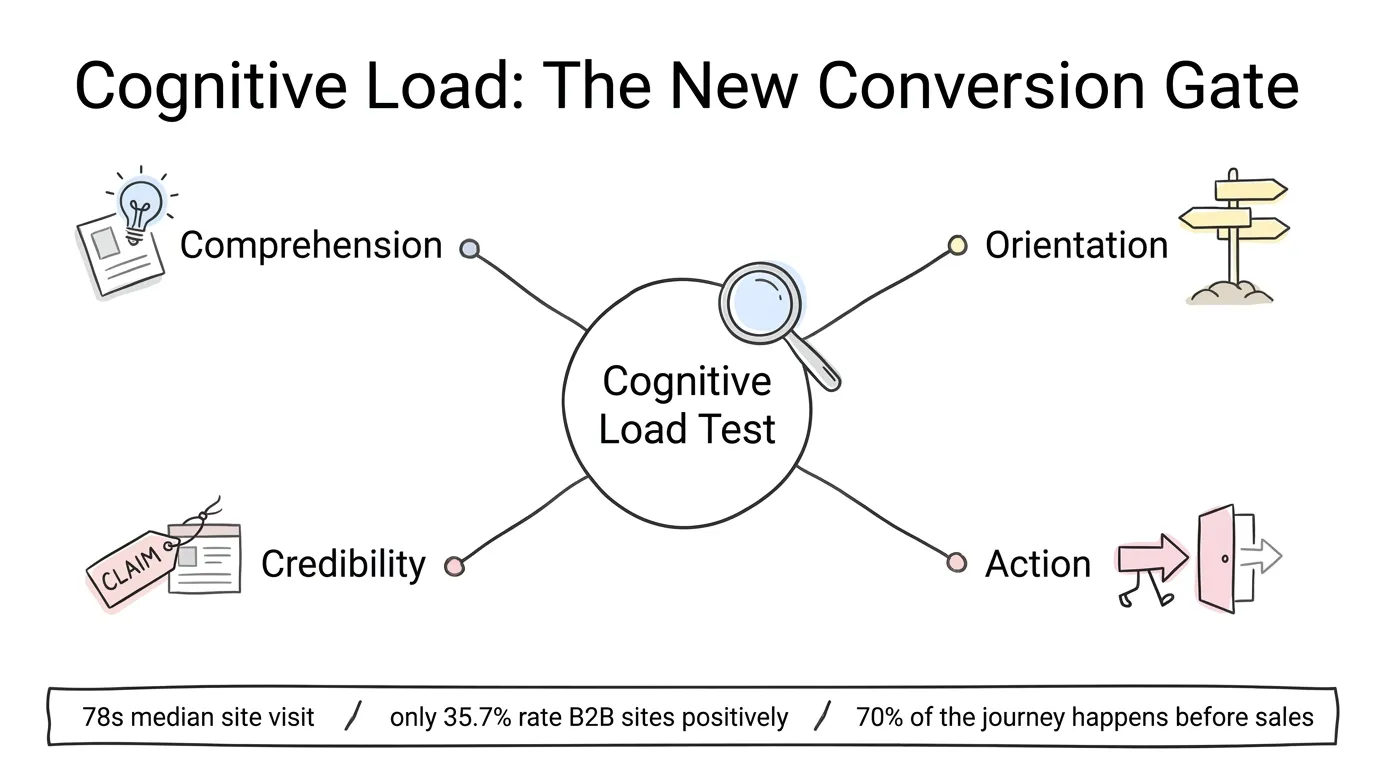
The article's two visitor profiles deserve a close read. One is the verifier who has done the homework: they arrive having already read analyst reports, customer reviews, and AI-generated comparisons, and they're on your site purely to verify — they want concrete product specifications, methodology, security details, and quantifiable results; adjectives like "industry-leading" and "transformational" only create new problems. The other is the late-arriving stakeholder suddenly pulled into the buying group, usually visible in analytics as a burst of visits — they tear through page after page downloading everything, trying to compress months of homework into days. Chaotic navigation forces them to assemble the company's story from scattered pages; a cognitively efficient site hands them a complete path from business problem to solution, evidence, implementation expectations, and next steps. The author's high-scoring template is an evidence chain: claim, metric, source, methodology, product capability — each link locking into the next.
He adds one more layer: whatever makes things easier for humans makes things easier for AI. Consistent naming, clear headings, claims sitting next to their evidence, visible dates and methodology — these conventions reduce ambiguity in AI interpretation and make the models more willing to cite you accurately. GEO gets your content into the candidate set; cognitive clarity determines how long you stay in it.
💬 Practitioner take: run the four cognitive-load dimensions as this week's website self-audit, page by page. Put the evidence chain at top priority: add a source and a methodology next to every numeric claim — it takes no engineering resources and pays out twice, in credibility and AI citation rate. And stop stacking adjectives onto detail pages; a 78-second median session has no room for a second empty phrase.
🔗 Further reading: Read the full article
A Step-by-Step GEO Guide: AI Overviews Now Cover More Than Half of Google Searches, Top-Result CTR Falls from 28% to 19%
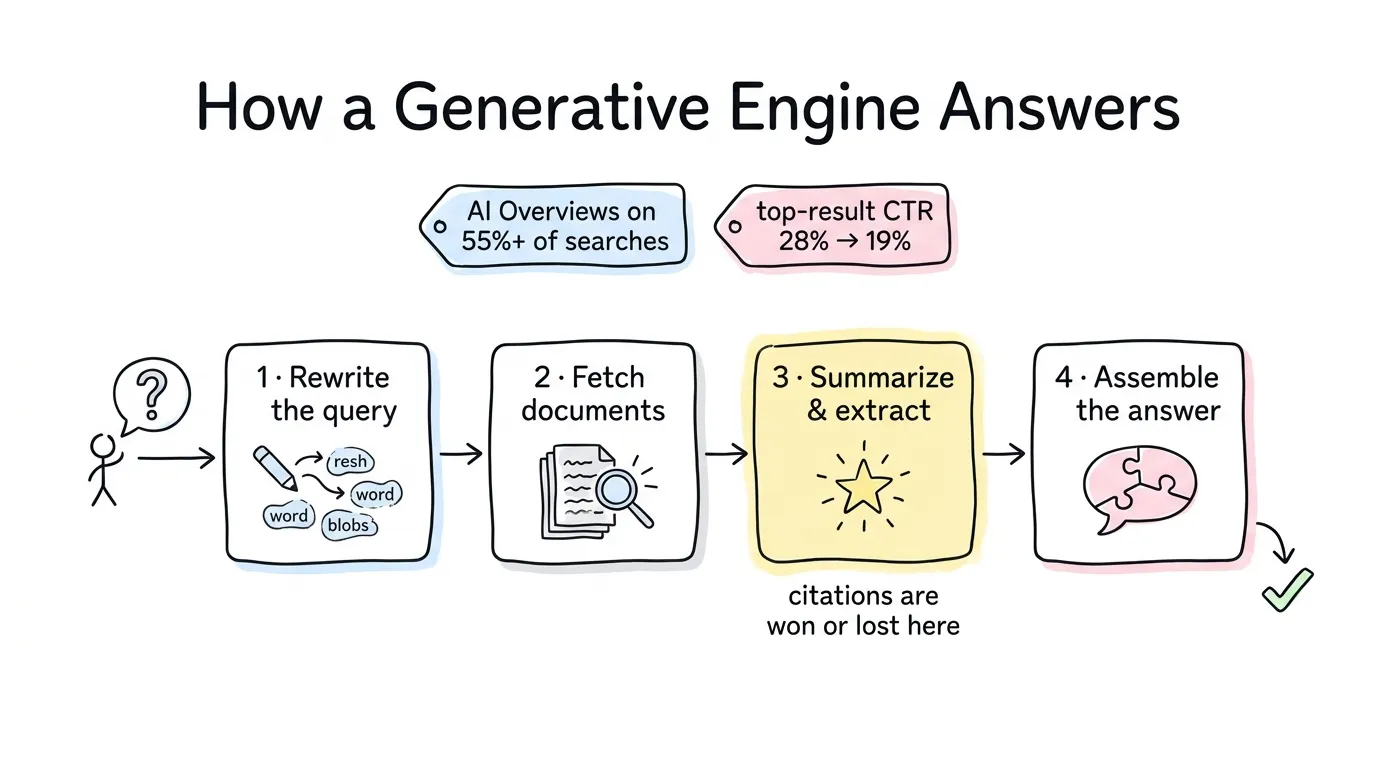
O8 agency has published a 19-minute-read long-form guide to GEO (Generative Engine Optimization) — the most systematic step-by-step tutorial available right now. The opening numbers set the scene: AI Overviews now appear in more than 55% of Google searches, and the click-through rate on top organic results has dropped from 28% to 19%, almost overnight.
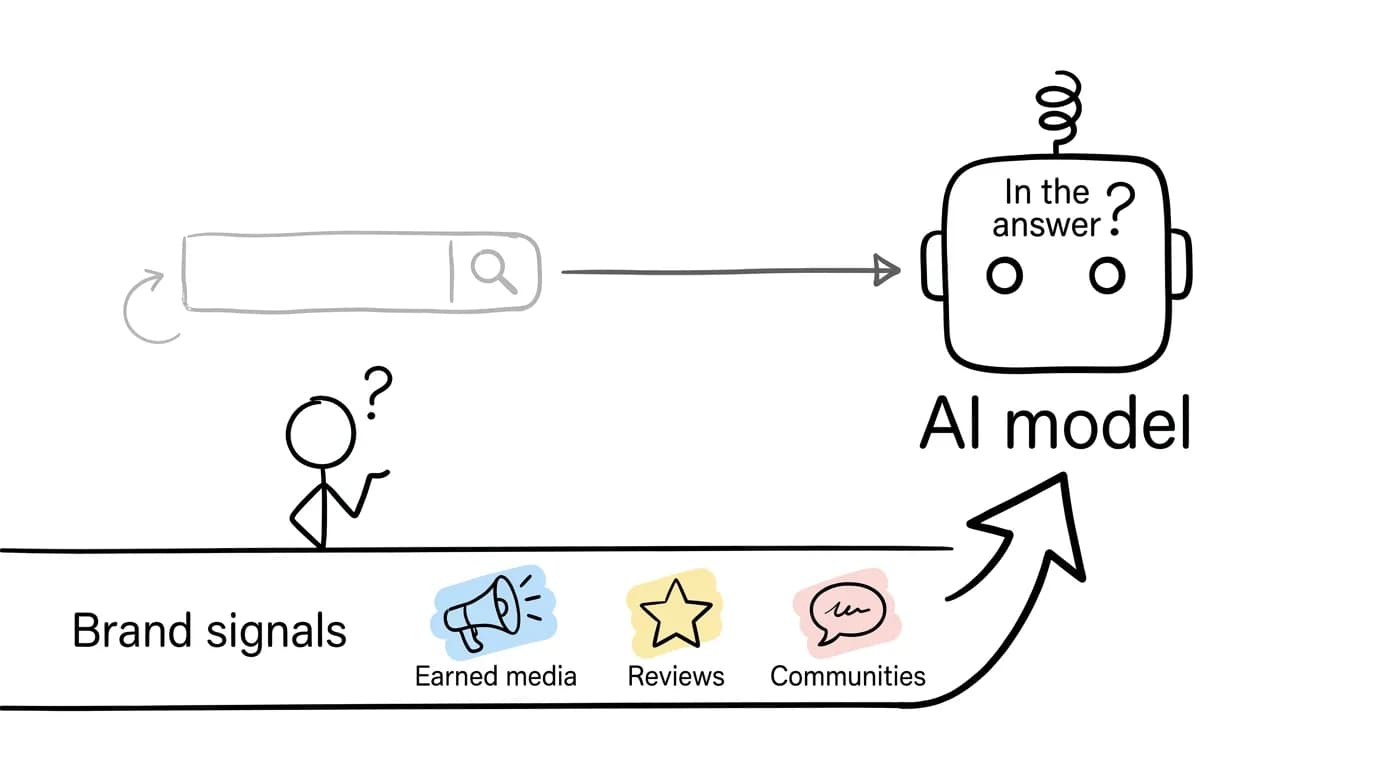
The guide's stance is that GEO complements SEO rather than replacing it: quality, E-E-A-T, and authority remain the shared foundation, and pages that rank high on Google often enjoy a head start with AI as well. The differences come down to three things. Generative engines favor clearly identifiable entities — known brands get recommended more easily, and a keyword-stuffed domain won't be cited by AI no matter how high it ranks; HubSpot gets recommended by ChatGPT as a reliable CRM on the strength of brand recognition accumulated across many trusted sources. They favor concise summaries — long, dense, keyword-laden paragraphs lose out. And they favor cross-source trust signals — brands mentioned repeatedly and positively on Reddit, G2, Capterra, and review media are preferred; backlinks are no longer the only hard currency. Go Fish Digital's Chris Long has tested this: when generative platforms pick their summaries, they markedly prefer structured headings (H2, H3), bulleted lists, and clear summaries.
The guide also breaks down the four-step mechanism by which a generative engine answers a question: first it rewrites your original query into a more searchable form, then calls a search engine to fetch documents, then a summarization model extracts the key points, and finally a response model assembles the answer. Whether your content gets cited is decided at step three — that's where clearly structured, factually accurate, easy-to-digest content gets picked. The action checklist has nine items; beyond the technical ones, worth remembering: get your product into authoritative listicles and comparison posts, which get cited far more often than self-descriptive pages; keep your brand messaging consistent across your website, GitHub, LinkedIn, and external publications, because a broken footprint erodes the trust of users and AI alike; and keep monitoring how your citation sources shift — if citations start flowing to GitHub repos or YouTube transcripts, move your position accordingly.
The technical checklist is there too: add llms.txt to guide generative crawlers, fill in structured data like FAQPage, Product, and HowTo, reduce client-side rendering so AI can crawl clean HTML, and don't block LLM crawlers in robots.txt. Organize content for conversational long-tail queries and write declarative sentences concretely — say "over 92% of enterprise users say deployment is simple" rather than the vague "customers are generally satisfied." One caveat: this piece comes from a service provider, the publication date is unclear, and the lead-generation-for-consulting parts should be stripped out as you read.
💬 Practitioner take: start with a crawlability checkup — llms.txt and structured data are hours-to-launch moves with direct payoff. Then take inventory of your brand's presence on Reddit, G2, and the review sites; that's where AI actually sources its citations. Stop betting the whole budget on backlinks — carve out a slice for the long game of third-party mentions.
🔗 Further reading: Read the full article
🏷 Marketing Tools & Workflows
MOps Turns Agent Manager: Rules, Guardrails, and Approval Points All Need Redesigning
MarTech's MarTechBot explainer column (published after human editorial review) took on an organizational question: how should the MOps team of a leading marketing organization restructure itself to govern both autonomous AI agents and traditional software workflows? The answer comes in five parts. First, MOps shifts from operator to governor. The traditional MOps routine was system administration, campaign building, data routing, and vendor management; once agents take over the execution layer, the team's job becomes setting rules — establishing guardrails, drawing autonomy boundaries, defining performance thresholds, managing API and token costs, and monitoring agent behavior across platforms. Second, a centralized AgentOps — or so-called "agent factory" — team emerges. Letting every team ship its own agents is a recipe for chaos; a centrally built group constructs, tests, and deploys agents uniformly, with brand, security, and privacy checks all moved ahead of launch.
Third, agent effectiveness depends on context, not prompts. CRM history, real-time intent signals, and verified brand messaging are supplied through MCP (Model Context Protocol) integrations, context graphs, or a unified data layer — the goal is that wherever an agent works, it holds enough reliable information. Fourth, authorize by risk tier: routine tasks like social copy, broken-link checks, and listing monitoring can run on their own; shifting media budget, publishing external content, or changing CRM deal stages requires a human sign-off. The hard part is designing approval points without turning every agent workflow into a new bottleneck. Fifth, measurement switches tracks: once agents take over execution, seat licensing and feature adoption no longer prove value — watch task completion time, cost per execution, token consumption, and the team capacity freed up; some teams have begun tracking AI-visibility metrics like Share of Model. The whole piece lands in one sentence: MOps is moving from "running the tech stack" to "setting the rules for autonomous work."
💬 Practitioner take: write your own agent risk-tiering sheet this month — one page, spelling out which actions run automatically and which require a signature. Approval points at the two places — money and external communication — are enough; any more and it becomes bureaucracy. Hook up cost per execution first: it's the hardest currency you have with the CFO.
🔗 Further reading: Read the full article
The Marketing AI Use-Case List: 94% Are Using AI, but Success Hinges on the Data Chassis
Improvado has released its 2026 guide to marketing AI use cases, listing 12 measurable use cases across content, social, SEO, email, and advertising. It opens with a bracing contrast: 94% of marketers have already put AI into their workflows, yet results vary wildly — the difference isn't the model, it's data quality, workflow design, and organizational readiness. The authors are blunt that "using AI to improve marketing" is not a use case at all; a qualified use case needs four elements: a clearly defined problem, explicit data requirements, measurable outcomes, and a named owner. Only something like "use predictive lead scoring to rank outreach priority for accounts showing 60-day purchase signals, measured by sales accepted lead rate" counts.
For content, the path is to compress topic selection and briefing with Clearscope, Surfer, or MarketMuse first — days become hours — then let AI briefs aggregate the questions buyers actually asked in sales calls and support tickets into a topic calendar, then produce first drafts and variants with AI. The biggest risk is brand-voice drift; the fix is feeding the style guide into the system prompt. Social offers three automations you can switch on today: Buffer, Sprout, and Hootsuite posting-time prediction retrained on a single account's history instead of industry averages; Brandwatch and Sprinklr social listening that opens a warning window before a negative topic becomes the mainstream narrative; and AI moderation of ad comments to hold brand safety when you have no dedicated moderation team. Email changes are more substantive: rule-triggered gives way to behavior-driven sequence optimization — Klaviyo, Einstein, and HubSpot can all adjust content and cadence dynamically by a contact's actual behavior and predict lifecycle stage, so sequences follow behavioral signals instead of the calendar; paired list-cleaning tools (ZeroBounce, NeverBounce) and engagement scoring can route churn-risk people into win-back or suppression lists before they ever flag you as spam.
On selection, five criteria: explainability, integration depth, vendor stability, total cost of ownership, time to impact. Explainability sits first for a reason — if an AI recommendation can't answer "why," the people executing it won't trust it, and adoption stalls. The authors put it plainly: run the data audit before choosing tools. Deploying AI tools on fragmented data is the number-one cause of failed marketing AI pilots — in this context "garbage in, garbage out" isn't a cliché, it's the most common failure attribution.
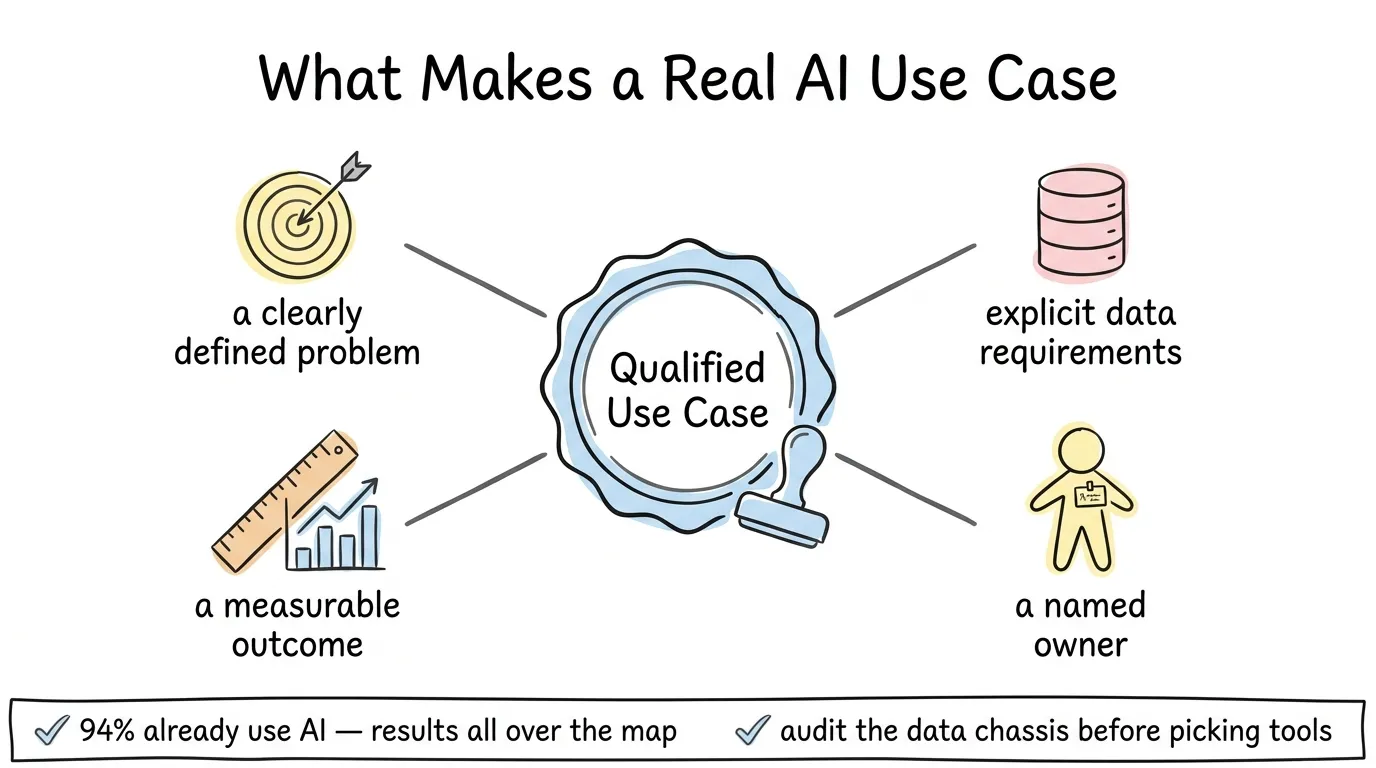
💬 Practitioner take: don't march down this list top to bottom. Score your own candidates on two axes — impact and feasibility — and the double-highs are this quarter's projects. The first thing to do is the data audit; half a day will expose which use cases have no business going to production. And until someone on the team is clearly accountable for results, don't sign a single annual contract for an AI tool.
🔗 Further reading: Read the full article
🏷 Brand & Advertising Practice
Mastercard, Newell, and Uber Executives Turn In Their AI Homework: Orchestration, Personas, and Attention Measurement
An Adweek BrandWeek roundtable (video published September 8, 28 minutes) brought together Cheryl Guerin, EVP of Brand Strategy & Innovation at Mastercard; Nick Hammitt, CMO of Newell Brands; and Edwin Wong, global head of measurement science at Uber Advertising. Mastercard's play is "AI as orchestration": its newly launched AI card-design studio systematizes the daily process of designing card faces for client issuing banks, running compliance, brand, and creative systems through one workflow, with personalized card faces opening to consumers early next year. Guerin cited the stat that 60% of consumers — especially Gen Z — want products that express their individuality. The company also launched the Mastercard Commerce Media retail media network in the same period, going from greenlight to launch in under a year.
Newell's play is AI personas. They feed their own first-party data into AI personas of target consumers — say, the first-time pregnant mom for Graco — and brand managers can query the persona's reaction to a new concept anytime, or pull it into the innovation process to review creative briefs. Hammitt says the system has been running for about a year and now extends to nearly every brand, and the time from idea to validated concept has compressed noticeably. He also flags a pitfall: the persona skews overly positive and will never come out and say an idea is bad — the judgment still has to come from a human. The whole pipeline holds to the "human-initiated, AI-amplified" principle, with legal and brand checks fixed at the key nodes.
The Uber Advertising segment is the most hardcore. Wong opened with a phenomenon: a few weeks ago, hundreds of Gen Z users collectively uninstalled their social apps in the name of a "dopamine detox"-style movement to take back their attention. Working with Adelaide and Canar, they built a custom attention unit that combines implicit gaze signals (duration, pixels, format, eye tracking) with explicit survey signals: the Journey TV ad unit scored about 11 percentage points higher than online video, and a post-checkout unit differed from the Journey format by 40%. The Kahlua case borrowed timing intelligence: a full-funnel push at the moment cocktail demand spikes — on the delivery side, Uber Eats saw a 188% incremental lift, and brick-and-mortar bars and restaurants that featured Kahlua specialty drinks saw a 7% lift. Wong's read on quick commerce is also worth filing away: what it sells on the surface is speed, but what it actually delivers is a sense of relief. Citing the psychological origins of cognitive load in the work of the 1980s researcher John Sweller, he says what Uber is doing is helping users reallocate cognitive resources — and in those moments, the entire funnel gets flattened. His judgment: contextual and temporal relevance sometimes matter more than traditional targeting — when the location is right, even five hundred feet is too far, and a $2 Starbucks coupon is one you hand over right at the office door.
On where the brand money goes, Hammitt offered the CFO's view. Newell has 50 brands; it can't invest heavily in all of them, and the argument is over which few should carry the critical mass of budget. His persuasive material is data: skip the upper layer of brand building and the conversion costs on the layer below rise year after year. Guerin added the multi-sensory angle: as logos shrink ever smaller on small screens, Mastercard simply took its name out of the logo, and a sonic brand launched alongside — sit down in an Uber or check out of an e-commerce order, and you hear that familiar melody.
💬 Practitioner take: three moves worth copying. First, pilot AI personas as a pre-screen for concepts — you skip a round of qualitative research — but mandate that a human holds the final veto. Carve a small slice of media budget for context-and-timing tests; even at half off, a number like 188% is worth verifying. And when reporting to leadership, switch to the language of attention plus brand lift — it's the measurement system that talks to a CFO right now.
🔗 Further reading: Read the full article
🏷 Policy & Compliance
RAND Breaks Down AI Privacy Risks: Repurposing, Spillover, Persistence — the U.S. Still Has No Unified Federal Framework
RAND has published a research brief analyzing the impact of AI on U.S. privacy law, with the EU AI Act as the point of comparison. The EU act passed the European Parliament in March 2024 and was approved in June, with sweeping provisions covering the development, testing, and use of AI; RAND's brief belongs to its AI governance series and is positioned as a reference point for U.S. policy debate — no verdicts, just a ranked set of options. The regulatory difficulty the authors flag is algorithmic opacity: regulators struggle to audit how an algorithm actually collects and transforms data and makes decisions on that basis. The report sorts AI's distinctive privacy risks into three classes: data repurposing (collected data re-invoked for another purpose), data spillover (inferences made about one person reaching unrelated third parties), and data persistence (data, once in a training set, lingers and resists deletion).
Policy options come in three tiers: data minimization and purpose limitation (with precedents in GDPR and California's APRA, a draft state privacy law), algorithmic impact assessments for public-facing deployments, and mandatory audits and disclosure. The binding constraint is that the U.S. lacks a unified federal privacy framework, and fragmented state laws both raise compliance costs and suppress innovation. The report argues for balancing regulation and innovation around three points: data, purpose, and outcomes. One caveat: the brief was published in August 2024, and its institutional details have aged — but the three-class risk taxonomy remains a good framework for a marketing team's compliance self-check. In the AI era, you always collect more data than you think you do.
💬 Practitioner take: teams doing personalization and AI targeting should walk their own data flows past the three risk classes: does the training set hold personal data beyond the original purpose, will model outputs leak information about adjacent populations, and can user deletion requests actually reach the training data. If you advertise on both U.S. and EU tracks, file under the AI Act's risk tiers on the EU side first, and track the diverging state-law requirements on the U.S. side.
🔗 Further reading: Read the full article
💡 Today's Big Picture
Put today's seven stories side by side and the change is happening at the same layer: AI has moved from a tool that writes content for you to a system layer that carries decisions. In the headline, the new MAP generation replaces rule-based workflows with reasoning; the MarTechBot item says MOps must shift from running the tech stack to setting rules for autonomous work; and the two AI-search pieces point at the same thing from opposite ends — visibility is only the entry ticket, and the content that keeps buyers is the content both humans and AI can easily read. In the same week, brand executives talked orchestration, personas, and attention measurement, while RAND pinned the compliance frame to three points: data, purpose, outcomes. The common thread: the old units of measurement are failing — seat licenses, click-through rates, viewability, one after another giving way to task completion time, share of citations, and attention.
A second thread running underneath: the data chassis keeps getting called out. Improvado's list opens with 94% adoption set against scattershot results and attributes the gap to data quality and organizational readiness; Newell's AI personas feed on first-party data only, for fear of hallucinations; agent effectiveness gets attributed to context engineering. Three stories, one judgment: models are depreciating, and clean, connected data is appreciating.
One reminder for marketers: the old systems keep charging you in hidden labor hours. Marketo's $50,000–$70,000 annual fee is only the sticker price — the dedicated administrator, the cost of learning the unwritten rules, and the manual configuration inside every workflow are the real spend. A website with crushing cognitive load works the same way: buyers aren't stolen by competitors, they're worn out by your navigation. The three things worth doing this week each take less than a day: run a MAP utilization audit, walk the website cognitive-load checklist, and write a one-page agent risk-tiering sheet. Swapping the chassis won't happen overnight — but the audit can be finished today.
Continue reading
Related articles
AI Marketing Daily · 2026-11-22
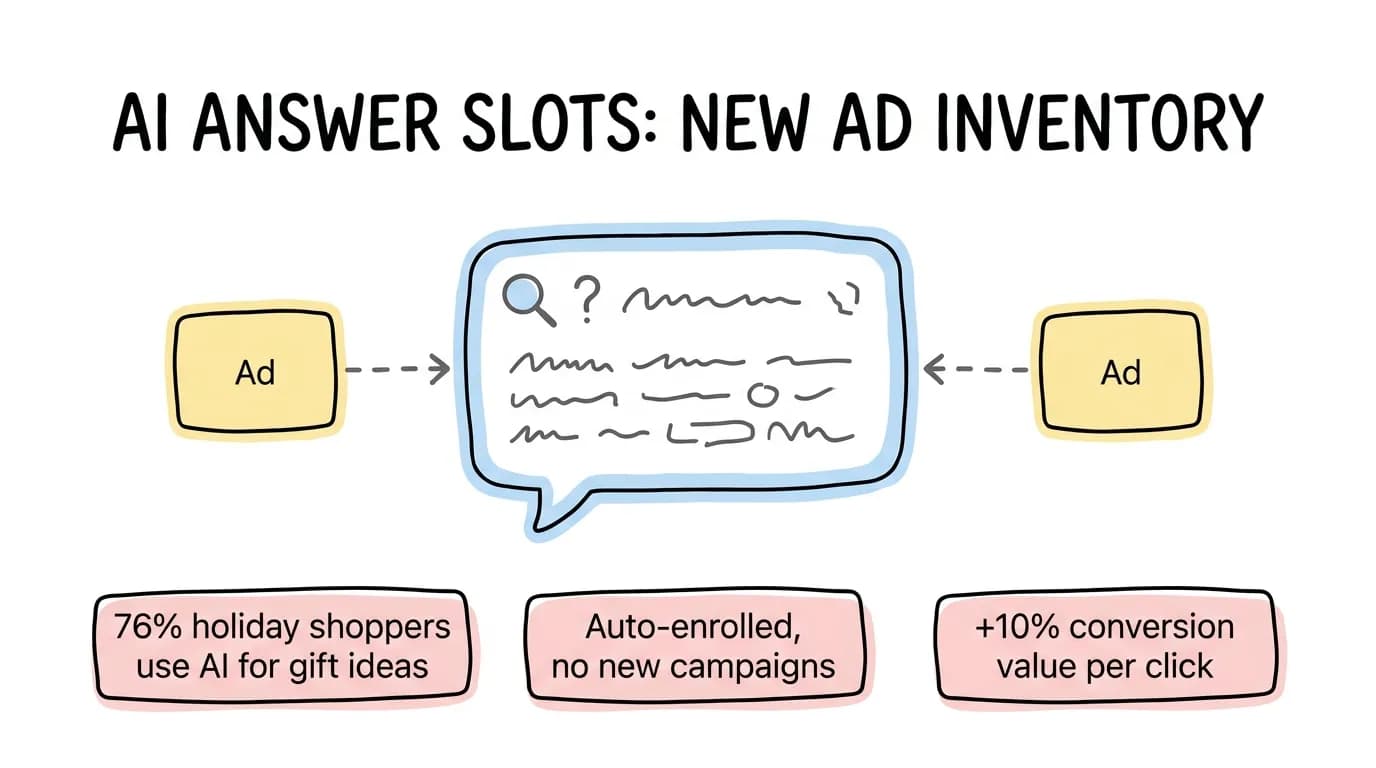
AI Marketing Daily for 2026-11-22 rounds up 20 items led by Microsoft opening Bing AI Overviews to ads and Google expanding AI Mode ads to ten countries, plus GEO guides, ad automation delegation guidance, AI Overviews CTR data, and a legal-risk checklist for AI-generated creative.
AI Marketing Daily · 2026-11-21
A November 21, 2026 AI-marketing daily covering AI search visibility, GEO methods, Google AI Mode ads expanding to ten countries, Meta's pre-Black Friday changes, agentic shopping, and industry adoption and ROI data.
AI Marketing Daily · 2026-11-20
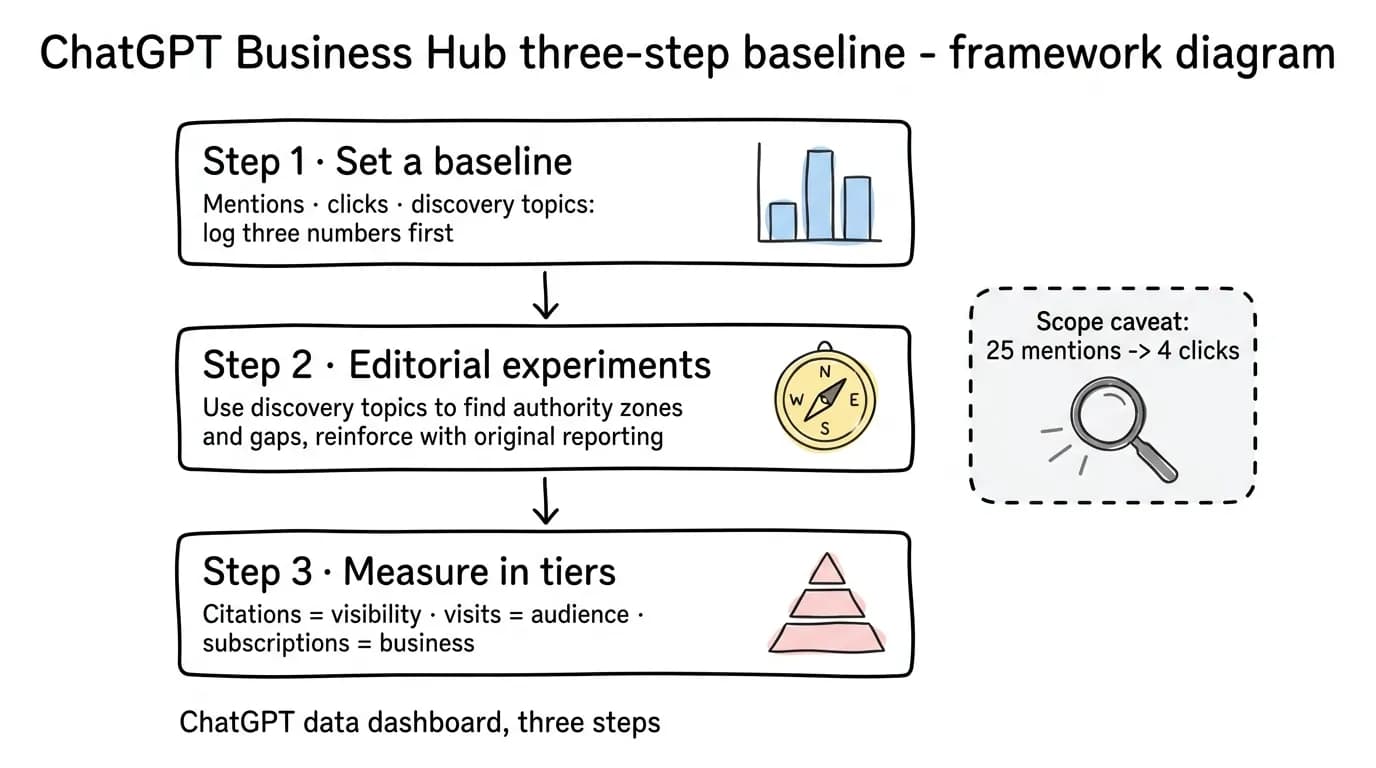
AI Marketing Daily for 2026-11-20 rounds up 19 items centered on measurement: OpenAI's ChatGPT Business Hub dashboard, EU rules for agent-mediated purchasing, Meta pausing four AI terms, and B2B data on shortlists and the dark funnel, each with action advice.