
What We Call Innovation Is Just a New Combination of Old Ingredients
A learn article distilling a panel conversation among executives from Mastercard, Newell Brands, and Uber Advertising on how their companies use AI for innovation, covering card design orchestration, human-initiated AI content workflows, ad attention measurement, commerce media, and AI consumer stand-ins.
The other day, I listened in on a conversation.
The EVP of Brand Strategy & Innovation at Mastercard, the CMO of Newell Brands, and the Global Head of Measurement Science at Uber Advertising sat down together to talk about one topic: how does your company actually use AI to innovate?
Sounds like prime conference-panel material, right? That's what I thought, too.
But half an hour in, I had filled page after page of notes. Not a single line of correct-sounding fluff — just concrete methods, concrete numbers, and concrete pitfalls.
Today, I'm breaking this conversation open and telling it to you, piece by piece.
Let's Start with Three Strange Phenomena
The moderator opened with a question: what consumer trend is reshaping how each of you innovates?
The first answer came from Uber. A few weeks ago, he said, hundreds of Gen Z users collectively deleted their social apps. They called it a "detox movement." For what? To take their attention back.
The second answer came from Newell Brands. What he sees is more and more "repeated verification" before people place an order. They want the full experience before they buy: put the product in their own home and see how it looks — a virtual placement works too; ask their friends — real friends, or AI ones; only after everything is confirmed will they press the pay button.
The third answer came from Mastercard. She gave a single phrase: agentic commerce.
What is agentic commerce? It's a dream people have chased for years: everyone has an assistant; you hand it a task, and it handles everything from research all the way to payment. Today, that dream is becoming reality. And once shopping is "outsourced" to an assistant, the trust problem becomes sharper than ever: how do you guarantee that a purchase your assistant completes on your behalf feels exactly the same as one you made by walking into a store yourself, or placing the order on a website yourself?
One is fleeing the screen. One is frantically verifying. One is handing away the power to buy.
On their own, these three things look completely unrelated. But put side by side, they point to the same place: the "process" of consumption is being redefined. Whoever redefines the process redefines the business.
So how do you actually do it? I've pulled three stories out of this conversation.
Story One: AI Is the Conductor, Not the Soloist
The Mastercard executive said that internally they look at AI on two levels: one level is efficiency — how much can AI speed up existing processes; the other level is innovation — what new things can AI bring.
On the efficiency level, she gave an example: an AI card design studio.
Think about it: how does a bank card design come to be? Design, compliance review, brand review, proofing, launch — round after round of process, often measured in months. And issuers all over the world submit design requests like this to Mastercard every single day.
Now, they have folded years of accumulated design experience, compliance rules, and brand guidelines into a single AI system. Issuers can design their own cards and iterate round after round, fast. The next step, expected early next year, is to open this capability to consumers and small business owners: your own card, your own personalized design.
Why go to all this trouble? She gave a number: 60%. Six in ten consumers — Gen Z above all — want their things to express "who I am."
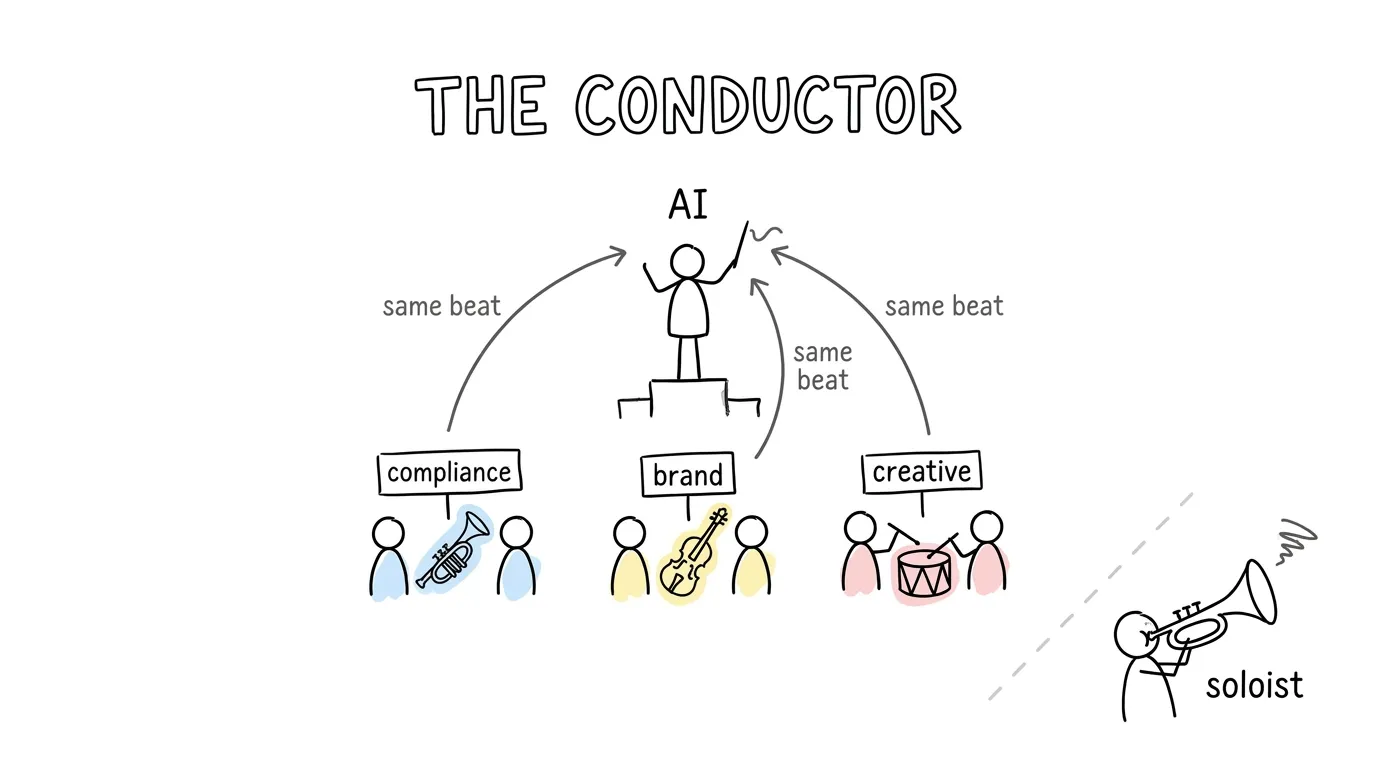
A card isn't just a payment instrument; it's also an expression of personality and identity. In the past, getting three systems — compliance, brand, and creative — to run smoothly at the same time across thousands of issuers was an impossible task. Now, AI has kneaded them together.
I love the word she used: orchestration.
What is orchestration? In a symphony orchestra, every player is a virtuoso. But without a conductor, however many virtuosos you have, what they play is just noise. AI's role at Mastercard is the conductor: it doesn't replace a single player — it lands dozens of players on the same beat.
Many companies treat AI as a soloist, bringing it in to duet with their existing processes. The people who use it well treat AI as the conductor.
Story Two: Humans Initiate, AI Amplifies
The second story comes from Newell Brands. The name may not ring a bell, but you surely know the brands under its roof: Yankee Candle, Graco, Oster. All physical goods you can touch and smell.
What can a company that sells candles and baby strollers possibly do with AI?
Their CMO started with the pressure: the volume of content needed this year is five to seven times last year's. Seven times. Content demand is exploding, budgets are not. What do you do?
The answer is to embed AI precisely into a few specific links of the "content supply chain."
For instance, Yankee Candle runs an email marketing business. In the past, between a design file and a fully coded email stood the manual labor of programmers. Now it's done in one click. A design file goes in; a sendable email comes out.
Bolder still is product content. In the past, producing assets for a new product meant: prototype, ship the sample to a photo studio, build the set, shoot, retouch — a cycle of about eight weeks. Now, they take the production files that are already being sent to supply-chain factories and use AI to generate a "digital twin" of the product — a 3D model identical to the real thing — and then produce the content in a virtual studio.
Eight weeks, compressed to one or two.
At this point you might ask: at this speed, how does brand tone survive? Won't AI improvise freely and turn a candle ad into anime?
Here is the line most worth stealing in their whole approach: all of the work is "Human-Initiated, AI-Amplified."
Humans set the direction first; AI does the accelerating. The pipeline has several manual checkpoints — brand standards and legal red lines — and not a single one can be skipped. What AI eliminates is the annoying, repetitive, mechanical work. Judgment stays firmly gripped in human hands.
AI's job is to turn a month's work into a day's work. As for which work to do, that is forever a human's business.
Story Three: From "Seen" to "Trusted"
The third story goes back to Uber — this time it's Uber Advertising. They talked about two things: one about measurement, one about the human heart.
Measurement first. Advertising has an old, stubborn problem: impressions can be counted, but once you've counted impressions, does that prove the ad worked? Seen is not the same as noticed; noticed is not the same as believed.
So Uber Advertising brought in two measurement companies to work with: Adelaide, which specializes in "passive attention," using dwell time, pixels, layout, and eye tracking to infer whether users are actually looking; and Kantar, which does "explicit research," directly asking users. The clever part is this: they did not apply the industry's standard benchmarks, but instead defined their own attention unit based on real feedback from their own ad placements.
And the result? Their Journey TV ad unit outperforms standard online video on attention by about 11%; post-checkout pages and Journey — those right-after-a-service moments — by about 40%.
This executive summarized it in one line that I think deserves to be pinned above every advertiser's desk: what we care about is not viewability, or even just attention, but accountability.
Now the human heart. In Australia, they did a study on "quick commerce." You'd think what users want is speed? The study says what users want is "relief."
That "relief" has psychological roots. The concept of cognitive load dates back to the 1980s, proposed by the Australian psychologist John Sweller. Human mental bandwidth is finite. When it is maxed out by trivia, whoever helps lift that load off wins.
What's on a user's mind is never a particular brand; it's "I have a need at this moment," plus "who can catch it at this moment." Whoever catches it, the user will, in that instant, compress the entire decision funnel into one thing: use it. And not just use it — they'll like the brand more, too. Because in the moment I needed it, it caught me.
Once the Logic Works, What Does It Look Like? Two Case Studies
Case One: Mastercard's Commerce Media Network
The biggest surprise of the whole conversation, for me personally, was that Mastercard has actually built its own commerce media — Mastercard Commerce Media. A payments company getting into the advertising business?
But once you hear her explanation, you'll feel this was the natural thing to do.
What does Mastercard hold in its hands? Vast global transaction data, 500 million opted-in users, a loyalty system, a personalization capability (from Dynamic Yield, acquired a few years ago), and a card-linked offers business that has been running for years, with several thousand advertisers already attached.
These assets each used to manage their own segment. What they did was string these assets into one network: 25,000 advertisers can segment audiences based on real purchase behavior, serve personalized messages, then trace all the way back to the purchase itself and calculate incrementality clearly.
How far can the measurement go? The return on ad spend they measured runs as high as 22%.
The most interesting part is the timeline: from decision to launch, this business took less than a year. They didn't invent any new technology from scratch; they took the parts already in the house and reassembled them into a new machine.
Oh, and a bit of trivia: when this advertiser-facing product launched, who did its own promotional placement go to? It went to Uber Advertising. Using an ad platform to reach advertisers. There's something rather interesting about that closed loop.
Case Two: Kahlúa's 188%
The second case comes from Uber. This time last year — that is, in 2025 — the liqueur brand Kahlúa partnered with Uber and blanketed every one of Uber's touchpoints with ads, including Uber Eats.
The timing was deliberate: the moment of making an espresso martini. As a result, Kahlúa-related sales in the delivery channel ran 188% above normal; and in offline bars and restaurants, wherever a menu featured a Kahlúa special, sales rose 7% as well.
Online advertising pushed people to offline barstools.
They also gave a more everyday example: you're walking to the office, there's a Starbucks 500 feet down the road, and the system serves you an offer — "$2 off at Starbucks." In that moment, audience targeting gave way to context and timing.
Contextual advertising is, in fact, the oldest form in the advertising industry. What AI does is make it smart again: every push lands precisely on the moment the user happens to need it.
The Uber executive said the vision for the next chapter is: give users "practical value" first, with the advertising behind it. Make an ad decision with the logistics-grade precision of dispatching a car or delivering a meal — let the user see it, remember it, feel the pull — and in the end, close the loop for the brand: exactly how much incrementality did this placement bring?
A Consumer Stand-In That Never Says "Kill It"
Newell also described an approach I hadn't come across anywhere else: building "consumer stand-ins" with AI.
Take Graco, which makes baby strollers. One of its core user personas is "the first-time expectant mother." In the past, this meant stacks of research reports; now, using years of proprietary data accumulated in-house, they have turned this expectant mother into an AI persona you can talk to.
Why stress proprietary data? Because they don't want hallucinations sneaking in. The persona must grow out of their own data; it cannot be something AI made up.
What can this stand-in do?
First, use it as a Jarvis. Brand leads can ask it at any time: "What do you think of this idea?" "Does this latest trend have anything to do with you?" It answers from the expectant mother's point of view, with real consumer evidence behind it.
Second, use it as an innovation partner. You can toss it a brief: "We're thinking of making a stroller that solves a certain need — what do you think? Would you buy it? How could it be changed for the better?" It will actually go off and "design," then come back with a proposal and a pile of new ideas. You can also flip it around: lead with a concept and ask how it feels. It will tell you: this part I like, this part I can't understand.
Sounds wonderful, right? But this CMO immediately added a dose of plain truth:
These AI personas are relentlessly positive. They will never say "this idea doesn't work, kill it." Ask them, and they will always compliment you.
So human judgment cannot be skipped. An AI stand-in can massively compress the time from inspiration to validating a concept, and push thinking a big step forward. But the final confirm key must be pressed by a real human.
And there is one more safeguard: for all work done with stand-ins, the wrap-up phase must bring in a batch of real users for final validation — to prevent charging into the market carrying an "enormous misunderstanding."
They've been running this play for about a year now — expanding from three or four personas to nearly every brand in the portfolio. Now they've even started playing "persona pairing": seating two personas from different brands together to attack the same innovation problem, to see what they can knock out.
How Do You Ask a CFO to Fund Emotion?
In the latter half of the conversation, the topic turned to brand and emotion.
The Newell CMO said their products are good enough, but for too many years they told stories only through the "product features" lens. The product lens drags the brand into a functional, rationalized space. Yet people don't buy rationally at every moment.
He gave a wonderful example: blenders — any brand can pulverize things. The differences between products are real, but small. So why is it the name consumers blurt out that belongs to Oster?
It's the layer beyond the product: the brand story. A good product, paired with a story that can hit the human heart, is what floats to the very top at the moment of the purchase decision.
But emotional narratives are hard to sell — especially hard to sell to a CFO. How do you make the case?
His answer comes in two layers. The lucky layer: their CEO used to be a CFO, and the current CFO came out of P&G. At P&G, brand is a kind of faith — an easy case to make. The layer beyond luck is data: countless studies prove that if the brand-building upstream is not done, customer acquisition costs downstream get more expensive year after year. Upstream brand-building looks like toiling for someone else's benefit; it's really how you build your own capital.
The truly hard part is the multiple-choice question. Newell owns 50 brands; it's impossible to invest heavily in all of them. Which few brands do you press the limited brand budget down on? That is what he thinks about every day.
The Last Story: The Logo Without a Name
My personal favorite passage of the whole conversation came from Mastercard, about multisensory branding.
She said brand innovation must follow the migration of user behavior. Step one: users all moved onto small screens, where the logo shrank very small — on cards and in interfaces, that line of letters spelling Mastercard had become too small to read clearly. What to do? They simply removed the name from the logo. Just two circles left. The whole world recognizes it anyway.
That takes an extraordinary amount of confidence.
Step two: sound. In the era of smart speakers and audio, your brand may not be "seen" at all. When it can't be seen, how does it become trusted? They built a sonic brand. Whether you're sitting in an Uber or checking out online, the moment that familiar melody plays, trust gets reinforced one more time.
Step three: touch. The instant a transaction completes, the phone delivers a specific pattern of vibration. That "click" of reassurance: your money landed safely.
And then they went ahead and opened restaurants, letting users bring taste, hearing, and smell into play, too.
How do you explain opening restaurants to a CFO? Her answer made me chuckle, and then I wrote it down: "We're not in the restaurant industry. We're in the experience industry."
Experience comes with a ledger you can actually count. As long as a user attends one experience — or even just receives an invitation to one — brand perception, favorability, and usage all see a measurable lift. The effect of sonic and haptic branding is even more concrete: with a sonic brand backing it up, the reinforcement of trust is doubled. This trust doesn't only flow back to Mastercard itself; it also flows back to merchants. Think of the little shop on the corner, gaining a tangible layer of steadiness inside an e-commerce transaction.
In Closing
Listening through the whole conversation, you'll find that these three companies' moves are completely different: one uses AI to remake the card-issuing process, one uses AI to compress the content supply chain, and one uses AI to pin advertising into a specific moment and place.
But spread the notes out and look, and underneath it's really the same sentence:
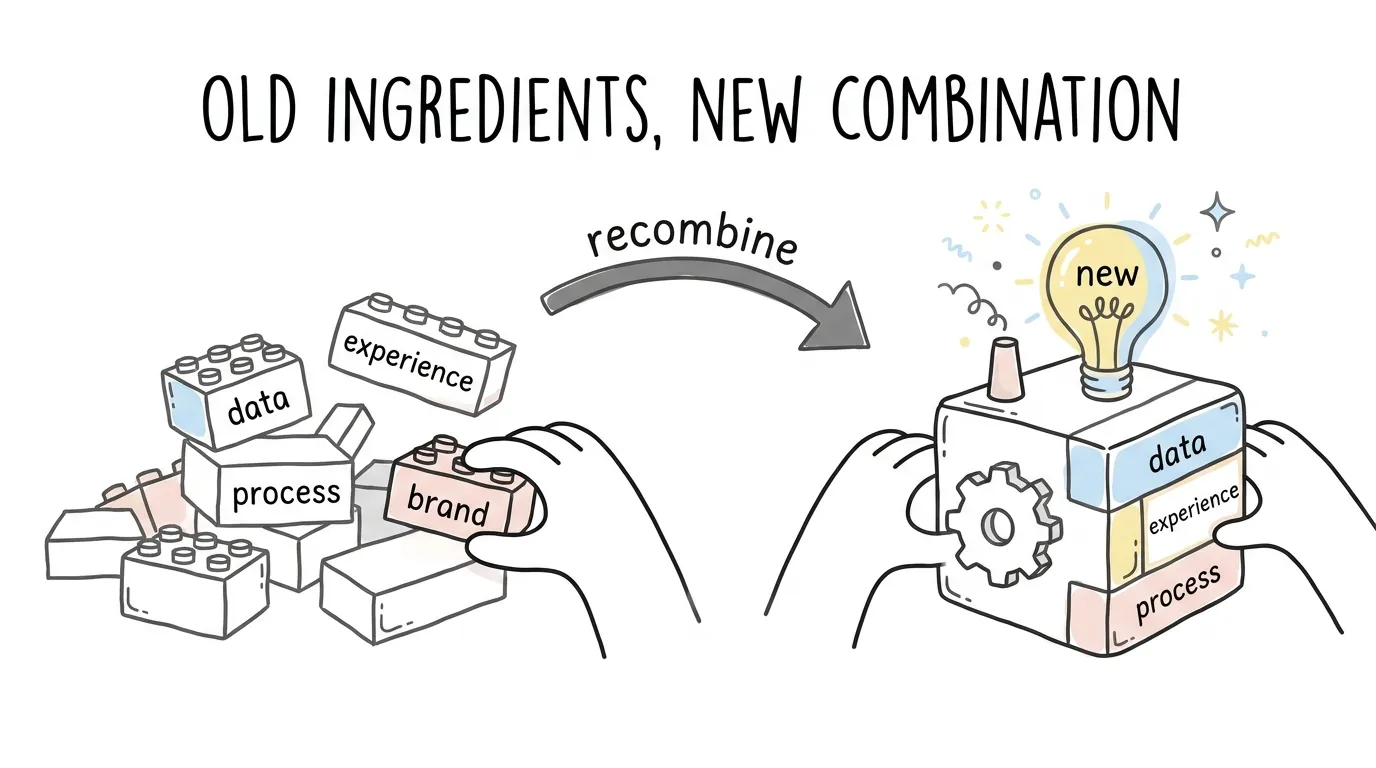
The essence of innovation is not creating something from nothing; it is the new combination of old ingredients.
The card design studio combines design experience, compliance rules, and creative assets that already existed. The commerce media network combines transaction data, loyalty, and personalization capability. The digital twin combines production files that were always going to be handed to the factory anyway. Even the multisensory brand combines nothing more than the seeing, hearing, and touching that a logo was always supposed to do.
The assets were always there. What changed is the way they are combined.
And the steering wheel of combination has been gripped in human hands from start to finish. Humans initiate, AI amplifies; humans judge, AI accelerates.
Return to the three phenomena at the start: young people are fleeing the screen, consumers are verifying repeatedly before they buy, and the power to purchase is being handed over to agents. The more automated the tools, the more valuable judgment; the more virtual the touchpoints, the more expensive trust.
AI has driven the cost of "execution" down to the floor. What to do with the time saved? Spend it thinking about the things machines cannot think up: what is a real need, what is a good story, what is worth placing a heavy bet on.
May you, too, find that new combination within your own assets.
Continue reading
Related articles

It's 2026: Stop "Buying" AI Tools for Your Marketing Team — Start "Hiring" AI Agents
This learn article explains how AI agents differ from standalone AI tools in marketing, outlines three agent categories — build-your-own platforms, CRM-native agents, and vertical tools — and covers use cases across SEO, social media, advertising, and reporting, plus criteria for choosing one.

Did the Money You Spent on AI Marketing Ever Come Back?
A guide to measuring AI marketing ROI across three layers: ad reports, sales pipeline, and the financial ledger. Covers metrics such as ROAS and CPA, eight dashboard metrics, industry benchmarks, and common measurement mistakes.

How to Pick a Creative Automation Platform: First, Figure Out What These Eleven Actually Do
A learn article sorts eleven creative automation platforms — including Bannerflow, Celtra, Smartly.io, and Storyteq — into four functional groups and proposes five evaluation questions covering publishing reach, automation depth, ease of adoption, team fit, and verifiable evidence.