
In the Age of AI, Why Are Privacy Laws Starting to Buckle?
An article examining why privacy laws struggle to keep pace with AI, covering algorithmic opacity, data repurposing, spillover, and persistence, plus regulatory approaches like data minimization, impact assessments, audits, and AI content labeling.
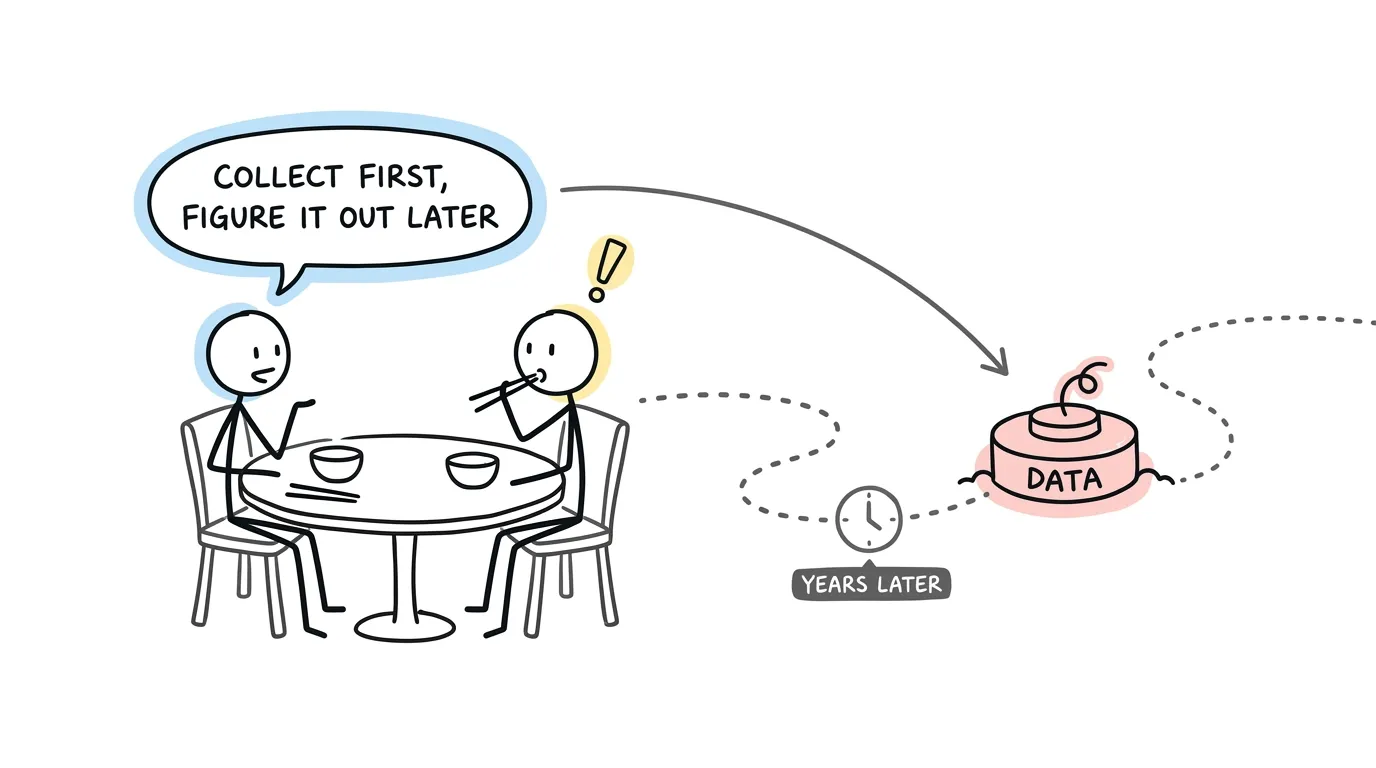
A few days ago I had dinner with a friend. He had just entered the AI race, building an interview assistant. When the conversation turned to data, he said something that stuck with me:
"Collect first, figure it out later. There'll always be a way to use it down the road."
I put down my chopsticks, thought for a moment, and told him: in the age of AI, that may be the most expensive sentence you'll ever say.
Why do I say that? Let's talk about it today.
First, a state of affairs that should worry you
Take a guess: does the country with the most aggressive AI industry have a single, unified national data protection law?
It doesn't.
The United States still has no sweeping federal privacy law covering the entire country. What it has instead is a patchwork of state regulations, plus a few federal rules for special domains like health information. And the rules differ from state to state: what keeps you compliant in California might put you over the line in the next state over. Companies have complained that this fragmentation keeps pushing compliance costs higher — and ends up stifling innovation instead. In October 2023, Biden publicly urged Congress to hurry up and pass bipartisan legislation to "protect Americans' privacy, including guarding against AI-related risks." In 2024, lawmakers in Congress even pushed the American Privacy Rights Act (APRA), which aimed to wrap its arms around the entire lifecycle of data — collection, transfer, and use. It went nowhere.
When it comes to privacy, the law is ultimately the last line of defense.
But is legislation enough?
No. Because many of the problems AI brings are ones the old laws never saw coming.
What is "algorithmic opacity"?
What does algorithmic opacity mean?
It means this: no one can say for sure what the algorithm actually did with the data, how it did it, or how it arrived at its decisions.
Opacity has three sources.
First, the algorithm itself is too complex. Layer upon layer of nested neural networks — the human mind simply can't keep up.
Second, companies deliberately keep it hidden. The algorithm is a trade secret, protected by law, off-limits to inspection.
Third — and this is the most interesting one — the algorithm was produced by machine learning, and even the people who built it can't predict how it will behave once it goes live. Which is a little unsettling.
Think about what that means.
Data goes in, decisions come out, and in between sits a black box. Want to check whether it's abusing people's privacy? Not a chance.
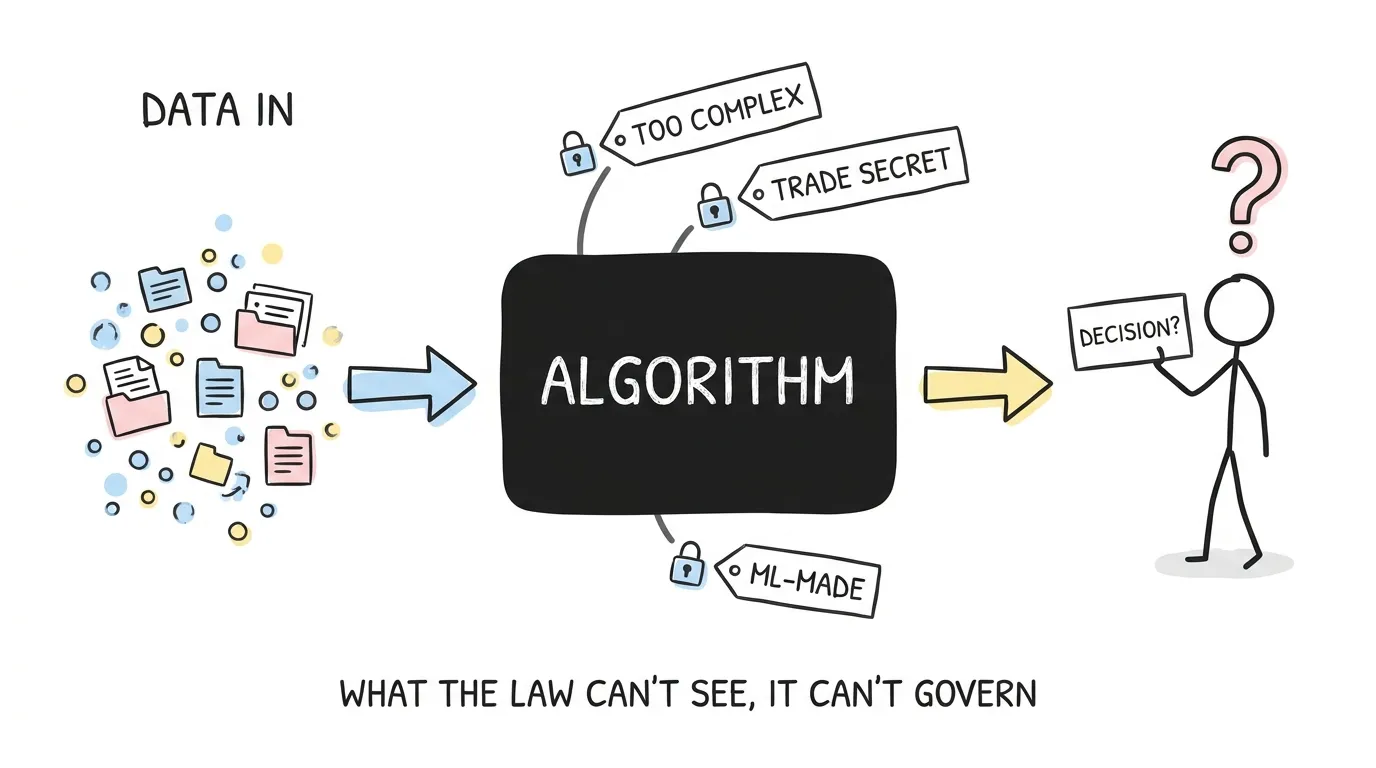
What happens inside the black box is invisible to the law — and what the law can't see, it can't govern.
Three problems that keep getting worse
On top of this black box sit three old problems that AI has amplified.
The first: data repurposing.
What is data repurposing? It's when data gets used for things no one mentioned at the time — you never knew, and you never consented.
Here's an example that started out with the best of intentions. After the 2008 financial crisis, the U.S. economic stimulus package set aside money specifically for digitizing medical records. The idea was lovely: when you switched hospitals, your records could travel with you.
And what happened? Hospitals and insurance companies later fed that data into medical algorithms, computing each person's health risk — and deciding whether you qualified for treatment. A 2019 study even found that a large-scale healthcare risk algorithm carried racial bias.
Data originally collected to make your record transfers easier had become the basis for pricing you.
Worse still, the vast troves of old data accumulated over the past decade are being dug up and recombined by AI, doing things no one could have foreseen on the day the data was collected.
The second: data spillover.
You take a photo with a friend, and you consent. Did your friend consent? Nobody asked.
You take a genetic test and upload it to a platform like 23andMe. You got tested — but in doing so, half of your parents' and siblings' genetic information leaked out too.
The data is collected from one person, but it ensnares a whole crowd.
The third: data persistence.
Over the past decade, the cost of storing data has fallen through the floor. Even the tiniest company can hold onto data indefinitely. And once data goes into an AI model, scrubbing it out completely is nearly impossible.
The trouble is, people change.
When you're young, you're carefree, willing to hand over everything. As you get older, you grow more cautious. But that consent you gave at twenty could mean your data is still being used when you're eighty.
What you consented to wasn't a single use. It was a lifetime.
Why the old prescription stopped working
Traditional privacy legislation all follows roughly the same blueprint: start by giving every person a few basic rights, and grow the rest of the framework out from there. Europe's GDPR and California's CCPA both work this way.
Which rights? To know — what data they collected about me; to trace the flows — who they shared it with; to delete — wipe it out; to correct — fix what's wrong.
Before AI came along, as long as a company managed its databases well, honoring these rights was hard work — but doable.
And now?
With algorithmic opacity, you don't even know how your data was used — so where does deletion even start? With data repurposing, you don't know whose hands it ended up in. With data spillover, you can't even fully list "what data exists under my name." With data persistence, the right to deletion runs straight into a wall.
Every single one of these rights gets hit by AI precisely where it's blind.
So what do we do?
Four prescriptions
I've come across a systematic discussion of this that lays out four prescriptions.
Prescription one: collect less.
The term of art is "data minimization." Collect only the portion of data strictly necessary to deliver the service — nothing beyond that. APRA limits collection to what is "necessary and proportionate"; GDPR requires that data be relevant to the purpose of processing and limited to what is necessary; and the EU Artificial Intelligence Act (AI Act), passed in 2024, goes a step further — it requires AI systems to observe the minimization principle whenever they process personal data across the entire lifecycle, and explicitly bans the indiscriminate scraping of online photos and surveillance footage to build facial recognition databases.
APRA also built in a "duty of loyalty": before your sensitive data is passed to a third party, your explicit consent must be obtained first.
In one sentence: before collecting, ask yourself — do you really need it?
Prescription two: a checkup first.
The term of art is "algorithmic impact assessment." Before an algorithm goes live, its purpose, its coverage, and who it might harm must be laid out clearly in writing. APRA requires large data holders to conduct such assessments and submit them to the Federal Trade Commission (FTC), and Congress gets to see them. GDPR requires data protection impact assessments. The AI Act pushes one step further: government agencies, public-service institutions in education, healthcare, housing, and justice, and banks and insurers must complete a fundamental rights impact assessment before deploying high-risk AI.
Prescription three: an annual inspection.
The checkup is before launch; the annual inspection is after. An algorithm audit pulls out a system's design, inputs, outputs, uses, and performance and examines them from the ground up: Is it accurate? Is it biased? Is it transparent? Did it hold the line on privacy? The AI Act turned this into a formal institution called the conformity assessment. Providers of high-risk systems must prove they comply, provide a written declaration of conformity, and keep it on file for ten years.
Ten years. This isn't about getting through an inspection. This is putting yourself on the record.
Prescription four: show your cards.
Anything generated with AI has to be labeled as such. The AI Act already mandates labeling AI-generated content; and when an AI system categorizes you by biometric traits or guesses at your emotions, you must be told. In 2023, the U.S. Senate also pushed an AI Labeling Act, requiring AI products like chatbots to disclose what they are — and obliging developers to keep the downstream in line, so nobody takes the tech and quietly misuses it.
Will regulation kill innovation?
By this point you're surely asking: with regulation this tight, can innovation even survive?
The concern is legitimate. Overregulate, and you really can strangle the technology. That's why the AI Act leaves plenty of room: it sets up "regulatory sandboxes," letting companies — especially small and medium-sized businesses and startups — experiment with confidence under the regulator's watch; and when drafting codes of conduct for general-purpose models, developers were specifically invited to take part.
So what exactly should regulation regulate?
My view: don't regulate the technology itself. The technology will look different next year; the law will never catch up. What you should regulate are three stable things: what data goes into the algorithm, what it's used for, and what comes out at the end.
Technology goes obsolete. Data, purpose, and outcomes don't.
Finally, back to that dinner
At the end of that dinner, I told my friend: that line of yours — "collect first, figure it out later" — looks like a head start in the short run, and a landmine buried in the long run.
Compute will end up in surplus. Models will keep iterating. The trust that makes users willing to hand you their data — that is the true scarcity.
Here's hoping your product never needs its users to lie awake at midnight wondering where their data went.
Continue reading
Related articles

What Is GEO? How Your Brand Gets "Mentioned" in the Age of AI Search
An explainer on GEO (Generative Engine Optimization) for e-commerce and DTC brands: how it differs from SEO and AEO, why AI answers shape brand visibility, and eight practices covering question-focused content, consistent brand messaging, structured pages, external evidence, comparisons, and AI mention tracking.

AI Is Already Making Decisions for Your Customers. Are You on the List?
A learn article explains GEO (Generative Engine Optimization): why AI-generated answers now shape which brands customers see, and how SEO fundamentals, entity clarity, citable evidence, and monthly measurement affect visibility in AI answers.

Google Is Stuffing Ads Into AI Search: These Recent Stories Are Really One Story
A news roundup linking recent AI marketing stories—Google adding ads to AI Mode, Amazon's Ads Agent, ChatGPT image updates, a UK startup tracking brand mentions in AI answers, and an AI ransomware warning—arguing that control over ad data and visibility is shifting toward platforms.