
From Managing Tools to Managing Agents: The MOps Job Has Changed
A learn article on how MOps roles are shifting from operating marketing tools to managing fleets of AI agents, covering centralized agent teams (AgentOps), supplying agents with data context via protocols like MCP, tiered approval for high-risk tasks, and measuring agent value by work done rather than seats.
A while back, I had dinner with an old friend from the marketing technology world.
He has spent seven or eight years in marketing operations—what we usually call MOps. His daily work used to be building workflows, configuring systems, wiring up data. Over dinner, he told me: lately, I hardly do any of that anymore.
So what are you doing now?
He said: I'm managing a fleet of "digital employees."
What does that mean? His team had deployed a batch of AI agents that could write copy on their own, adjust ad campaigns on their own, keep watch on the data on their own. His job had shifted from "doing the work with his own hands" to "setting the rules for this fleet of agents."
The moment I heard that, I thought: oh? Now that's interesting.
And this isn't a change happening at his company alone. Across the marketing organizations running out in front, marketing technology teams are all going through the same role change: from the ones executing the tasks, to the ones managing a fleet of agents.
From Driver to Fleet Captain
What is MOps, exactly?
Simply put, it's marketing technology operations. The job used to be mostly system administration, campaign setup, data flow, vendor coordination—all "operator" work.
No matter how complex the tool, you were the one driving it with your own hands. You built one automation workflow, it ran one workflow. You configured one data route, it moved one batch of data.
And now?
Agents have arrived, and they do the work themselves. You no longer build every workflow. What you do is set the rules:
Under what conditions can an agent act on its own? Where are the boundaries? What is the performance red line? Who watches the cost of API calls and tokens? Once an agent is running across platforms, who keeps an eye on whether its behavior has drifted off course?
Here's an analogy. You used to be the driver—your hands on the wheel, your foot on the gas, and your foot on the brake too. Now you're the fleet captain, managing dozens of vehicles. You don't drive anymore, but you have to set the traffic rules for every car, plan the routes, and calculate the fuel.
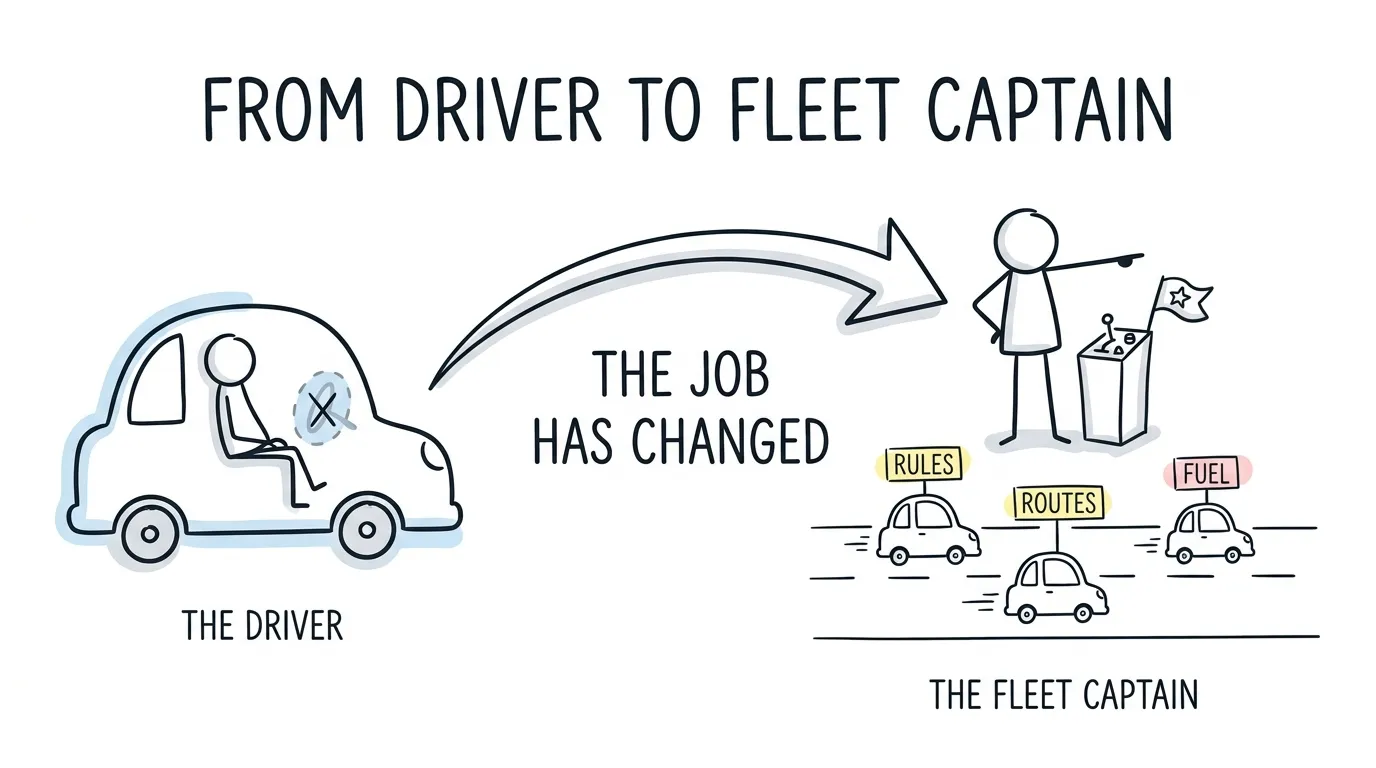
That is the first change: from operator to manager.
The Agent Factory
But new problems show up right away.
Suppose marketing keeps a few agents of its own, sales keeps a few, customer service keeps a few more—each building its own, each using its own. What happens?
Chaos.
Inconsistent style, no security guarantees, and when something goes wrong, no one to hold accountable.
So some organizations have started pulling this messy business together and building a dedicated team—some call it an "agent factory," others call it AgentOps.
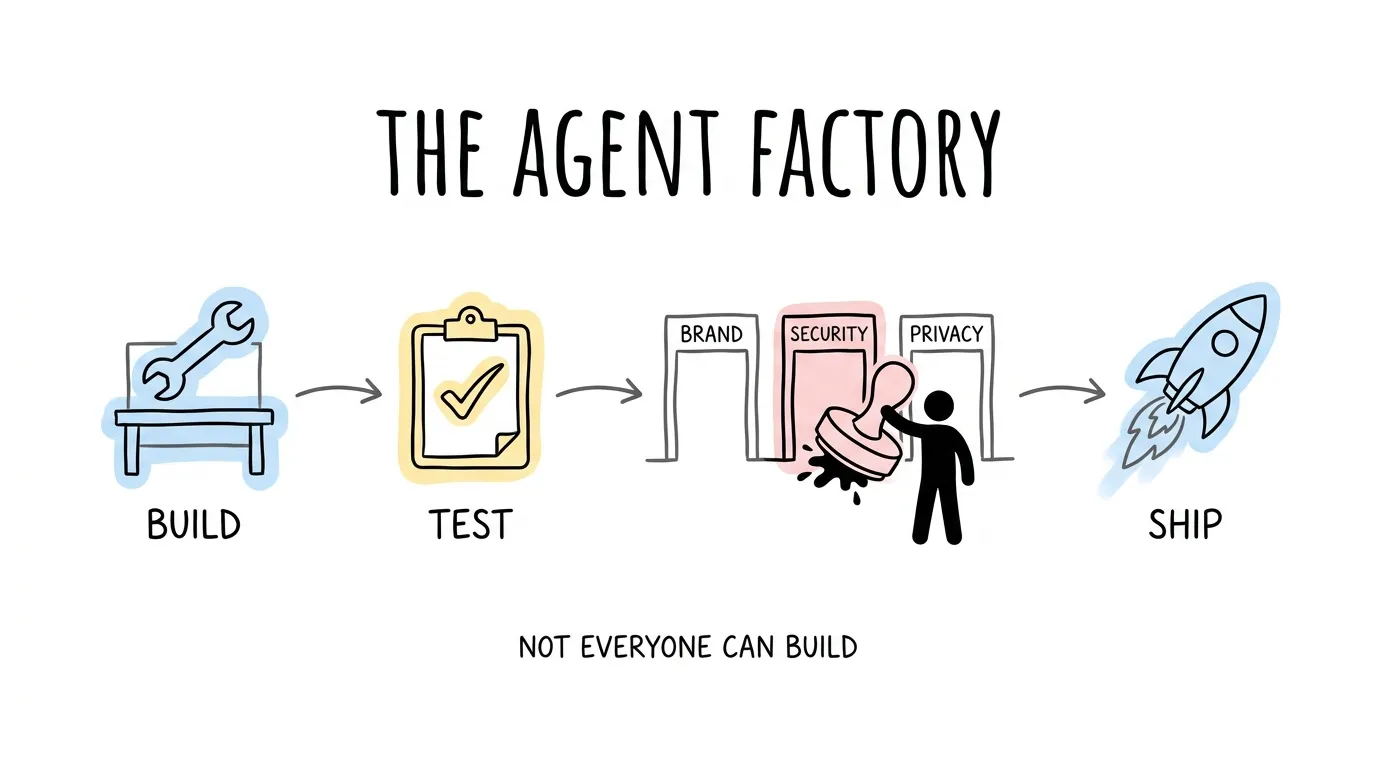
What does this team do? Three words: build, test, ship.
Build agents for the whole company. Once built, test them first. And passing the tests isn't the end—there are still several gates to clear: brand guidelines, security policies, privacy requirements. Not one can be skipped before going live.
What does it look like? A central kitchen. Before, every restaurant branch bought its own ingredients and did its own cooking, and the taste depended entirely on the chef's mood. Now the central kitchen handles purchasing, prep, and output standards in one place, and the branches only handle the final heating and plating.
Agents are the same. Anyone can use them, but not anyone can build them.
What Agents Lack Isn't Intelligence—It's Background
The second easy trap is putting your effort in the wrong place.
When many teams get hold of an agent, their first instinct is to tinker with the prompt—figuring out how to coax it into better behavior.
But here's the thing: the prompt is only the surface of whether an agent works well. What matters underneath is what it can actually see.
Think about it. You hand a newly arrived intern a note that says "do a good job." However smart he is, he still has no idea what to do, who to work with, or what materials he has on hand.
What do you need to give him? The customer's history, their intent signals at this very moment, brand assets verified as accurate, plus the business data scattered across all kinds of systems. Only with these can he make decent judgments.
Agents are the same. That's why many teams are now doing one thing: gathering the data scattered everywhere and feeding it to the agents—through protocols like MCP (an open protocol that lets AI agents plug into external tools and data), context graphs, and unified data layers.
The goal is just one: wherever the agent works, it always has solid ground to stand on.
What You Can Let Go, and What Needs Your Signature
The third question is the subtlest: delegation.
Should agents be left to handle everything on their own?
No.
It has to be tiered.
Low-risk things can be let go. Drafting routine social copy, checking for broken links, watching product listings for anomalies. When these go wrong it doesn't hurt much—let the agents run on their own, and people stay less involved.
High-risk things must have a human signature. Shifting ad budgets around, publishing customer-facing content, changing opportunity stages in the CRM. Once these go wrong, it's either real money lost, or something customers see on the spot.
The real kung fu of MOps shows right here: design the sign-off points well, so that they work as brakes, without becoming new traffic jams.
What if every single item needs human approval? Then the agent's efficiency is completely wasted. It's like hiring a PhD and only ever letting them help pour the water.
The Way You Do the Math Has Changed Too
One last change, hidden in the reports.
How did we used to measure the value of marketing technology? Seats, and feature usage. How many accounts were bought, how many people logged in, which features got adopted.
That math was designed for "tools." Tools are for people to use—the more people, the more the seats are worth.
But an agent is not a tool; it's more like an "employee." It does the work itself, and it takes up no seat. So how do you calculate whether it's worth it?
It comes down to four numbers:
One task—how long does it take to finish? One execution—how much does it cost? How many tokens did it burn? And most important of all, how many pairs of hands on the team did it set free?
Take an example. An agent that automatically patrols a few hundred landing pages for broken links every day might cost a few cents per run in tokens. Replace it with a human, and you'd need a dedicated person on it for the better part of a day. Before, this kind of math simply couldn't be done.
Some teams are also watching a new metric called Share of Model, which can roughly be understood as "model share": when AI gives an answer, how much of your brand shows up in it?
You see, tools are billed by headcount; agents have to be billed by the work.
Finally, Back to My Friend
At the end of that dinner, I asked him: are you worried? All that craft of building workflows—it's about to depreciate any day now.
He thought for a moment, and said: not worried. Skills depreciate. Judgment doesn't.
Before, his value was knowing how to master the tools. From now on, his value is knowing when to let go, and when to call a halt.
This is probably the most down-to-earth part of this whole change: the marketing technology team has gone from "running a system" to "setting up a set of rules for a fleet of agents that work on their own."
Systems are dead; rules are alive. Whoever nails the rules first pulls ahead.
And I wish you the same: may you soon rise from the driver's seat, and become that composed fleet captain.
Continue reading
Related articles

What Is an AI Marketing Agent? From "Using AI" to "Delegating to AI"
A learn article explaining what an AI marketing agent is, how it differs from rule-based automation, and which repetitive tasks such as lead qualification, reporting, and campaign monitoring can be delegated while humans keep key decisions.

Marketing Automation Is Shifting from "You Do It" to "You Say It"
This article explains how marketing automation is shifting from rule-based platforms that merely execute toward AI agents that plan, create, publish, and review campaigns, covering delegable tasks, underlying technologies, tool categories, adoption steps, and risks such as privacy and automating without strategy.

When AI Does the Creative, Mistakes Come in Batches Too
A learn article on the risks of using generative AI for marketing creative across brand, legal, compliance, and operational layers, with case examples and seven practices for review, rights clearance, documentation, and vendor governance.